











Thinking of launching an app in Germany? Excellent plan! With strong economic potential and tech savvy population, and love for innovative solutions, Germany soars as a profitable market for tech businesses looking to launch new apps. The mobile app market in Germany is really dynamic, and launching an app in Germany requires careful planning, understanding of the local culture, and overcoming the key legal and business complications.
If you are a business wanting to know how to launch an app in Germany, then read this blog till the end. From devising the strategy that fits the German market to the steps that will seal the success of your mobile app in Germany, we got it all covered.
So, let’s dive into the app launch process in Germany that locks the success of your app in the German market and captures the attention of millions of users. Let’s begin!
Why Is Germany a Prime Market for App Launches?
Germany is one of Europe’s largest and most stable digital economies, making it an attractive destination for launching mobile apps. With over 80 million people and high smartphone penetration, businesses can access a large and tech-savvy user base ready to adopt innovative mobile application development solutions.
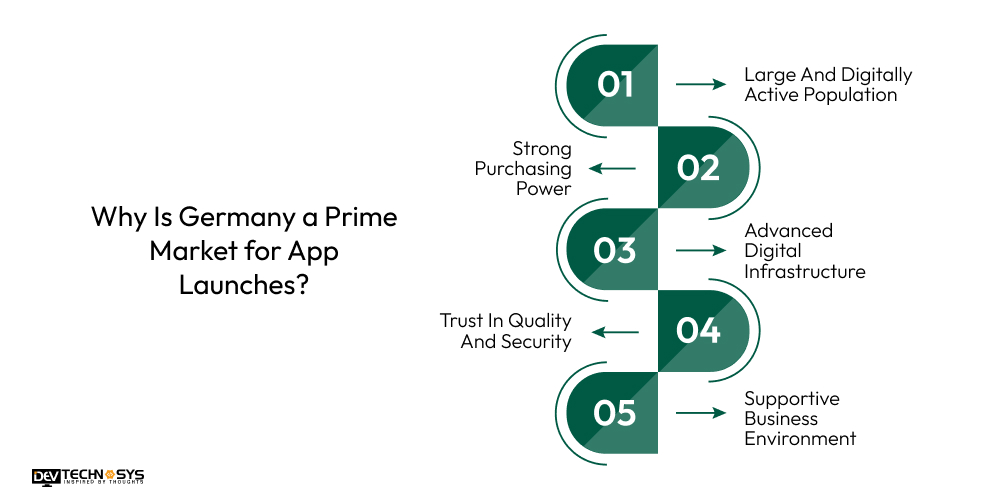
1. Large And Digitally Active Population
Germany has over 80 million residents with high smartphone and internet penetration. A large, tech-aware audience increases user acquisition potential and creates strong demand for innovative mobile applications across multiple industries.
2. Strong Purchasing Power
Building Android app development solutions for German consumers is a great venture. German users have high disposable income compared to many European countries. This increases opportunities for app monetization through subscriptions, premium features, and in-app purchases.
3. Advanced Digital Infrastructure
Germany has a highly developed digital ecosystem with widespread high-speed internet, expanding 5G networks, and strong cloud technology adoption. This advanced infrastructure allows businesses to launch feature-rich, high-performance mobile apps.
4. Trust In Quality And Security
Considering the mobile app launch in Germany is a great decision because German users place strong importance on data privacy, security, and product reliability. Apps that prioritize secure authentication and high performance are more likely to build long-term trust and maintain a strong brand reputation.
5. Supportive Business Environment
Germany offers a stable economy for on demand app development and launch, particularly in innovation hubs like Berlin and Munich. With access to EU markets, funding opportunities, and government-backed initiatives, businesses can scale their mobile apps efficiently and expand across Europe.
German App Market Landscape
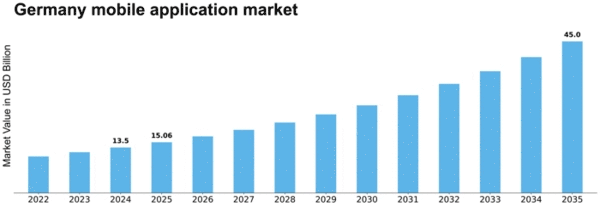
- The Germany mobile application market is projected to grow from 15.06 USD Billion in 2025 to 45.0 USD Billion by 2035, exhibiting a CAGR of 11.5% during the forecast period 2025 – 2035.
- As of November 2025, a growing number of applications leverage AI technologies to enhance user experience and functionality.
- As of November 2025, approximately 95% of the population has access to mobile internet, facilitating the widespread use of applications across various sectors.
- The major players include Apple Inc (US), Google LLC (US), Facebook Inc (US), Amazon.com Inc (US), Microsoft Corp (US), Samsung Electronics Co Ltd (KR), and ByteDance Ltd (CN).
What is the Process to Launch a Mobile App In Germany?
Launching a mobile app in Germany requires more than simply publishing it on an app store. It requires a well-planned strategy, GDPR compliance, cultural alignment, and strong localization. Now let’s take a look at the steps to launch an app in Germany:
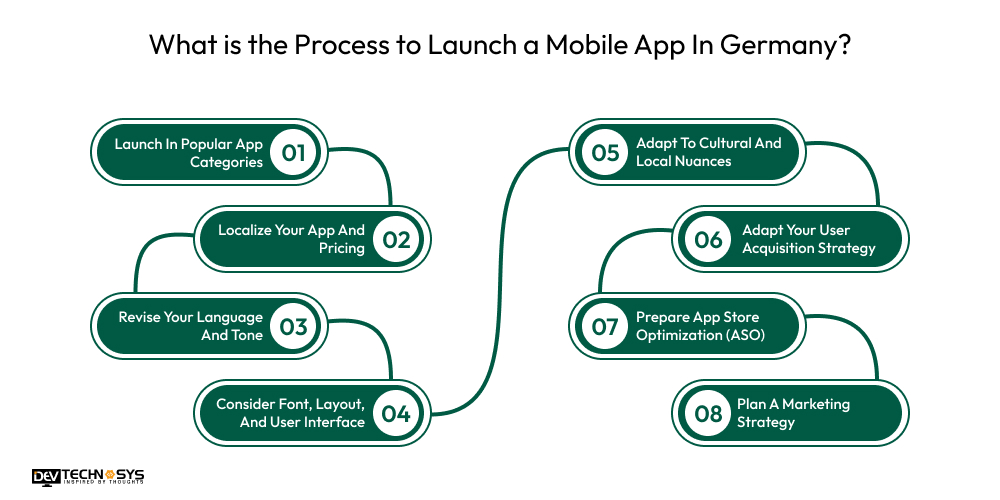
1. Launch In Popular App Categories
Germany app launch requirements include analyzing which app categories perform well in Germany. It includes fintech, eCommerce, mobility, health, SaaS, and productivity tools. Understanding what German users already trust, and what they feel is missing, helps you position your app strategically and reduce market-entry risks.
2. Localize Your App And Pricing
Proper localization includes professional German translation, culturally appropriate visuals, and region-specific settings such as euro (€) pricing, date formats, and metric units.
Integrate trusted local payment methods like PayPal, SEPA direct debit, and invoice-based payments. German users value clarity in costs, so they avoid hidden fees and unclear subscription terms.
3. Revise Your Language And Tone
Communication in Germany tends to be direct, informative, and professional. Avoid hype-driven marketing language or exaggerated promises. Instead, clearly explain your app’s features, benefits, and security measures. Focus on transparency and factual messaging, as this builds credibility and long-term user trust.
4. Consider Font, Layout, And User Interface
German words are often longer than English equivalents, which can affect buttons, menus, and layout spacing. Design a flexible interface that adapts without breaking structure. Prioritize readability, logical navigation, and minimal clutter.
5. Adapt To Cultural And Local Nuances
Privacy, reliability, and efficiency are highly valued in Germany. Build a digital business by clearly communicating GDPR compliance, data handling practices, and security protocols. Offer accessible customer support and transparent policies.
6. Adapt Your User Acquisition Strategy
Mobile app development services involve using data-driven marketing strategies tailored to German audiences. Invest in Google Ads, localized social media campaigns, content marketing, and partnerships with credible influencers. Educational blog posts, comparison guides, and case studies often perform better than aggressive sales messaging.
7. Prepare App Store Optimization (ASO)
Research German-language keywords relevant to your niche. Write concise yet informative descriptions and include high-quality screenshots that demonstrate real functionality. Encourage early users to leave authentic reviews. Strong ASO increases visibility in both major app stores and supports organic growth.
8. Plan A Marketing Strategy
Developers who provide MVP app development services create a structured launch roadmap that includes pre-launch teasers and post-launch engagement plans.
Track user behavior through analytics tools and continuously gather feedback. Regular updates, performance improvements, and responsive customer support are essential for long-term success in German market.
You can reach out anytime; we are available 24/7. Our team provides a quick response.

How Mobile App Trends Are Shaping Germany’s Digital Market?
The startup ecosystem for apps in Germany is thriving due to tech trends like fintech, healthtech, mobility, e-commerce, and AI-powered apps, creating a competitive and innovative environment for digital solutions.
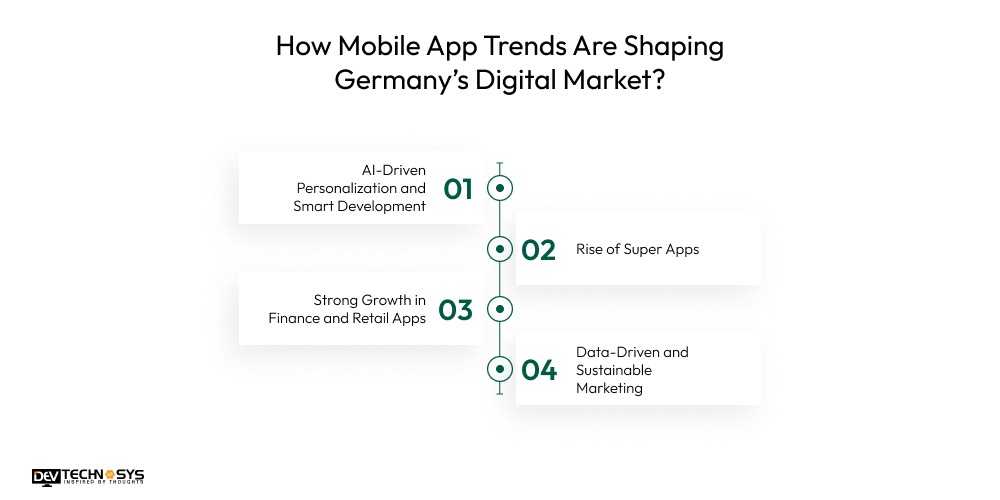
1. AI-Driven Personalization and Smart Development
Artificial intelligence is becoming a core part of mobile app strategy in Germany. Companies that offer Hybrid application development services use AI to deliver personalized content, smarter product recommendations, and improved customer experiences. AI also supports predictive finance tools, fraud detection, and optimized logistics operations.
Industry Insights:
According to Grand View Research, companies that prioritize AI-driven personalization see a 25% increase in customer lifetime value (CLV).
2. Rise of Super Apps
German users are gradually adopting “super apps” that combine multiple services into one platform. These apps integrate finance, shopping, messaging, and more, offering convenience and seamless navigation. This consolidation trend reflects growing demand for efficiency and simplified digital experiences.
3. Strong Growth in Finance and Retail Apps
Finance apps are leading the German market, especially secure, mobile-first banking and digital payment solutions. While new shopping app installs have slightly slowed, revenue continues to grow through improved in-app purchasing, personalized deals, and social commerce integrations via platforms like Instagram and TikTok.
4. Data-Driven and Sustainable Marketing
German businesses rely heavily on data analytics to improve user targeting and campaign performance. However, privacy remains a top priority. Companies focus on GDPR compliance, ethical data usage, and sustainable digital strategies that align with consumer expectations for transparency and responsibility.
What Are the Smart Mobile App Categories to Target in Germany?
The most popular app categories to target in Germany include gaming, social media, entertainment, education, Finance, and Lifestyle. Let’s discuss each of these top-performing app industries in detail.
1. Gaming
Gaming remains one of the strongest app categories in Germany in terms of downloads and revenue. Skill-based, strategy, and logic games perform particularly well. German users value quality gameplay, smooth performance, and making this category highly competitive but profitable.
Industry Insights:
As stated by Business of Apps, 2025 data shows a shift in momentum, with casino games seeing a 5.7% increase in creative output.
2. Social Media & Communication
Social and messaging apps continue to dominate daily usage. Platforms like TikTok, Instagram, WhatsApp, and Facebook attract massive engagement. German users rely heavily on these apps for communication, content sharing, and community building, creating opportunities for niche social platforms and communication tools.
3. Entertainment
Streaming and digital content apps are highly popular in Germany. Music platforms like Spotify, video streaming services, and on-demand content apps see consistent growth. Subscription-based entertainment models work well, especially when offering localized and high-quality content.
4. Education
Education apps rank among the top categories across both major app stores. Language learning, skill development, and online certification platforms such as Duolingo are widely used. Demand is driven by students, professionals, and lifelong learners seeking flexible and digital learning solutions.
5. Finance & Investment
Finance apps generate significant revenue in Germany. Mobile banking, digital wallets, investment platforms, and personal finance management apps are in high demand. Security, GDPR compliance, and transparent financial tools are critical success factors in this category.
Want a chatbot demo or pricing? Fill the form and talk to our experts today.
Pick what you need below — you can select more than one — then tap Get detail to continue.
-
Chatbot demo dashboard
-
Cost to develop an app
-
Industry report
-
Case study
Why Legal and Regulatory Requirements Matter for Launching an App in Germany?
Legal and regulatory compliance is critical when launching an app in Germany because the country has some of the strictest data protection and consumer protection laws in Europe. Ignoring these requirements can negatively impact app development and launch in Germany.
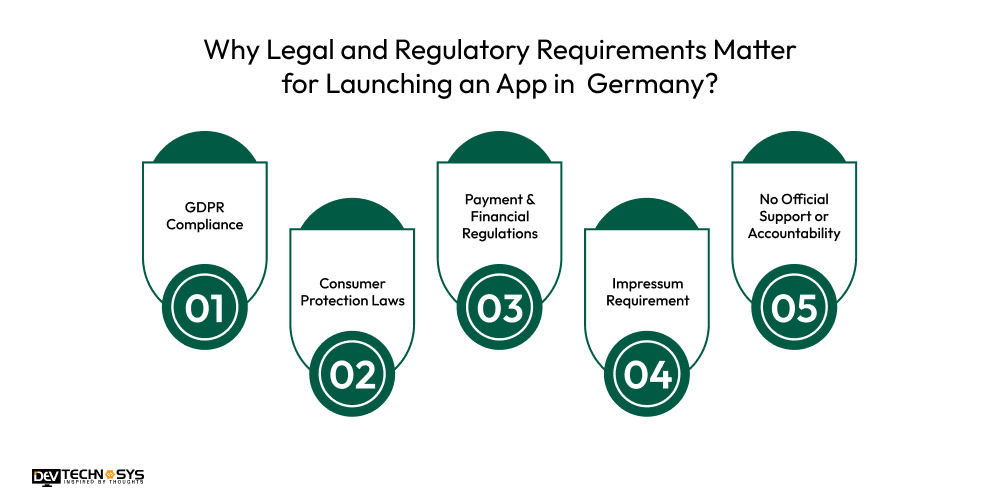
1. GDPR Compliance:
German app regulations in Germany strictly enforce the General Data Protection Regulation (GDPR). Apps must clearly explain how user data is collected, stored, and processed.
2. Consumer Protection Laws:
German regulations require clear pricing, subscription transparency, and fair cancellation policies. Hidden charges or misleading offers can quickly lead to penalties and loss of user trust.
3. Payment & Financial Regulations:
If your app handles payments, banking, or financial services, you may need additional licenses and must comply with EU financial regulations. Security standards and fraud prevention systems are especially important.
4. Impressum Requirement:
Data protection laws for apps in Germany require most commercial apps and websites to include an “Impressum” with company details. Missing this mandatory information can result in warnings or fines.
5. Building Trust & Market Credibility:
Compliance is not just about avoiding penalties; it builds credibility. German users highly value privacy, transparency, and security. Meeting legal standards strengthens user confidence and supports long-term growth in the market.
Which Tech Stack Should You Choose for a Scalable Mobile App?
Choosing the right tech stack helps your mobile app handle growth, high traffic, and future updates smoothly. Your startup app development company in Düsseldorf will choose a scalable setup that improves performance, security, and long-term stability. Below is a simple and practical tech stack overview.
Layer |
Technology Options |
Purpose |
| Frontend (iOS) | Swift | High performance and native optimization for Apple devices. |
| Frontend (Android) | Kotlin | Modern, secure, and officially supported for Android development. |
| Cross-Platform | Flutter, React Native | Faster development for both iOS and Android with a shared codebase. |
| Backend | Node.js, Django, Ruby on Rails, .NET | Handles business logic and server-side operations efficiently. |
| Database (SQL) | PostgreSQL, MySQL | Structured data storage with reliability and scalability. |
| Database (NoSQL) | MongoDB, Firebase | Flexible schema and ideal for real-time applications. |
| Cloud Infrastructure | AWS, Google Cloud, Microsoft Azure | Scalable hosting, storage, and global performance support. |
How Much Does it Cost to Launch an App in Germany?
The cost to launch an app in Germany ranges from $8,000 to $25,000, depending on features, design, platform, type, development expertise, development region, and tech-stack used. The basic mobile app development cost in Germany will be between $8,000 and $12,000.
The mid-range apps require more than just basic features and functionalities, so the development cost ranges from $15,000 to $18,000. Now, if you are considering launching an advanced app for enterprises, then the app launch budget in Germany may exceed $25,000.
App Level |
Estimated Cost |
Timeline |
| Basic MVP | $8,000 – $12,000 | 2 – 3 months |
| Standard App | $12,000 – $18,000 | 3 – 4 months |
| Advanced App | $18,000 – $25,000 | 4 – 6 months |
The cost to launch an app in Germany depends on several key factors. Understanding these elements helps plan an accurate budget and timeline for your app project.
1. App Features
The cost to develop a mobile app MVP will fall on the lower side, while apps with real-time features, dashboards, or automation require more development hours and a higher budget. The more features, functionality, integrations, and scalability you require, the higher the overall development cost and timeline.
App Type |
Estimated Cost |
| Basic MVP | $8,000 – $12,000 |
| Standard App | $12,000 – $18,000 |
| Advanced App | $18,000 – $25,000 |

2. Platform Choice
Building for a single platform (iOS or Android) is cheaper than developing for both. Native mobile app pricing in Germany will be more than cross-platform solutions. Cross-platform frameworks like Flutter or React Native reduce development time and overall costs by 20% to 40%.
Platform |
Estimated Cost |
| Single Platform (iOS or Android) | $8,000 – $15,000 |
| Native Both Platforms | $18,000 – $25,000 |
| Cross-Platform (Flutter/React Native) | $12,000 – $20,000 |
3. UI/UX Design Quality
Basic template-based designs reduce app launch budget in Germany. Custom interfaces, animations, and premium branding increase expenses. Here’s a table showing the cost to launch an app in Germany by design level.
Design Level |
Estimated Cost |
| Basic Template | $8,000 – $12,000 |
| Custom UI/UX | $12,000 – $20,000 |
| Premium/Advanced | $18,000 – $25,000 |
4. Development Team Location
Hiring developers in Germany is more expensive compared to outsourcing to Eastern Europe or Asia. The developers typically charge $70 to $120 per hour, which increases the total project budget. Take a look at the table below and learn
Region |
Estimated Cost |
| Germany | $18,000 – $25,000 |
| Western Europe | $15,000 – $22,000 |
| Eastern Europe | $12,000 – $18,000 |
| India/Southeast Asia | $8,000 – $15,000 |
5. Maintenance & Updates
The maintenance cost of mobile app typically cost 15% to 20% of the initial development budget annually. The factors responsible for the ongoing support, bug fixes, feature upgrades, and security updates are.
Maintenance Level |
Estimated Cost |
| Basic | $1,200 – $2,500/year |
| Standard | $2,500 – $5,000/year |
| Advanced | $5,000 – $8,000+/year |
How an App Development Company Can Help You Launch Faster?
Partnering with an experienced app development company in Berlin can significantly speed up your launch process while reducing costly mistakes. Their structured approach, technical expertise, and dedicated teams help turn your idea into a market-ready product efficiently.
- Faster Planning And Strategy: Professional teams validate your idea, define features, and create a clear roadmap. This avoids delays caused by unclear requirements or scope changes.
- Experienced Development Team: You get access to skilled designers, developers, and QA testers who work simultaneously, accelerating development without compromising quality.
- Agile Development Process: Most app development companies in Frankfurt follow agile methods, delivering features in phases. This allows quicker MVP launches and faster feedback cycles.
- Technical Expertise: A skilled development team will choose the right tech stack, ensure scalability, and implement strong security practices from the start.
Conclusion
Launching an app in Germany requires careful planning, compliance with local regulations, and choosing the right development strategy. Start by defining your app’s purpose, target audience, and feature set.
If you are a business wanting to launch an app like Germany, contact a top company for mobile app development services. Turn to Dev Technosys, a leading provider of app development solutions in Hamburg. Stay locked-in for more updates.
Frequently Asked Questions
Find answers to the most common questions related to this article.
Launching an app in Germany typically costs between $8,000 and $25,000, depending on the app’s complexity, platform choice, design requirements, third-party integrations, and whether you hire a local German team or outsource overseas.
The timeline to develop and launch a mobile app in Germany varies based on app complexity. A basic MVP can be ready in 2 to 3 months, a standard app in 3 to 4 months, and an advanced app with real-time features and integrations may take 4 to 6+ months.
Yes, any app handling personal data in Germany must comply with German legal requirements in Germany, which include user consent, secure data storage, encryption, and clear privacy policies. Non-compliance can lead to legal penalties and fines.
Hiring a trusted app startup in Germany provides better local compliance, easier communication, and understanding of the market. Outsourcing to Eastern Europe or Asia can save costs significantly while maintaining quality, but requires careful project management.