


















Quick Summary:
The custom school management software development cost typically ranges from $30,000 to $150,000+, while an MVP can start from $10,000+. The final cost depends on software complexity, features, integrations, security, and scalability.
Cost Impacted by Software Complexity:
-
- Basic/MVP ($10,000–$30,000): Student profiles, timetable scheduling, attendance, fees, notifications, and admin dashboard.
- Mid-Level ($30,000–$80,000): Exams, academic analytics, parent portal, timetables, payments, communication, reports, and mobile apps.
- Advanced/Enterprise ($80,000–$150,000+): Teacher dashboard, AI analytics, multi-campus support, automation, advanced reporting, and scalable infrastructure.
Cost Based on Software Types:
-
- Basic School Management System: $30,000–$50,000
- School ERP: $50,000–$100,000
- Multi-Campus Platform: $70,000–$120,000
- AI-Powered Software: $100,000–$150,000+
Cost Based on Regions:
-
- USA: $60,000–$150,000+
- Australia: $50,000–$130,000
- Canada: $45,000–$120,000
- India: $30,000–$80,000
Additional Costs:
-
- Maintenance & Updates: Around 15%–20% of development cost annually.
- Hosting & Infrastructure: Varies with users, storage, and traffic
- Third-Party Integrations: Payments, SMS, email, biometric systems, and other APIs.
- Security & Compliance: Encryption, access controls, testing, and data-protection requirements.
In this digital world, the demand for automated operations has increased because of reduced manual or human efforts. However, in the education industry, there are many schools that are still managing the school’s operations manual and using paperwork.
Those schools adopt school management software to increase management efficiency and reduce manual errors. However, they are worried about the cost to develop school management software, so there is no need to take more stress about the cost.
Read this blog until the last line to learn about school management software development cost in USA. This blog gives you an idea of key cost factors, features, development stages, and ongoing expenses. By the end, you’ll have a clearer vision of the investment required to build a school management solution.
What is School Management Software?
School management software is a digital solution that enables schools to streamline administrative operations and increase productivity. It often contains functions such as student enrollment, attendance monitoring, student performance tracking, gradebook management, scheduling, staff-parent communication, and reporting.
This program streamlines day-to-day operations, improves data administration, and improves overall coordination, ensuring that educational institutions run smoothly and manage resources, students, and staff more effectively.
How Much Does it Cost to Develop School Management Software?
The cost to build school management software can range from $10,000+ for an MVP with basic features and functionalities. Mid-level software with advanced modules, integrations, mobile apps, and reporting capabilities can cost around $30,000–$80,000, while a fully customized, enterprise-grade solution with AI, multi-campus support, advanced security, and scalable infrastructure can cost $80,000–$150,000+.
But how long does it take to build school management software? The development timeline for school management software ranges from 2 to 12+ months, depending on project complexity.
There are many factors that cause the differentiation in the total school ERP software development cost, including features, platform, UI/UX design, Integrations, and more, which I will cover in the next section in detail
Software Type |
Estimated Cost |
Timeline |
| MVP/Basic | $10,000–$30,000 | 2–4 months |
| Mid-Level | $30,000–$80,000 | 4–7 months |
| Advanced/Enterprise | $80,000–$150,000+ | 7–12+ months |
Market Insight
According to Business Research Insights, the global school management software market is valued at USD 20.48 Billion in 2026 and is expected to reach USD 67.79 billion by 2035, expanding at a CAGR of 14.23% from 2026 to 2035.
What Factors Affect The Cost to Create School Management Software?
The total cost to develop a school management software is determined by a number of factors. The factors affecting the total cost range from long-term support to design and are all very important in determining the ultimate school management app development cost.
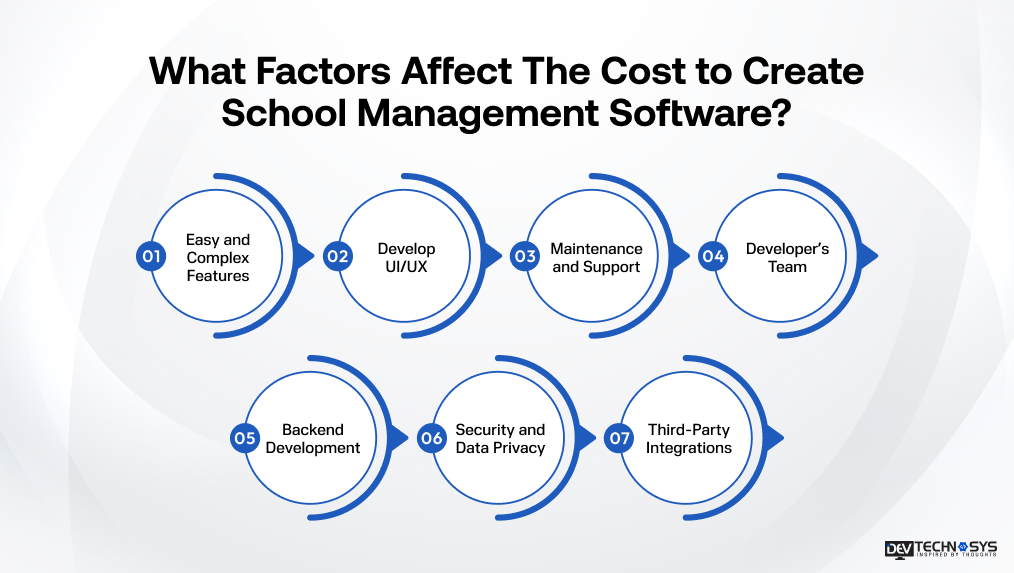
1. Easy and Complex Features
The functionality and features to develop an educational app/software can increase the cost significantly. Implementing more complex features like real-time teacher-student communication, sophisticated reporting, or connectivity with outside educational systems might increase prices, although basic functions like grade administration and attendance tracking are reasonably priced.
2. Develop UI/UX
The software’s intuitiveness, usability, and accessibility for many stakeholders, including administrators, teachers, and students, depend heavily on the design of the user interface (UI) and user experience (UX). Designing an engaging experience can greatly increase the cost of custom software development, and a clean, aesthetically pleasing interface is essential.
3. Maintenance and Support
System upgrades, maintenance, and post-launch support are essential to maintaining the software’s functionality. These IT consulting services consist of performance optimization, security patches, and bug fixes.
If the program requires frequent upgrades to incorporate new educational resources or conform to new requirements, the continuous expense of maintenance may be a major consideration.
4. Developer’s Team
The school management software development cost in India or any other region is affected by the development team’s size and level of experience. Generally speaking, a larger, more seasoned team with specific talents (such as software testing services, developers, project managers, quality assurance engineers, and UI/UX designers) will charge more.
Additionally, compared to areas with lower labor costs (like India or Eastern Europe), development expenses will be substantially greater if the team is headquartered in a high-cost zone (like the USA or UK).
5. Backend Development
Databases, server-side logic, and system infrastructure are all under the purview of backend development. A strong, scalable, and secure backend can handle massive volumes of data, especially as the educational system expands.
Hire software developers to develop strong backend systems with high availability and security features can be costly and calls for a talented development team.
6. Security and Data Privacy
cost to develop student information system depends on security and data privacy. School software handles sensitive information such as student records, attendance, grades, staff details, and payment data. Encryption, role-based access, secure authentication, audit logs, backups, and privacy controls increase development effort but are essential for protecting educational data.
7. Third-Party Integrations
Integrating payment gateways, video-conferencing tools, SMS/email services, biometric attendance systems, learning management systems, accounting software, or government education platforms can increase the development costs of education IT solutions and platforms. Each integration may require API development, testing, authentication, and ongoing maintenance.
Cost Factor |
Estimated Cost Impact |
Approx. Cost |
| Easy and Complex Features | 20%–30% | $6,000–$45,000 |
| UI/UX Development | 10%–15% | $3,000–$22,500 |
| Maintenance & Support | 10%–15% | $3,000–$22,500 |
| Developer’s Team | 20%–30% | $6,000–$45,000 |
| Backend Development | 15%–20% | $4,500–$30,000 |
| Third-Party Integrations | 5%–15% | $1,500–$22,500 |
| Security & Data Privacy | 5%–15% | $1,500–$22,500 |
Hidden Factors Impacting The School Management Software Development Cost
The preliminary price estimate does not reflect the entire ownership cost. Factors like data migration, integrations, cloud computing solutions, security updates, support, and modifications can substantially increase expenses after the implementation of the core school management software.
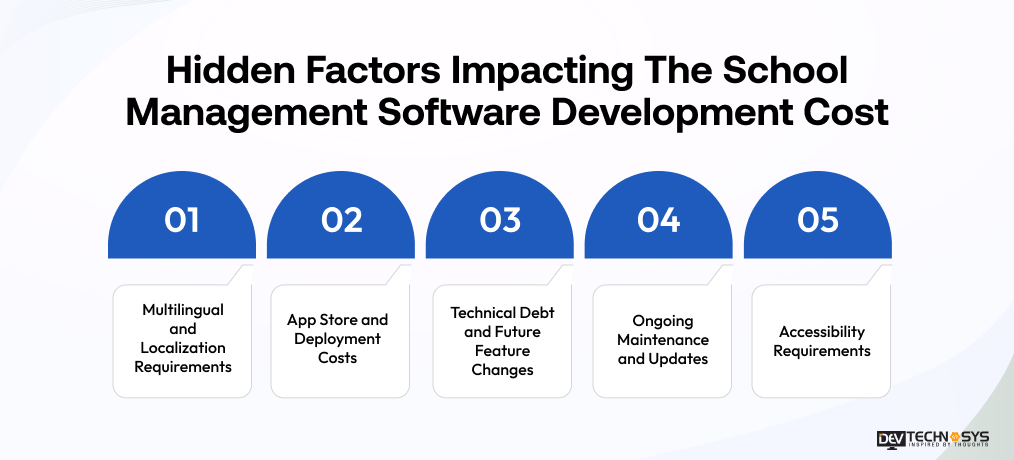
1. Multilingual and Localization Requirements
Developing multilingual support involves more than translating interface text. Localization may require developers to use local date formats, notifications, reports, databases, search functionality, and right-to-left layouts that lead to an increase in both development and support costs.
Benefit in Real World:
According to the Swiss Federal Department of Foreign Affairs, Switzerland has four official national languages: German, French, Italian, and Romansh. Its multilingual education environment means a school platform serving different linguistic regions may need localized interfaces, reports, notifications, and content.
2. App Store and Deployment Costs
If a school management program has apps for either Android or iOS operating systems, the deployment will require extra work for app store preparation, compatibility, testing, release management, and regular updates. All these activities will raise the costs over the costs linked with the development of the core web platform.
Real World Insight:
Apple reviews all apps and app updates submitted through App Store Connect against technical, content, and design requirements. A school-management app therefore requires additional release preparation and review management beyond developing the core application.- Source: Apple Review
3. Technical Debt and Future Feature Changes
Decisions made while developing software may increase the total development cost caused by changes in requirements. Poor architecture, coupled modules, obsolete dependencies, or rushed work can lead to more expensive integrations and feature updates, contributing to the high total cost of ownership of the software.
Real-world example:
NCES reports that 79% of participating states and territories in its 2018 Statewide Longitudinal Data Systems survey collected data across multiple agencies. Such interconnected systems can require ongoing integration and architecture changes as data requirements evolve.
4. Ongoing Maintenance and Updates
Classroom management software like Canvas needs constant maintenance to fix bugs, patch vulnerabilities, accommodate operating system changes, perform API updates, optimize databases, make backups, and introduce new educational needs. These costs recur and are separate from the costs of development.
Real World Insight:
The UK Department for Education updated its 2026–27 school census technical specifications and validation rules multiple times during 2026, illustrating why MIS products require continuing updates after deployment.
5. Accessibility Requirements
Creating accessible dashboards, forms, reports, mobile interfaces, keyboard control, screen reader support, captions, and proper contrast of colors may require additional UX, development, and testing efforts. It is important to be concerned about accessibility during the architecture and design phases rather than adding accessibility features after the development process is finished.
Industry Insight:
According to the U.S. Department of Justice’s Title II rule, WCAG 2.1 Level AA is established as the technical standard for covered state and local government web content and mobile apps, with compliance dates extending into 2027 and 2028.
Hidden Cost Factor |
Cost Impact |
Approx. Cost |
Additional Timeline |
| Multilingual & Localization Requirements | 5%–10% | $1,500–$15,000 | 2–5 weeks |
| App Store & Deployment Costs | 2%–5% | $600–$7,500 | 1–3 weeks |
| Technical Debt & Future Feature Changes | 5%–15% | $1,500–$22,500 | 2–6 weeks |
| Ongoing Maintenance & Updates | 10%–20% annually | $3,000–$30,000/year | Ongoing |
| Accessibility Requirements | 3%–8% | $900–$12,000 | 1–4 weeks |
Types of School Management Software With Their Development Costs
School management software falls into several categories/types, including Student Information System (SIS), School Administration Software, Learning Management System (LMS), School ERP Software, etc. If you are approaching a software development company, that means you already have a certain type of school management app in mind that you wish to create. But does every type cost the same? No, it’s not. In this section, we will discuss the types of school management software and their development costs.
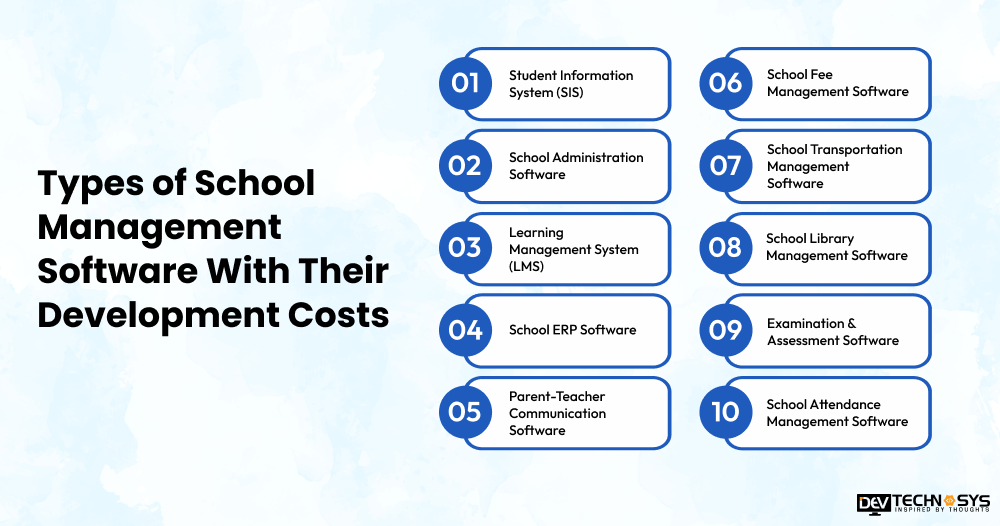
1. Student Information System (SIS)
A student information system offers a unified source of information related to students’ academic records, enrollment, attendance, admission management, grades, and any other information regarding students. It allows school management and faculty members to access required information about students in real-time while eliminating paperwork, duplication, and re-entering information.
2. School Administration Software
School administration software facilitates performing routine administrative functions in schools, including student records, report card generation, admission functions, employee management, scheduling, and inter-departmental communication. This software automates many operations, allowing school administrators to manage routine functions of administration and academics from a centralized point.
3. Learning Management System (LMS)
The learning management system provides tools to teach online and perform tasks related to online learning, such as managing online courses and projects, assignments, quizzes, and assessments. Thus, it allows teachers to perform their work while students complete their courses online and track their progress.
4. School ERP Software
School ERP software integrates multiple institutional functions into a centralized system, including academics, administration, finance, human resources, attendance, communication, and reporting. It provides schools with shared data, automated workflows, and centralized visibility across different departments and operations.
5. Parent-Teacher Communication Software
Parent teacher communication app development cost generally lies between $25,000 and $50,000. Communications software for parents and teachers provides a single platform that allows users to send messages and general notifications, track academic performance, and inform parents about attendance, events, and other school-related activities involving their children.
6. School Fee Management Software
School fee management software lets schools use automated solutions to process tuition fees, invoices, payments, receipts, refunds, and reports. This makes it possible to reduce the workload of admin staff processing payments and to control the payment process in an easier way. If you want to build software like PowerSchool for fee management, contact a leading school management software development company.
7. School Transportation Management Software
Transportation management software for schools allows schools to manage buses, routes, drivers, their vehicles, students, and schedules of student pickup and drop-off. Additionally, such software is regularly updated with GPS trackers, providing parents and schools with the real-time status of transport arrangements.
8. School Library Management Software
School library management software allows the automation of book cataloging, management of member records, and information on books loaned out; at the same time, librarians efficiently manage book stocks and the distribution of books among the school children.
9. Examination & Assessment Software
Examination & assessment software deals with coordinating exam schedules, preparing exam papers, evaluating students, grading, reporting, marking, etc. It helps teachers automate evaluation processes and deliver timely results to students and parents. The online exam portal development cost depends on factors like features, functionalities, custom design, and tools and technology used.
10. School Attendance Management Software
School attendance management software tracks student attendance in the classroom. This is achieved through various methods such as the use of mobile apps, RFID, fingerprint readers, etc. It helps schools maintain real-time attendance records, notify about absenteeism, and prepare necessary reports. School attendance management software development cost typically lies between $25k and $55k+
School Management Software Type |
Estimated Development Cost |
Development Timeline |
Complexity |
| Student Information System (SIS) | $30,000–$70,000 | 3–5 months | Medium |
| School Administration Software | $35,000–$80,000 | 4–6 months | Medium–High |
| Learning Management System (LMS) | $40,000–$100,000 | 4–7 months | High |
| School ERP Software | $70,000–$150,000+ | 7–10+ months | High–Advanced |
| Parent-Teacher Communication Software | $25,000–$50,000 | 3–4 months | Basic–Medium |
| School Fee Management Software | $25,000–$55,000 | 3–5 months | Medium |
| School Transportation Management Software | $35,000–$75,000 | 4–6 months | Medium–High |
| School Library Management Software | $20,000–$40,000 | 2–4 months | Basic–Medium |
| Examination & Assessment Software | $30,000–$65,000 | 3–5 months | Medium |
| School Attendance Management Software | $25,000–$55,000 | 3–5 months | Medium |
Note: The education app development costs are indicative and can overlap because many school management solutions combine multiple modules.
School Management Software Development Cost Based on Development Stages
The total development cost of software like Gradelink can be divided across different stages of the school management software development lifecycle. The exact allocation varies with software complexity, integrations, number of platforms, and customization requirements.
Development Stage |
What It Includes |
Estimated Cost |
| Planning & Requirements | Business analysis, requirements gathering, project scope, and technical planning | $2,000–$8,000 |
| UI/UX Design | Wireframes, prototypes, user flows, and interface design | $3,000–$12,000 |
| Frontend Development | Web/mobile interfaces, dashboards, forms, and responsive screens | $6,000–$30,000 |
| Backend Development | APIs, database, authentication, business logic, and admin functions | $8,000–$35,000 |
| Third-Party Integrations | Payment gateways, SMS, email, video, analytics, and other APIs | $2,000–$10,000 |
| Testing & QA | Functional, usability, performance, security, and compatibility testing | $3,000–$15,000 |
| Deployment | Server configuration, app deployment, database setup, and release management | $1,000–$5,000 |
| Maintenance & Support | Bug fixes, monitoring, optimization, updates, and technical support | $2,000–$10,000+ |
Note: These stage-wise figures are indicative and should not be added directly to calculate the total, as some activities overlap across project stages and the final cost depends on the project’s scope and complexity.
Security and Compliance Requirements in School Management Software Development
School management software handles sensitive information such as student records, academic performance, attendance, parent details, staff information, and payment data. Security should therefore be considered throughout development, from authentication and data storage to access control, integrations, monitoring, and compliance.
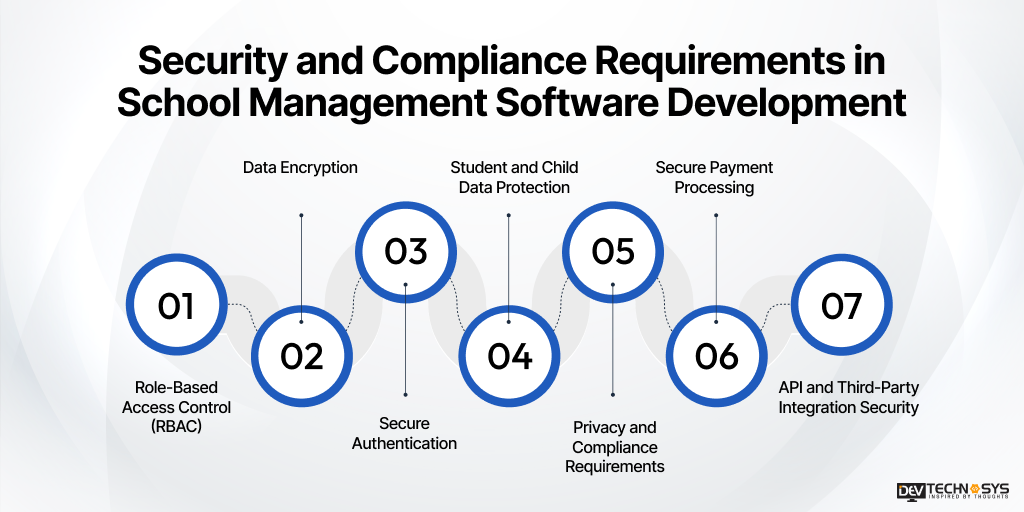
1. Role-Based Access Control (RBAC)
For Beginners, it is important to implement permission levels according to each user’s role, enabling administrators, teachers, and students to access only what they need. As a result, unauthorized users cannot access student data, finances, learning activities, or schoolwork processes.
2. Data Encryption
School management software development cost in UK and the USA are impacted by the addition of security measures. It is crucial to ensure that all valuable information (as it moves from one point to another and outside of its holder) is protected and that only trusted protocols (e.g., TLS) are used.
3. Secure Authentication
Using different methods of authentication, such as using quality passwords, multi-factor authentication (MFA), etc., will help ensure that only authorized users get access to confidential school data.
4. Student and Child Data Protection
Because school platforms can collect student and child data, virtual classroom app development experts must ensure that the platform keeps the information secure and that parents or guardians can access it.
5. Privacy and Compliance Requirements
FERPA compliant school management software cost depend on the country, users, and type of information processed. For U.S. schools, FERPA governs access to and disclosure of education records, while COPPA may apply to online services collecting personal information from children under 13.
6. Secure Payment Processing
If the platform supports online fee collection, avoid storing sensitive card information unnecessarily. Use reputable payment gateways and follow applicable payment-security requirements, including PCI DSS obligations where cardholder data is involved.
7. API and Third-Party Integration Security
School software often integrates payment gateways, learning platforms, communication tools, identity providers, and government systems. APIs should use authentication, authorization, encryption, and monitoring to reduce integration-related security risks.
Requirement |
What to Implement |
Purpose |
| Role-Based Access Control | Role-specific permissions | Limits unauthorized data access |
| Data Encryption | Encrypt data in transit and at rest | Protects sensitive information |
| Secure Authentication | Strong passwords, MFA, session management | Prevents account compromise |
| Child Data Protection | Data minimization and retention controls | Protects children’s information |
| Privacy Compliance | FERPA, COPPA, and applicable privacy laws | Supports regulatory compliance |
| Payment Security | Secure gateways and PCI DSS controls | Protects payment information |
| API Security | Authentication, encryption, validation, rate limiting | Secures third-party integrations |
| Monitoring & Auditing | Logs, alerts, and security testing | Detects suspicious activity |
| Backup & Recovery | Automated backups and recovery procedures | Prevents permanent data loss |
How To Reduce The School Management Software Development Cost?
Reducing the cost of building school administration software necessitates a strategic strategy that prioritizes optimizing the development process, limiting complexity, and leveraging efficient resources. Here are five excellent techniques to reduce expense without sacrificing quality:
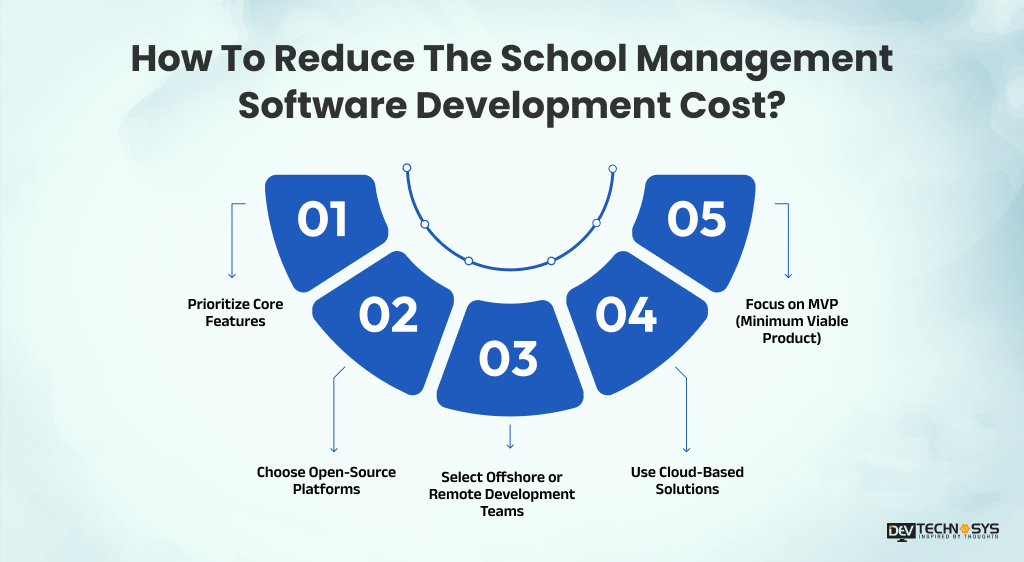
1. Prioritize Core Features
Rather than integrating every potential feature from the start, focus on the key functionalities that are required for the product to perform. Key functions such as attendance monitoring, grade management, and scheduling can serve as the foundation of the software.
Later versions may include additional features such as parent-teacher communication, reporting systems, and mobile applications. Keep the first build modest and phased to decrease upfront development expenditures.
2. Choose Open-Source Platforms
Using open-source software or frameworks can considerably cut school fee management software development costs. Open-source solutions include pre-built modules and libraries, which can save time over constructing things from scratch.
Hire ServiceNow developers for backend development, where security, scalability, and database administration tools are already built into several open-source platforms.
3. Select Offshore or Remote Development Teams
One of the most efficient cost-cutting strategies is to hire offshore or remote developers from nations with reduced labor expenses. Countries such as India, Eastern Europe, and Southeast Asia have highly qualified developers who can deliver excellent work at a lower cost than developers in high-cost nations such as the United States or the United Kingdom.
4. Use Cloud-Based Solutions
Using cloud-based solutions instead of traditional on-premises software can save you time and money. Cloud solutions provide scalability, security, and lower infrastructure costs because you don’t need to invest in expensive servers or hardware.
Additionally, cloud-based school management software development services, built-in upgrades and maintenance, reducing the need for ongoing human management and saving long-term costs.
5. Focus on MVP (Minimum Viable Product)
Create a Minimum Viable Product (MVP) to release the product with only the most important features. By focusing on a simple version of the program that provides value, you can get early user input and make necessary changes.
According to the software development company, this reduces the danger of overdeveloping features that may not be required and allows for more precise budgeting.
Build vs Buy vs Development Partner: Should Schools Develop Custom Software or Use an Existing Platform?
Schools generally have three options: buy ready-made school management software, build a fully custom platform, or work with a development partner. The right approach depends on budget, required features, customization, integration needs, and long-term scalability.
Factor |
Buy Existing Software |
Build Custom Software |
Development Partner |
| Initial Cost | Low | High | Medium–High |
| Customization | Limited | Extensive | Extensive |
| Development Time | Short | Long | Medium |
| Scalability | Depends on vendor | High | High |
| Integrations | Predefined options | Fully customizable | Fully customizable |
| Maintenance | Vendor-managed | School manages | Partner-managed |
| Best For | Standard requirements | Unique workflows | Schools needing tailored solutions |
According to Promod Jangid, Tech Head at Dev Technosys, businesses should:
- Buy existing software when the school needs standard features, including attendance, fees, student records, examinations, and communication without significant customization.
- Build custom software when the school has highly specific workflows, complex requirements, or needs complete control over the platform.
- Choose an experienced development partner when the school wants customized software but does not have an in-house team to handle development, integrations, maintenance, and future scaling.
How to Calculate the Total Cost of Ownership (TCO) of School Management Software?
The initial development cost does not represent the complete cost of owning school management software. Total Cost of Ownership (TCO) includes development, infrastructure, integrations, maintenance, security, support, and future enhancements required to operate the platform over several years.
TCO Component |
What It Includes |
Estimated Cost |
| Initial Development | UI/UX, frontend, backend, database, features, testing, and deployment | $10,000–$90,000+ |
| Cloud Hosting | Servers, storage, backups, CDN, monitoring, and bandwidth | $1,000–$5,000/year |
| Third-Party APIs | Payments, SMS, email, video, maps, and other services | $500–$3,000/year |
| Security Updates | Vulnerability fixes, dependency updates, monitoring, and testing | $1,000–$5,000/year |
| Maintenance | Bug fixes, optimization, database maintenance, and updates | $2,000–$8,000/year |
| Technical Support | Troubleshooting, monitoring, helpdesk, and user support | $1,500–$6,000/year |
| Data Migration | Cleaning, transforming, validating, and transferring records | $1,000–$5,000 |
| New Features | Additional modules, mobile features, AI, dashboards, and workflows | $2,000–$10,000/year |
| Compliance Updates | Privacy, accessibility, education-data, and payment requirements | $500–$3,000/year |
| Scaling Infrastructure | Additional computing, storage, databases, and traffic capacity | $1,000–$5,000/year |
3-Year TCO Example
For a school management platform development, the three-year TCO can increase based on usage, integrations, maintenance, and feature updates.
Initial Development |
Estimated 3-Year Additional Costs |
Approx. 3-Year TCO |
| $30,000 | $8,000–$15,000 | $38,000–$45,000 |
| $75,000 | $15,000–$30,000 | $90,000–$105,000 |
| $150,000 | $25,000–$50,000 | $175,000–$200,000 |
TCO formula:
3-Year TCO = Initial Development + Hosting + APIs + Maintenance + Support + Security + Migration + New Features + Compliance + Scaling
Why Dev Technosys is Your Best School Management Software Development Partner?
Dev Technosys is a CMMI Level 3 and ISO 9001:2015 certified software development company founded in 2010, delivering iOS, Android, and cross-platform software with an 89% project success rate. With 16+ years of experience, our team provides end-to-end development, from UI/UX design and development to testing, deployment, and ongoing support.
Our past software development projects achieved 98% fraud-detection accuracy and 30% reductions in operational costs. The company has also been featured on The Hans India’s list of Top Software Development Companies, a testament to its industry recognition and track record of delivering technology solutions.
Still Doubtful? Hear From Our Clients
“One of their developers integrated so well into our workflow that she felt like part of our internal team rather than an external contractor. Their flexibility in structuring contracts for a small company was truly impressive.”
Kirill Olenev, Senior Android Software Engineer, Drivemode (Tokyo) · (5.0 · Verified on Clutch)
Conclusion
In this blog, we explored the school management software development cost in top countries and provided a separate cost table to easily get the cost estimation. We also offer the various cost factors that can impact the overall development cost and how to reduce the mobile app development cost.
Building school management software is a profit-generating opportunity for businesses, and it provides various benefits to school staff, such as attendance tracking, student information, and more.
We hope that you have cleared all your doubts regarding the development cost. If not, then you can consult with a school management software development company to receive detailed information about the cost.
Frequently Asked Questions
Find answers to the most common questions related to this article.
The cost of developing school management software varies widely, typically ranging from $30,000 to $150,000, depending on factors like features, complexity, platform, customization, team location, and ongoing maintenance. Prices can vary significantly based on requirements. MVP development costs can start at $10,000, while advanced software can exceed $150,000.
Creating school management software typically takes 3 to 9 months, depending on the complexity, features, customization, and team size. The timeline can be extended if additional functionalities or integrations are required during the development process.
There are various steps to develop school visitor management software; here are the steps:
- Define requirements and needs
- Features and functions
- Tech stacks
- Design UI/UX
- Development
- Testing and security
- Release and Maintenance
To reduce development costs, prioritize core features, use open-source platforms, hire offshore or remote teams, opt for cloud-based solutions, and build a Minimum Viable Product (MVP) to minimize initial expenses and improve scalability.