














Quick Summary:
The video streaming app development cost typically ranges from $8,000 to $30,000+ depending on the features, streaming quality, and platform scale. A basic MVP-based streaming app may cost $8,000 to $12,000, mid-level apps with advanced functionality range from $15,000 to $20,000, while enterprise-grade streaming platforms with AI recommendations, live streaming, and global scalability can exceed $30,000.
Cost Impacted by Project or Development Complexity:
-
- Basic/MVP ($8,000 – $12,000+): Includes user registration, video library, basic search, standard video playback, and a simple admin panel.
- Medium Complexity ($15,000 – $20,000+): Adds subscription models, payment integration, HD streaming, content management system, watchlists, and multi-device compatibility.
- Complex/Enterprise ($25,000 – $30,000+): Includes AI-based recommendations, live streaming, multi-language support, smart TV apps, advanced analytics, DRM protection, and CDN integration.
Key Cost Drivers:
-
- App Features: On-demand video platforms cost less compared to apps with live streaming, AI personalization, and original content distribution.
- Streaming Infrastructure: Costs vary based on CDN usage, cloud hosting, storage capacity, and bandwidth consumption.
- Platform Choice: Native development for iOS, Android, and Smart TV apps costs more than cross-platform frameworks.
- UI/UX Design: Custom UI components, animations, and interactive layouts increase development and design expenses.
Development Timeline of Video Streaming App:
-
- MVP: 3 to 5+ months
- Mid-Level App: 5 to 7+ months
- Enterprise Platform: 9 to 12+ months or longer
Cost Based on the Different Regions/Countries:
-
- Video streaming app development cost in the United States ranges from $18 to $50 per hour.
- Video streaming app development cost in the United Kingdom & Western Europe ranges from $20 to $50 per hour.
- Video streaming app development cost in Eastern Europe ranges from $20 to $45 per hour.
- Video streaming app development cost in Southeast Asia ranges from $15 to $24 per hour.
- Video streaming app development cost in Australia ranges from $22 to $48 per hour.
Additional Cost:
-
- Maintenance & Support: Around 15% to 20% of the initial development cost annually.
- Content Licensing: Ongoing fees for acquiring rights to movies, TV shows, or sports content.
- Cloud & CDN Services: Recurring costs for hosting, storage, and video delivery infrastructure.
- Marketing & User Acquisition: Expenses for app store optimization, paid advertising, and influencer marketing.
Are you thinking of developing a video streaming app? Great decision! But proceeding without a basic understanding of video streaming app development costs can be a costly mistake! Cost is a crucial factor to consider when building an app, especially a video streaming app. From content delivery and cloud infrastructure to security, UI/UX design, and the technology stack, every element impacts the cost to build a video streaming app.
So, what will the video streaming app price estimate be? That’s what we’ll discuss in this blog today to help businesses plan their development budget. We will walk you through a complete budget breakdown, providing a realistic view of the video streaming platform development cost. So, let’s not waste time and dive right into it!
What is a Video Streaming App?
In simple words, a video streaming app is a digital platform that streams videos, movies, and live video content directly to devices over the internet in real-time without requiring a full file download.
These apps are accessible on smartphones, smart TVs, and computers. Some prominent examples include Netflix, Amazon Prime Video, Mubi, Hulu, and Peacock TV.
How Much Does it Cost to Build Video Streaming App?
Wondering how much does it cost to make a streaming app? Well, the video streaming app development cost relies on multiple factors, including features, the location of the development team, UI/UX design, and technology stack. The general estimate of the OTT app development cost is $8,000 to $ 25,000. Generally, creating a basic app costs lees then developing an advanced app.
The cost to develop a mobile app with mid-level complexity will be around $12,000 to $18,000. Now, if you add advanced features such as multilingual support, custom UI/UX, multi-device support, and AI integration, the video streaming app price estimate can exceed $25,000. The type of Video streaming a[pp you want to develop can also impact the total development cost.
The cost of building a live streaming app will vary depending on the features you want. Therefore, if you want to build an app like Amazon Prime, then we recommend contacting the relevant app development company for a quote based on your requirements.
App Complexity |
Development Timeline |
Estimated Cost |
| Basic MVP App | 4–6 weeks | $8,000 – $12,000 |
| Standard Streaming App | 6–8 weeks | $12,000 – $18,000 |
| Advanced MVP App | 8–10 weeks | $18,000 – $25,000 |
How do Different Types of Video Streaming Apps Impacts The Developent Cost?
There are various factors that can affect the video streaming app development cost. Types are one of them. Let’s discuss the types of OTT streaming apps and see the impact they have on development cost.
1. On-Demand Video Streaming Apps (VOD)
On-demand video (VOD) streaming apps, such as Netflix, Disney+, and Hulu, let users watch pre-recorded video content instantly from any device, at their convenience.
The cost to build an app like Hulu is driven by video storage, content management systems, adaptive bitrate streaming, search, and recommendation engines.
Subscription management and DRM security further increase the cost to create video streaming app. As content libraries grow, CDN and cloud costs rise, making long-term scalability a major budget factor.
App Complexity |
Cost Range |
Timeline |
| Basic | $8,000 – $12,000 | 6–8 weeks |
| Mid-Level | $12,000 – $18,000 | 8–12 weeks |
| Advanced | $18,000 – $25,000 | 12–16 weeks |
2. Live Streaming Apps
Live streaming apps require real-time video capture, encoding, broadcasting, and ultra-low latency delivery. Live chat, moderation tools, recording, and stream scheduling are some of the advanced features that add to the complexity and cost to build video streaming app.
Due to heavy bandwidth usage, scalable cloud infrastructure, and advanced streaming protocols, both development and ongoing operational costs will be more than traditional on-demand (VOD) streaming platforms.
| App Complexity | Cost Range | Timeline |
| Basic | $10,000 – $14,000 | 8–10 weeks |
| Interactive | $14,000 – $20,000 | 10–14 weeks |
| Advanced | $20,000 – $25,000 | 14–18 weeks |
Industry Insight: According to Technavio, live videos capture user attention 10 to 20 times longer than pre-recorded content.
3. User-Generated Content (UGC) Streaming Apps
UGC on-demand app development solutions easily handle massive video uploads, compression, and AI-based content moderation. Adding creator tools, feeds, engagement features, and recommendation algorithms increases the cost of infrastructureand development, especially as user volume scales rapidly.
If you want to build an app like Mubi, then considering the UGC factor is highly important. Take a look at the table below to understand this cost factor in a better way.
App Complexity |
Cost Range |
Timeline |
| Basic | $9,000 – $13,000 | 6–8 weeks |
| Social | $13,000 – $18,000 | 8–12 weeks |
| Advanced | $18,000 – $24,200 | 12–16 weeks |
4. Educational & Corporate Streaming Apps
The cost to build video streaming app for educational and corporate-based content will be around $8,000 to $24,000. From on-demand learning and live training to content management for students and employees, Education and corporate apps do it all.
The main focus of these apps is ensuring safe access, role-based permissions, progress tracking, certifications, and integrations with LMS or enterprise systems.
While streaming features are simpler, higher security, analytics, and compliance requirements advance the overall video streaming app development cost.
App Complexity |
Cost Range |
Timeline |
| Basic | $8,000 – $12,000 | 6–8 weeks |
| Mid-Level | $12,000 – $18,000 | 8–12 weeks |
| Advanced | $18,000 – $24,000 | 12–16 weeks |
5. Social Video Streaming Apps
Social video streaming apps allow users to broadcast and watch live, real-time video content. At the same time, they interact directly with broadcasters through features like real-time chat, likes, comments, shares, and social feeds.
Incorporating social features requires complex backend logic and scalable databases, which increases the cost to develop video streaming app. Continuous engagement features and real-time syncing significantly raise development and maintenance costs.
App Complexity |
Cost Range |
Timeline |
| Basic | $9,000 – $13,000 | 6–8 weeks |
| Engagement | $13,000 – $19,000 | 8–12 weeks |
| Advanced | $19,000 – $25,000 | 12–16 weeks |
Industry Insight: Video content accounts for 82% of all global internet traffic, and Users spend an average of 100 minutes daily watching online videos. Source: Dotstark
6. OTT (Over-The-Top) Streaming Apps
OTT apps stream video, audio, and media content directly over the internet. OTT development cost estimation depends on the features and functionalities added.
An OTT app supports multiple devices, user profiles, watch history sync, parental controls, and DRM, which increases both on-demand app development solutions and testing costs.
TV app support (Fire TV, Roku, Apple TV) adds extra budget. Custom OTT app development pricing model operates via Subscription Video on Demand (SVOD), Free Ad-supported Streaming TV (FAST), or Transactional Video on Demand (TVOD).
App Complexity |
Cost Range |
Timeline |
| Basic | $10,000 – $14,000 | 8–10 weeks |
| Subscription | $14,000 – $20,000 | 10–14 weeks |
| Advanced | $20,000 – $25,000 | 14–18 weeks |
7. Sports Streaming Apps
Sports live streaming app development demands the addition of live streaming, multi-camera angles, real-time scores, highlights, instant replays, and massive concurrent users. Low latency and high availability are critical, making infrastructure, CDN usage, and testing costs significantly higher.
The live streaming app development cost for Native platforms (iOS + Android) will be higher. In contrast, cross-platform frameworks (React Native/Flutter) can range from $10,000 to over $20,000. The table below will help you understand the cost to develop video streaming app and its development time.
App Complexity |
Cost Range |
Timeline |
| Basic | $12,000 – $16,000 | 8–10 weeks |
| Mid-Level | $16,000 – $20,000 | 10–14 weeks |
| Advanced | $20,000 – $25,000 | 14–18 weeks |
8. Short-Video Streaming Apps
Short video streaming platforms enable creating, sharing, and viewing of short-form content. Short video apps use personalized algorithms to obtain engagement and viral trends.
Short video app development involves focusing on delivering vertical videos, infinite scrolling feeds, filters, and powerful recommendation algorithms. Video streaming app development cost may rise due to AI-based content discovery, video processing, and heavy backend optimization for high engagement.
App Complexity |
Cost Range |
Timeline |
| Basic | $9,000 – $12,000 | 6–8 weeks |
| Social | $12,000 – $18,000 | 8–12 weeks |
| Advanced | $18,000 – $25,000 | 12–16 weeks |
Want a chatbot demo or pricing? Fill the form and talk to our experts today.
Pick what you need below — you can select more than one — then tap Get detail to continue.
-
Chatbot demo dashboard
-
Cost to develop an app
-
Industry report
-
Case study
How Much Investment Goes Into Top Video Streaming Platforms?
So, are you ready to build the next trending video streaming app like Netflix? Not so fast, first you need to learn how much an application streaming service cost. The Video streaming app price estimate for the most popular OTT apps is as follows:
1. Cost to Build an App Like Netflix
A streaming app development quotation for a Netflix-like app will be around $12,000 to $25,500. It is a generic estimate which can change depending on factors like features, platform choice, appdesign and more.
Netflix is a highly popular OTT app that provides features like personalized recommendations, multiple user profiles, subscription management, high-quality video streaming, and content categorization.
Adding custom features and functionality, along with monetization models, can affect the overall cost of a custom video streaming app. Take a look at the table below to know the cost to build an app like Netflix in USA.
Feature |
Cost |
Timeline |
| Signup/Login | $1,000–$2,000 | 1–2 wks |
| Video Catalog | $2,000–$4,500 | 2–3 wks |
| Video Playback | $1,500–$3,500 | 2–3 wks |
| Admin Panel | $1,500–$3,000 | 2–3 wks |
| Add-ons (basic recommendations, multi-device) | $2,000–$5,000 | 2–3 wks |
2. Cost to Build an App like Amazon Prime
Do you want to build an App like Amazon Prime? Great idea! But do you know how much budget is needed to make a live streaming app like Amazon Prime? The basic cost of building OTT platform like Amazon Prime ranges from $10,000 to $24,800.
This estimate includes minimum viable product (MVP) and the features added, such as user registration and login, a searchable video library, content categorization, basic subscription management, and standard video playback.
The final video streaming app development services price varies based on factors such as the number of supported platforms (Android, iOS, web, or Smart TVs), the design complexity, and video quality.
Feature |
Cost |
Timeline |
| User Profiles/Login | $1,200–$2,500 | 1–2 wks |
| Video Library | $2,000–$4,500 | 2–3 wks |
| Subscription Management | $1,500–$3,500 | 2–3 wks |
| Multi-device Support | $1,500–$3,500 | 2–3 wks |
| Admin Panel | $1,800–$3,800 | 2–3 wks |
3. Cost to build an app like YouTube
YouTube-like app development cost will be around $8,000 to $25,000+ or more. Keep in mind that YouTube, every now and then, releases updates and new features that impact the cost. So if you want to develop an app like Youtube you need to think of the ongoing costs beforehand.
The total cost of web app development services for a high-quality streaming platform like YouTube ranges from $10,000 to over $18,000, with highly complex, enterprise-grade apps potentially exceeding $25,000.
Feature |
Cost |
Timeline |
| Signup/Login | $1,200–$2,500 | 1–2 wks |
| VOD Library | $2,000–$4,500 | 2–3 wks |
| Live Channels (Optional) | $2,500–$5,000 | 2–3 wks |
| Ads/Subscription | $1,500–$3,500 | 2–3 wks |
| Admin Panel | $1,800–$3,500 | 2–3 wks |
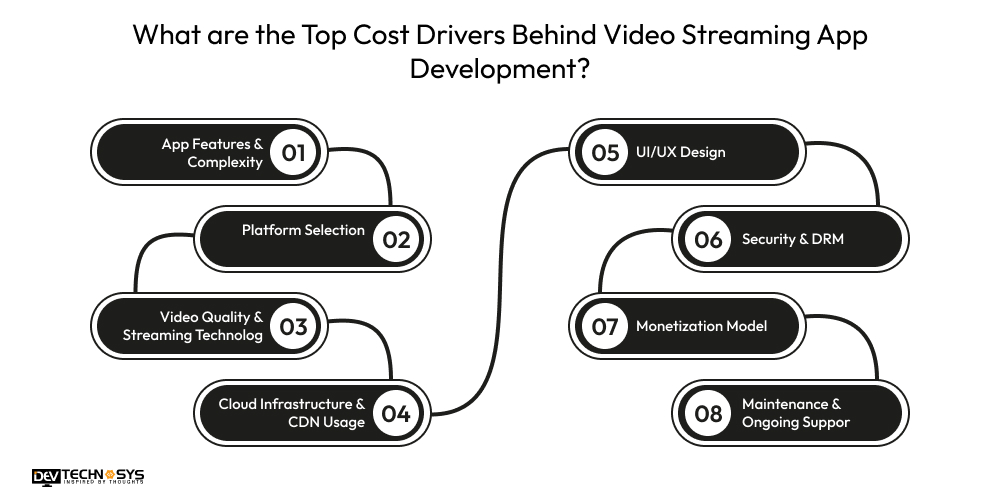
What are the Top Cost Drivers Behind Video Streaming App Development?
There are various factors that can influence the overall video streaming app development cost. From features to design to tech stack, every element plays a crucial role in decking the budget. Let’s uncover these factors and see how they impact the streaming app development cost factors.
1. App Features & Complexity
If you do a video streaming app budget breakdown, you will see that features added in a video streaming platform are one of the crucial cost influencers.
The feature complexity and scope play a major role in determining the cost of a video streaming app. Basic apps with essential features such as user login, video search, and standard playback take less time to build ,and they are most cost-effective.
According to a cross platform development company in America, the cost to make video streaming app increases with the addition of complex features, such as live streaming, AI-powered content recommendations, and multi-device synchronization.
Feature Level |
Included Scope |
Estimated Cost Impact |
Timeline |
| Basic | Video playback, search, and user login | Low | 4–6 weeks |
| Medium | Offline viewing, profiles, watch history | Medium | 6–10 weeks |
| Advanced | Live streaming, AI recommendations, sync | High | 10–16 weeks |
2. Platform Selection
Another one of the streaming app development cost factors is the choice of platform. It directly impacts the development budget and timeline. Building a streaming app for a single platform, such as Android, iOS, or web, helps keep costs under control.
In contrast, developing for multiple platforms simultaneously requires separate design considerations, platform-specific optimizations, and extensive quality assurance.
Supporting Smart TVs and streaming devices like Roku, Fire TV, and Apple TV further increases costs, as each platform has unique UI standards, thereby increasing overall development effort.
Platform Choice |
Description |
Cost Impact |
Timeline |
| Single Platform | Android or iOS | Low | 4–6 weeks |
| Multi-Platform | Android + iOS + Web | Medium | 8–12 weeks |
| Smart TV Apps | Roku, Fire TV, Apple TV | High | 10–16 weeks |
3. Video Quality & Streaming Technology
Lower video quality and standard streaming protocols keep infrastructure and stream application cost manageable. Supporting HD, 4K, adaptive bitrate streaming, and low-latency delivery demands advanced encoding techniques, higher processing power, and greater bandwidth usage, all of which raise development and operational costs.
These technologies demand higher processing power, increased bandwidth, and more sophisticated streaming workflows, significantly increasing both the operation and backend cost for a video streaming platform.
Streaming Level |
Supported Quality |
Cost Impact |
Timeline |
| Standard | SD streaming | Low | 4–6 weeks |
| Enhanced | HD + adaptive bitrate | Medium | 6–10 weeks |
| Advanced | 4K, low-latency streaming | High | 10–14 weeks |
4. Cloud Infrastructure & CDN Usage
Video streaming apps depend heavily on cloud infrastructure for video storage, processing, and delivery. Cloud services handle essential tasks such as transcoding videos into multiple formats and ensuring scalable performance during traffic spikes.
As the user base and content library grow, cloud resource usage and CDN bandwidth consumption increase, leading to higher recurring CDN cost for video streaming.
Additionally, the need for global content delivery, low buffering, and uninterrupted streaming further adds to infrastructure expenses and long-term operational investments.
| Infrastructure Scale | Usage Level | Cost Impact | Timeline |
| Basic Cloud Setup | Limited storage & traffic | Low | 3–5 weeks |
| Scalable Setup | Auto-scaling & CDN | Medium | 6–8 weeks |
| Global Delivery | Multi-region CDN | High | 8–12 weeks |

5. UI/UX Design
User interface and user experience design play a crucial role in the success of a video streaming app. Simple, template-based designs reduce development effort and help control initial costs.
In contrast, custom, visually engaging, and interactive UI/UX designs require extensive design planning, frontend development, animations, and usability testing. While these elements increase upfront Smart tv app development costs, they significantly improve user engagement, viewing experience, and retention rates.
Design Level |
Scope |
Cost Impact |
Timeline |
| Template-Based | Basic UI components | Low | 3–4 weeks |
| Custom Design | Branded UI & animations | Medium | 5–7 weeks |
| Premium UX | Interactive, personalized UI | High | 8–10 weeks |
6. Security & DRM
Security is a critical factor in determining the cost of a video streaming app, especially for platforms offering premium or licensed content. Basic authentication and standard access controls are relatively inexpensive to implement.
However, advanced security requirements such as video encryption and compliance with content protection standards significantly increase development effort.
According to an OTT app development company in USA, these security layers require specialized third-party integrations, rigorous testing, and ongoing monitoring, all of which contribute to higher development and operational costs.
Security Level |
Features |
Cost Impact |
Timeline |
| Basic Security | Login & access control | Low | 3–4 weeks |
| Enhanced Security | Encryption, secure APIs | Medium | 5–7 weeks |
| DRM Protection | Content licensing & DRM | High | 8–12 weeks |
7. Monetization Model
The chosen monetization strategy directly affects the complexity and cost of development. A free streaming app without monetization features is simpler and more cost-effective to build.
In contrast, implementing subscriptions, advertisements, pay-per-view content, or in-app purchases requires secure payment gateways and detailed revenue-tracking mechanisms, which increases the cost to develop a mobile app to a great extent. These features add backend complexity, require compliance with financial regulations, and increase both development time and overall cost.
Monetization Type |
Implementation Scope |
Cost Impact |
Timeline |
| Free App | No monetization | Low | 2–3 weeks |
| Ads-Based | Ad servers & tracking | Medium | 4–6 weeks |
| Subscription / PPV | Billing & payment systems | High | 6–10 weeks |
8. Maintenance & Ongoing Support
The cost of building a video streaming app extends well beyond its initial launch. Continuous maintenance is essential to ensure smooth performance and user satisfaction. This includes server monitoring, bug fixes, security updates, feature enhancements, and infrastructure scaling to support a growing user base.
As the platform evolves, ongoing operational expenses increase, making long-term maintenance and support a crucial component of the total ownership and video streaming website development cost.
Support Level |
Scope |
Cost Impact |
Timeline |
| Basic Support | Bug fixes & monitoring | Low | Ongoing |
| Regular Updates | Feature upgrades | Medium | Monthly |
| Full Maintenance | Scaling & security updates | High | Continuous |
Security and Compliance Considerations for Video Streaming Apps
Security plays an important role in the development of video streaming applications since it is necessary to ensure the protection of premium content, accounts, payments, and viewings. Security also helps in preventing piracy and unauthorized access to the platform.
Protect Video Content With DRM and Encryption
For video content to be delivered via HLS/DASH, encryption is required; the same goes for protection through DRM(digital rights management). This can be done through Multi-DRM systems like Google Widevine, Apple FairPlay, and Microsoft PlayReady. Other methods that can be used include signed URLs, tokenized access, secure key distribution, and playback tokens.
Secure Accounts, APIs, and Streaming Infrastructure
OAuth 2.0 or OpenID Connect, multi-factor authentication, role-based access control, and session management are needed for user accounts, while streaming APIs require authentication, authorization, rate-limiting, and input validation. TLS is used for content ingestion and API communications, while WAF and DDoS Protection will help in defending against infrastructure-based attacks.
Protect Personal and Payment Data
Personal data is gathered by the streaming platforms, including subscriptions, device and viewing data. It must be encrypted while in transit and when stored; proper access management is necessary, and cloud key management services must be used. If the platform supports card payments, then PCI DSS must also be taken into account.
Follow Privacy and Regulatory Requirements
Depending on the intended market segment, it will be necessary to comply with regulations such as GDPR and CCPA/CPRA. Privacy policies, consent management, data retention policy, user deletion requests, breach management, and audit logging should be included in the platform architecture.
Strengthen Anti-Piracy and Security Monitoring
Piracy of content can be deterred by using techniques such as dynamic watermarking, concurrent-stream restrictions, geoblocking, device approval, and suspect playback. Constant security monitoring, vulnerability assessments, penetration testing, and audit logging should be able to detect anomalous access patterns and possible attacks before they do much harm.
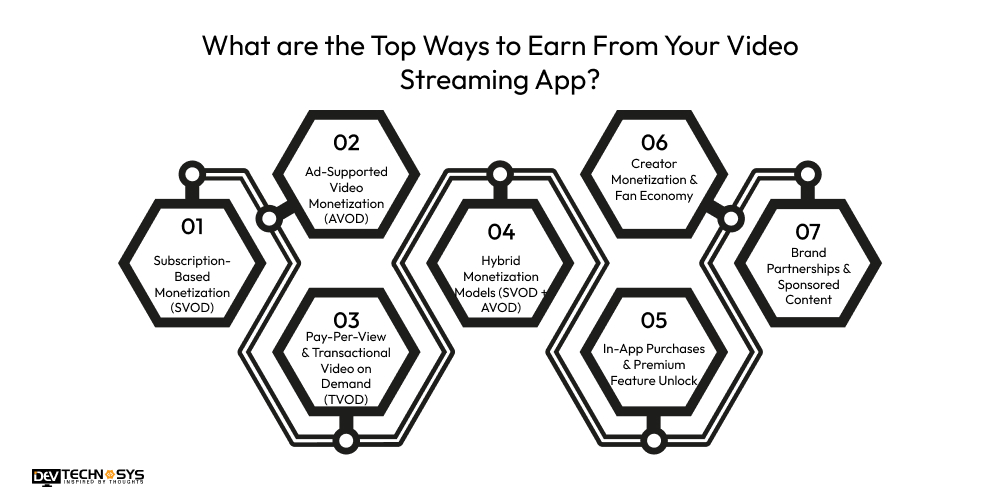
What are the Top Ways to Earn From Your Video Streaming App?
By 2026, video streaming apps have evolved far beyond simple subscription-based platforms. With rising content costs, intense competition, and increasingly selective users, modern streaming apps rely on diversified monetization strategies to generate sustainable revenue while maintaining a strong user experience. Let’s take a look at some of the advanced strategies.
1. Subscription-Based Monetization (SVOD)
Subscription Video on Demand (SVOD) continues to be one of the most reliable monetization strategies. Users pay a recurring monthly or yearly fee to access premium, ad-free content. In 2026, subscription models have become more flexible, offering tiered plans such as mobile-only access, HD or 4K upgrades, family plans, and region-based pricing.
Industry Insight: According to Grand View Research, 64% of video streamers prefer subscription video-on-demand (SVOD) platforms for ad-free, premium experiences.
2. Ad-Supported Video Monetization (AVOD)
Ad-supported monetization remains highly effective, particularly in price-sensitive markets. Platforms generate revenue through pre-roll, mid-roll, and post-roll video ads, banner ads, and sponsored placements.
In 2026, AI-driven ad targeting, real-time bidding, and contextual advertising ensure that ads are more relevant to users, increasing engagement and advertiser ROI without compromising the viewing experience. Hire dedicated developers from top agencies in NYC to implement this monetization strategy in your video app.
3. Pay-Per-View & Transactional Video on Demand (TVOD)
Pay-per-view remains especially popular for live sports, concerts, special events, and exclusive movie releases. Users pay a one-time fee to access specific content. In 2026, frictionless payment systems, digital wallets, and one-tap purchases have made transactional monetization more accessible, allowing platforms to generate high-margin revenue from premium events.
4. Hybrid Monetization Models (SVOD + AVOD)
Hybrid monetization has become a dominant strategy in 2026, especially for those wanting to create a video streaming app. Platforms offer users the option to watch content for free or at a lower cost with ads, while premium subscribers enjoy an ad-free experience.
This approach helps streaming apps attract a broader audience, convert free users into paying subscribers, and maximize overall revenue across different user segments.
5. In-App Purchases & Premium Feature Unlocks
Streaming apps increasingly monetize through optional in-app purchases beyond content access. Users can pay for offline downloads, early episode releases, advanced playback controls, exclusive bonus content, or higher video resolutions. This strategy allows platforms to monetize power users without forcing subscriptions on casual viewers.
6. Creator Monetization & Fan Economy
Creator-driven monetization has become central to UGC, live-streaming, and short-video platforms. Creators earn through fan subscriptions, tips, virtual gifts, exclusive live sessions, and paid memberships.
Experts who provide entertainment app development services state that these app platforms take a percentage of creator earnings, creating a scalable revenue model while encouraging content creators to stay active and loyal.
7. Brand Partnerships & Sponsored Content
Brands increasingly collaborate with streaming platforms for native advertising opportunities. Sponsored shows, branded series, influencer partnerships, and product placements generate high-value revenue. In 2026, brand integrations are designed to feel organic, blending seamlessly into content rather than disrupting the viewer experience.
Lessons on Cost Control From Failed Video Platforms
Many video streaming apps failed because they spent too much too soon. Some add unnecessary features or build expensive custom technology before researching. Some scaled too quickly, spending more on servers, bandwidth, and marketing without a steady user base.
Other apps underestimated ongoing costs like maintenance, updates, and licensing fees. These expenses quickly ate into their revenue, making the platform unsustainable.
The key lesson is to start small and focus on essential features first. Use cloud services and cost-effective third-party tools. Plan your budget carefully and track expenses at every stage.
Smart cost management helps your streaming app survive, grow steadily, and avoid the mistakes that caused others to fail. The table presented below explains how making mistakes with the budget can impact the success of your on-demand video streaming app.
Cost Mistake |
Lesson Learned |
|---|---|
| Overspending on untested features | Launch an MVP first; focus on essential features |
| Scaling too fast with expensive servers | Scale infrastructure gradually with user growth |
| Ignored maintenance & licensing costs | Always include recurring expenses in the budget |
| Excessive marketing spend | Base marketing budget on proven engagement |
| Building costly in-house technology | Use third-party integrations to save costs |
| Poor cost monitoring | Track expenses regularly and optimize spend |
| Overbuilt features & design | Align features with actual user needs |
Conclusion
The video streaming app industry is booming at a rapid ace evident in the increased demand of video and OTT appa nd web development. The cost of developing a video streaming app depends largely on the app’s features, platform coverage, streaming technology, and scalability requirements.
To manage expenses effectively, businesses should start with a well-defined MVP, prioritize essential features, and scale gradually based on user demand and growth.
Partnering with leading video streaming app development companies in USA, such as Dev Technosys, ensures better cost control and long-term success in the competitive video streaming market.
Frequently Asked Questions
Find answers to the most common questions related to this article.
The cost of building a video streaming app depends on several important factors. These include the number of features the app offers and how complex those features are, the platforms the app supports (Android, iOS, web, or Smart TVs), and the video quality and streaming technology used. Cloud infrastructure, CDN usage, UI/UX design quality, security and ongoing maintenance also play a major role.
Yes, live streaming apps usually cost more to build than on-demand (VOD) streaming apps. Live streaming requires real-time video capture, processing, and delivery with very low delay. It also needs strong servers, high bandwidth, and systems that can handle many users watching at the same time. All these technical requirements increase development effort as well as ongoing infrastructure and maintenance costs.
Building a streaming app for multiple platforms increases the overall cost to $18,000 to $25,000. When an app supports Android, iOS, web, and Smart TVs, each platform needs separate development, design adjustments, performance optimization, and testing. Smart TV platforms also have different navigation and screen requirements.
Higher video quality directly increases development and operating costs. Supporting HD, 4K, adaptive bitrate streaming, and low-latency delivery requires advanced video encoding, real-time processing, and more bandwidth. All of these requirements raise both the initial development cost and the ongoing expenses.
DRM is important because it protects premium and licensed video content from unauthorized copying or sharing. To implement DRM, developers need to add encryption, secure user access, and content protection systems. These features often require third-party services and additional testing. Because of this added complexity and security work, DRM increases the overall cost of building and maintaining a video streaming app.
The cost of developing a streaming service typically ranges from $8,000 to $25,000 for a basic to mid-level platform. Pricing varies based on features, content type, streaming quality, platform support, security, and scalability requirements.
To build a live event streaming platform, start with market research and choose a reliable cloud hosting provider. Integrating live video streaming APIs, implementing real-time chat and ticketing, ensuring low-latency delivery, adding secure payments, and optimizing performance through rigorous testing.