


















With the increasing demand of food delivery, there is a huge popularity of food delivery platforms, and every offline food business wants to transform its business online. Now, we introduce a new food platform, Virtual Kitchen, also called Cloud Kitchen.
In the recent few decades, “Kitchen United” has been one of the popular cloud kitchen platforms where it enables users to order food and take away the food.
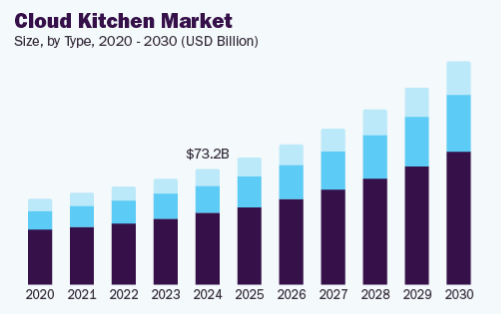
Look what I found: cloud kitchen platforms were valued at around $73.18 billion in 2024. It is projected to increase to around $154.9 billion by the end of 2032.
As we show, the above data that build a cloud kitchen platform like Kitchen United is one of the most lucrative opportunities for businesses.
In this blog, we will explore how to develop a cloud kitchen platform like Kitchen United and what core features and functions must be installed.
Let’s get started!
What Is Kitchen United?
Kitchen United offers shared, fully equipped kitchen rooms specifically for food delivery enterprises. These platforms allow restaurants, food brands, and delivery-only concepts to operate without the need for a physical dine-in facility.
Cloud kitchen app like Too Good To Go handle food preparation, delivery logistics, and order management, allowing enterprises to concentrate on cooking and expanding their operations. They optimize expenses and reach by linking to meal delivery apps, allowing firms to grow and serve more people.
- The platform combines innovative technology for order administration, kitchen operations, and delivery tracking to streamline the entire food preparation and delivery process.
- Kitchen United allows food enterprises to run numerous brands from a single kitchen, making it more cost-effective for operators to scale and test new concepts.
- The platform connects to prominent meal delivery services, providing a built-in network for seamless order fulfillment and delivery, allowing businesses to reach a larger audience without having to handle logistics themselves.
- Kitchen United offers cutting-edge kitchen facilities, including cooking equipment and storage, allowing food enterprises to focus on production without the cost of owning a kitchen area.
Market Analysis of Cloud Kitchen Platforms
- According to the global market, the cloud kitchen industry was worth $73.18 billion in 2024 and is expected to expand to $154.9 billion by the end of 2032.
- A survey found that Asia has the highest number of cloud kitchen platform users, with a 55% market share.
- According to a survey, 48% of the whole audience orders food from cloud kitchens or virtual eateries.
- According to the survey, the cloud kitchen platform market revenue is predicted to grow by 10% by the end of 2026.
- According to the global market, the cloud kitchen platform’s compound annual growth rate will accelerate to approximately 9% by 2032.
Top 10 Cloud Kitchen Platforms Like Kitchen United
These platforms provide businesses with shared culinary areas, delivery infrastructure, and technology solutions for scaling in the burgeoning food delivery market. Here, we provide the best food app ideas that help businesses to understand their functionality:
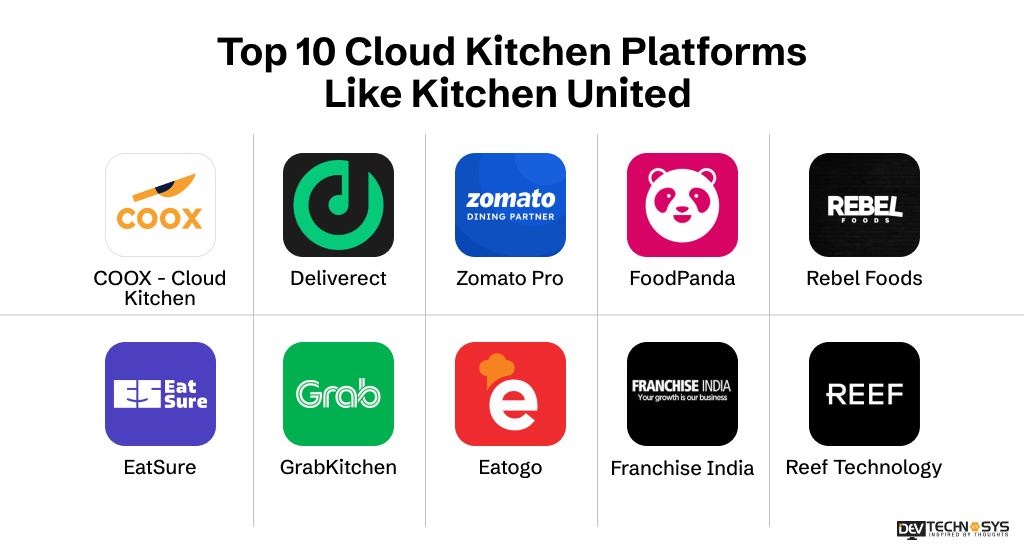
| App | Downloads | Ratings | Launch Year | Availability |
| Coox | 5K+ | 4.6 | 2019 | Android/iOS |
| Deliverect | 500K+ | 4.5 | 2018 | Android/iOS |
| Zomato Pro | 100M+ | 4.4 | 2018 | Android/iOS |
| FoodPanda | 100M+ | 4.2 | 2012 | Android/iOS |
| Rebel Foods | 100M+ | 4.2 | 2012 | Android/iOS |
| EatSure | 10M+ | 4.1 | 2019 | Android/iOS |
| GrabKitchen | 10M+ | 4.3 | 2018 | Android/iOS |
| Eatogo | 10M+ | 4.4 | 2013 | Android/iOS |
| Franchise India | 10M+ | 4.0 | 2006 | Android/iOS |
| Reef Technology | 50K+ | 3.9 | 2013 | Android/iOS |
Why Most Businesses Invest In The Cloud Kitchen Platform Like Kitchen United?
Most businesses invest in Kitchen United alternatives because they provide many important benefits that correspond with the growing demand for meal delivery services and the changing dynamics of the restaurant sector.
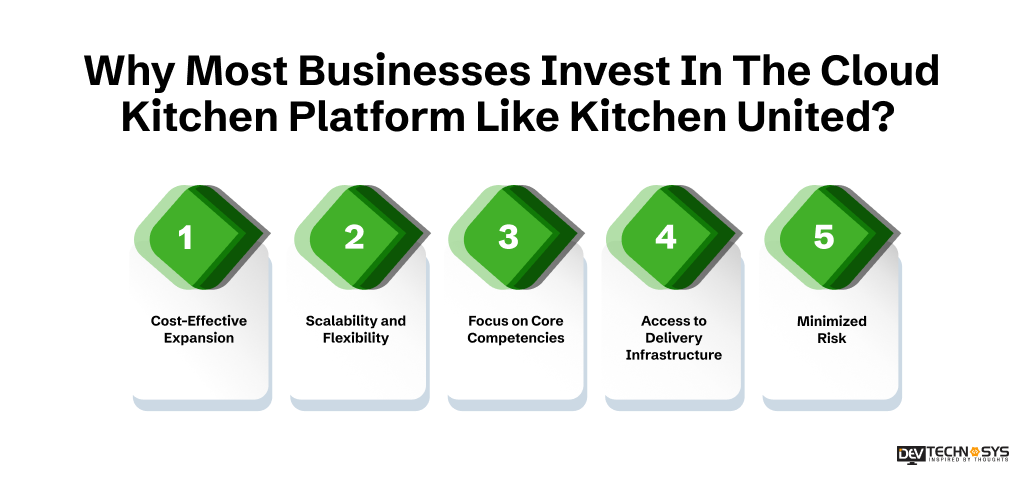
1. Cost-Effective Expansion
Traditional brick-and-mortar restaurants necessitate substantial investments in real estate, remodeling, staffing, and operational costs. Cloud kitchens, on the other hand, offer a shared kitchen infrastructure, removing the need for enterprises to invest in setting up their own kitchens.
This drastically reduces starting and operational expenses, making it a viable choice for both established restaurants and new food companies wishing to expand quickly.
2. Scalability and Flexibility
Cloud kitchen systems let organizations to scale quickly without being constrained by physical location. A restaurant may simply run various brands or menus from the same kitchen, resulting in better resource use and more efficient operations.
Cloud kitchen platform like Kitopi allows businesses to experiment with different food concepts, target new consumers, and test new ideas without incurring the costs of operating additional sites.
3. Focus on Core Competencies
By outsourcing physical kitchen operations and logistics to cloud kitchen platforms, food businesses can focus on what they do best: cooking delicious food and providing memorable brand experiences.
The cloud kitchen platform handles additional difficult areas, including kitchen administration, staffing, and delivery coordination, allowing businesses to streamline operations and save time on logistical challenges.
4. Access to Delivery Infrastructure
As meal delivery services gain popularity, businesses are more reliant on third-party applications such as Uber Eats, Grubhub, and DoorDash to reach clients. Top restaurant management software, such as Kitchen United, integrates with these delivery networks, giving businesses the infrastructure they need to manage orders efficiently and grow their client base.
This means that firms may capitalize on the expanding delivery sector without having to invest in their own logistics.
5. Minimized Risk
Cloud kitchens are a lower-risk option than traditional restaurants since they allow for the flexibility to increase operations and reduce upfront costs. This makes them particularly interesting to startups, investors, and entrepreneurs who want to test the viability of a concept in a low-cost setting before making significant investments.
How To Build A Cloud Kitchen Platform Like Kitchen United?
Building a cloud kitchen platform like Kitchen United requires a detailed roadmap, covering everything from market research to technology development, and efficient operational management. Below are the seven key steps to guide to start a cloud kitchen platform development process:
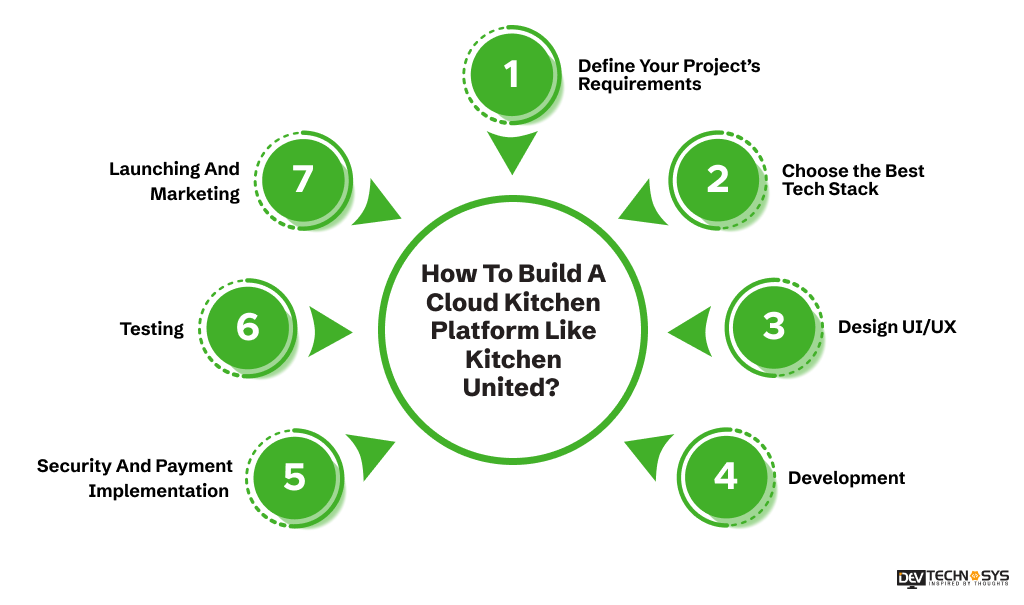
1. Define Your Project’s Requirements
Before starting development, conducting thorough market research is crucial to understanding the demand for cloud kitchens in your target area. Identify your target audience, customer preferences, and potential competition.
You need to decide on your revenue model—whether it will be based on a subscription fee from restaurants, a commission per order, or a combination of both.
| What are your project’s basic or core requirements? |
| Clear your future goals. |
| Which cloud kitchen platforms are more trending in this competitive market? |
2. Choose the Best Tech Stack
Selecting the right technology stack is key for the functionality and scalability of your cloud kitchen platform. Some important technologies to consider include: React, Angular, or Vue.js for creating dynamic user interfaces. Node.js, Ruby on Rails, or Django for robust backend solutions.
Hire dedicated developers that ensure high performance, scalability, and ease of integration with third-party services like delivery apps, payment gateways, and POS systems.
| Which type of tech stacks are used in your app development? |
| Define your scalability requirements. |
| Choose advanced or core tech stacks. |
3. Design UI/UX
The UI/UX design should prioritize ease of use for both restaurants and customers. For restaurant operators, the platform should provide easy access to order management, inventory tracking, and performance analytics.
For customers, the interface should be smooth, with an intuitive food discovery and ordering experience. Consider offering features like real-time order tracking, custom menus, and promotional banners.
| Choose the best user interface design. |
| Analyze the existing cloud kitchen platform design to get new design ideas. |
| Select the top designing tools, such as Adobe XD. |
4. Development
The backend of the cloud kitchen platform is the most complex part, as it will handle multiple integrations and processes. Key features to include in your backend development: A real-time system to handle incoming orders, track deliveries, and manage kitchen workflows.
Automated stock tracking, supply chain management, and integration with suppliers to ensure smooth kitchen operations.
| Do you want to create hybrid or native apps? |
| Choose the dedicated developers. |
| Implement a high number of features and functions. |
5. Security And Payment Implementation
Ensure seamless payment integration through trusted gateways like Stripe, PayPal, or regional payment solutions. Security is paramount, especially when handling sensitive data such as customer payment details.
Hire mobile app developers from an mobile app development company to implement encryption protocols, secure payment processing, and compliance.
| Make sure that all features and functions are working properly |
| Use various payment integration methods to increase flexibility. |
| Check the app’s security measurements. |
6. Testing
Before launching the platform, conduct extensive testing, including: Ensuring all features work as expected (order management, payment processing, inventory tracking). Test the platform under high loads to ensure it can handle spikes in traffic or orders, particularly during peak hours.
Optimize the platform to minimize latency, improve server response times, and ensure seamless user interactions.
| Test the app properly before publishing. |
| Use various testing methods such as unit and integration testing. |
| Fix the bug and errors that are found during testing. |
7. Launching And Marketing
Once the platform is ready, prepare for the launch by creating a marketing plan. Focus on digital marketing strategies, partnerships with food brands, influencer promotions, and social media campaigns.
Offer initial discounts or free trials to attract restaurant partners and customers. After launch, provide continuous support for troubleshooting and gather feedback from both restaurant operators and customers.
| Publish your app on selected platforms like Android and iOS. |
| Use the best marketing techniques. |
| Assign the post-maintenance phases to maintain the app’s performance. |

10 Must-Have Features of Cloud Kitchen Platforms
These characteristics allow cloud kitchens to run more efficiently, decrease expenses, and improve the entire customer and business experience, making them critical for a successful delivery-only food business.
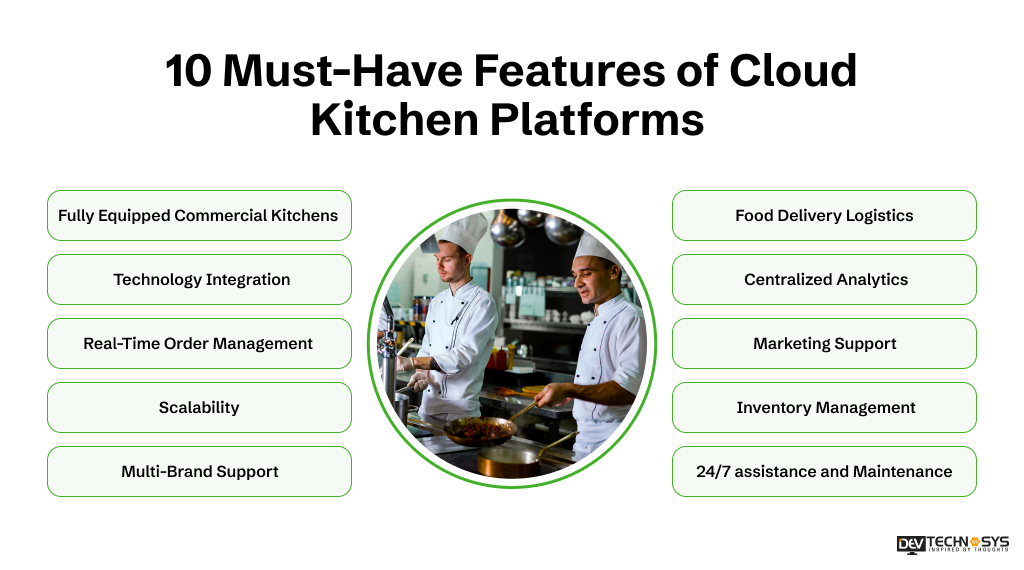
1. Fully Equipped Commercial Kitchens
Cloud kitchen software should offer high-quality, commercial-grade kitchen facilities, such as cooking equipment, storage, and prep rooms, allowing enterprises to concentrate on food production.
2. Technology Integration
A seamless integration with POS systems, order management platforms, and third-party delivery apps (such as Uber Eats and Grubhub) promotes smooth operations and improves order flow.
3. Real-Time Order Management
Kitchen United clone softwares handling orders in real-time, tracking deliveries, and offering operational insights is critical for improving kitchen productivity and reducing errors.
4. Scalability
Develop a restaurant waitlist app allow businesses to extend their operations, whether by expanding into new locations or launching numerous virtual restaurant brands from the same kitchen.
5. Multi-Brand Support
The white label cloud kitchen delivery platform is able to operate multiple food brands or concepts from a single kitchen. Each with its own menu and brand identity is critical for maximizing space and resources.
6. Food Delivery Logistics
An integrated delivery infrastructure that includes partnerships with popular food delivery services or in-house delivery solutions enables businesses to reach customers more efficiently.
7. Centralized Analytics
Build a food ordering application to display performance data like sales, inventory levels, and customer feedback; business executives can make data-driven decisions and enhance operations.
8. Marketing Support
Platform similar to Kitchen United should include marketing tools and support to help operators increase exposure, run promotions, and attract more customers to their brands.
9. Inventory Management
Kitchen United alternatives allow users to use proper inventory tracking, procurement systems, and automated stock alerts to help decrease waste, streamline supply chain management, and maintain food safety.
10. 24/7 Assistance and Maintenance
Kitchen United cloud kitchen platform offers continuous technical and operational assistance, which is critical for keeping the kitchen working effectively, resolving difficulties quickly, and providing uninterrupted service.
The Cost To Develop A Cloud Kitchen Platform Like Kitchen United
The cost to build a platform like Kitchen United varies greatly based on the platform’s complexity, functionality, and geographic location. The average restaurant mobile app development cost ranges between $8,000 to $25,000.
This covers the cost of software development (e.g., order management, POS systems, analytics), hardware (kitchen equipment and infrastructure), and delivery service integration. Additional expenses include operational setup, marketing, and legal fees, which can raise the total investment for a fully functional platform.
| Cloud Kitchen Platform Development | Estimated Cost | Time Frame |
| Basic Platform Development | $8000 – $12000 | 3 to 5 Months |
| Mid-Premium Platform Development | $12000 – $19000 | 5 to 8 Months |
| High-Premium Platform Development | $25000+ | 9+ Months |
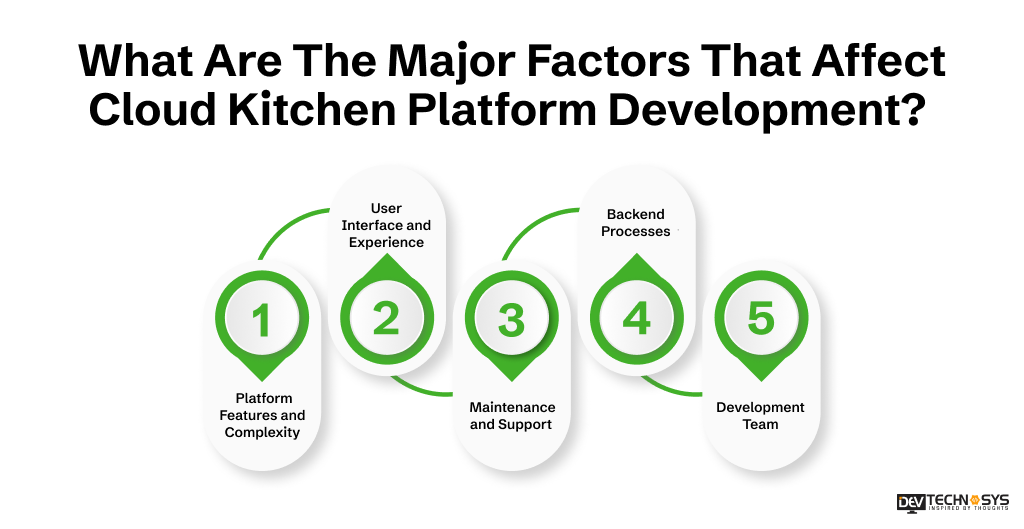
What Are The Major Factors That Affect Cloud Kitchen Platform Development?
Several main elements influence the creation of a cloud kitchen platform, affecting both its cost and usefulness. Understanding these components is critical for firms considering cloud kitchen software development.
1. Platform Features and Complexity
The platform’s features, such as order management, integration with POS systems, inventory tracking, kitchen operations, and real-time delivery management, can significantly impact food delivery app development costs and timelines.
Advanced features, such as multi-brand management, customer analytics, or AI-driven demand forecasting, can further complicate the development process.
| Features | Cost Estimation |
| Core Features | $8,000 – $12,000 |
| Advanced Features | $15,000 – $20,000 |
2. User Interface and Experience
The platform’s UI/UX design is critical to making it intuitive and usable for both restaurant operators and customers. A well-designed, easy-to-use interface improves efficiency and user satisfaction, but creating a seamless, adaptable design takes time and work.
| Design Quality | Cost Estimation |
| Basic Design | $8,000 – $12,000 |
| Complex Design | $15,000 – $22,000 |
3. Maintenance and Support
Post-launch maintenance and updates are critical for keeping the platform working successfully. Budgeting for continuous support is critical when determining the overall food truck website development cost and the long-term viability of a cloud kitchen delivery platform.
| Maintenance Phase | Cost Estimation |
| Simple Maintenance Phase | $2,000 – $4,000/year |
| Complex Maintenance Phase | $8,000 – $10,000/year |
4. Backend Processes
Scalability, real-time order processing, API interfaces, inventory management, security, and payment gateway systems are all impacted by backend development for cloud kitchen delivery platforms.
While secure transactions and managing heavy traffic during peak hours are critical for maximum performance, efficient database design, load balancing, and analytics are necessary for seamless operations.
| Backend Development | Cost Estimation |
| Basic Backend Process | $10,000 – $18,000 |
| Premium Backend Process | $20,000 – $28,000 |
5. Development Team
A cloud kitchen delivery platform’s development team usually consists of DevOps engineers, database administrators, UX/UI designers, backend developers, and frontend developers.
Each is essential to providing a high-performance cloud kitchen solution because it guarantees smooth integrations, safe transactions, effective order administration, user-friendly design, and scalability.
| Developer’s Location | Cost Estimation |
| Asia Pacific | $8,000 – $15,000 |
| North America | $15,000 – $20,000 |
| Eastern Europe | $13,000 – $18,000 |
| Western Europe | $16,000 – $25,000 |

5 Monetization Techniques of Cloud Kitchen Platforms
With the help of these monetization strategies, cloud kitchen ordering platforms can produce a variety of income streams and assist restaurant owners in effectively growing their enterprises. Cloud kitchen ordering platforms can optimize revenue through a variety of monetization strategies. Here are five essential tactics:

1. Subscription Model
For restaurant partners, cloud kitchen ordering platforms may use a subscription-based business model in which operators pay a set monthly amount to have access to the kitchen’s equipment, space, and technological infrastructure.
The platform receives steady, recurring revenue from this strategy. The subscription gives food businesses flexibility by adjusting according to the kitchen’s location, size, and number of brands using it.
2. Commission on Orders
Restaurants may be charged a commission by platforms such as Kitchen United for each order that is processed via the platform. This commission may take the form of a flat fee per order or a percentage of the order value.
According to the food donation app development company, this guarantees that the platform makes money when restaurants expand their delivery services.
3. Fee for Delivery and Logistics
A fee for handling delivery logistics is another source of income. This can entail providing internal delivery services or collaborating with outside delivery apps. Either a per-order fee or a tiered price structure depending on delivery volume, distance, or time can be applied by the platform to manage deliveries.
4. Marketplace for Food Brands
Platforms for cloud kitchens can establish a marketplace for food brands, enabling eateries or food entrepreneurs to test new ideas or introduce new brands without having to make large upfront investments.
In order to assist the brand become more visible, the platform may charge a fee for listing, branding, or marketing services, or it may take a percentage of sales from newly launched brands.
5. Analytics and Data Services
Cloud kitchens gather useful information on inventory usage, client preferences, and sales. By providing restaurant operators with insights and analytics services that help them optimize their menu selections, pricing policies, and customer interactions, platforms may make money off of this data.
As we discussed earlier with food delivery app development company, providing these insights as premium services, they can generate more income.
Read Also
A Complete Guide To Start A Cloud Kitchen In 2023
Major Steps To Build A Cloud Kitchen Platform Like Kitopi
Cloud Kitchen Management Software Development
Conclusion
In this blog, we explored the detailed information about how to build a cloud kitchen platform like Kitchen United and how it can be beneficial to businesses. Careful planning, strategic execution, and the appropriate technological stack are necessary when creating a cloud kitchen platform like Kitchen United. The procedure entails creating an effective, scalable backend to handle logistics, inventory, and orders while integrating with outside delivery services. Sustainable revenue streams are also offered via monetization techniques like commissions, subscription models, and data services.
Are you looking to create a cloud kitchen platform like Kitchen United? Then, consult with a custom cloud kitchen management software development company to receive highly developed solutions.
Frequently Asked Questions
Q1. How Much Does It Cost To Build A Cloud Kitchen Platform Like Kitchen United?
The Kitchen United cloud kitchen platform development costs range from $8,000 to $25,000. It depends on various factors such as features, functions, project’s complexity, and infrastructure.
Q2. How Long Does It Take To Make A Cloud Kitchen Platform Like Kitchen United?
It usually takes 6 to 12 months to build a cloud kitchen platform like Kitchen United, depending on the features, testing, integrations, and complexity needed. Depending on the resources and extent of work, timelines can change.
Q3. How Can I Make Money From My Cloud Kitchen Platforms?
There are many advanced money-making strategies that allow businesses to generate new revenue streams.
- Subscription Plans
- Freemium Model
- Advertising
- In-App Purchase
- Delivery Fees
Q4. Why Do Most Businesses Invest In Cloud Kitchen Platform Development?
Businesses invest in cloud kitchen platform development to reduce overhead, scale quickly, streamline operations, optimize delivery logistics, and tap into the growing demand for delivery-only services, all while minimizing upfront costs.