



















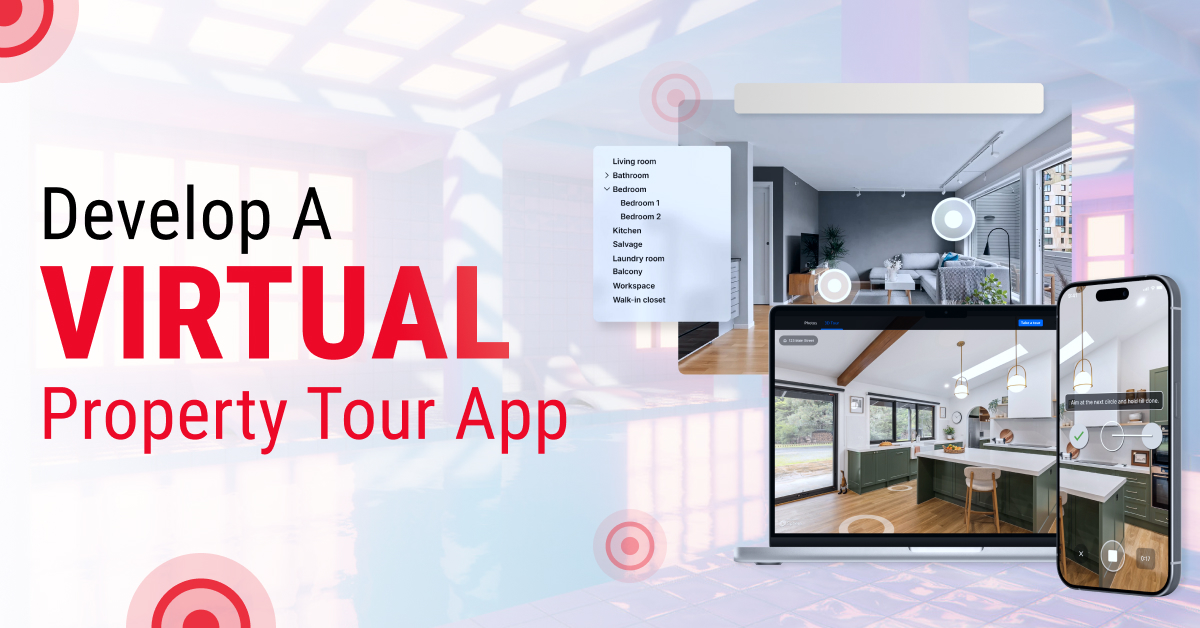
“Improve the experience of the users by gifting them a virtual property tour application.”
Are you in the real estate business, looking for a supervised solution? Then it is the right time for you to develop a virtual property tour app that collects all data and provides a 3D model for all surfaces. These applications are revolutionizing the real estate business allowing users to make wise decisions without any difficulty.
As an investor, it is necessary for you to know the current market of the real estate industry. You must get virtual property tour app development services that are affordable and provide quality. Additionally, there are a lot of things that you must understand before starting.
In this blog, we will see the process and the cost to build a virtual property tour app along with features, top brands, and monetization.
What is the Virtual Property Tour App?
Users can explore real estate listings using 360° photos, 3D walkthroughs, or augmented reality experiences with a real estate virtual reality app. By virtually simulating in-person visits, the virtual open house app facilitates effective communication between agents, renters, and buyers. Investment of money in real estate app development services is beneficial for businesses in the modern era:
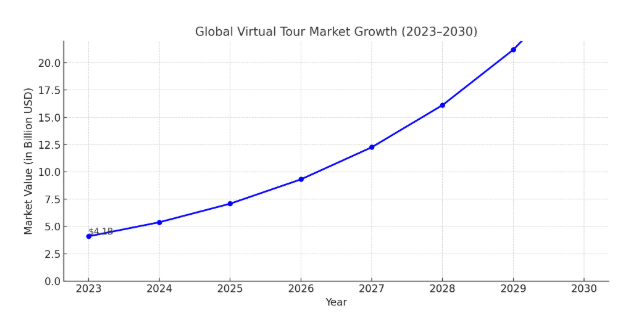
- The global virtual tour market was valued at $4.1 Billion in 2023.
- Expected to grow at a rate of 5% CAGR from 2024 to 2030.
- 68% of homebuyers prefer listings with virtual tours over static images.
- Real estate listings with virtual tours receive 87% more views than those without.
- The virtual real estate solutions market is projected to reach $19.8 Billion by 2030.
How Does a Virtual Property Tour App Work?
Through immersive 360° or 3D experiences, consumers can remotely browse real estate listings with a virtual home tour app. Its interactive and real-time capabilities expedite the process of finding a property:
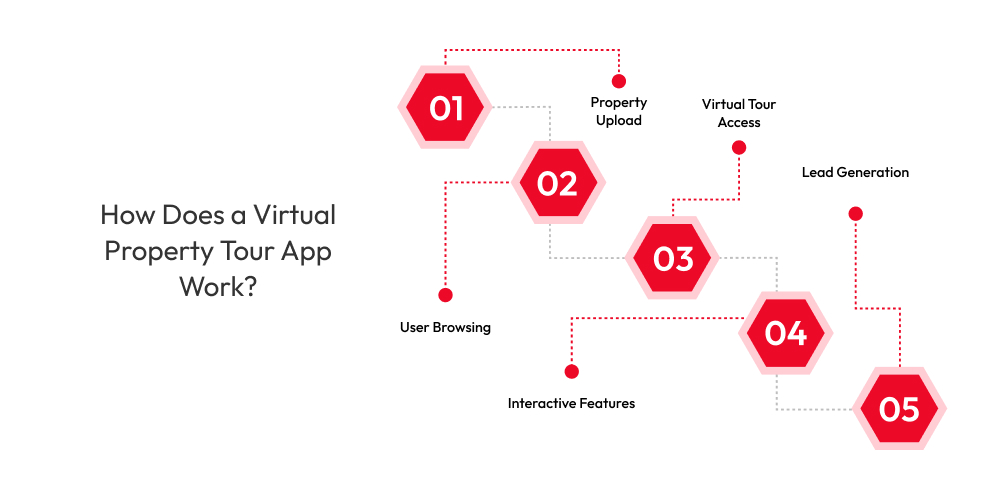
1. Property Upload
A virtual real estate tour app allows agents or owners to post virtual tour material, photos, and property details. After verification, listings are made available to users in the app’s database.
2. User Browsing
Using criteria like location, price, and kind, users peruse the available homes. You can create a mobile app with quick access to tour options and a clear UI being the features of the app.
3. Virtual Tour Access
You can make a virtual property tour app allowing users to begin a 3D or 360° tour of the property. With its expansive vistas and seamless movement, the tour replicates an in-person visit.
4. Interactive Features
The app might have voice overs, agent chat, room measurements, and hotspot navigation. Businesses should build an app like Rightmove to improve decision-making and user engagement.
5. Lead Generation
Through chat or integrated forms, interested consumers can arrange visits or get in touch with agents directly. For follow-up and conversion, you can provide virtual tours and 3D visualisation in real estate.
Benefits of Developing Online Property Tour Apps
Entrepreneurs can build a virtual property tour app which provides convenient, and immersive property viewing experiences. They simplify the purchasing and rental process and increase engagement:
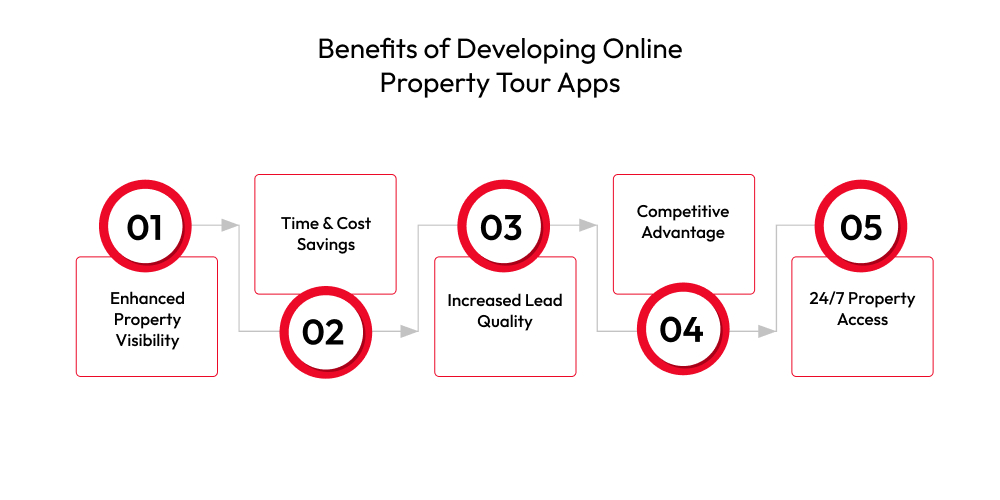
1. Enhanced Property Visibility
Businesses build apps for virtual tours that display properties to a wider audience through real estate AR/VR app development services. Interactive tours increase the number of views and user interest in listings. Better exposure and quicker reactions result from this.
2. Time & Cost Savings
You can create a virtual property tour app that reduces site visits and saves time. Sellers use Android application development services with digital elements to cut marketing expenses. For everyone concerned, it reduces travel and schedule difficulties.
3. Increased Lead Quality
Users can pre-qualify properties using virtual tours, which include comprehensive information and images. Conversion rates are increased with management of the cost to develop a virtual property tour app. This separates serious prospects from casual browsers.
4. Competitive Advantage
A real estate business differentiates from traditional listings by developing a high-tech 3D property tour application. It draws in tech-savvy customers and creates a contemporary company image. Maintaining a competitive edge with home service app development services guarantees market relevance.
5. 24/7 Property Access
Regardless of time zone or location, potential buyers can view properties at any time. This 24/7 accessibility improves user engagement and convenience. Additionally, the use of virtual property tour app development services speeds up the decision-making process.
What is the Use of AI in Virtual Property Tour App Development?
By providing more intelligent, individualized, and effective user experiences, artificial intelligence (AI) improves virtual property tour applications. Use of AI in the real estate industry changes people’s search, exploration, and interaction with properties. Businesses can increase user engagement and real estate conversion rates through virtual property tour app development services:
- Recommends properties based on user preferences and browsing behavior.
- Enhances 3D tour quality using image recognition and optimization.
- Automates property tagging and content descriptions from visuals.
- Provides chatbots for instant user assistance and scheduling.
- Analyzes user engagement to optimize tour layouts and features.
How to Make Virtual Real Estate Tour Applications?
Now, it becomes necessary for a business investor to develop a virtual property tour app for user satisfaction. Here, we will understand the fundamental development stages in detail:
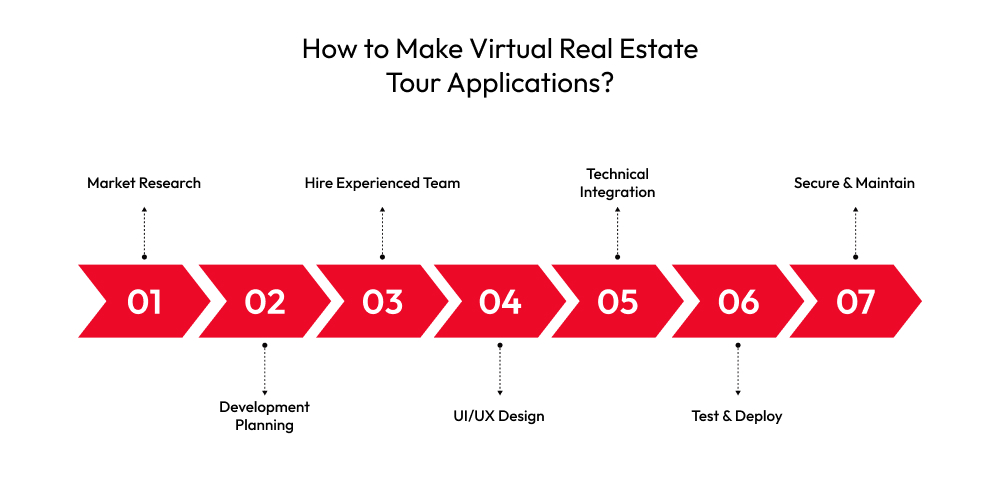
1. Market Research
Analyze your target audience’s preferences and problems to build a virtual property tour app. You must study rivals and trends in real estate technology to get real estate IT solutions. Recognize the features that people anticipate, such as interactive maps, 360° views, and AR/VR integration.
To present your app in a distinctive way, find holes in the current offerings. Compile information on monetization tactics, platforms, and device usage.
- Who is the primary target audience?
- What features do users expect?
- How are competitors in the market?
2. Development Planning
Make a thorough roadmap that describes the functionality, architecture, and technology stack of the application. Describe essential features including communication tools, search filters, tour engines, and property uploads to decrease the cost to create a virtual property tour app.
Determine the project’s scope before allocating funds, schedules, and resources. Give MVP features priority over upcoming releases.
- What platforms should the app support?
- What will be the core features for the MVP?
- What is the estimated budget for app development?
3. Hire Experienced Team
You must hire a knowledgeable team from a reputed real estate application development company that includes QA testers, AR/VR experts, and project managers. Seek out developers who have worked with virtual tour software or real estate. Make sure the group is skilled in scalable backend systems.
Depending on your budget, think about working with an agency to make a virtual property tour app. Hiring decisions should be based on IT expertise, communication, and dependability.
- Should I hire freelancers or outsource to an agency?
- What technical skills should the developers possess?
- How will the team communicate during the project?
4. UI/UX Design
Create a user-friendly and visually appealing interface that improves interaction and navigation. Make sure that contact details, search criteria, tours, and classifieds are all easily accessible. Contact a virtual property tour app development company to use responsive design so that it works on all devices.
Keep users’ attention on properties by using rich images and simple layouts. With seamless transitions and simple controls for virtual tours, you can create an immersive experience.
- How can the interface provide virtual tour experiences?
- What visual elements enhance user engagement?
- How can the design accommodate both buyers and agents?
5. Technical Integration
Put in place database administration, backend technologies, and APIs to provide content distribution, user accounts, and listing uploads. For immersive tours, incorporate 3D model viewers, 360° video players, or AR/VR engines by using virtual tour app development services.
For improved usefulness, use AI development services to include chatbots, analytics tools, GPS, and mapping. Assure scalable server architecture and safe cloud storage.
- What tech stack will support the app features?
- Which APIs will be needed for maps or payments?
- How will backend systems handle large multimedia files?
6. Test & Deploy
Test devices and operating systems to find and address bugs, lags, and compatibility problems. To verify responsiveness, correctness, and UI flow, conduct usability testing within the virtual tour real estate app development services. Test database functionality, security levels, and API integrations.
After the app passes quality assurance testing, launch a virtual property tour app to make it available online. After launch, keep a tight eye on consumer feedback.
- What types of testing will be conducted?
- How will real estate agents provide feedback?
- What is the deployment plan for app stores?
7. Secure & Maintain
Update the app frequently to add features, fix bugs, and support new devices with real estate VR app development services. Put secure login procedures, SSL encryption, and data privacy compliance into practice. Keep an eye on user behavior and performance indicators to spot areas for improvement.
Provide avenues of help to address user problems with the help of on demand app development solutions. App stability, security, and relevancy are guaranteed by routine maintenance.
- What security measures will protect user data?
- How frequently will updates be released?
- What is the plan for customer support?
Exciting Features of Digital Home Tour Apps
Businesses must create a real estate mobile app that includes interactive and engaging features. These characteristics streamline real estate experiences, improve engagement, and make decision-making easier:
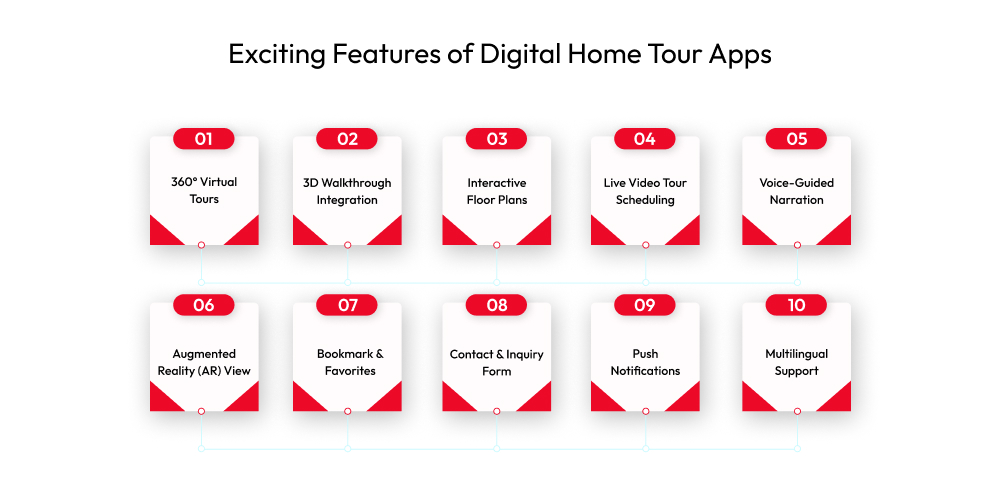
1. 360° Virtual Tours
Users can explore every angle of a property with panoramic 360° views. It is beneficial to build real estate apps like Zoopla that provide a realistic and immersive experience similar to visiting in person.
2. 3D Walkthrough Integration
Enables users to navigate through a 3D-rendered version of the home. You can create a real estate virtual walkthrough that offers a detailed, room-by-room journey and better spatial understanding.
3. Interactive Floor Plans
A 360 virtual tour real estate app allows users to view floor layouts with clickable hotspots to jump into specific rooms. It helps visualize dimensions, flow, and functionality of the property.

4. Live Video Tour Scheduling
This feature allows users to book real-time guided video tours with agents. It provides virtual 3D tours for real estate and personalized walkthroughs of the property.
5. Voice-Guided Narration
Audio guides provide property descriptions and highlight features during the tour. So, you should build real estate apps like Zillow that enriches the user experience and mimics a professional agent’s briefing.
6. Augmented Reality (AR) View
AR lets users create a virtual tour for real estate or decor into the property using their device camera. It offers a futuristic, personalized way to envision living in space.
7. Bookmark & Favorites
A remote property tour app allows users to save properties they like for later review or comparison. This makes property hunting more organized and efficient.
8. Contact & Inquiry Form
Built-in forms allow instant communication with property agents or sellers. You can develop an app like Realtor that simplifies lead generation and follow-up processes.
9. Push Notifications
A 3D virtual property tour app notifies users about new listings, price drops, or scheduled tours. Keeps them engaged and updated in real-time.
10. Multilingual Support
Businesses can create a virtual home tour app that offers support for multiple languages for a wider audience reach. It enhances accessibility and user satisfaction globally.
Top 10 Virtual Property Tour Applications
By facilitating remote property exploration, virtual property tour applications have transformed the real estate sector. Businesses are investing money to develop a virtual property tour app to improve the rental experience. These ten platforms are at the forefront of this digital revolution:
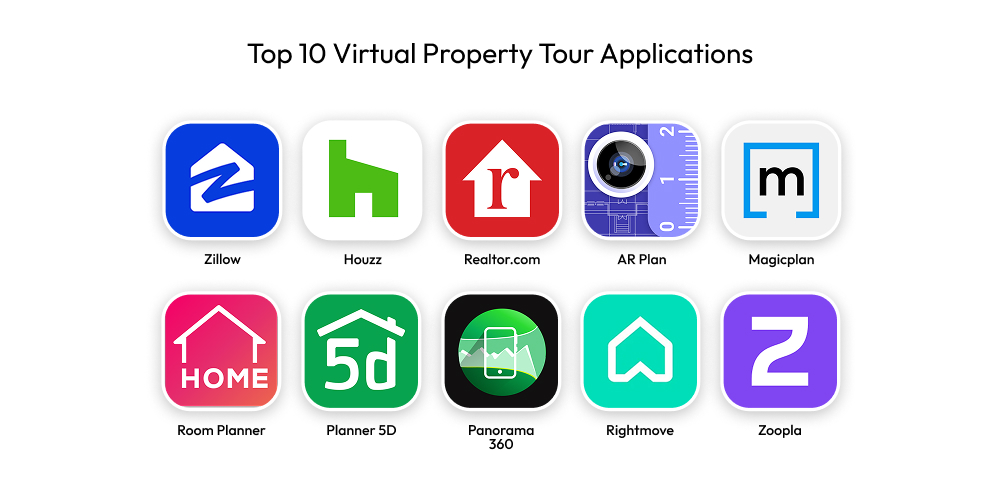
Top 10 Virtual Property Tour Apps |
Supported Devices |
Downloads |
Ratings |
| Zillow | Android|iOS | 50M+ | 4.7 |
| Houzz | Android|iOS | 10M+ | 4.7 |
| AR Plan | Android|iOS | 10M+ | 4.4 |
| Realtor.com | Android|iOS | 10M+ | 4.4 |
| magicplan | Android|iOS | 10M+ | 4.3 |
| Room Planner | Android|iOS | 10M+ | 4.1 |
| Planner 5D | Android|iOS | 10M+ | 3.8 |
| Panorama 360 | Android|iOS | 10M+ | 3.7 |
| Rightmove | Android|iOS | 5M+ | 4.7 |
| Zoopla | Android|iOS | 5M+ | 4.5 |
Tech Stack Used to Develop a Virtual Property Tour App
It takes a mix of front-end, back-end, and iOS app development services for real estate visualization app development. High-quality virtual experiences, scalability, and seamless performance are guaranteed by real estate visualization technology. A table detailing important elements and their uses may be found below:
Component |
Application |
| React Native / Flutter | Cross-platform mobile app development for iOS and Android |
| Unity / Unreal Engine | Creating immersive 3D environments and virtual tours |
| Three.js / WebGL | Rendering 3D models and 360° views in web applications |
| Node.js / Django | Backend development for handling APIs, data, and user management |
| PostgreSQL / MongoDB | Database management for storing listings, user data, and media assets |
| AWS / Google Cloud | Cloud infrastructure for hosting, storage, and scalability |
| Firebase | Real-time data sync, push notifications, and authentication |
| Stripe / Razorpay | Secure in-app payment processing for subscriptions or listings |
| Mapbox / Google Maps API | Displaying property locations and geographic data |
| Socket.io / WebRTC | Enabling real-time chat and live video tours between users and agents |
What is the Virtual Property Tour App Development Cost?
The cost to develop a virtual property tour app is depending on a number of factors. Every component like the location of your development team or the platform and complexity of the program affects the virtual property tour app development cost. Let’s understand these factors:
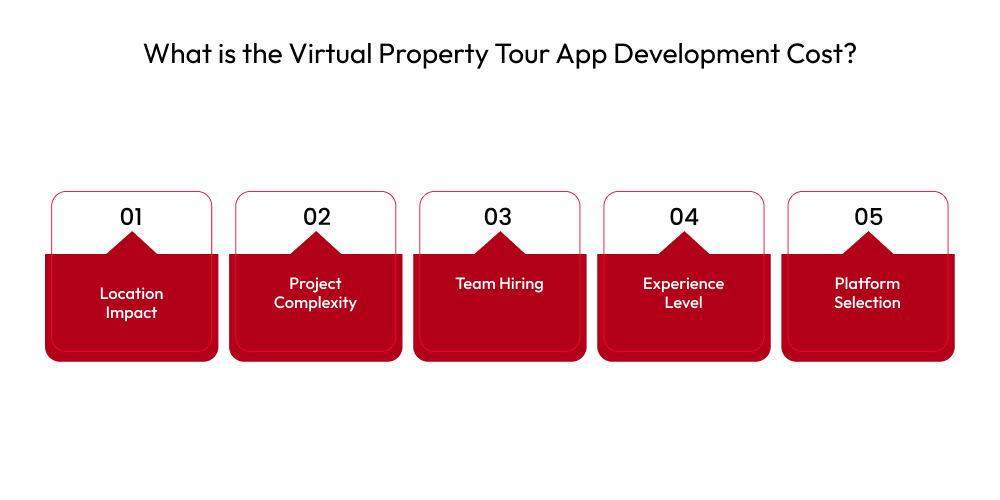
1. Location Impact
The cost to build a virtual property tour app gets affected with Western Europe and North America having greater rates than Asia or Eastern Europe. Costs can be greatly decreased by outsourcing to nations like India or Ukraine. But communication and time zone differences should also be taken into account.
Location Impact |
Estimated Cost |
| USA | $25000-$30000 |
| Australia | $20000-$25000 |
| India | $5000-$12000 |
| UK | $15000-$20000 |
| UAE | $8000-$15000 |
| Brazil | $12000-$16000 |
2. Project Complexity
A real estate app with panoramic view is less expensive than those with AI, AR, and 3D walkthroughs. More advanced tech stacks are needed for more complicated functionalities. The cost of real estate app development is further raised by data management, backend infrastructure, and customization.
Project Complexity |
Development Time |
Estimated Cost |
| Simple | 2-5 months | $5000-$10000 |
| Moderate | 5-8 months | $10000-$15000 |
| Complex | 8-12 months | $15000-$20000 |
| Premium | More than 12 months | $20000-$25000 |

3. Team Hiring
The virtual property tour app development cost is impacted when a freelance developer, internal team, or outsourcing firm is hired. Freelancers are less expensive but less scalable than agencies, who may charge more yet provide full service packages. Pricing is also influenced by team size and experience.
Team Hiring |
Estimated Cost |
| In House Team | $5,000-$8,000 |
| Full-Time Freelancers | $3,500-$5,000 |
| Developer Outreach | $8,000-$15,000 |
4. Experience Level
An app for remote property viewing is expensive due to highly skilled developers or agencies charging extra money. They offer improved quality, dependability, and speed of execution. Teams delivering a low real estate website development cost have performance and delivery issues.
Experience Level |
Cost Estimation |
| Junior/Entry-Level | $8000-$12000 |
| Mid-Level/Experienced | $12000-$16000 |
| Senior/Expert | $16000-$20000 |
| Professional | $20000-$24000 |
5. Platform Selection
The virtual property tour app cost is higher when developing for both iOS and Android than when launching on just one platform. Cross-platform alternatives like Flutter or React Native are less expensive than native apps. The decision should be in line with your target market and financial limitations.
Platform Selection |
Estimated Cost |
| Native App | $10,000-$15,000 |
| Flutter App | $15,000-$18,000 |
| Hybrid App | $18,000-$20,000 |
How to Monetize a 3D Home Tour Application?
A property listing app with virtual tours can make money using a variety of monetization strategies. These tactics provide value to stakeholders while maintaining app growth:
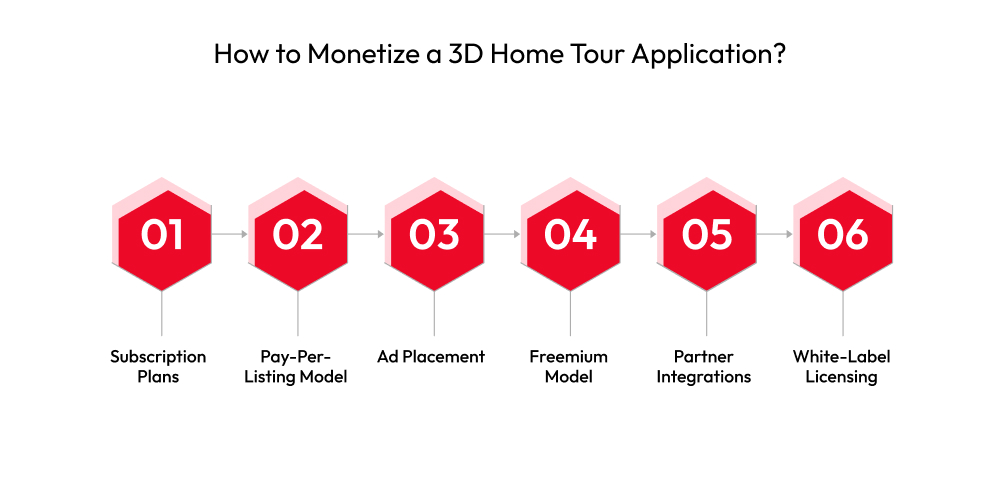
1. Subscription Plans
A 360-degree property tour app provides realtors and agencies with tier-based memberships. Premium services including limitless listings, advanced analytics, and priority support are available with real estate application development services. This guarantees consistent recurring revenue.
2. Pay-Per-Listing Model
Users should be charged to upload a 3D tour of each property. Smaller agencies with fewer listings or infrequent customers would benefit greatly from this model. The use of virtual real estate tour app development services permits monetization per transaction and provides flexibility.
3. Ad Placement
A VR app for real estate includes native or banner advertisements from real estate companies or third-party ad networks. You can advertise home services or display adverts about real estate. This is the future of VR and AR that generates passive income without requiring direct payments from end users.
Pick what you need below — you can select more than one — then tap Get detail to continue.Want a chatbot demo or pricing? Fill the form and talk to our experts today.
Chatbot demo dashboard
Cost to develop an app
Industry report
Case study
4. Freemium Model
Give users free access to the most basic functions, with the option to upgrade to more advanced tools. 3D editing, branded tours, and comprehensive analytics helps in balancing the cost to build a virtual property tour app Over time, this draws in a large user base and turns into valuable clients.
5. Partner Integrations
An augmented reality real estate app provides in-app promotion allowing businesses to team up with home improvement companies and interior designers. These collaborations produce set ad fees or referral commissions. By using mobile app development services, you can generate additional revenue.
6. White-Label Licensing
Give other real estate companies or platforms permission to use your app’s technologies under their name. This broadens your reach and brings in a sizable amount of B2B revenue. It’s a scalable method of making money that helps in balancing the cost to make a virtual property tour app.
In a Nutshell!!
We understand that as a business investor, you are concerned about the cost to develop a virtual property tour app. But, through this blog, you can easily manage your budget and development resources. It is mandatory to focus on some major points:
- Observe existing virtual property tour app development solutions.
- Contact a reliable mobile app development agency ensuring the availability of tools and technologies.
- You must create a virtual property tour app by following a unique development approach.
- The virtual house tour app development cost is managed by implementing monetary methods.
These points will help entrepreneurs to gather people in large numbers that will result in revenue generation and business growth.
FAQs
Q1. Which Virtual Home Tour Apps are Widely Used in the USA?
In the United States, Matterport, Realtor.com, and Zillow 3D Home are well-known virtual home tour applications. These platforms provide immersive property views, interactive floor plans, and 360° walkthroughs.
Q2. How Long Does it Take to Develop a Virtual Property Tour App?
Usually, it takes 4 to 6 months to develop a feature-rich virtual property tour application. The intricacy of elements like backend development, AR integration, and 3D tours determines timelines. For quicker market launch, MVPs with limited functionality can be created in 8–12 weeks.
Q3. How to Reduce the Virtual Property Tour App Development Cost?
- Start building core features.
- Use third-party tools to avoid complex features.
- Outsource experienced developers to get high-quality work.
Q4. What is the Rate of Hiring Property App Developers?
Hiring property app developers often costs between $10 and $60 per hour. Developer experience, geography, and technology stack all affect rates. There are also fixed-price models for short-term, clearly defined projects.
Q5. What is the Maintenance Cost of 3D House Tour Apps?
Annual maintenance expenses usually fall between 15% and 20% of the initial development cost. This covers bug patches, upgrades, server costs, and the addition of new features. Apps that use cutting-edge technology, such as AR or 3D modeling, can require a little more maintenance.
Q6. Are Digital Property Apps Accurate and Secure?
Yes, high-precision 3D scanning and GPS tagging are used by contemporary digital property apps to ensure visual accuracy. Data encryption, safe login procedures, and adherence to privacy regulations all contribute to security.