
























Deploying a smart contract on a blockchain enables automation of a specific program.
The blockchain type determines the cost of deploying a smart contract.
On Ethereum, the gas fees, which are transactional costs on the network, are accessed to pay network users.
The complexity of the smart contract determines the amount of gas consumed, increasing the cost.
Smart contracts can cost a few dollars or more, depending on the network congestion.
Thus, planning the deployment of smart contracts is essential, as is checking gas prices to reduce unnecessary expenditure.
In this blog, we will explore how much it cost to deploy a smart contract and other related information.
Let’s start!
What is a Smart Contract?
The smart contract is a self-executing digital agreement that is stored on the blockchain. It is directly written into a code in blockchain; this code is executed when the predefined conditions are met without the need for intermediaries or humans.

It makes transactions more secure, accurate, transparent, and tamper-proof, this is making them ideal for supply chain, finance, transactions, and other applications. The smart contracts offer various functionalities or benefits such as security, reducing cost, automation, and efficiency.
What is the Cost to Deploy a Smart Contract?
The cost to deploy a smart contract is around $8,000 to $25,000 or depending on various factors. It involves a wide variety of factors such as blockchain networks, project complexity, network fees, gas fees, and more.
There are also additional factors that include development, security measurements, testing, and more. More premium smart contracts that require a higher storage area automatically lead to a higher cost. So, here we provide the detailed table to get the estimated cost:
Smart Contract Type |
Complexity |
Estimated Deployment Cost |
| Simple Contract (e.g., basic token) | Low | $8,000 – $10,000 |
| Standard Contract (e.g., NFT or DeFi contract) | Medium | $10,000 – $15,000 |
| Advanced Contract (multi-function, high storage) | High | $15,000 – $20,000 |
| Enterprise-Level Contract (complex integrations, audits) | Very High | $20,000 – $25,000 |
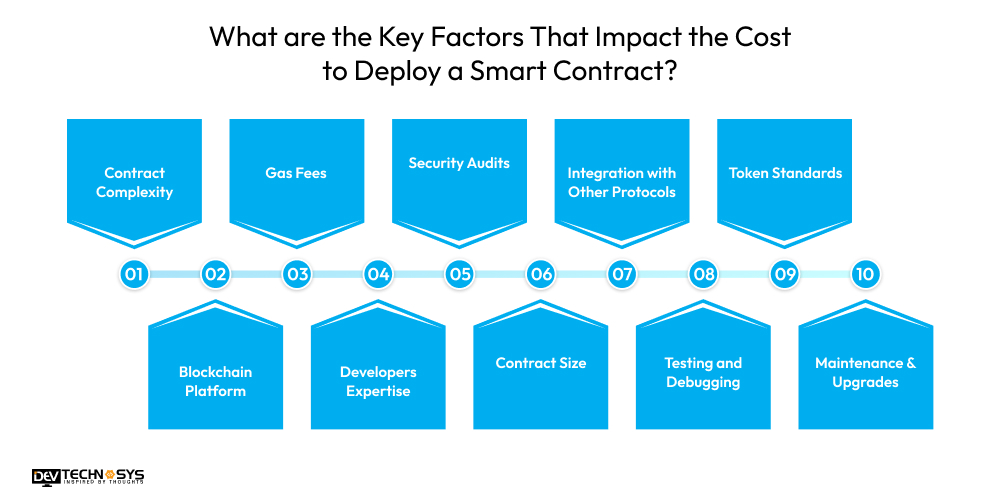
What are the Key Factors That Impact the Cost to Deploy a Smart Contract?
To maintain the fixed budget of deployment, you need to observe these key factors that can affect deploy Ethereum smart contract cost. Let’s figure out the major factors affecting smart contract cost:
1. Contract Complexity
Contract complexity is one of the most common and well-known factors that can easily influence the total smart contract creation cost. The complex smart contract includes logic layers, integration, and multiple functions; this requires more development time, security auditing, and testing. Create a Smart contracts like ERC-20 tokens with simple functionality can be built at a lower cost.
Level |
Description |
Estimated Cost Range (USD) |
| Simple | Basic ERC-20 or time-lock contract | $8,000 – $10,000 |
| Moderate | NFT, staking, or simple DeFi logic | $12,000 – $17,000 |
| Complex | Multi-feature DeFi, DAO, or multi-contract system | $18,000 – $25,000 |
2. Blockchain Platform
There is a wide range of blockchain networks for smart contract deployment. If businesses deploy smart contracts on Ethereum, then it will be expensive and it has higher gas fees as compared to others like Polygon and Binance Smart Chain.
So, choosing a blockchain platform depends on personal preferences, and each blockchain platform has different security audits and transaction speed. At last, some premium blockchain networks can increase the cost to create a smart contract.
Platform |
Typical Network Fees |
Estimated Total Cost (USD) |
| Polygon / BNB Chain | Low gas, fast deployment | $8,000 – $11,000 |
| Avalanche / Fantom | Moderate gas, balanced cost | $11,000 – $15,000 |
| Ethereum Mainnet | High gas, strong security | $15,000 – $23,000 |
3. Gas Fees
Gas fees are also known as transaction costs. These fees are based on the blockchain network because each network has different fees. Especially on the Ethereum network, it charges higher gas fees, which can directly impact the cost to build a smart contract. Optimizing smart contract code to use less gas and deploying during off-peak network hours can help reduce the overall cost to create a smart contract.
Network Load |
Description |
Estimated Gas Portion of Cost |
| Low Congestion | Off-peak hours | +$100 – $300 |
| Average Load | Regular hours | +$300 – $800 |
| High Congestion | Peak network traffic | +$800 – $1,500 |
4. Developers Expertise
Moving to the fourth factor, blockchain developers’ expertise and living location can also impact the blockchain app development cost. If developers have more experience and a rich skill set, then they can demand higher salary packages, but they deliver secure, scalable, and reliable smart contracts. Lesser-experienced developers can be available at a cheaper cost, but they can lead to bugs and vulnerabilities.
Expertise Level |
Quality / Risk Level |
Estimated Development Cost (USD) |
| Junior Developer | Basic quality, higher risk | $6,000 – $9,000 |
| Mid-Level Developer | Reliable, standard efficiency | $9,000 – $13,000 |
| Senior / Specialized Developer | Highly optimized, secure code | $14,000 – $20,000 |
5. Security Audits
Security audits are crucial to identify vulnerabilities in a smart contract before deployment. Professional auditing firms or experts analyze the code, ensuring it’s secure against hacks and exploits.
Audit costs vary depending on contract complexity and firm reputation. While optional, audits are highly recommended, as they can prevent potential financial losses and boost investor confidence in your blockchain project.
Audit Depth |
Scope |
Estimated Audit Cost (USD) |
| Basic Internal Review | Automated tools only | $1,000 – $3,000 |
| Standard Third-Party Audit | Manual + tool verification | $3,000 – $7,000 |
| Enterprise-Grade Audit | Multi-round, top audit firms | $8,000 – $12,000 |

6. Contract Size
Larger smart contracts consume more blockchain storage and computational power, increasing smart contract development costs. Every line of code adds to the byte size, directly affecting the gas needed for deployment.
Developers often optimize code to minimize size without losing functionality. Keeping contracts lean not only reduces gas fees but also improves efficiency, making them easier to maintain and upgrade in the future.
Code Size |
Lines of Code (Approx.) |
Impact on Total Cost (USD) |
| Small | Under 500 lines | $8,000 – $10,000 |
| Medium | 500 – 1,000 lines | $10,000 – $14,000 |
| Large | 1,000+ lines | $15,000 – $20,000 |
7. Integration with Other Protocols
The smart contracts interact with various protocols such as oracles, decentralized exchanges, liquidity pools, and more. Each third-party integration needs extra development time, add coding, integrate security audits, testing, and more; these can increase the cost to deploy a smart contract.
These integrations enhance functionality but demand higher development effort and auditing, raising the overall cost to develop a smart contract.
Integration Level |
Example |
Estimated Added Cost (USD) |
| Basic | Minimal or none | +$0 – $1,000 |
| Moderate | Using oracles or external APIs | +$1,000 – $3,000 |
| Advanced | Multiple DeFi or NFT protocol links | +$3,000 – $6,000 |
8. Testing and Debugging
In this cost-effective factor, testing must be conducted before deploying the smart contract to make sure that all functionalities and services are working correctly. Developers use tools like Hardhat, Truffle, and more to find bugs or glitches and solve them as soon as possible.
The debugging can reduce the post-deployment risks, future costs, and more. Some of the testing techniques are paid, which is why it raises the overall Binance Smart Chain development cost.
Testing Scope |
Coverage |
Estimated Cost (USD) |
| Basic Unit Tests | Core functions only | $500 – $1,500 |
| Standard QA Testing | Functional + integration tests | $1,500 – $3,000 |
| Extensive Simulation | Fuzzing, stress, and security tests | $3,000 – $5,000 |
9. Token Standards
The token standard you choose, such as ERC-20, ERC-721, or ERC-1155, affects cost and complexity. ERC-20 contracts are simpler and cheaper to deploy, while ERC-721 (NFTs) and ERC-1155 (multi-token) contracts require additional functionality, raising the cost to launch a smart contract.
Selecting the right standard based on your project’s goals ensures cost efficiency, scalability, and compatibility within the broader blockchain ecosystem.
Token Type |
Use Case |
Estimated Cost (USD) |
| ERC-20 | Fungible token | $8,000 – $10,000 |
| ERC-721 | Non-fungible (NFT) | $10,000 – $14,000 |
| ERC-1155 | Multi-token system | $14,000 – $18,000 |
10. Maintenance & Upgrades
In the last cost-affecting factor, maintenance and upgrades are a must to maintain the actual performance and speed of the smart contract. It includes various maintenance services such as fixing bugs or glitches, design enhancements, regular backups, updating outdated features, and more.
Upgradeable contract patterns like proxy contracts can increase accessibility and flexibility, but they can raise the cost of smart contract development services.
Maintenance Level |
Frequency |
Annual Cost Estimate (USD) |
| Minimal | One-time fixes only | $500 – $1,000 |
| Moderate | Quarterly checks & patching | $1,000 – $3,000 |
| Extensive | Continuous monitoring & upgrades | $3,000 – $6,000 |
You can reach out anytime; we are available 24/7. Our team provides a quick response.

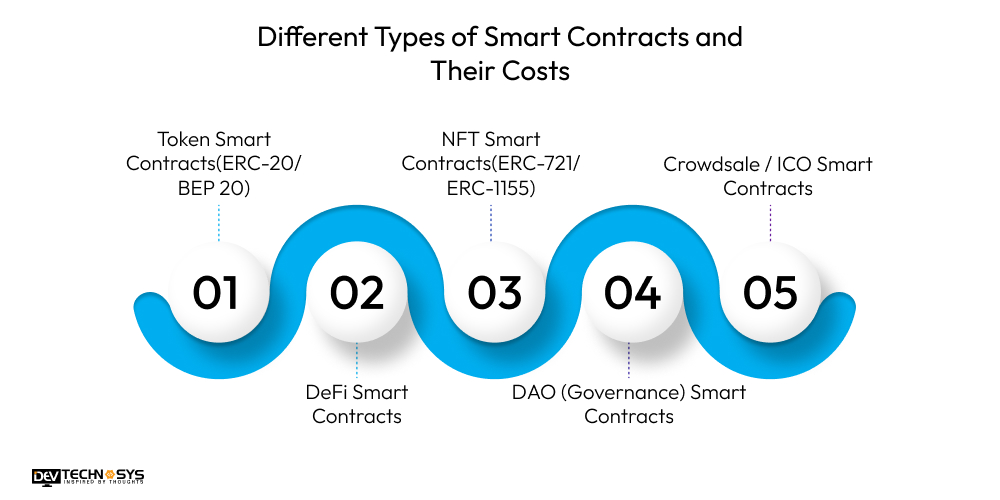
Different Types of Smart Contracts and Their Costs
Do you want to develop a smart contract like existing ones? But you are aware of these smart contract types. No need to go anywhere. Here we provide the different types of smart contract and their cost.
1. Token Smart Contracts(ERC-20/BEP 20)
The token smart contracts can easily make and manage the fungible digital assets on the blockchain network. If businesses create ERC-20 tokens, then these smart contracts ensure secure, transparent, and automated transactions without any third-party involvement. It is mainly used for cryptocurrencies, DeFi platforms, and reward systems.
Level |
Description |
Estimated Cost (USD) |
| Basic | Simple ERC-20/BEP-20 token with basic transfer and balance functions | $8,000 – $10,000 |
| Standard | Adds minting, burning, pausing, and ownership control | $10,000 – $13,000 |
| Advanced | Includes staking, vesting, governance, or upgradeable logic | $13,000 – $17,000 |
2. DeFi Smart Contracts
The DeFi smart contracts automate decentralized operations like yield farming, borrowing, lending, staking, and more. They can remove intermediaries like banks and streamline these financial operations on a blockchain network. These contracts ensure 100% accuracy and transparency in the digital finance ecosystem.
Level |
Description |
Estimated Cost (USD) |
| Basic | Single staking or liquidity pool with a reward mechanism | $12,000 – $15,000 |
| Standard | Multi-token yield farming and automated rewards | $15,000 – $20,000 |
| Advanced | Complex lending, borrowing, or a DAO-integrated protocol | $20,000 – $25,000+ |
3. NFT Smart Contracts(ERC-721/ERC-1155)
NFT smart contracts enable the management and creation of unique and fungible digital assets that represent art, in-game items, and collectibles. Businesses can also create an ERC-721 token, which enables them to ensure authenticity and rarity. They can power marketplaces and an NFT ecosystem using blockchain standards.
Level |
Description |
Estimated Cost (USD) |
| Basic | Simple NFT minting and transfer functions | $9,000 – $12,000 |
| Standard | Adds metadata, royalties, and minting controls | $12,000 – $16,000 |
| Advanced | Multi-token (ERC-1155), batch minting, marketplace integration | $16,000 – $22,000 |
4. DAO (Governance) Smart Contracts
DAO smart contracts offer highly automated decision-making and fund management services. Members can access the high-level controls, such as approving changes, managing resources, allocating funds transparently, and performing more tamper-proof operations. These smart contracts enable a community-based voting and proposal system.
Level |
Description |
Estimated Cost (USD) |
| Basic | Simple voting and proposal submission | $10,000 – $14,000 |
| Standard | Weighted voting, role-based permissions, and fund allocation | $15,000 – $20,000 |
| Advanced | Treasury management, multi-signature wallets, and modular governance | $20,000 – $25,000+ |
5. Crowdsale / ICO Smart Contracts
Crowdsale smart contracts manage fundraising campaigns like ICOs or token sales. They automatically collect investor funds, issue tokens, and enforce sale rules such as pricing, caps, or vesting.
With the help of a Blockchain development services provider, these contracts ensure transparent, secure, and automated capital raising while protecting both investors and project creators from fraud or manipulation.
Level |
Description |
Estimated Cost (USD) |
| Basic | Fixed-rate token sale with simple wallet integration | $9,000 – $12,000 |
| Standard | Includes bonus tiers, whitelist, and refund logic | $12,000 – $17,000 |
| Advanced | Dynamic pricing, vesting schedules, and compliance/KYC integration | $17,000 – $23,000 |
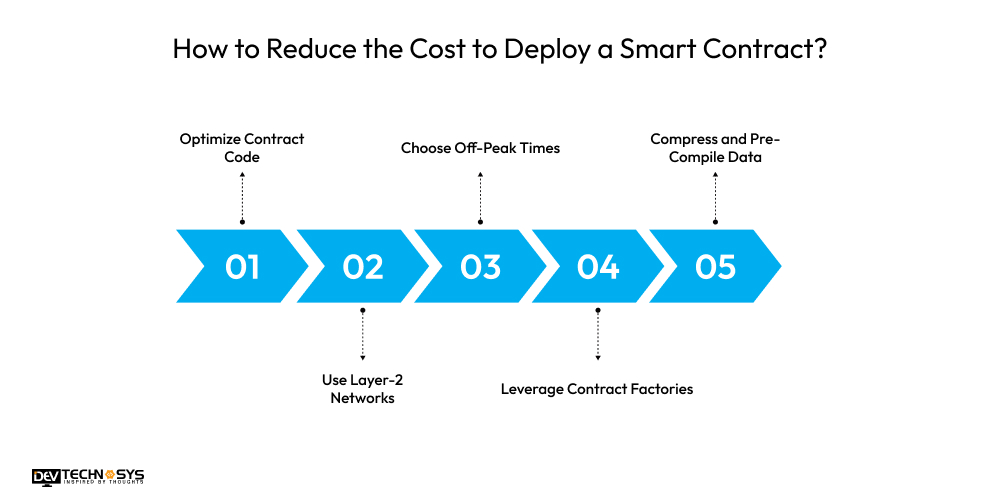
How to Reduce the Cost to Deploy a Smart Contract?
Smart contract deployment can be expensive due to gas fees and network congestion. To minimize costs, optimize contract code, use Layer-2 networks, deploy during low-demand periods, leverage proxy or factory patterns, and store large data off-chain for efficiency and affordability.
1. Optimize Contract Code
Use efficient logic, minimize storage variables, and remove redundant functions. Gas costs depend on computation and storage usage, so simplifying your contract structure and using libraries effectively can significantly lower the cost to deploy a smart contract app.
2. Use Layer-2 Networks
Deploy on Layer-2 scaling solutions like Arbitrum, Optimism, or Polygon. According to the Ethereum development company, these platforms offer cheaper transaction fees while maintaining Ethereum security, drastically reducing deployment and interaction costs compared to the Ethereum mainnet.
3. Choose Off-Peak Times
Gas prices fluctuate with network demand. Deploy contracts during periods of low congestion to save on transaction fees. Monitoring real-time gas trends helps identify the most cost-effective time to deploy.
4. Leverage Contract Factories
Instead of deploying identical contracts multiple times, use a factory pattern or proxy clones. As we discussed earlier with a Web3 development company, this reuses existing bytecode, saving deployment gas and ensuring cheaper contract creation for multiple instances.
5. Compress and Pre-Compile Data
Avoid large on-chain data and unnecessary computations. Store heavy data off-chain and reference it via hashes. Pre-compile critical functions or constants to minimize runtime execution, further cutting down deployment costs.
Conclusion
The price for deploying a smart contract is influenced by the network selected, the complexity of the contract, and the gas prices. Simple contracts might cost a couple of dollars, but intricate smart contracts may cost hundreds. Engaging with a qualified smart contract development company offers the benefits of optimized code, an economical execution of the process and improved security.
With the effective designs and the balance between the smart contract complexity and the development costs, organizations will be able to reduce costs and achieve optimal results on the blockchain.
Frequently Asked Questions
Find answers to the most common questions related to this article.
Smart contract deployment costs vary by blockchain. On Ethereum, it can range from $8,000–$25,000 depending on gas prices, while BNB Chain and Solana offer cheaper fees, typically under $6,000 due to lower network congestion.
Key factors include network congestion, gas prices, contract size, computational complexity, and blockchain type. Storage-heavy or complex smart contracts consume more gas, directly increasing smart contract deployment cost across different blockchain networks.
BNB Chain and Solana are generally more cost-efficient for smart contract deployment than Ethereum. They offer faster transaction speeds, lower gas fees, and scalable infrastructure, making them ideal for affordable blockchain project development.
Use tools like Remix, Hardhat, and Truffle for efficient coding and testing. Gas optimization analyzers, Solidity linters, and deployment estimators help detect unnecessary code and minimize gas usage before contract deployment.
Gas fees determine how much you pay for executing transactions on the blockchain. High network demand raises gas prices, significantly increasing smart contract deployment costs, especially on Ethereum during peak congestion periods.













