




















In this high-tech and digital world, even vehicles are becoming smarter, connected, and software-driven. It is true to say that the vehicles are not just made of steel and engines, but also strengthened by software, data, and real-time decisions.
This is surely because automotive enterprises are widely dependent on Software-as-a-Service (SaaS) solutions. So basically, SaaS software has become the engine behind automotive enterprises to build a smart, connected, and seamless automotive ecosystem.
Automotive SaaS software for enterprises is necessary because the traditional system has security, data, and scaling risks. This is why many renowned companies are adopting enterprise automotive SaaS solutions to solve these challenges and make flexible software.
In this blog, we will explore multiple things related to SaaS software for automotive industry. It includes Automotive SaaS challenges, importance, types, solutions, and so on. As the future of mobility is going to be more software-driven, understanding this transformation is essential.
What is Automotive SaaS Software?
Have you seen an automotive enterprise where real-time analytics empowered smarter and faster decisions in the organization? This is where an automated Saas platform steps in as a game-changer, as an automotive software application.
An enterprise SaaS automotive software is a cloud-based system that helps businesses manage the functioning of the entire automotive operations. It includes streamlining manufacturing, supply chains, connected vehicles, dealer networks, and customer experiences.
The essential features of automotive enterprise software solutions include real-time data analytics, cloud scalability, system integration, cybersecurity, and AI-driven automation.
-
Enterprise Adoption Trends 2026:
As per the perspective of 2026, SaaS adoption in the automotive industry is growing at a rapid pace. The need for this adoption is primarily to support electric vehicles, smart factories, and software-defined vehicles.
Even though SaaS software development services have also become a priority for global OEMs and suppliers to keep pace with technology as quickly as mobility. Their main focus is on faster innovation, lower costs, and agility in a market.
What Is The Importance of SaaS in the Automotive Industry?
The SaaS adoption in the automotive industry is crucial not only for manufacturers but also for dealerships and customer experience. In this section, we will understand the importance played by SaaS in the automotive industry.
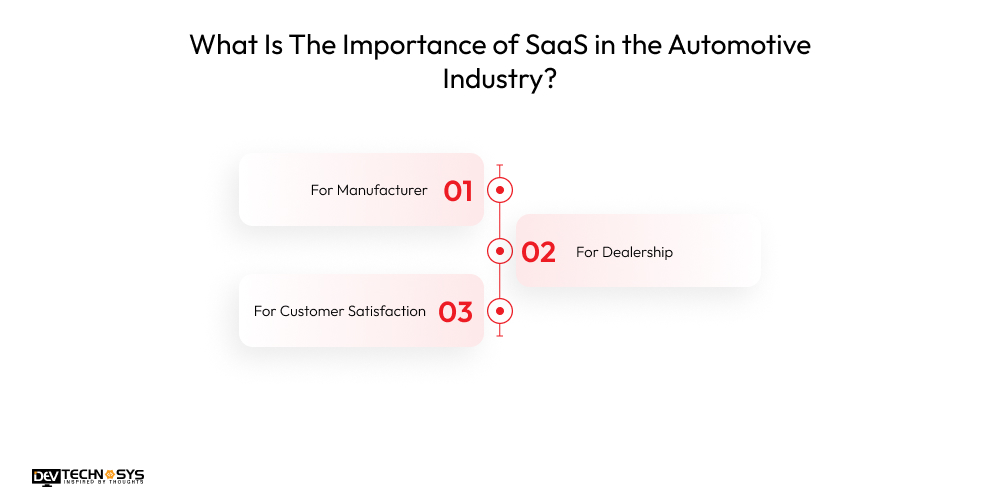
1. For Manufacturer
The automotive SaaS solutions are essential for manufacturers because they optimize complex manufacturing. It helps improve quality control and makes the workflow smooth with real-time data. The car service app development services with SaaS make the company scale by avoiding large hardware investments and license fees.
Apart from this, the automotive SaaS software for enterprises collaborates to allow seamless file sharing and communication. It even lets the automotive companies develop and update softwares quickly with the latest features. These features are implemented directly in the vehicle without the need for service visits.
2. For Dealership
When it comes to dealership and sales, the automotive software development manages inventory, CRM, marketing, and service appointments. It even lets businesses make data-driven sales decisions while offering insights for smart marketing and competitive analysis. Also, it reduces the cost by eliminating IT overhead, hardware expenses, and licensing fees.
3. For Customer Satisfaction
The automotive SaaS implementation also provides satisfaction to users by delivering new features and improvements after purchase. As the automotive SaaS architecture is entirely digital, it connects consumers to dealers and services perfectly while integrating AI in software development. Users get more satisfaction as they get premium services through a subscription model, and only have to pay for the features they access.
What Are The Types of Automotive SaaS Software for Enterprises?
It is evident that automotive SaaS solutions for enterprises offer scalability, flexibility, and data access to improve operational efficiency. However, there are major and widely accepted types of cloud-based automotive software that we will discuss now.
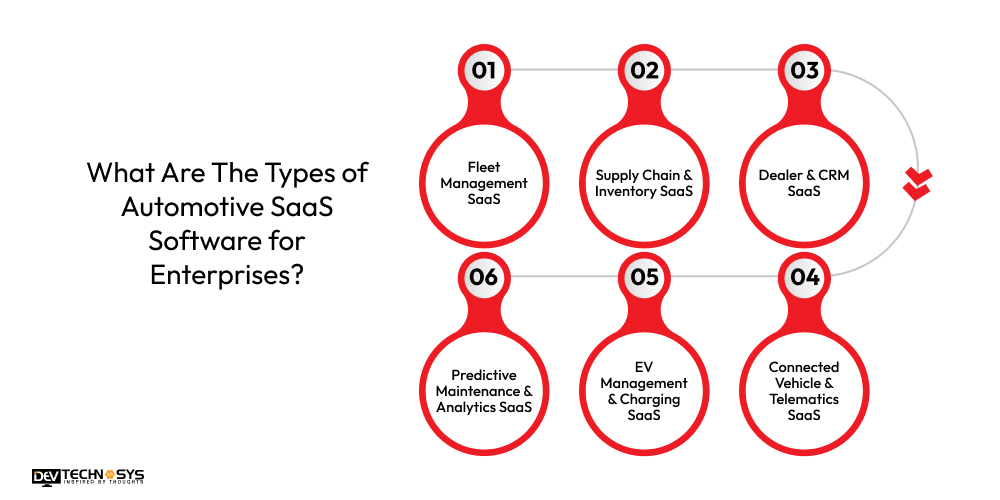
1. Fleet Management SaaS
The Fleet Management SaaS is a software that helps companies track and manage their vehicles efficiently. It keeps control of location, fuel usage, driver behavior, maintenance schedules, and routes.
These measures help in enhancing safety, lowering prices, and keeping the operations of legacy system integration in automotive SaaS running efficiently.
2. Supply Chain & Inventory SaaS
The Supply Chain and Inventory SaaS is a type of automotive software development services that help companies manage vehicles, parts, and inventory.
Along with this, it also keeps a check on the stock level, supply orders, deliveries, and demand. With this, companies can make sure that the right parts are available at the right time without overstocking.
3. Dealer & CRM SaaS
The Dealer and CRM SaaS is another popular Automotive SaaS microservices type that helps car sellers to manage customers, customer data, services, and sales.
It records the details of the customers, tracks leads, schedules test-drives, and manages follow-ups. It leads to the betterment of client relationships and leads to increased sales and customer satisfaction.
4. Connected Vehicle & Telematics SaaS
One more type, Connected Vehicle and Telematics SaaS, allows businesses to collect data from vehicles by utilizing sensors and GPS. With this and AI development services, they can receive real-time information about vehicle location, performance, speed, and the driver’s driving behavior. This type is really mandatory for vehicle monitoring to ensure safety and efficiency.
5. EV Management & Charging SaaS
As electric vehicles are commonly preferred by buyers these days, the EV Management and Charging SaaS is a well-known software type. It helps enterprises manage not only electric vehicles but also charging stations. It makes EV operations easier for businesses and fleet owners by tracking battery health, charging status, energy usage, and station availability.
6. Predictive Maintenance & Analytics SaaS
The Predictive Maintenance and Analytics SaaS is one of the most famous types of automotive SaaS cloud solutions. It predicts failures before they happen by using the data and analytics of the vehicle. This lets companies schedule maintenance early and reduce breakdowns by lowering repair costs. Its main focus is to improve vehicle reliability and uptime.
Want a chatbot demo or pricing? Fill the form and talk to our experts today.
Pick what you need below — you can select more than one — then tap Get detail to continue.
-
Chatbot demo dashboard
-
Cost to develop an app
-
Industry report
-
Case study
What Are The Benefits of Using Automotive SaaS Software for Enterprises?
The automotive SaaS software provides smart ways to manage operations, providing operational efficiency, scalability, flexibility, reduced costs, risk management, and more. Here, we will discuss some of the automotive software development trends and benefits.
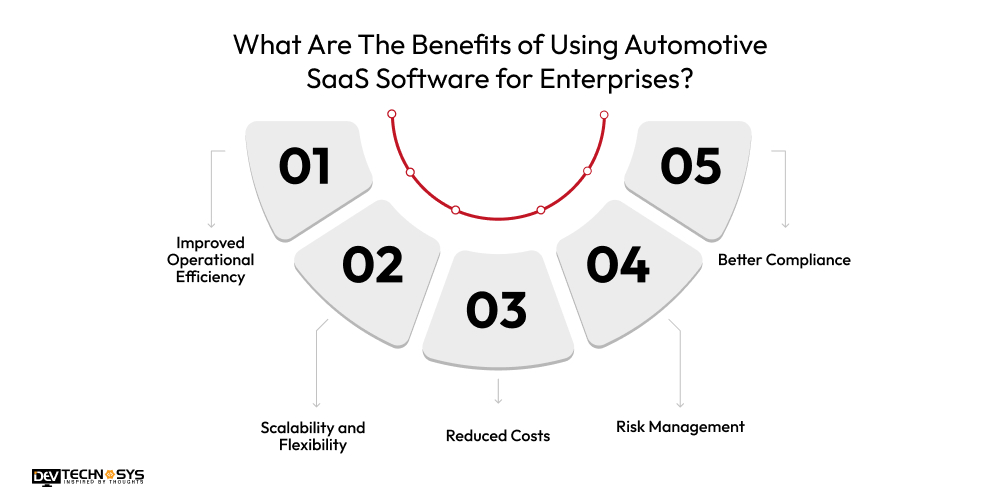
1. Improved Operational Efficiency
An Automotive SaaS microservices architecture simplifies the daily tasks by automating them. It even centralizes the data and provides real-time insights on it.
This helps in decreasing manual work, minimizing errors, and improving coordination in every team. It even allows enterprises to manage vehicles, inventory, and customers more skillfully.
2. Scalability and Flexibility
The Automotive SaaS data management solutions can effortlessly scale with the growing business requirements. Enterprises can add users, new features, or locations without the need for extreme infrastructural changes. It allows them to adapt according to the market changes and seasonal demand while expanding the automotive operations.
3. Reduced Costs
Another benefit of Automotive SaaS is that it reduces the automotive software development cost by eliminating expensive hardware. It also lowers IT maintenance expenses and offers subscription-based pricing. Due to this, enterprises can save money on software upgrades, system management, and downtime. It also helps optimize resource usage across operations.
4. Risk Management
The Automotive SaaS cloud architecture works for real-time monitoring, predictive analytics, and alerts for proper risk management. With this, enterprises can detect the risk at an early stage, and they can reduce vehicle breakdowns. It also prevents safety incidents and makes proactive decisions to decrease the operational risks.
5. Better Compliance
The SaaS platform built by a mobile application development company helps businesses to meet regulatory or industry standards. It allows the automation of compliance tracking, reporting, and documentation. They even make sure the accuracy in records, timely updates, and transparency. It lessens the chances of penalties and non-compliance issues.
What Are The Key Challenges in Implementing Automotive SaaS Software for Enterprises?
The complex legacy systems, stringent compliance requirements, robust cybersecurity, and internal resistance to change are the key challenges of implementing automotive SaaS for enterprises. Be it technological, operational, cultural, or security-related, here we will discuss these challenges.
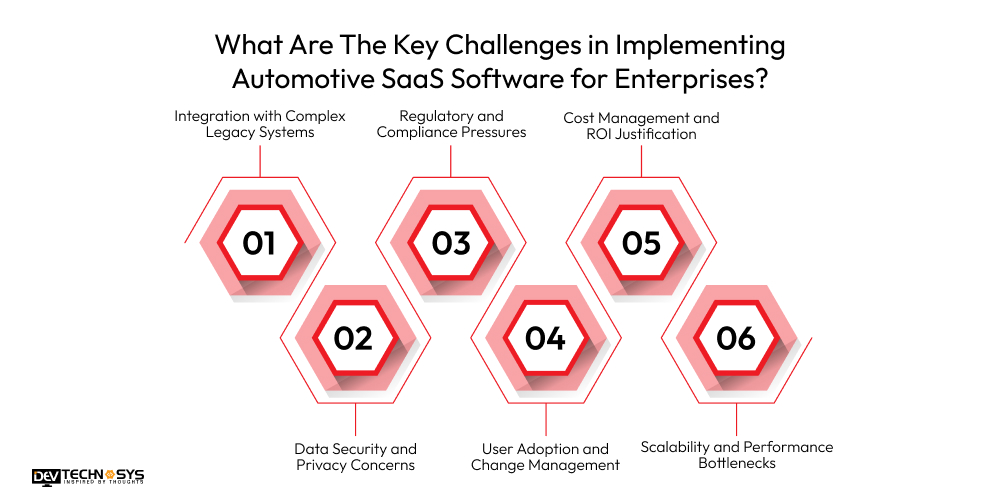
1. Integration with Complex Legacy Systems
A large number of businesses use traditional software and hardware, which increases the difficulty of getting them connected with new SaaS solutions. It is not just full of risk but also time-consuming.
If they are integrated poorly, it leads to automotive SaaS integration challenges, causing data errors, system downtime, and slower operations across departments.
2. Data Security and Privacy Concerns
Generally, automotive SaaS platforms store sensitive data of customers, vehicles, and location data when they develop an automotive website. Therefore, protecting this data from cyberattacks is extremely important.
So, preventing data breaches, managing access control, and ensuring secure cloud storage can be the biggest automotive SaaS data security challenges.

3. Regulatory and Compliance Pressures
Every automotive company is obliged to follow strict safety, data protection, and regional regulations properly. These regulations are constantly changing, so Saas solutions must adapt to these laws across markets. It is one of the automotive SaaS compliance challenges that makes implementation complex and demands regular updates.
4. User Adoption and Change Management
Users as well as employees may find it difficult to adapt to the latest SaaS tools. It is purely due to a lack of training or resistance to change. These lead to multiple challenges in automotive SaaS development. It slows down the adoption, reduces productivity, and restricts the overall value of the software.
5. Cost Management and ROI Justification
The upfront costs, ongoing subscriptions, integrations, and customization can increase the cost of automotive mobile app development. Due to this, companies carefully plan the budget and measure returns. This can be the reason for Automotive SaaS scalability issues and financial constraints that might affect the long-term business growth benefits.
6. Scalability and Performance Bottlenecks
The scalable automotive SaaS solutions must scale smoothly as the data, users, and connected vehicles increase. But there might be some Automotive SaaS performance issues that affect the scalability in the long run. It slows down response times, system downtime, and poor user experience during peak usage.
What Are The Solutions to Overcome Automotive SaaS Challenges?
By strengthening security, using the right technologies, adding intelligence, and delivering better processes, enterprises can overcome these obstacles. Here, we will discuss some of these solutions to build secure, scalable, and future-ready automotive software systems.
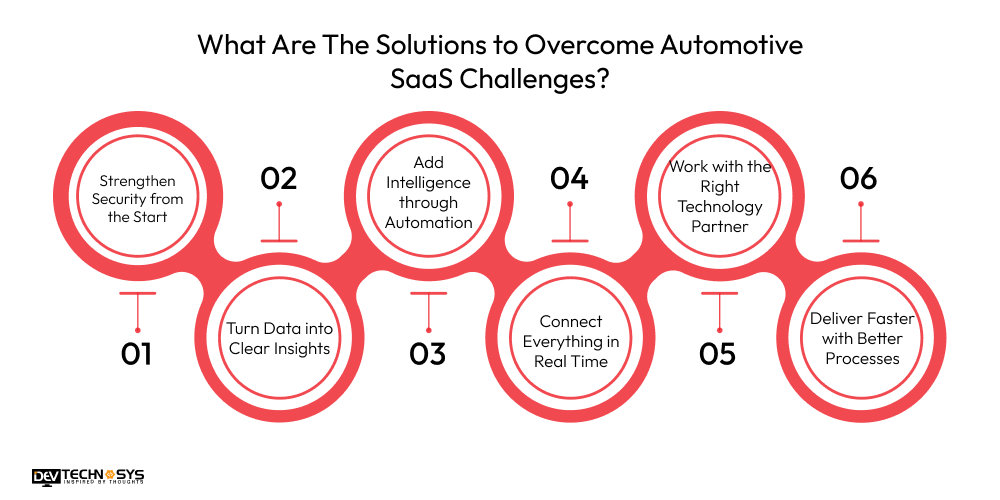
1. Strengthen Security from the Start
Businesses must adopt secure automotive SaaS platforms from the very beginning of the development. These platforms integrate encryption, access controls, regular monitoring, and other security measures.
Their main purpose is to build customer trust and protect the sensitive data of the vehicle and the customer. It also reduces the risks of cyberattacks in connected automotive ecosystems.
2. Turn Data into Clear Insights
When enterprises use Automotive SaaS data analytics solutions, even for car rental app development, they easily understand the vehicle’s performance, user behavior, and operations.
The clear insight helps organizations in making smart and fast decisions and reducing downtime. It also enhances services too, without overwhelming teams with complex technical details.
3. Add Intelligence through Automation
Adding AI and ML in automotive SaaS solutions lets businesses provide predictive maintenance, smart alerts, and automated workflows. These are widely used technologies that can reduce human efforts and upgrade the accuracy. Apart from this, integrating intelligence through automation allows companies to respond quickly to changing conditions and customer needs.
4. Connect Everything in Real Time
Many companies also incorporate IoT-enabled automotive SaaS to make the vehicles, sensors, and systems connect regularly. This enables real-time data sharing that enhances tracking, diagnostics, and efficiency. This measure is beneficial, especially for fleets, mobility services, and connected vehicle operations.
5. Work with the Right Technology Partner
Partnering with the right technology partner, such as an artificial intelligence development company, is really necessary to tackle automotive SaaS challenges. A perfect partner helps the enterprise design a scalable and future-ready solution. They make sure the business goals are aligned with the right technologies to deliver long-term value.
6. Deliver Faster with Better Processes
Adopting DevOps for automotive SaaS improves collaboration between the teams and delivers faster and better processes while reducing errors. It also includes continuous testing and deployment to ensure the stability of the systems. These systems can easily adapt to new changes and offer processes according to the requirements of the business grows.
You can reach out anytime; we are available 24/7. Our team provides a quick response.

How To Choose The Right Automotive SaaS Software for Enterprises?
To select the right automotive SaaS software for enterprises, a business must identify its specific needs, scalability, integration capabilities, and vendor support. Here we will discuss the ways to find out your perfect software seamlessly.
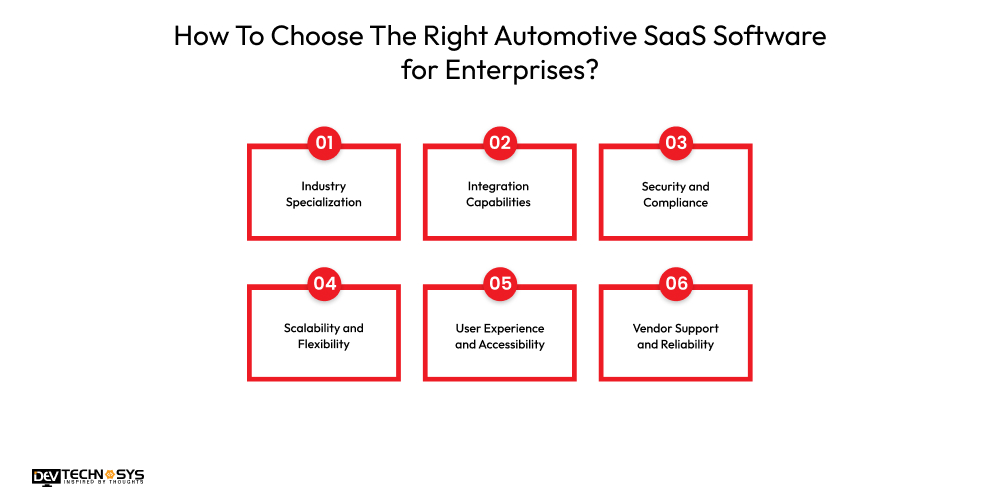
1. Industry Specialization
The first thing businesses must see is that the SaaS software should be specifically designed for the automotive industry only. For this, you must understand what is automotive software development is and how it actually works. Then you have to identify the solution that knows vehicle data, fleet operations, and automotive workflows better.
2. Integration Capabilities
The right SaaS software should have seamless integration capabilities so that it easily works with existing solutions. When a software offers easy integration, it streamlines the data flows without disruption and reduces manual work. It allows enterprises to connect customer apps, backend systems, and third-party services efficiently.
3. Security and Compliance
The ability to maintain security and compliance is essential for the software, especially when using AI in automotive software development. The selected software should protect sensitive data, follow regional regulations, and include built-in compliance features. All these are mandatory for a software to reduce cyber risks and legal challenges.
4. Scalability and Flexibility
Enterprises must pick the automotive SaaS software that grows as your business expands. The platforms should be flexible to smoothly adopt the new changes and still maintain scalability. Whether adding vehicles, users, or new services, the platform must make the business grow without expensive redesigns or performance slowdowns.
5. User Experience and Accessibility
A good automotive SaaS software should be intuitive and easy to use for everyone, whether technicians, managers, or staff. Make sure the software is primarily designed for auto repair shop management software development. It focuses on clear dashboards, easy navigation, and mobile access to improve daily productivity.
6. Vendor Support and Reliability
Select an automotive SaaS software for vendor that has proven automotive experience, reliable uptime, and responsive support. Strong vendor partnerships ensure continuous updates, quick issue resolution, and long-term stability as enterprise automotive operations continue to evolve.
Conclusion
Last but not least, the Automotive SaaS software for enterprises helps in enhancing efficiency and reducing costs. It also lets the businesses make better and more informed decisions, whether it is about operations or vehicle management.
Despite this, enterprises go through some challenges when they build automotive garage software. It includes problems related to integrations, scalability, data accuracy, and much more. However, by taking some essential measures like Automotive SaaS API integration or investing in data analytics, these issues can be resolved.
The automotive industry is evolving continuously, especially with connected vehicles, and putting enterprises in competition. To remain competitive, agile, and future-ready, they have to move with the advancing technology and transforming digital landscape.
How Dev Technosys Could Be The Best Selection For Automotive SaaS Software for Enterprises?
Dev Technosys is one of the most popular and trustworthy names for businesses that want to build an automotive software. It is a reliable mobile and web app development company serving startups, small, and large businesses.
They have been in this industry for more than 15 years and have been offering perfect, scalable, cost-effective, and profitable solutions. They have 700+ clients worldwide, serving in 71+ countries, and the best part is 1500+ successful projects.
This company has been the best at delivering advanced and futuristic digital solutions for every industry, whether healthcare, automotive, on-demand, and whatnot. We think you must now end your search for a reliable SaaS development company when Dev Technosys is by your side.
Frequently Asked Questions
Find answers to the most common questions related to this article.
The automotive SaaS software is a cloud-based technology that is designed to service the automotive industry. It helps enterprises manage vehicles, fleet, sales, marketing, logistics, and almost every operation online. It also offers scalability and real-time data access while lowering the IT costs.
Generally, enterprises require SaaS in the automotive sector due to the following reasons:
To improve efficiency
To reduce operational costs
To access real-time data
To scale easily
For better fleet management
Customer engagement
Predictive maintenance
Faster decision-making
The main challenges that are very commonly discovered in Automotive Saas adoption include:
Integration with Complex Legacy Systems
Data Security and Privacy Concerns
Regulatory and Compliance Pressures
User Adoption and Change Management
Cost Management and ROI Justification
Scalability and Performance Bottlenecks
Change management during SaaS deployment
AI-powered automotive SaaS solutions improve Automotive SaaS by helping in predictive maintenance, smarter analytics, demand forecasting, driver behavior analysis, and personalized customer experiences. It helps enterprises automate processes, reduce downtime, optimize operations, and make data-driven decisions faster.
The deeper AI integration, connected and autonomous vehicles, advanced EV management, real-time analytics, and greater automation are considered the future of automotive SaaS for enterprises. With this, enterprises will rely more on cloud-based platforms to stay competitive and adapt to industry innovation.