




















Key takeaways:
-
- The average mobile app development timeline in Canada usually ranges from 4 to 18 weeks.
- App’s complexity, number of features, backend, third-party API’s, security, design, maintenance, etc., are factors that influence app development timeline.
- This blog also covers real-life examples and an exact mobile application development timeline in Canada of various industries.
The mobile-first economy of Canada, the second-largest country in the world, is empowered by advanced technology. It revolutionized the way people commute, communicate, travel, bank, shop, learn, and whatnot.
It is mainly due to the high smartphone penetration and a thriving tech ecosystem. It is a favorite destination not only for traveling but also for mobile app development. Therefore, businesses in cities like Toronto, Vancouver, and across Canada are rapidly investing in mobile app development.
Before anything, understanding the mobile app development timeline in Canada is crucial for better planning. It is a mandatory part to know for ideal budgeting, launch planning, market success, and staying competitive.
Generally:
- Basic mobile apps may take 2–4 months
- Medium-complexity apps often require 4–6 months
- Enterprise-level or custom apps can take 6+ months
This timeline is heavily dependent on multiple factors, including features, platform choice, UI/UX design, integrations, testing, and others. This blog covers the app development timeline in Canada thoroughly to launch a successful application.
Industry Insight:
According to Grandviewresearch The Canada mobile application market generated a revenue of USD 22,823.4 million in 2024 and is expected to reach USD 52,473.4 million by 2030.
What is the Typical Timeline for Mobile App Development in Canada?
The mobile app development time in Canada may require approximately 4 to 18 weeks. This timeframe usually depends on several factors, like backend infrastructure, third-party APIs, compliance, features, complexity, and more.
- A simple app takes less development time because it integrates basic but core functionalities. The simple hybrid app development services include basic security, designs, APIs, technologies, etc.
- A mid-level app takes a bit more time to develop, as it involves standard additions. It involves payment gateways, real-time features, cloud-based backend, stronger security protocols, and more.
- An enterprise-level or highly advanced app takes most of the time for development. It comprises AI/ML integration, real-time data, high-level security, scalable cloud infrastructure, multi-language support, and so on.
We will now understand the app development duration in Canada through a detailed breakdown table:
App Type |
Features |
Estimated Time |
| Basic App | Essential functions, simple navigation, minimal database, limited third-party tools | 2-4 months |
| Business App | Interactive UI, payment systems, API integrations, user dashboards, cloud backend | 4–6+ months |
| Enterprise App | Advanced automation, AI-driven features, complex architecture, high-level security & scalability | 6–12+ months |
Planning a Mobile App?
Get a tailored development cost estimate in 3 simple steps — app basics, features, timeline, and your contact details.
- 3 quick steps
- 100% free
- Reply in 1 business day
2 Minutes Read
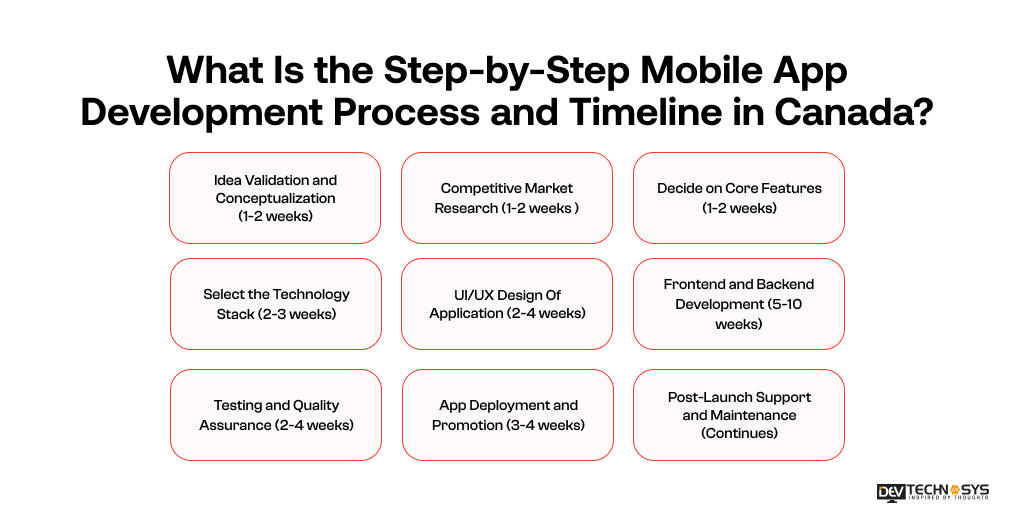
What Is the Step-by-Step Mobile App Development Process and Timeline in Canada?
The timeline also relies on the mobile app development process in Canada. Once you know the development stage, you will have a clear idea of the development time.
It even helps you plan your budget and resources to get a realistic launch expectation. For a smoother development journey, we will now understand the timeline from idea to deployment.
1. Idea Validation and Conceptualization (1-2 weeks)
To create a mobile app in Canada, you must be clear on what you have to build. It means an undeniable scope, purposes, objectives, target audience, and functionalities.
When there is no confusion and misunderstanding on these elements, businesses can easily focus on future goals. It is a time-consuming process, and if the project is big, it is even more demanding.
Activity |
Time |
| Brainstorming app ideas | 2–3 days |
| Define core purpose | 1–2 days |
| Identify the target audience | 1–2 days |
| Initial concept validation | 1–2 days |
| Total | 1–2 weeks |
2. Competitive Market Research (1-2 weeks )
Once you are done with validation, you have to start work analysing and researching the market. It involves knowing the latest and upcoming trends, people’s preferences, the target audience, pain points, and competitors.
It helps enterprises discover the market gaps and determine a unique value proposition. This step ensures the product meets real user needs effectively.
Activity |
Time |
| Research competitor apps | 2–3 days |
| Analyze user feedback | 2 days |
| Identify market gaps | 1–2 days |
| Compile research insights | 1–2 days |
| Total | 1–2 weeks |
3. Decide on Core Features (1-2 weeks)
Now, you should focus on identifying the essential features your app must include. As features are the foundation of the apps, add features that solve user problems easily.
Businesses can prioritize core features and functionalities first and gradually upgrade with time and according to user feedback. Clear feature planning also helps reduce the cost to develop a mobile app.
Activity |
Time |
| List potential app features | 2–3 days |
| Prioritize features | 1–2 days |
| Create a feature roadmap | 2–3 days |
| Review with stakeholders | 1–2 days |
| Total | 1–2 weeks |
4. Select the Technology Stack (2-3 weeks)
Picking the right technology stack includes programming languages, frameworks, databases, and cloud hosting solutions. This selection entirely depends on the app’s complexity, scalability needs, budget, and platform.
When technologies are selected perfectly, it offers the application’s performance, security, maintainability, and long-term growth. It even ensures faster development and seamless future upgrades.
| Activity | Time |
| Choose frontend technology | 2–3 days |
| Choose backend technology | 2–3 days |
| Select the database and servers | 2–3 days |
| Decide on third-party APIs | 1–2 days |
| Total | 2–3 weeks |
5. UI/UX Design Of Application (2-4 weeks)
How your app will look and present in front of users is assured by its UI and UX design. The main focus of UX remains on usability, navigation, and user satisfaction. UI strengthens visual components like colors, typography, and layout.
The purpose of UI/UX design in app creation is to ensure the app is intuitive and engaging. Design lets the application effortlessly align with the brand identity.
Activity |
Time |
| Wireframing screens | 3–5 days |
| Create design prototypes | 4–6 days |
| User experience testing | 3–5 days |
| Finalize UI/UX design | 2–3 days |
| Total | 2–4 weeks |
6. Frontend and Backend Development (5-10 weeks)
Users initially interact with an intuitive interface and client-side functionalities. This is what comes under the frontend development. Whereas backend development works on servers, databases, APIs, authentication, and business logic. In this step of the mobile app development process, frontend and backend together ensure data flow, responsiveness, and secure operations.
Activity |
Time |
| Frontend development | 3–6 weeks |
| Backend development | 3–6 weeks |
| Integrate APIs & services | 1–2 weeks |
| Iterative feature updates | 1–2 weeks |
| Total | 5–10 weeks |
7. Testing and Quality Assurance (2-4 weeks)
Before releasing the app for people’s use, it is required to do thorough testing and get quality assurance. It makes sure the app functions properly on various devices, operating systems, and screens.
When you identify the issues, bugs, and fix them before launch, it improves reliability and user satisfaction. It also saves businesses from costly post-release issues or negative reviews.
Activity |
Time |
| Functional testing | 3–5 days |
| Performance testing | 3–5 days |
| Security testing | 2–4 days |
| Bug fixing & improvements | 1–2 weeks |
| Total | 2–4 weeks |
8. App Deployment and Promotion (3-4 weeks)
Now, you can deploy your app on app stores while strategically implementing App Store Optimization. This makes your app meet platform guidelines and get optimized with descriptions and visuals.
To promote the application, businesses can integrate marketing campaigns, social media outreach, influencer partnerships, and paid ads. This increases visibility, downloads, and early user engagement.
Activity |
Time |
| Prepare app for stores | 3–5 days |
| Submit to App Store/Play Store | 2–4 days |
| Marketing campaign planning | 1 week |
| Launch promotions & PR | 1–2 weeks |
| Total | 3–4 weeks |
9. Post-Launch Support and Maintenance (Continues)
The development process doesn’t end with the deployment. After launch, ongoing monitoring, bug fixing, and performance optimization are mandatory. Collecting user feedback and improving functionalities is even better to retain customers.
To make your app stay competitive in this rapidly evolving market, continuous support after launch is required. It saves you from the unbearable maintenance cost of mobile app.
Activity |
Time |
| Monitor app performance | Ongoing |
| Bug fixes & updates | Ongoing |
| Customer support | Ongoing |
| Feature enhancements | Ongoing |
| Total | Continuous |
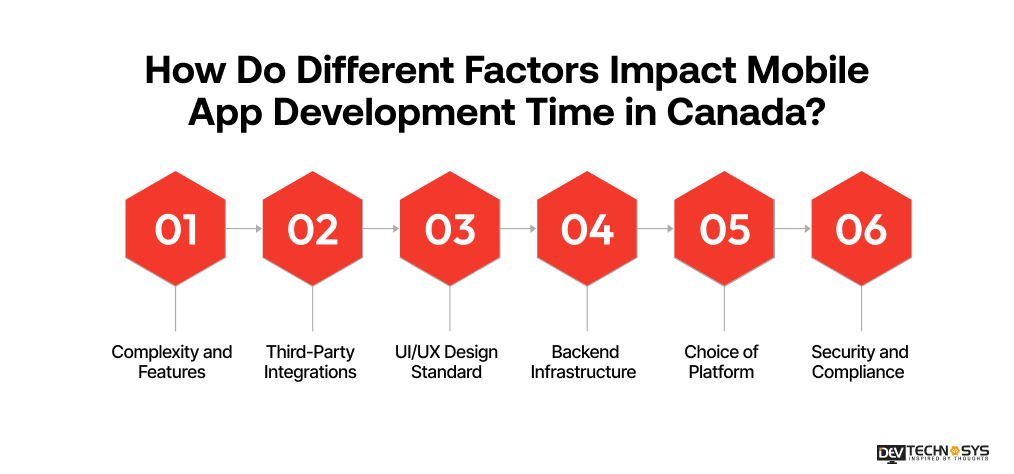
How Do Different Factors Impact Mobile App Development Time in Canada?
The average mobile app development timeline in Canada fluctuates according to several factors. These factors include platform choice, third-party integrations, security & compliance, feature & complexity, design standards, and more. Here, we will understand how these factors influence the mobile app project timeline in Canada.
1. Complexity and Features
As the digital market of Canada is highly competitive, the apps require advanced features, which raises the complexity. The high-tech features that increase the complexity include real-time tracking, AI integration, secure payments, and multilingual support. More complex features require an elevated mobile app development cost and timeline in Canada.
App Complexity Level |
What It Includes |
Timeline Impact |
| Basic App | Login, profile, simple features | Shorter timeline due to limited development work |
| Medium Complexity | Payments, APIs, dashboards | Moderate increase due to added functionality |
| High Complexity | AI, real-time features, advanced systems | Longer timeline because of complex coding and testing |
2. Third-Party Integrations
Multiple Canadian apps are developed incorporating third-party APIs. Some common APIs are payment gateways, banking systems, healthcare platforms, mapping services, or government APIs.
These integrations demand compatibility tests, security validations, and compliance checks. This can delay development due to integration approval, clarity, and limitations.
Integration Level |
Examples |
Timeline Impact |
| Limited | Payment gateway, social login | Slight increase for API setup |
| Multiple | Payments, maps, CRM tools | Moderate increase for integration and testing |
| Complex/Regulated | Banking, healthcare, government APIs | Longer timeline due to security and compliance checks |
3. UI/UX Design Standard
A mobile application development company focuses on making visually appealing, user-friendly, and interactive apps. The user base in Canada or worldwide expects simple navigation, minimal layout, fast-loading screens, and an uncluttered structure. Making changes in designs as per user feedback can extend the app development timeframe in Canada.
Design Level |
Description |
Timeline Impact |
| Standard Design | Basic layouts and branding | Faster design and approval process |
| Custom Design | Unique UI, animations | Extra time for revisions and testing |
| Accessibility-Focused | WCAG standards, bilingual support | Additional time for compliance and localization |
4. Backend Infrastructure
Secure cloud hosting, data compliance, and scalable infrastructure are the major requirements of apps operating in Canada. This strengthens the backend infrastructure of the app, whether servers are hosted locally or internationally. So, infrastructure setup, database configuration, and security architecture can boost the development timeline.
Infrastructure Type |
Characteristics |
Timeline Impact |
| Basic Setup | Simple database and hosting | Quick implementation |
| Cloud-Based | Scalable hosting and real-time data | Moderate planning time |
| Enterprise-Level | High scalability and security | Longer due to architectural complexity |
5. Choice of Platform
The selection of whether to build an app on iOS, Android, or both platforms can impact the timeline. In Canada, iOS has a strong market penetration, but Android remains constant. Separate development for both platforms needs different codebases, resources, and efforts. This raises the mobile app development Timeline in Canada.
Platform Strategy |
Scope |
Timeline Impact |
| Single Platform | iOS or Android | Shorter development cycle |
| Native (Both Platforms) | Separate iOS and Android apps | Longer due to dual development |
| Cross-Platform | Shared codebase | Balanced timeline with additional testing |
6. Security and Compliance
Canada has strict privacy laws, such as PIPEDA and provincial data protection regulations. They require strict data handling, encryption, and user consent mechanisms.
Applications in healthcare, fintech, or e-commerce sectors require additional compliance reviews and security testing. This can lengthen the app development phase’s timeline in Canada.
Security Level |
Requirements |
Timeline Impact |
| Standard Security | Basic encryption and authentication | Minimal delay |
| Regulatory Compliance | PIPEDA, fintech, healthcare rules | Adds compliance review time |
| Advanced Security | End-to-end encryption, audits | Significantly increases the timeline |
Canadian Tax & Legal Guidelines for Mobile App Development Projects
Legal and regulatory compliance is a must for mobile app development in Canada. Companies must take into consideration various privacy laws, taxation obligations, intellectual property protection, and accessibility requirements.
Compliance with these must be planned for as early as the planning phase of mobile app development, as doing so can avoid any post-launch delays and additional changes in the app.
1. Compliance with Canada’s Privacy Laws
Applications that collect, utilize, or share private data are required to follow the Personal Information Protection and Electronic Documents Act (PIPEDA). In some provinces such as Quebec, provincial laws such as Law 25 may have to be followed too.
Therefore, development should include mechanisms for collecting user consent, privacy policies, and secure data processing, which may delay the project.
2. GST/HST Registration for Digital Services
Businesses selling commercial applications, subscriptions, or in-app purchases in Canada may have to register for collecting Goods and Services Tax (GST) or Harmonized Sales Tax (HST) depending on their business activities, customer location, and place. Therefore, tax planning, invoicing, and payment approaches have to be taken into account while developing the product.
3. Intellectual Property Rights Protection
Original software code is automatically protected by Canadian Copyright Law, while trademark law prevents application names and logos from being used by other businesses. Development agreements must clearly define who owns the software code, graphics, and intellectual property so that further disputes are avoided.
4. Accessibility and Consumer Protection Requirements
Organizations in the public and business sector have to take into account accessibility requirements such as the Accessible Canada Act and the laws of individual provinces like the Accessibility for Ontarians with Disabilities Act (AODA).
The introduction of accessibility requirements, as well as requirements related to consumer protection in the process of development, leads to the enhancement of user experience.

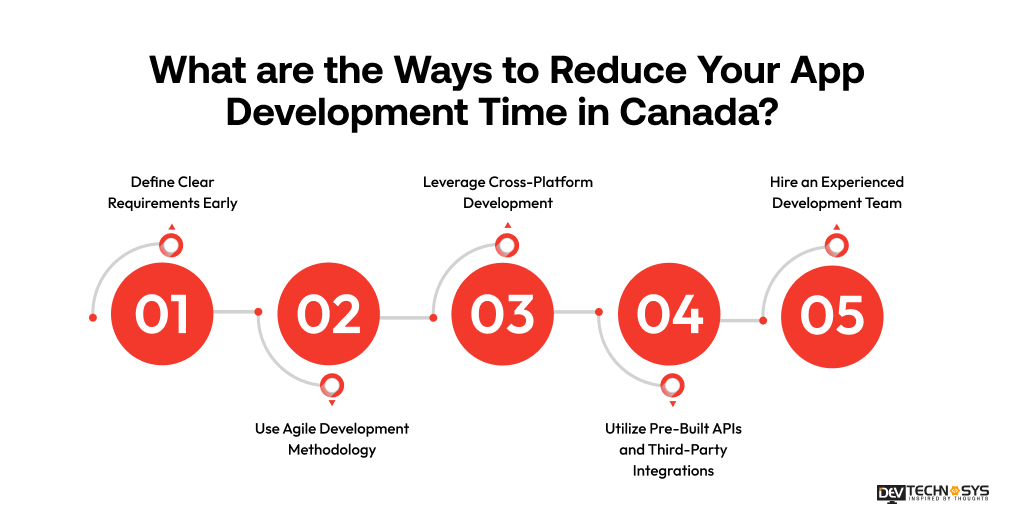
What are the Ways to Reduce Your App Development Time in Canada?
Strategic planning, resource management, MVP development, agile methodology, etc.,are some ways to reduce iOS and Android app development services time. Businesses can speed up the app development time by streamlining processes and utilizing modern practices.
Fast track developemnt never compromises with quality, compliance, and performance standards. Now we will discuss measures to decrease the enterprise mobile app development timeline in Canada.
1. Define Clear Requirements Early
Before reaching to deveopemnt step, ensure you are clear about your objectives, features, target audience, and technical expectations. When you are sure about every requirement from the beginning without confusion, it minimizes scope changes. As these changes and misunderstandings are reduced, it automatically prevents costly development delays.
2. Use Agile Development Methodology
Leveraging Agile methodology lets the developemnt teams work in short sprints or tasks. These tasks are based on continuous feedback that helps identify issues at an early stage.
Due to regular testing and iterative releases, quick adjustments can be made easily. It accelerates development progress while focusing on flexibility and product quality.
3. Leverage Cross-Platform Development
A cross-platform development company can use frameworks like Flutter or React Native for multi-platform development. This type of development works for iOS and Android simultaneously, leaving no need for separate development. It not only lowers the development costs but also the mobile app development Timeline in Canada.
Industry Insight:
As per ZipDo, it is found that 72% of developers now use cross‑platform tools such as Flutter or React Native, which significantly accelerate development.
4. Utilize Pre-Built APIs and Third-Party Integrations
Rather than working on every single development from scratch, businesses can utilize reliable APIs. They can use pre-built APIs for payments, authentication, analytics, or AI functionalities.
This method can save development time while guaranteeing reliability and seamless performance. It gives time to developers to concentrate on core business features.
5. Hire an Experienced Development Team
Businesses can hire mobile app developers from Canada who are cost-effective and highly skilled. These developers confirm efficient planning, technological expertise, and quick problem-solving skills. When the development team is experienced, they follow best development practices while avoiding common mistakes.
What Are the Timeline Differences for Mobile, Web, and Cross-Platform App Development?
In this section, we are differentiating between application types and their timelines. This comparison between mobile, web, and cross-platform is crucial for planning, budgeting, and ensuring a smooth project delivery. Each app type has unique requirements that impact the overall timeline.
Stage |
Mobile App Timeline |
Web App Timeline |
Cross-Platform App Timeline |
Key Factors Influencing Timeline |
| Idea Validation and Conceptualization | 1–2 weeks | 1–2 weeks | 1–2 weeks | Complexity of idea, clarity of purpose, target audience, and feasibility checks |
| Competitive Market Research | 1–2 weeks | 1–2 weeks | 1–2 weeks | Competitor apps, user expectations, industry trends, and regulatory requirements |
| Decide on Core Features | 1–2 weeks | 1–2 weeks | 1–2 weeks | Number of features, feature complexity, must-have vs nice-to-have features |
| Select the Technology Stack | 2–3 weeks | 1–2 weeks | 2–3 weeks | Choice of programming languages, frameworks, platforms, and integration needs |
| UI/UX Design of Application | 2–4 weeks | 1–3 weeks | 2–3 weeks | Device-specific UI, responsiveness, navigation complexity, brand guidelines |
| Frontend and Backend Development | 5–10 weeks | 4–8 weeks | 5–9 weeks | Platform requirements, code reusability, APIs, and multi-device support |
| Testing and Quality Assurance | 2–4 weeks | 1–3 weeks | 2–3 weeks | Device/OS diversity, browser compatibility, performance, security, bug fixing |
| App Deployment and Promotion | 3–4 weeks | 1–2 weeks | 2–3 weeks | App store approvals, server setup, marketing campaigns, and launch coordination |
| Post-Launch Support and Maintenance | Ongoing | Ongoing | Ongoing | Updates, new features, bug fixes, and monitoring user feedback |
What is App Development Duration in Canada: Real-Life Case Studies?
The enterprise or startup app development timeline in Canada varies according to industries. Be it healthcare, on-demand, social media, or fintech, every app has different development requirements. In this section, we will know the timeline and real-life examples of some industries.
1. Fintech Apps
Developing a fintech app in Canada usually takes 6 to 12 months. This is because a fintech app demands strong security and financial regulations. It also comes with transaction encryption, fraud detection systems, and seamless banking integrations. All these elements require compliance approval and multiple security tests.
Examples: Wealthsimple, KOHO, PayBright.
2. On-Demand Apps
On-demand apps include features like real-time tracking, multi-user dashboards, payment integration, push notifications, and scalable backend systems.
Therefore, the mobile app development timeline in Canada for on-demand apps is 4 to 8 months. For a smooth user experience with on-demand apps, performance optimization is necessary.
Examples: SkipTheDishes, Uber, DoorDash.
3. Healthcare Apps
Healthcare apps often take 8 to 14 months due to strict privacy laws for secure patient data storage. It also includes telemedicine functionality, third-party integrations, and compliance with healthcare regulations. Thorough testing is required to make sure data protection and system reliability.
Examples: Maple, TELUS Health MyCare, Babylon Health.
4. E-Commerce Apps
To make an e-commerce app in Canada, it will take 5 to 9 months. This timeline depends on catalog size, payment systems, logistics integrations, inventory management, and personalization. These components need scalability and secure checkout systems that determine the development duration.
Examples: Shopify, Well.ca, Amazon.
How Much Time Is Required to Develop an AI-Powered App in Canada?
A mobile and web app development company takes 3 to 8 months to build an AI-powered app in Canada. The final development time is determined by the AI complexity, data availability, and features. Such types of projects involve machine learning, natural language processing, computer vision, and other advanced technologies.
That’s why it requires additional time for data training, testing, and optimization. AI-powered app development requires proper planning, prototyping, and continuous testing.
This ensures a scalable, high-performing, and market-ready AI-powered application. However, it increases the app development timeline and cost in Canada.
AI Component |
What It Typically Includes |
Estimated Timeline |
| Machine Learning Module | Data preprocessing, feature selection, model training, validation, and iterative improvement. | 10–18 weeks |
| Natural Language Processing | Text/data cleaning, intent detection, chatbot or voice assistant training, and fine-tuning. | 6–12 weeks |
| Computer Vision Integration | Image/video dataset collection, labeling, model training, and scenario testing. | 12–20 weeks |
| Predictive Analytics Engine | User behavior analysis, trend prediction, anomaly detection, and dashboard integration. | 8–16 weeks |
| AI Testing & Optimization | Continuous testing, performance tuning, error correction, and scalability improvements. | 4–8 weeks |
Conclusion
Canada can be a great decision for businesses looking for mobile app development. Basically, it is an exciting journey that takes 4-18 months, depending on the app’s complexity. Simple apps can be developed quickly, while advanced ones need extra development time.
For smooth planning and high-quality delivery, you can partner with an Android and iOS app development company. The right company not only saves your time but also makes your app scalable and engaging.
Do you also want to build an app that stays ahead in the competitive Canadian market? This blog covers everything to understand realistic timelines, so businesses can strategically plan budgets and speed up launches.
Frequently Asked Questions
Find answers to the most common questions related to this article.
The mobile app development timeline in Canada normally takes 4 to 18 months. The development time depends on multiple factors like the app’s complexity, features, security, backend, design, and more. Generally, a simple app takes less development time than an advanced one.
Have a look at the development phases with their timeline:
Idea Validation and Conceptualization (1-2 weeks)
Competitive Market Research (1-2 weeks )
Decide on Core Features (1-2 weeks)
Select the Technology Stack (2-3 weeks)
UI/UX Design Of Application (2-4 weeks)
Frontend and Backend Development (5-10 weeks)
Testing and Quality Assurance (2-4 weeks)
App Deployment and Promotion (3-4 weeks)
Post-Launch Support and Maintenance (Continues)
Multiple factors affect the mobile application development timeline in Canada. Here we are mentioning some of them:
Complexity and Features
Third-Party Integrations
UI/UX Design Standard
Backend Infrastructure
Choice of Platform
Security and Compliance
Yes, whether in Canada or any other location, the development process can be sped up. However, it requires several measures to be taken, such as:
Define Clear Requirements Early
Use Agile Development Methodology
Leverage Cross-Platform Development
Utilize Pre-Built APIs and Third-Party Integrations
Hire an Experienced Development Team
The frontend and backend development stage takes most of the time in Canada, approximately 5 to 10 weeks. This step involves rigorous performance on servers, databases, APIs, authentication, business logic, and so on.