

















Key takeaways:
-
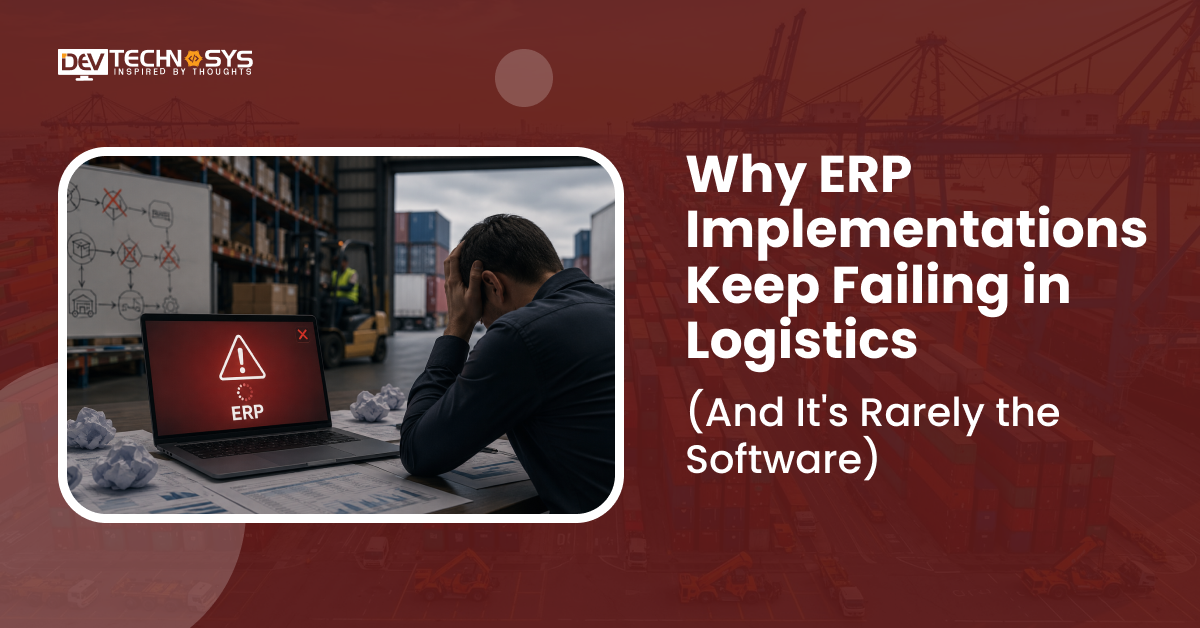
- ERP implementation failures are rarely caused by the software. The main issues are poor planning, incorrect data, low user adoption, and inefficient processes
- According to Gartner, it can cost around $12.9 million annually to organizations because of poor data quality.
- Adoption of Modern cloud ERP is increasing as supply chains become more digital, improving visibility, decision-making, and automation.
- Logistics companies face most of the ERP failures because of more complexities, as it involves multi-warehouse operations, fleet management, and third-party logistics (3PL).
ERP implementation includes collecting data, real-time reports, and streamlining operations across your entire supply chain. Despite all the benefits, many logistics companies are disappointed by ERP Implementation. They have to face many challenges, such as projects going over budget, timelines increasing, etc.
When this happens, we tend to blame the ERP system, but when you understand the real issues, you will get to know that the software is not the problem; the issue arises due to how you integrate it into your system.
In this blog, we have pointed out the reasons why ERP software struggles specifically in logistics, what makes it challenging, and how you can set it up for a successful integration.
Why Logistics Companies Invest in ERP Systems?
You must already know that Logistics is a complex industry to work in. It moves very fast; hence, timing is most important, and the margins are also less. These are the reasons why most companies integrate ERP systems and try to solve the operational issues:
- It centralizes the fragmented data from various departments (warehouse, transportation, inventory, and finance) into a single source.
- It improves real-time visibility into inventory levels, shipments, and fleet status.
- It automates manual processes like invoicing, compliance reporting, and order processing.
- It helps in scaling the business as the company expands into new regions or adds new services.
- It provides better forecasting that helps plan future demand and optimize routes.
Theoretically, an ERP system is the solution to all the issues. It can integrate the disconnected spreadsheets, legacy systems, and manual workflows into a single platform. This provides better control over data to the leadership. But the main challenge comes when it is time to translate all that potential into a system that can actually work properly as the logistics team operates on the ground.
Are ERP Projects Really Failing?
Yes, that’s true, and we have numbers to back this up. Industry research has consistently proved that a large number of ERP implementation projects have failed to meet their original goals, whether it is completing the timelines, staying on budget, or delivering the required functionality.
Some studies also suggest that the failure rate of logistics ERP solutions is above 50% across various industries.
In recent industry research, here is what the data states:
| Statistics | Figure | Source |
| Overall ERP implementations that fail to meet original objectives | 55% – 75% | Gartner / industry analyses |
| ERP projects predicted to fail to meet business goals by 2027 | 70%+ | Gartner |
| Discrete manufacturing ERP projects that fail to meet goals | 73%, with cost overruns averaging 215% | Gartner |
| ERP projects completed on time and within budget | 30% (approx) | Godlan |
| Failures happen because of the top three factors ( bad data migration, change management, inexperienced teams) | 75%+, combined | Godlan 2026 analysis |
Logistics is quite vulnerable to ERP implementation strategy. That means it would work better with a retail business because they have comparatively standardized processes, but in logistics, it involves various locations, different compliance requirements, diverse fleets, and constantly shifting demand patterns.
Hence, because of the increased complexity, there are more chances of things going wrong.
Also, keep in mind that “failure” does not mean that the system has completely shut down. Moreover, it means:
- Promised features were not delivered completely.
- Even after the system goes live, the employees are still reverting to the old manual process.
- The cost goes way over the originally decided budget.
- The rollout takes twice as long as it was planned.
- After it goes live, the user adoption stays low.
Want a chatbot demo or pricing? Fill the form and talk to our experts today.
Pick what you need below — you can select more than one — then tap Get detail to continue.
-
Chatbot demo dashboard
-
Cost to develop an app
-
Industry report
-
Case study
The Biggest Myth: ERP Software Isn’t the Real Problem
Most logistics companies believe that the reason for ERP implementation failure is choosing the wrong software, but it is not at all true. Most of the modern ERP platforms, such as SAP, Microsoft Dynamics, Oracle NetSuite, or a custom-built solution, are totally capable of handling the logistics workflows if they are configured accurately.
Most companies blame the software simply and don’t want to indulge in the real-world conversations, such as planning gaps, execution failures, and internal readiness. In simple words, ERPs are just the software; their success totally depends on how you have implemented it, how you use it, and whether the processes are mapped out properly beforehand.
Thinking that ERP software is wrong can also cause bigger issues. Companies think that this particular software is not suitable for the company and then invest in another ERP software, but eventually they have to deal with similar issues because the root problem has not been solved yet.
Reasons why ERP Implementations keep Failing in Logistics
In logistics companies, the various departments of inventory, transportation, warehouses, finance, and customer services are interconnected very closely. If a small issue arises in one department, then it can quickly affect the entire supply chain.
Here are the reasons why ERP implementations keep failing in logistics and their solutions:
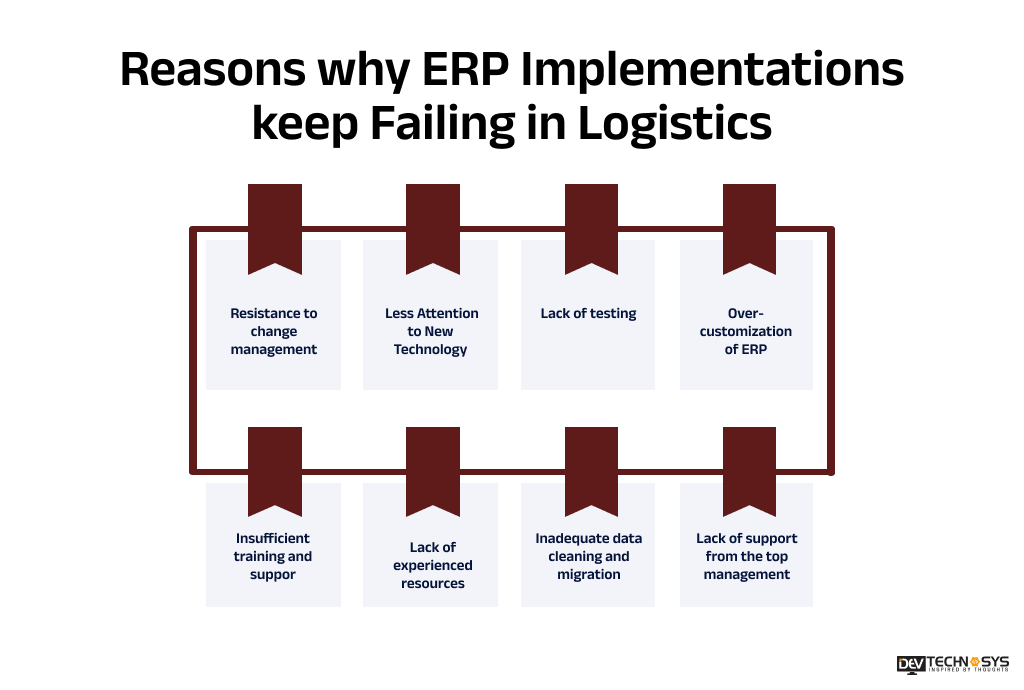
1. Resistance to change management
Whenever you come up with a new approach for people/employees to complete their tasks, it is common to face some resistance. In business settings and workplaces, this type of response is quite normal.
Solution: To solve this issue, you can create a change management strategy even before the project starts. This will assist your staff in making a new and innovative corporate culture.
2. Less Attention to New Technology
When you integrate new technology into the old processes, the adoption rates can slow down. With ERP software, everyone requires a new way of thinking. Businesses that fail to integrate the updated processes and new tools increase the risk of missing live dates.
Solution: The project owner needs to develop an implementation strategy that outlines the steps required to manage the unique tasks in the project. This needs to be conveyed to the employees, and they must follow it.
3. Lack of testing
ERP systems are very complicated and versatile; hence, for successful ERP software development, rigorous testing is necessary. Apart from testing, this process also includes assessing and fixing issues.
Solution: You need to implement the plan with testing at early stages. Also, User Acceptance Testing (UAT) is important to avoid ERP implementation failures.
4. Over-customization of ERP
Over-customization decreases the functionality of ERP systems and complicates upgrades and testing. It eventually increases all other costs and risks. You should be aware that modification is costly and it should only be done when there is no other option left. Most ERP systems have simple configurations that do not require significant modification.
Solution: You should implement the best practices and give priority to the configuration over customization. You should only customize when it is extremely necessary, and don’t forget to consider the long-term effects.
5. Insufficient training and support
For an ERP implementation, it is important to provide personal training to each employee. If there is any user who is not trained regarding the system, then there are high chances that they will drain it completely. The project will suffer if there are fewer support resources available to solve go-live issues.
Solution: To solve this problem, you can make an extensive training program for all users. To address the problems of users, you can provide continuous assistance and resources to them.

6. Lack of experienced resources
It is necessary to have relevant talent and experience in your ERP team. You can either train your present personnel, or you can also acquire resources from outside as contractors, but this will take a lot of time and money.
Solution: To save your time and money, the best thing you can do is to train your current staff members so that they can use ERP systems more efficiently. You should encourage communication among your team members and promote information exchange.
7. Inadequate data cleaning and migration
Mostly, legacy systems store data for years or decades. Data cleaning is important in ERP implementation; it determines how much data needs to be transferred to the new system. You need recent records for this, as there is no use in filling the ERP with useless data.
Solution: You should perform a complete audit and cleansing before migrating the data into the new system. It is essential to create an efficient data migration strategy and test it completely.
8. Lack of support from the top management
In logistics companies, if leaders fail to play their roles and keep track of their teams, there is a high chance of mistakes being overlooked and deadlines being missed.
Solution: It is essential for the leadership to be involved in the process as early as possible. They also need to make sure to understand the project completely.
Logistics Challenges That Make ERP Implementation Harder
You cannot approach logistics similarly to other industries when it comes to ERP rollouts. There are various factors that make implementation in logistics difficult:
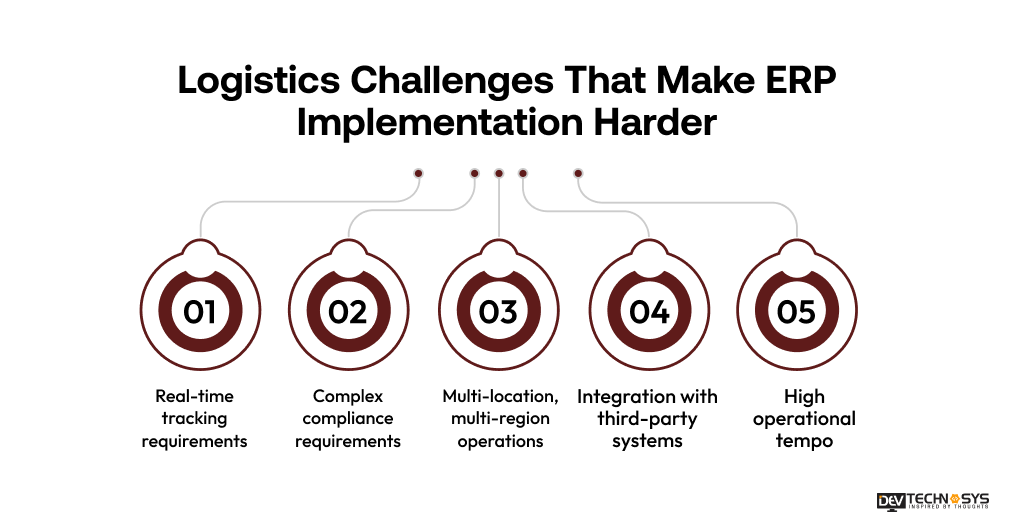
Real-time tracking requirements
It is one of the most common ERP implementation challenges. In logistics ERP implementation, we need to integrate IoT sensors, real-time GPS tracking, and telematics data. This makes the technical part more complex than old office systems.
Complex compliance requirements
In logistics, there are various layers included that add up to the complexity, such as customs documentation, cross-border shipments, and regional transportation regulations. Because of such complexity, generic ERP configurations don’t work.
Multi-location, multi-region operations
In logistics, different warehouses, distribution centers, and regional offices operate with different processes. This makes overall system standardization difficult.
Integration with third-party systems
Logistics companies usually depend on various specialized tools, such as EDI platforms, WMS, TMS, and customer portals. It can be a technical challenge to integrate all of these into an ERP.
High operational tempo
Most logistics companies run 24/7; that means there is very little scope for extended downtime in the testing or implementation phases.
Planning a Mobile App?
Get a tailored development cost estimate in 3 simple steps — app basics, features, timeline, and your contact details.
- 3 quick steps
- 100% free
- Reply in 1 business day
2 Minutes Read
Early Warning Signs for ERP Project Failure
If you recognize the trouble at an early stage, then you can save your project from failing completely. Here are the early signs that you should detect:
- Missing milestones early in the project: If the early stages are already behind schedule, there is a high chance that later phases will not go smoothly because they are more complex.
- Data quality issues during testing: If the migrated data has some errors or inconsistencies at the time of user acceptance testing, then it shows deeper data governance problems.
- Less engagement from frontline staff: If frontline staff, including dispatchers, warehouse workers, or drivers, are not involved in testing sessions or feedback, it can cause adoption issues.
- Changing scope constantly: If there are frequent requests to add more features without adjusting the budget or timeline, it shows a lack of discipline.
- Disengagement of Leadership: When executive sponsors do not engage with the project, stop taking updates, or do not track the progress, there is a high chance the project will fail.
Tips for Successful ERP Implementation in Logistics
For successful logistics ERP implementation, it is important that you follow some of the tips. They can help companies make the ERP integration work:
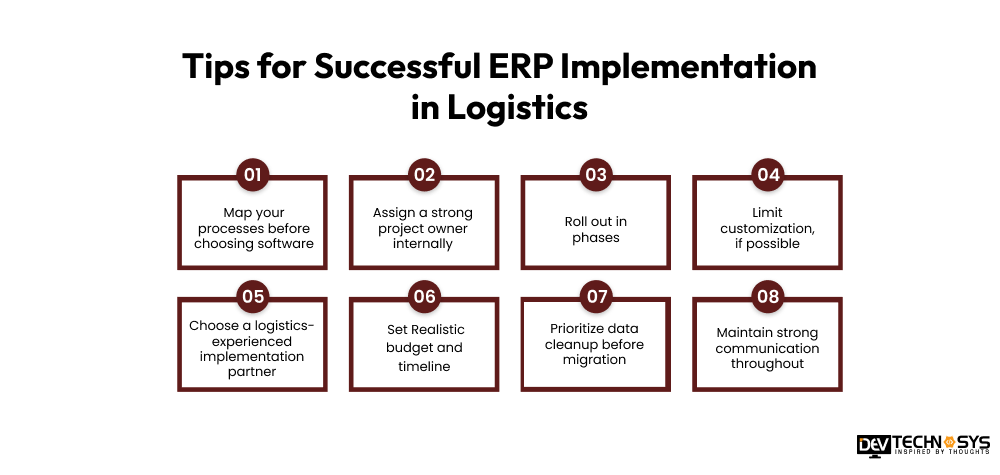
1. Map your processes before choosing software
Before choosing the logistics ERP software, you need to understand how your operations work, including exceptions and edge cases.
2. Assign a strong project owner internally
There should be a project owner who has business context in mind, as well as enough authority to make quick, informed decisions throughout the project.
3. Roll out in phases
Instead of making a big launch of the project, you should consider doing phased rollouts by location, department, or function. This way, the risk is reduced, and you can make adjustments along the way.
4. Limit customization, if possible
Before demanding heavy customizations, you need to evaluate whether your existing processes can adapt to standard ERP capabilities.
5. Choose a logistics-experienced implementation partner
You need to choose the right partner who has proven experience in ERP software development, especially in logistics companies, so that they can understand the operational part better.
6. Set Realistic budget and timelines
Most logistics projects take longer than initially decided and go over budget because of the continuous changes. Hence, you should choose a budget by evaluating it accurately and set a realistic timeline for the completion of the project.
7. Prioritize data cleanup before migration
It is necessary to audit and clean up the existing data before migrating it into a new system. This helps avoid confusion about the information.
8. Maintain strong communication throughout
It is important that all stakeholders, including managers, executives, and frontline staff, stay informed about the project’s progress, changes, and what to expect at every phase.
Conclusion
Implementing ERP in logistics does not fail because of bad software. It simply does not work because the implementation has not been planned, communicated, or executed properly. ERP rollouts in logistics become harder than in other industries because they already face operational challenges. But you can manage them with the right approach.
You need to consider ERP implementation as a business transformation project and not just a software installation. It requires choosing the right partner, mapping your processes thoroughly, changing the management, and setting realistic expectations daily.
You can also consider taking ERP Integration Services from Dev Technosys. We have a team of expert developers with many years of experience. They can also consult you regarding how to implement it correctly in your logistics company.
Frequently Asked Questions
Find answers to the most common questions related to this article.
It can take anywhere from 6 months to 2 years for ERP implementations in a logistics company, but it totally depends on the size of your company and its complexity. It can take longer for multi-region rollouts.
The most common causes of ERP implementation failure are inadequate change management and poor process mapping. They cause more issues than any software itself.
You should choose a partner with proven experience in supply chain or logistics implementations, not just general ERP expertise. You can also ask for references and case studies from similar logistics companies
It is better for the companies if they involve employees early in the project. They should provide them role-based training, tell them the benefits of the new system, and provide them support continuously after deployment
Generally, it is better to adapt the processes to ERP’s standard functions instead of customizing the system entirely. In most cases, excessive customization can increase cost, complexity, and long-term maintenance.