


Key Takeaways:
-
- Context and data about customers, combined with reasoning based on goals, are utilized in AI agent CRM to handle changing workflows and facilitate the making of strategic business decisions.
- In rule-based CRM, routines are performed based on established triggers, settings, and performance of tasks that are guaranteed to be performed similarly.
- AI applications customize customer communications using chat history, preferences, aims, and other available behavioral information.
- When selecting a CRM, factors like the complexity of processes involved, cost, integration needs, preparedness of data, and the extent of involvement of human users should be taken into account.
Your customer relationship management system can wait for orders or can start to use proactive thinking. The main difference between a classic CRM and an AI platform is that classic systems operate using “if-this-then-that” methods, thus controlling repetitive activities that include generating leads, reminders, and e-mail communications.
AI can analyze the environment, understand consumer behavior, make decisions, and act independently without excessive human participation.
While progress in this area is reshaping the approach to leads, sales, customer support, and involvement, is artificial intelligence always better than classical CRM systems? Not really.
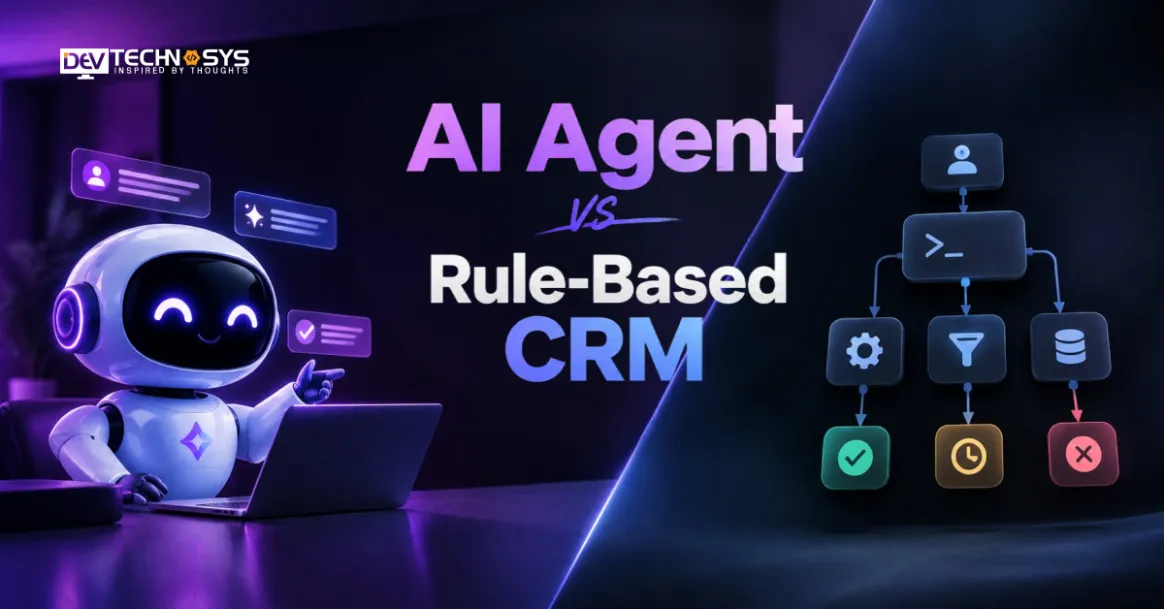
Each of these types of systems has specific advantages, disadvantages, and limitations. Being aware of the differences between AI Agent vs Rule-Based CRM helps organizations to select the most suitable approach.
AI Agent vs Rule-Based CRM: What’s the Difference?
An AI-powered CRM system relies on artificial intelligence techniques to interpret the situation, assess customer data, make decisions, and perform operations while involving human input to a minimum degree. The CRM that is rule-based operates according to pre-established sets of commands, triggers, and conditions to automate specific actions. The main difference between the two technologies consists of the ability of AI agents to adapt to changing circumstances, in contrast to systems based on strict logic.
Industry Insights:
“According to Gartner, CRM software spending with agentic AI capabilities is forecast to overtake non-agentic CRM spending by 2028, reaching $216 billion by 2029.”
What is an AI Agent in CRM?
An AI agent in CRM is defined as software that utilizes artificial intelligence to interpret customer context, assess the data available in the system, and decide on what actions to take to achieve the goals established. The AI agent can run complex operations independently as well as modify its actions based on different situations occurring at the moment. Moreover, it can switch complex or delicate customer touchpoints over to human representatives if human judgment is required.
What is a Rule-Based CRM?
A rule-based CRM is the automatic processing of customer-related activities based on such elements as pre-set conditions and rules, as well as if-then logic. It carries out activities triggered once the required triggers take place. However, this type of CRM does not have any independent technical capabilities and can be utilized only within the framework of defined requirements.
How Does an AI Agent CRM Work?
An AI agent Customer Relationship Management (CRM) system accumulates customer data, studies the situation, deduces what the customer wants to achieve together with their business objectives, and chooses the most suitable course of action. It then acts accordingly, such as replying or changing the records, and applies the experience of this action to find better ways of dealing with the customers in the future.

1. Customer Data
Gathers customer data from connected intelligent CRM systems and other sources, including customer profiles, behavior, history of purchases, preferences, and customer conversations.
2. Context Analysis
Processes customer data to interpret the meaning and identify the intent of the customer conversation.
3. Reasoning
Assesses the available information, business objectives, the needs of the customer, and the consequences.
4. Decision
Chooses the most suitable course of action based on a combination of customer information, rules, business goals, data, and outcome.
5. Action
Carries out different activities like sending messages, updating the record in CRM systems, entering details into a calendar, creating messages, and so on.
6. Feedback
Uses customer responses to ensure the effectiveness and success of its solution and improve the performance of future actions.
How Does a Rule-Based CRM Work?
In a rule-based CRM, the beginning of any activity is triggered by a specific event, followed by a condition, a rule, and an action. This method governs predictable automation, but the downside is that the system cannot adjust automatically to situations that break the predetermined rules.

1. Initiator
An event that was previously defined activates the particular process in the CRM system. The event may include things like acquisition of a new lead, getting a customer message, a completed sale, or submission of a form.
2. Evaluation
The CRM performs an evaluation to check whether certain conditions are met. Evaluation includes lead status, customer location, purchase price, response time, or sales stage.
3. Guideline
If the evaluation proves successful, the system applies rules that were previously set to decide on actions if conditions are satisfied.
4. Execution
Once all conditions are met according to the logic, the CRM automatically performs the necessary actions, be it sending out an email, updating the system, assigning leads, or following up on something.
AI Agent vs Rule-Based CRM: Key Feature Comparison
The comparison shows the differences between the AI agent and the rule-based CRMs in how they make decisions, apply AI CRM sales automation, adapt, analyze data, facilitate the workflow process, provide customer context, deal with exceptions, involve human beings, and respond to changes in customer needs. Let’s take a look at the AI CRM features comparison.
Feature | AI Agent CRM | Rule-Based CRM |
| Decision-Making | Goal-oriented and context-aware | Based on predefined rules |
| Data Analysis | Analyzes customer data and interaction history | Uses fixed data conditions |
| Workflow | Handles multi-step, dynamic workflows | Follows predefined workflows |
| Adaptability | Adapts to changing customer situations | Limited to configured conditions |
| Automation | Can execute tasks autonomously | Executes triggered actions |
| Logic | Uses AI reasoning and contextual analysis | Uses if/then logic |
| Customer Context | Understands intent, history, and conversation context | Responds to specific predefined inputs |
| Complex Tasks | Can manage connected and complex tasks | Best for simple, repetitive tasks |
| Exceptions | Can assess situations and escalate when necessary | Requires human intervention outside predefined rules |
| Learning & Feedback | Can use feedback to improve future decisions | Does not independently learn from outcomes |
| Predictability | AI CRM decision-making may vary based on context | Highly predictable and consistent |
| Human Involvement | Primarily for escalation and oversight | Often required for exceptions and new scenarios |
What Are the Benefits of AI Agent CRM?
With the benefits of AI CRM, companies can automate intricate processes, gain better insights into their clients, cut down on redundant work, and improve interactions with clients. All of this will help to simplify operations and let people concentrate on meaningful dialogues with clients.
1. Automates Complex Customer Workflows
An AI agent CRM can orchestrate a variety of customer tasks from multiple systems. It can decode requests coming in, figure out needed procedures, change information in the system, start follow-ups, and address exceptions. Thus, being able to lower the number of employees required to carry out every event.
2. Provides Context-Aware Customer Interactions
AI agents are capable of analyzing the customer’s records, past discussions, wishes, orders, and existing CRM information before they respond. This context allows them to make their reaction appropriate rather than relying on simple messages or standard responses.
3. Reduces Manual CRM Tasks
AI agents can relieve companies of a number of repetitive CRM tasks such as entering data, amending records, qualifying leads, arranging follow-ups, creating tickets, and collecting information. By minimizing these processes, employees can allocate more time to building relationships with customers and dealing with more valuable tasks.
4. Customizes Client Relationships
AI assistants are able to monitor client profiles, history of communication, interests, and actions. As a result, companies are able to communicate information that suits the needs of their clients and customize the timing of follow-ups, as well as develop experiences that meet each client’s individual requirements based on the information they have.
5. Facilitates Quick Decision-Making
CRM software similar to HubSpot is capable of faster analysis of the necessary customer information, making observations, comparing the existing variants, and recommending appropriate measures. They introduce important information into work and facilitates the work of support and sales teams.
Market Insights:
“According to McKinsey, 62% of organizations are experimenting with AI agents, while 23% are already scaling agentic AI somewhere across their enterprises.”
What Are the Benefits of Rule-Based CRM?
Rule-based CRM provides predictable automation, consistent business logic, easier workflow management, and greater control over fixed processes. Its predefined structure can also simplify implementation, auditing, and troubleshooting, making it suitable for businesses with repetitive workflows and clearly established operational requirements.
1. Predictable Automation
The rule-based customer relationship management system works according to pre-arranged rules and actions. As a result, businesses can determine ahead of time exactly what will happen when any specific event occurs in their systems. This makes understanding, tracking, and managing automated workflows much simpler in case of standard interactions with customers.
2. Easier Workflow Management
The rule-based CRM is based on clearly defined triggers, rules, and actions that allow firms to manage repetitive custom CRM development workflows. The team plans the different stages of the work in advance, which simplifies setting up, monitoring, and updating workflows without any complex decision-making systems involved.
3. Lower Implementation Complexity
The implementation of rule-based CRM is made easier since the organization of business processes is intuitive. The team can set particular triggers, conditions, and actions without implementing advanced AI solutions or complex cognitive systems, thus simplifying the process.
4. Consistent Business Logic
The business logic in rule-based CRM remains unchanged, as the same rules are used when the necessary conditions are fulfilled. As a result, businesses can streamline processes such as AI CRM lead management, notifications, follow-ups, customer segmentation, etc.
5. Easier Auditing and Troubleshooting
As rule-based CRM involves a set of rules for the activities, it is simple to find out why some CRM workflow automation took place. When build a custom CRM system, it involves analysis of triggers, conditional statements, and results. This makes it easy to troubleshoot and gain an understanding of how certain CRM processes operate.
What Are the Limitations of AI Agent CRM?
CRM with an AI agent may include increased complexity of implementation, requirements for governance, dependencies on data quality, and the ability to produce wrong outcomes and decisions. Additionally, companies also have to introduce continuous monitoring, evaluation, human control, and effective implementation mechanisms to ensure a high level of performance of the agents.
1. More Challenging Implementation
AI agent CRM is often more complex to implement as compared to automation systems in general. Companies may have to set up many different systems, including integrations, AI models, data pipelines, workflow design, testing, and security measures, if they intend for their agents to work effectively in many situations.
2. AI Governance Needs
AI agent CRM, like any kind of software, requires governance policies that define proper use, access policies, data use policies, and other issues. Firms may need to specify policies for monitoring agent activities, how they handle sensitive information, how to keep track of decisions, and how to deal with the relevant risks.
3. Data Quality Dependency
AI agents make use of relevant, accurate, and structured data regarding customers. Lack of completeness of records, outdated information, inconsistent data, or diverged systems may impact their understanding of the context and lead to less relevant recommendations, alerts, or actions.
4. Hallucination and Incorrect-Decision Risk
AI systems are capable of producing flawed data and making poor decisions, particularly when the information at their disposal is partial, unclear, and/or outside the bounds of their design. To mitigate such risks, organizations need to rely on solid data.
5. Monitoring and Evaluation Requirements
CRM AI agents require continuous monitoring to be able to assess the quality of system responses, success in task completion, decision-making accuracy, the escalation process, and effectiveness of the workflow. Hire dedicated CRM developers to use specific sets of tests, data logs, and human assessments in order to find problems and perfect the work of agents over time.
What Are the Limitations of Rule-Based CRM?
Rule-based CRM can be restrictive when circumstances change or are different from preconditions. Its limitations are as follows: it lacks flexibility, requires constant rule maintenance, is not good at managing exceptions, has little understanding of the context, and workflows become complicated as companies include more processes.
1. Limited Adaptability
Rule-based CRM considers only pre-set conditions and actions, which restricts its ability to adapt to variations in customer situations. If a situation does not match the programmed conditions, the AI CRM software would not be able to respond properly without devising new rules, programming, or seeking human assistance.
2. Rule Management
Changing business processes, changing customer needs, and changing organizational policies mean that CRM rules should be applied with enough frequency to reflect the changes. Updating the multitude of existing conditions, triggers, and actions may require much time and lead to the emergence of overlapping or contradicting rules needing a lot of testing and administration.
3. Struggle to Manage Exceptions
Rule-based customer relationship management systems (CRM) function adequately in cases when they come across situations that meet pre-defined conditions, but may experience problems in unpredictable situations. Any exceptions that lie beyond configured workflows may require manual action, generate new rules, or change processes in order to take correct actions and keep the workflow.
4. Low Understanding of Context
Rule-based CRM often assesses predefined fields and situations rather than interpreting broader customer context. It can fail to recognize the customer’s conversation history, intent, tone, or nuances of requests, provided these factors are beyond the frame of the established rules.
5. Complicated Management of Workflows
It could be challenging for organizations to manage their complex processes when they have many triggers and conditions, but it becomes even more complicated when they implement dependent actions and instructions. According to the custom CRM development company, maintaining and changing extensive rules becomes a laborious task, and monitoring a combination of several workflows becomes difficult.
Industry Insights:
“In accordance with Salesforce, 77% of service teams deploying AI agents use them across both customer-facing and internal operations, expanding automation beyond conventional CRM workflows.”
AI Agent CRM vs Rule-Based CRM: Which Is More Cost-Effective?
Rule-based CRM can be a cost-effective system for repetitive and uncomplicated processes. While AI-driven CRM will entail higher initial expenditure, it will yield more advantages when dealing with complicated situations, different kinds of communication, and processes calling for comprehensive decision-making.
Cost Factor | AI Agent CRM | Rule-Based CRM |
| Initial Cost | Generally higher due to AI development and integration | Generally lower for predefined workflows |
| Implementation | More complex and requires specialized expertise | Simpler when processes are clearly defined |
| Maintenance | Requires model, workflow, and performance monitoring | Requires updating rules and conditions |
| Scalability | Suitable for complex and changing workflows | Works well for stable, repetitive processes |
| Automation Scope | Handles dynamic, multi-step tasks | Handles predefined, repetitive tasks |
| Decision-Making | Context-aware and goal-oriented | Fixed and rule-driven |
| Human Intervention | Mainly for exceptions and escalation | More likely when conditions are not predefined |
| Best Cost Fit | Complex customer operations and adaptive workflows | Simple processes with predictable requirements |
AI Agent vs Rule-Based CRM: Which One Should You Choose?
When client workflows are fluid, context is important, many systems need to be coordinated, or decisions depend on many data points, choose an AI-powered agent. Choose a rule-based CRM when the situation is predictable, repetitive, well-defined, and requires automated processes in a clear manner. You can also check out the difference between CRM vs ERP software:
Choose AI Agent CRM When:
1. Workflows are Variable in Nature
Opt for the AI agent CRM if the processes you are following are frequently changing and you need to perform different actions according to the customer and the circumstances. The AI agent will adjust the subsequent steps accordingly instead of following a template.
2. Customer Interactions Require Context
AI agent CRM works best when the interaction with the customer is based on dialogue history and various factors such as customer preferences and desires, previous actions performed, and current requests.
3. Multiple Systems Need Coordination
In the context of customer operations needing coordination across different systems like CRM, support, communication, payment, or scheduling, one could select an AI agent CRM as an option. Such systems can conduct several steps while predicting which action or system should come next.
4. Teams Handle Large Volumes of Customer Interactions
If there is a team handling customer requests, conversations, or other repetitive tasks/ requests, AI agent CRM can assist them. The agents will take care of all repetitive operations and let the teams sort out the complex cases requiring human attention.
5. Decisions Require Analysis of Multiple Data Points
AI agent CRM should be selected when making decisions involves different data points about customers, operations, or behavior. Hire dedicated developers to analyze all relevant information together and help to reach decisions, while simple predefined rules may not offer enough information.
Choose Rule-Based CRM When:
1. Workflows Are Consistent
Choose rule-based CRM when the workflows of the customer remain the same and occur under the same conditions. It is practical to automate periodic work because everything, including the conditions, triggers, and actions, is predefined.
2. Business Rules Rarely Change
Select rule-based CRM systems when the company’s operations, policies, and workflows remain stable. In this situation, rules enable companies to continue to automate processes, as the need for redesign is reduced significantly.
3. Consistency is More Important than Flexibility
Select rule-based CRM systems when consistent execution of the operations takes precedence over the ability to adapt to changed situations. The system operates based on the same rules anytime the conditions for the use of those rules are met.
4. Processes Are Simple
Use rule-based CRM when processes involve simple triggers, conditions, and actions. Activities such as notifications, lead assignments, reminders, and status updates can be automated easily without requiring complicated data interpretation or independent decision-making ability.
5. The Need for a Budget-Conscious Implementation
Choose rule-based CRM if the goal is to lessen the implementation complexity and manage initial costs effectively. Business processes can often be mapped out with predefined workflows that leverage existing AI agent CRM capabilities.
Choose a Hybrid CRM When:
Hybrid CRM is a blend of rule-based CRM automation and AI, drawing on the strengths of each. Rules deal well with predictable processes, while AI manages complex decisions that require context. For example, rules might be applied to assign leads to territories, AI will analyze intentions and make recommendations, and humans make decisions about high-value prospects.
AI Agent vs Rule-Based CRM: Real-World Use Cases
Both AI agents and rule-based CRM systems serve various business requirements from sales to customer service to marketing, e-commerce, and B2B. AI agents in CRM perform companies’ systematic tasks where there are context-based decisions and dynamic interactions. Rules-based systems, on the other hand, are capable of executing predictable tasks by referring to established processes and rules.
1. Sales CRM
AI agents for sales CRM make it possible to sort out leads by analyzing people’s intention, degree of attention, and customer statistics, allocate opportunities according to the specific environment, follow up with customers, and manage the opportunities. Rule-based CRM can do it by establishing fixed rates for lead scoring, relying on a certain territory, creating timetables for follow-ups, etc.
2. Customer Service CRM
AI agents can differentiate tickets by analyzing the customer’s intention and the context of the conversation, construct appropriate answers, find out whether escalation is needed, and review customer history at a glance. Standard CRM makes it possible to classify tickets according to the specified criteria, send uniformly constructed replies, escalate issues, etc.
3. Marketing CRM
Artificial intelligence can observe customer actions for segmentation in real time, customize marketing messages according to individual situations, and analyze behavioral data. Traditional CRMs provide predefined segments of customers, send messages based on set parameters, and monitor established metrics of AI CRM customer engagement.
4. E-commerce CRM
Artificial intelligence can analyze past browsing and purchasing behavior of customers and help with product recommendations and customer retention strategies. Traditional CRMs rely on sets of characteristics to define what products should be offered, when to send abandoned cart messages, and how to retain customers through fixed offers.
5. B2B CRM
Artificial Intelligence systems are able to evaluate account activities, level of interest, communications, and deal progress in order to produce account insights, highlight prospects, and assist in forecasting sales. Rule-based CRM allows generating account scores, giving priority to deals according to the pre-set criteria, and taking advantage of established rules and previous conditions for sales forecast generation.
Conclusion: AI Agent vs Rule-Based CRM
AI tools and traditional CRMs fulfill differing purposes. CRM that employs rules works best when tasks require repetition and prediction. AI instruments are required when it is needed to interact with information and make decisions. Companies may also utilize both solutions. A professional AI development company will assist in choosing and integrating the suitable CRM solution.
Frequently Asked Questions
Find answers to the most common questions related to this article.
AI agent CRM is a CRM system that is powered by AI technology and is able to use AI for contextual understanding, information analysis, decision-making, and task completion. Rule-based CRM works according to prearranged rules, triggers, and situations. An AI agent can adapt to an evolving situation; rule-based systems provide predictable, reliable CRM automation for simple, fixed operations.
Neither of the methods can be considered superior to the other. The applicability of the AI agent CRM is typical for dynamically changing affairs, context-sensitive engagements, and complex decision-making processes; the rule-based CRM is more successful for simple and regular actions that should be performed in a steady way.
Definitely yes. Companies can use a mix of these two methodologies to create a hybrid customer relationship management system. Intelligent CRM automation based on rules is responsible for standard scenarios, while AI technologies take care of the tasks that require comprehension and reasoning. For instance, rules can be applied to determine that a lead should be sent to a different unit
An AI agent may assess leads, evaluate client communications, modify CRM records, organize recurrences, create replies, summarize events, rank opportunities, get data, and manage complex procedures. The actual capabilities of the AI agent will be defined by the existing data, other systems connected to the AI, objectives of the company, and available methods of protection
A hybrid CRM can be beneficial when a company has both predictable and dynamic workflows. While standard procedures can be managed by rules, the AI-based agents can make context-sensitive decisions. This approach allows businesses to maintain control over formal processes and, at the same time, use AI technology in cases where it is expedient


