














Key Takeaways:
-
- Google Pay’s Indian entity has been profitable since at least FY2020, with a reported profit of ₹6.6 crore in FY2024.
- According to CoinLaw, the UPI segment crossed over 12.1 billion transactions in March 2025, solidifying its place as one of the world’s most-used digital payment systems.
- Users utilize mobile wallets to make mobile recharges, bill payments, movie/travel bookings, and money transfers from one bank account to another.
- The cost to build an e-wallet mobile app is around $8,000 to $25,000+. It can exceed depending on the complexity of the app and the number of advanced features used.
In a digitally advanced world where people want everything to be fast-paced, secure, and efficient, the way people make payments also needs transformation. That’s where digital wallet app development steps in. eWallet mobile apps like Google Pay have significantly improved the way we manage finances, streamlining payment transactions with just a few taps on the phone.
With millions of users turning to mobile payments, the demand for ewallet mobile app development is increasing rapidly. If you’re a business or entrepreneur wanting to capitalize on this rising demand, then the time is now! Businesses can simply build an app like Google Pay and ensure steady revenue and customer loyalty.
But, how to build an ewallet app like Google Pay? Don’t worry, that’s exactly what we are going to discuss in this blog. This blog will guide you through the Google Pay ewallet mobile app development procedure from ideation to deployment. So, let’s dive into the world of e-wallet apps and uncover the secrets of successful ewallet app development.
What is Google Pay?
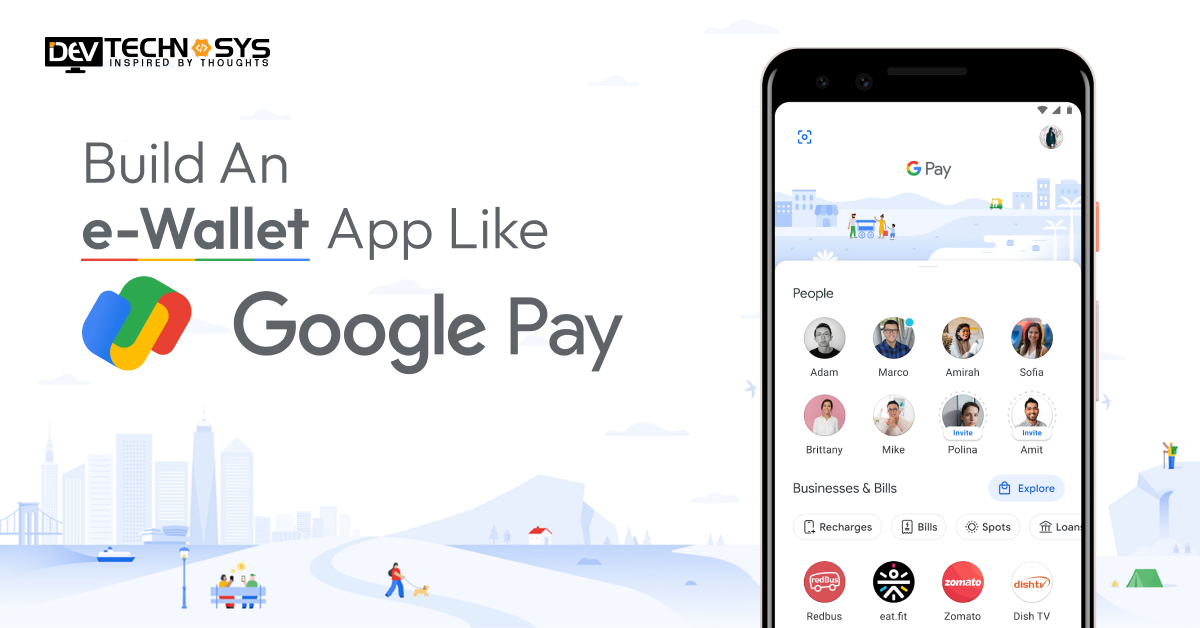
Google Pay refers to a digital wallet platform for mobile that enables users to send and receive money and manage their spending. Launched in 2015, it has gained over 1 billion downloads from the Google Play Store. This online payment system allows users to pay quickly and securely without needing physical debit or credit cards.
Banking app like barclays also contains features like self-transfer, bill payments, bank transfers, net banking, and pay contacts, and pay any number. It serves as a digital platform to store payment transaction history, loyalty cards, and tickets, with the help of technologies like Near Field Communication (NFC) for online, contactless payments in-store.
Global e-Wallet App Market Statistics
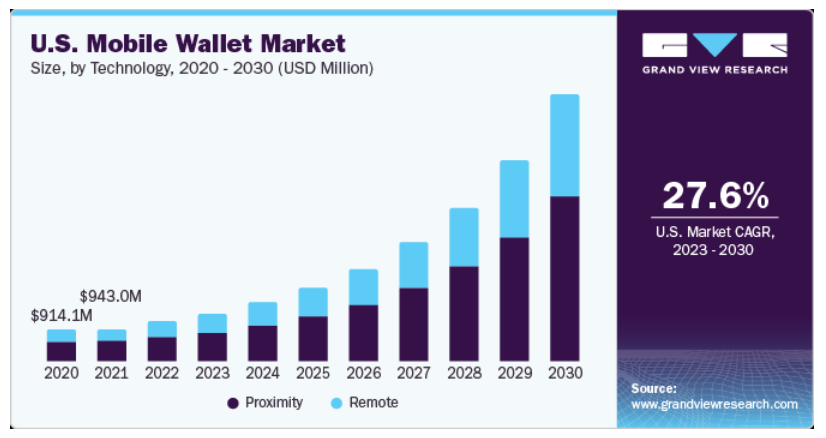
- The global mobile wallet market size was estimated at USD 7.42 billion in 2022 and is projected to reach USD 51.53 billion by 2030, growing at a CAGR of 8.5% from 2023 to 2030.
- Asia Pacific dominated the mobile wallet market in 2022 with a share of 32.3% and is expected to grow at the fastest CAGR of 28.9% during the forecast period.
- Latin America is expected to register at a significant CAGR of 28.6% over the forecast period.
- By technology, the remote technology segment is expected to grow at the fastest CAGR of 28.6% during the forecast period.
By application, the retail and e-commerce segment accounted for the largest revenue share of 32.0% in 2022 and is expected to maintain its position over the forecast period.
How Do Ewallet Apps Like Google Pay Apps Work?
Before we dive into the section on mobile wallet app development, you must learn how Google Pay and the incredible mobile wallet app work with this guide.
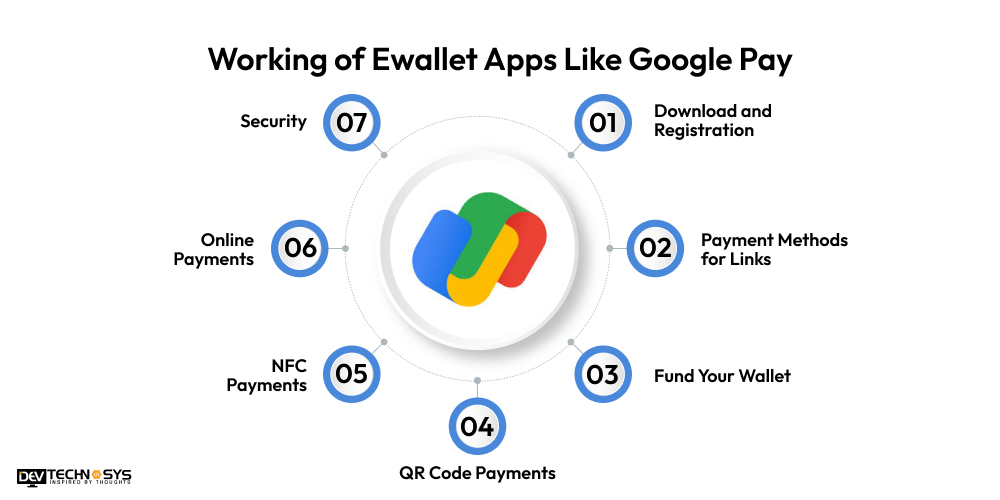
1. Download and Registration:
Download the e-wallet app from the app shop and fill out the specified information to create an account.
2. Payment Methods for Links:
Connect your e-wallet account to your financial institution’s money owed, credit/debit playing cards, or different charge techniques.
3. Fund Your Wallet:
You can use a debit or credit card or transfer cash from your connected bank account in your e-wallet.
4. QR Code Payments:
Enter the amount to be paid by scanning the QR code presented at the merchant’s point of sale (POS).
5. NFC Payments:
Tap your smartphone at the POS terminal to make a contactless price, which helps NFC.
6. Online Payments:
Use your e-wallet to make purchases on websites and packages that deliver e-wallet bills.
7. Security:
The best e-wallet applications use modern protection techniques, including tokenization, encryption, and biometric authentication, to protect your financial data.
Why Do Entrepreneurs Develop An Ewallet App Like Google Pay?
Many entrepreneurs want to develop an ewallet app like Google Pay, but only 1% know why it’s profitable and incredible. If you’re wondering, am I on that list? Let’s check it out. Check mark these five reasons to create an ewallet app like Google Pay and answer yourself: Are you the one?
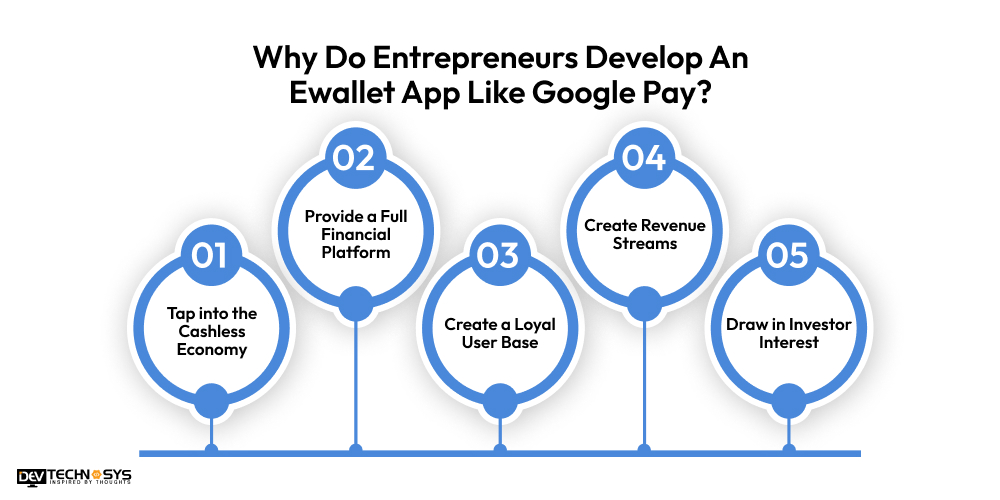
1. Tap into the Cashless Economy
This is a significant possibility because of the global shift toward digital bills. Entrepreneurs can take advantage of this trend and meet the increasing demand for secure and easy charge options by investing in cross-platform mobile app development.
2. Provide a Full Financial Platform
E-wallet apps can do more than facilitate transactions. Businesses can broaden a one-for-all monetary solution by combining functions like loans, investments, invoice charges, and money transfers. This will attract more customers and raise user engagement.
3. Create a Loyal User Base:
An adequately designed e-wallet app might cultivate a devoted user base through tailored offers, incentive schemes, and particular reductions. By understanding user alternatives and behavior, entrepreneurs can customize their on-demand app development solutions to fulfill certain needs, inspiring repeat use and brand advocacy.
4. Create Revenue Streams:
Transaction charges, merchant partnerships, interest on user deposits, and statistics monetization are only some of the revenue streams that other apps like Google Pay offer. Diversifying sources of income allows business owners to ensure long-term profitability and boom. So, if you want to create an ewallet app like Cashuu, invest immediately.
5. Draw in Investor Interest:
An adequately designed e-wallet application with a tremendous user base, a solid marketing strategy, and obvious room for expansion can attract a lot of interest from investors.
Entrepreneurs can obtain finance to amplify their companies and spur a boom by demonstrating the e-wallet apps like Freecharge sturdy return on funding.
You can reach out anytime; we are available 24/7. Our team provides a quick response.

Smart Steps to Build an App Like Google Pay
In this section, we have compiled a step-by-step guide to develop an app like Google Pay, which you must know. So, without wasting any second, let’s dive into this section for some Google Pay or buy now pay later app development fun.
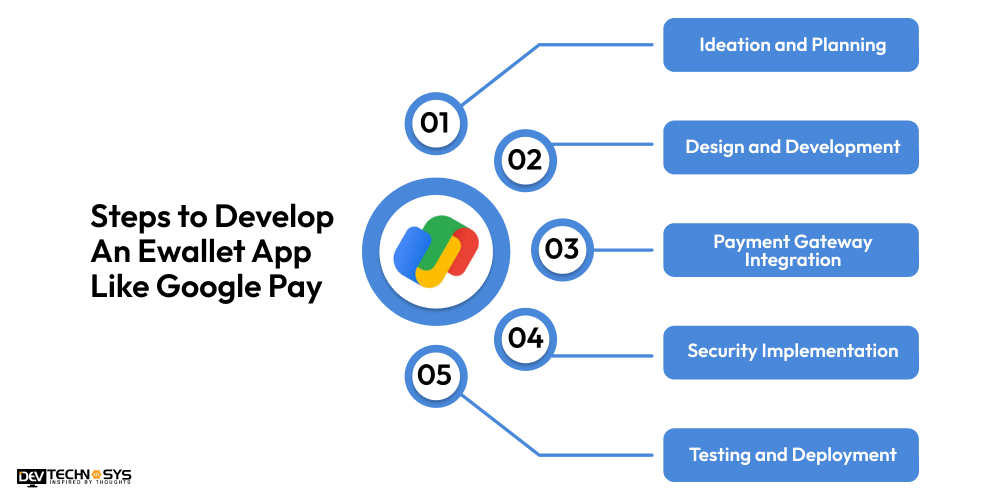
1. Ideation and Planning
To build an app like Google Pay, start by describing the main features, target market, and exceptional selling propositions of your app. In the beginning of the mobile app development process, conduct in-depth market research to locate opportunities and gaps.
Work with your banking app development company to provide a complete project plan and polish your idea. During this stage, to develop an ewallet app like Google Pay, the capability, user use race, and user experience are described.
2. Design and Development:
The next step in e-wallet app development is creating an intuitive and user-friendly app design. To develop an app like Google Pay, you need to hire skilled UI/UX designers with years of experience in creating custom layout designs and wireframes.
The designing phase includes schemes, typography, icons, and graphics. The UX design focuses on the overall user experience to ensure the app is intuitive, accessible, and provides a delightful and beneficial experience.
3. Development Phase
This stage of Google Pay app development can be divided into two major components: frontend and backend development. Besides them, API integration, security modules, and scalability planning are also part of this step.
The fintech app development company will begin building the frontend and backend of the Google Pay alternative app as soon as the design is complete. The backend controls server-side logic, data storage, and security, while the frontend handles pricing and the user interface.
4. Payment Gateway Integration:
To develop an app like Google Pay, you must facilitate clean transactions, including safe payment gateways with Stripe, PayPal, or Braintree. Contact your hired fintech app development company and ensure that the process of integrating APIs proceeds quickly while remaining compliant with all applicable security guidelines. For secure banking app development, a payment gateway integration is crucial.
Without a strong payment gateway integration, even a well-designed e-wallet app will fail to charm the users. It’s the backbone of secure banking app development, ensuring compliance, safety, and user confidence in every transaction.
5. Security Implementation:
This is the fourth stage to build an app like Google Pay, in which you must prioritize protection to safeguard consumer data and price range. Experts who provide android app development services will add robust security mechanisms like biometric authentication, tokenization, and encryption in the app. It is vital to remember to find the errors, bogs, or vulnerabilities early and do ongoing security audits.
6. Testing
To build an app like Google Pay, experts need to thoroughly test the G-Pay clone app before launch. The testing stage for a w-wallet app involves various testing methods, including unit, functional, security, performance, usability, and user acceptance testing (UAT. It ensures your app like Google Pay stays reliable, secure, and meets user expectations.
Key aspects to test include user registration, bank account linking, bill processing, and transaction security across different devices and operating systems.
7. App Deployment
According to experts who provide peer-to-peer payment app development, the deployment phase is the final stage of the Software Development Life Cycle (SDLC). Before deploying, ensure all compliance requirements, payment integrations, and security measures are finalized and tested.
Submit the app to iOS and Android app stores with all necessary assets like descriptions, screenshots, and privacy policies. After server and infrastructure setup and ensuring user access and data migration, make the app publicly available for download.
8. Maintenance and Support
Maintenance and support are a crucial part of developing an e-wallet app like Google Pay. In this stage service offers ongoing bug fixes, security patches, feature upgrades, scalability adjustments, and performance tracking.
It not only ensures the app remains functional, but also secure, and relevant for users and evolving market trends. This continuous effort is crucial for maintaining customer trust and a positive user experience after the initial launch.
“To develop an ewallet app like Google Pay collaboration with Dev Technosys became a calculated decision that has substantially modified our enterprise. Our concept was realized through their talented enterprise mobile app development company, which produced a secure and smooth virtual fee system. In addition to streamlining our business approaches, the online banking app development has improved client loyalty and satisfaction. Their professionalism, experience, and willpower to impart excellence have greatly inspired us.”
Allen Klester
Important FAQs
Q1 Can You Define Must-Have Payment Features For An e-Wallet MVP?
Yes, an e-wallet MVP should include essential features such as user registration & authentication, bank account linking, balance checking, money transfers (P2P), QR code payments, bill payments, and transaction history. These core features ensure a smooth user experience and validate your app idea before scaling with advanced functionalities.
Q2. What Security Standards and Compliance Requirements Are Needed for e-Wallets?
E-wallets must follow PCI DSS (Payment Card Industry Data Security Standard), GDPR (for data privacy in the EU), and local financial regulations like RBI guidelines in India or PSD2 in Europe. Compliance ensures legal acceptance, secure transactions, and protection of sensitive user data.
Q3. What Security Measures Are Crucial In Digital Wallet App Development?
Digital wallet apps must ensure high security with end-to-end encryption, two-factor authentication, biometric login (fingerprint/face recognition), and fraud detection mechanisms. Tokenization should be used instead of storing card details, and adherence to PCI DSS standards is crucial to safeguard user data.
Types of E-wallet Apps
Knowing about the process to create an ewallet app like Google Pay isn’t enough. You must tknow which sector you are entering with the e-wallets app. Apps for e-wallets have completely modified how we pay.
They offer a safe and clean way to do business, each online and rancid. These are some of the most popular classes of banking app development.
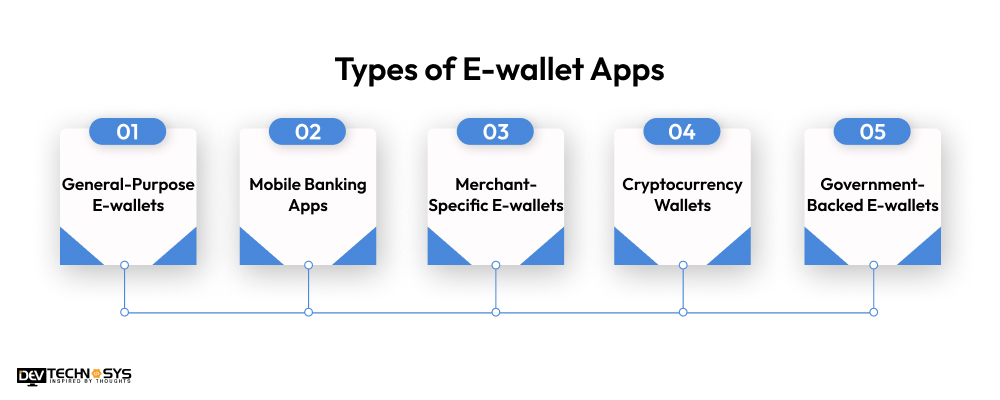
1. General-Purpose E-wallets
Online shopping, invoice charges, and peer-to-peer transfers are just a few of the numerous uses for those multipurpose e-wallets.
- Examples:Google Pay, Apple Pay, PayPal
- Benefits:
- Wide acceptance
- Multiple payment options
- Secure transactions
2. Mobile Banking Apps
Traditional banks provide those wallet app development, allowing customers to use their mobile phones to pay bills, switch cash, and get the right to enter their bank accounts.
- Examples:HDFC Bank Mobile Banking, ICICI Bank Pockets
- Benefits:
- Direct access to bank accounts
- Secure and reliable
- Additional banking services
3. Merchant-Specific E-wallets
Certain corporations or merchants have evolved digital payment apps for Android to promote purchaser loyalty and streamline bills within their network.
- Examples:Amazon Pay, Flipkart Pay
- Benefits:
- Exclusive offers and discounts
- Seamless checkout process
- Loyalty rewards
4. Cryptocurrency Wallets
These blockchain app development are designed to shop, send, and acquire cryptocurrencies like Bitcoin and Ethereum.
- Examples:Coinbase Wallet, MetaMask
- Benefits:
- Access to the world of cryptocurrencies
- Secure storage of digital assets
- Potential for high returns

5. Government-Backed E-wallets
These government-backed e-wallets are frequently utilized for digital payments, social welfare programs, and tax collection.
- Examples:UPI-based apps in India like PhonePe, Google Pay, and Paytm
- Benefits:
- Secure and reliable
- Wide acceptance
- Government benefits and subsidies
The demands and tastes of all and sundry determine which e-wallet to use. By being privy to the various sorts and their features, users can develop an ewallet app like Google Pay for their financial requirements.
Unique & Essential Features of App Like GooglePay
Having a list of must-have and unique features of Google Pay app is a must. Yes, you heard me right. There are multiple apps in the market, but if you want to fight the market, you need a blast of features to make your app attractive. So here is a list of unique features you need to add to your process to develop an ewallet app like Google Pay.
1. Admin Panel
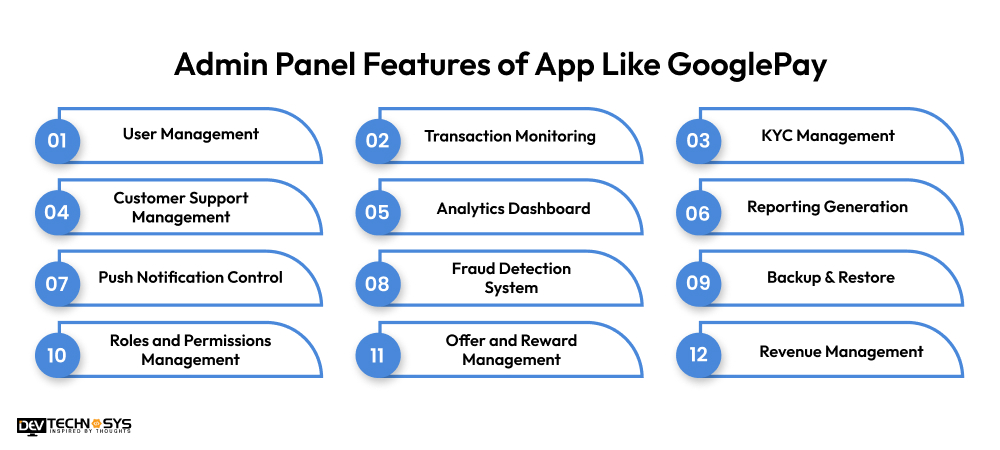
1. User Management
Facilitates powerful user account administration, tracking, and verification to stop fraud and enhance consumer experience.
2. Transaction Monitoring:
If you want to develop an eWallet app like Paytm don’t forget to add a transaction monitoring feature. It enables directors to peer, monitor, and examine every transaction to ensure safe and green cash transfers.
3. KYC Management:
Offers resources to supervise KYC approaches for user validation, helping in adherence to felony and regulatory requirements.
4. Customer Support Management:
An all-in-one dashboard to handle consumer problems and quickly cope with inquiries to enhance user satisfaction.
5. Analytics Dashboard:
Provides up-to-date statistics on revenue manufacturing, transaction volume, and user pastime.
6. Reporting Generation:
Reporting generation is a crucial feature to add to an e-wallet app. It permits automatic reporting on customers, transactions, and financial summaries to evaluate the performance of an app like PayPal.
This feature lets directors send personalized push notifications to focused customers for indicators, promotions, or modifications.
7. Fraud Detection System:
This react native app development monitors questionable interests and implements security measures to forestall fraud and protect people’s money.
8. Backup & Restore:
An app like Brigit includes a backup and restore feature, as it enables safe data backup. It also allows healing in times of payment system breakdown, stopping financial loss.
9. Roles and Permissions Management:
Team members should be assigned excellent roles and permissions to improve inner control. Include this feature when you create an ewallet application like Google Pay.
10. Offer and Reward Management:
Directors could make, alter, and oversee offers, reductions, and praise factors to keep customers engaged.
11. Revenue Management:
An ewallet app like Cash App includes a revenue management feature. It maximizes revenue, sales control monitors income from expenses, commissions, and other monetization channels.
2. Owner Panel
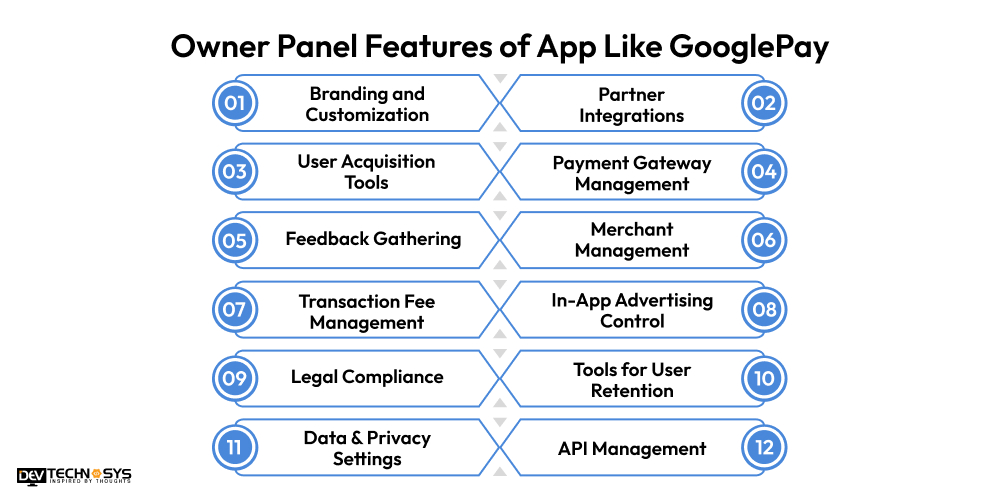
1. Branding and Customization:
It allows proprietors to adjust the topic, logo, and online shopping app development interface to better reflect their logo and make it more user-friendly.
2. Partner Integrations:
To make a similar app like Google Pay, form profitable collaboration. Oversees collaborations with banks, stores, and outside providers to improve the carrier environment.
3. User Acquisition Tools:
The user acquisition gear segment includes marketing equipment for onboarding new customers through referral schemes, sales, and advertising campaigns.
4. Payment Gateway Management:
To create Google Pay alternatives, add a feature like payment gateway management. Payment gateways ensure easy transactions across various networks and services through price gateway management.
5. Feedback Gathering:
Google Pay alternatives include gathering feature feedback. Gathering corrective feedback and reviews from real users helps enhance utility and performance, thus increasing user satisfaction.
6. Merchant Management:
Oversees service provider profiles, allowing commission units, onboarding, and transparent performance tracking with online payment apps like Google pay

7. Transaction Fee Management:
E-wallet mobile app development needs feature input like transaction fee management. Transaction fees are set and changed according to market traits to optimize sales while preserving competitiveness.
8. In-App Advertising Control:
This feature permits e-wallet app development companies to display commercials inside their apps to generate extra profits and monetize their apps.
9. Legal Compliance:
Protects customers and the popularity of mobile app development trends by ensuring adherence to national and global economic regulations.
10. Tools for User Retention:
Alternatives to Google Pay include cashback incentives, loyalty plans, and prizes to increase user happiness and retention.
11. Data & Privacy Settings:
This section sets up record-processing tactics to protect user facts and guarantee adherence to privacy guidelines.
12. API Management:
Oversees third-party APIs to facilitate seamless interaction with external structures and effective service integration. If you are building an e-wallet app like Google Pay, adding this feature is necessary.
3. User Panel
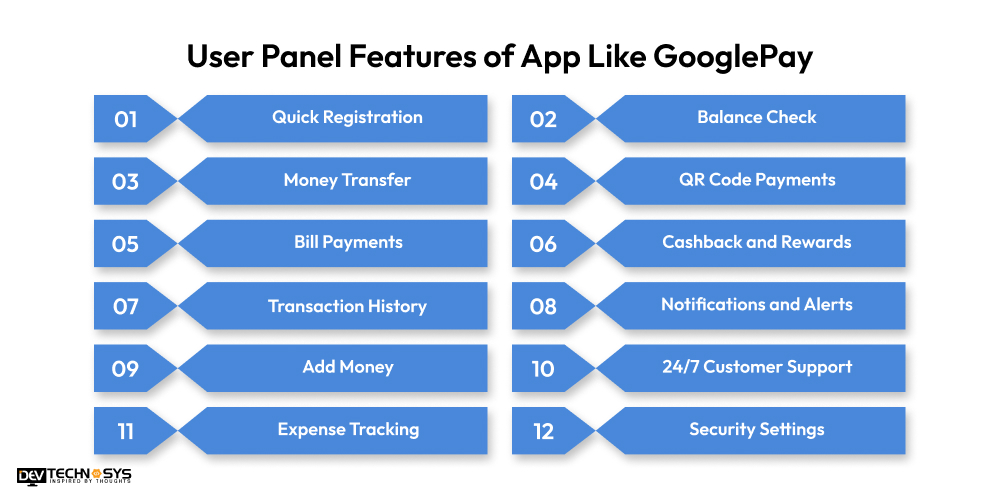
1. Quick Registration:
For convenient consumer onboarding, a short and clean sign-up system with social networking, telephone, or email login options.
2. Balance Check:
It gives clients speedy access to their contemporary stability and on-the-spot access to real-time account records.
3. Money Transfer:
With few transaction expenses and delays, ship cash securely to bank accounts, smartphone numbers, or app users.
4. QR Code Payments:
This technology lets customers transact quickly and contactless with friends and companies by scanning and paying with QR codes.
5. Bill Payments:
It is a one-forestall software program for bill settlements, facilitating the easy price of credit score card payments, application payments, and other fees.
6. Cashback and Rewards:
Encourages user loyalty and engagement by providing cashback rewards and transaction factors.
7. Transaction History:
Provides an intensive transaction history for tracking spending and confirming price records with ewallet app like PayPal.
8. Notifications and Alerts:
Offers on-the-spot alerts concerning forthcoming bills, successful transactions, and updates to reward factors.
9. Add Money:
Customers can add money from related financial institution accounts or credit cards for problem-free wallet recharges and top-ups.
10. 24/7 Customer Support:
Get help and assistance with any problems through smartphone, email, or chat, ensuring spark off trouble-solving.
11. Expense Tracking:
Assists purchasers in dealing with their financial well-being by providing price range management gear and spending information.
12. Security Settings:
Customers can configure aspect authentication, fingerprint or facial recognition, and PINs for expanded account protection.
How Much Does It Cost to Develop An Ewallet App Like Google Pay?
The cost to develop an ewallet app like Google Pay is around $8,000 to $25,000 or higher. The cost to build an ewallet app like Google Pay with basic features and functionalities is less.
However, if you want to develop an ewallet app like Google Pay with advanced features like revenue management and user acquisition tools, then the development cost will be higher. The following are a few vital variables that may affect the total Google Pay mobile app development cost:
| Phase | Timeline | Cost (USD) |
| Discovery & Planning | 1–2 weeks | $1,000 – $2,000 |
| UI/UX Design | 2–3 weeks | $1,500 – $3,000 |
| Backend Development | 4–6 weeks | $3,000 – $5,000 |
| Mobile App (iOS & Android) | 4–6 weeks | $3,000 – $5,000 |
| Integrations (gateway, KYC, QR) | 1–2 weeks | $1,000 – $2,000 |
| Security & QA | 2–3 weeks | $1,500 – $3,000 |
| Deployment | 1 week | $800 – $1,500 |
| Maintenance (initial) | 1–3 months | $1,000 – $2,500 |
What Factors Can Affect the Cost to Build an App Like Google Pay?
Here are the factors that affect the cost of creating an e-wallet app like Google Pay. It is advised to consider these factors before determining the budget for building an e-wallet app like Google Pay.
1. App Complexity and Features:
The cost to build an ewallet app will be immediately impacted by the intricacy of your ewallet software and the functions you wish to include. An app with complex capabilities like biometric identification, AI-powered fraud detection, and integration with numerous fee gateways may be more expensive than a primary ewallet app development with skills like consumer registration, login, fund transfer, and transaction history.
Features and Functionality |
Cost Range (USD) |
| Basic | $2,000 – $4,000 |
| Enhanced | $4,000 – $7,000 |
| Advanced | $7,000 – $10,000 |
2. Platform Selection:
The cost to develop an ewallet app like Google Pay will rely upon whether deciding to create it for iOS, Android, or both. In standard, creating for each structure will be more highly priced than simply one.
Platform Choice |
Cost Range (USD) |
| iOS Only | $27,000 |
| Android Only | $23,000 |
| iOS and Android | $30,000 |
3. Design and User Interface:
Your e-wallet app’s design and user interface (UI/UX) greatly impact how well users interact with it and how quickly it is, followed by the ewallet app development cost. An app that is properly designed and has an easy-to-use UI can attract more users and enhance interaction. However, a complex design may also increase the cost to develop an ewallet app like Google Pay.
Design and UX |
Cost Range |
| Basic design and UX | $5,000 – $10,000 |
| Custom design and complex UX | $10,000+ |
4. Development Team Expertise:
The experience and expertise of your fintech app development services providers can significantly influence the general cost to build an ewallet app like Google Pay. Although they might charge extra, a group of skilled developers with a solid grasp of fintech and mobile app development can produce a first-rate app.
Development Team |
Cost Range (USD) |
| Small (1-2 developers) | $8,000 – $12,000 |
| Medium (3-5 developers) | $12,000 – $18,000 |
| Large (5+ developers) | $18,000 – $25,000 |
| Premium (Specialized team) | $25,000 – $100,000 |
5. Security and Compliance:
Since online payment apps like Google Pay manage private financial records, safety, and adherence to industry requirements, including PCI DSS, should be given top precedence.
The cost to develop an ewallet app like Google Pay might also increase if sturdy safety functions like multi-component authentication, tokenization, and encryption are applied.
Security & Compliance Factor |
Estimated Cost Impact |
| Data Encryption | $5,000 – $15,000 |
| Two-Factor Authentication (2FA) | $3,000 – $8,000 |
| PCI DSS Compliance | $10,000 – $25,000 |
| Fraud Detection Systems | $8,000 – $20,000 |
| Regulatory Compliance (e.g., GDPR) | $5,000 – $15,000 |
| Security Audits & Testing | $7,000 – $12,000 per audit |
6. Integration with Payment Gateways:
Integrating your e-wallet software with several payment gateways can give your customers freedom and convenience. However, it may also enhance the general Google Pay app development cost and complicate the development method.
Payment Gateway Integration |
Estimated Cost Range |
| Basic Integration | $5,000 – $10,000 |
| Multiple Gateways | $10,000 – $20,000 |
| Advanced Integration with Security | $20,000 – $35,000 |
7. Ongoing Maintenance and Support:
Following initial digital wallet app development, you may want to set aside a Google Pay app development cost range for customer support, enhancements, and upkeep. This includes repairing issues, sparkling functionalities, and guaranteeing the safety and capability of apps like Google Pay for Android.
App Store and Maintenance |
Cost Range |
| App Store fees and annual renewals | $55 – $100 |
| Maintenance | $2000 – $5,000 |
Estimated Price:
Depending on the aforementioned variables, cost to build an ewallet app like Google Pay everywhere is from $8,000 to $27,000 or more. For a more excellent particular estimate based on your unique requirements, it is crucial to talk with a pro ewallet app development company.
You can also create a secure, easy-to-use, reasonably priced e-wallet app by carefully weighing these variables and participating in an informed ewallet app development company.
How Do Ewallet Apps Like Google Pay Make Money?
Google Pay and different ewallet app development services use these amazing of methods to make money:
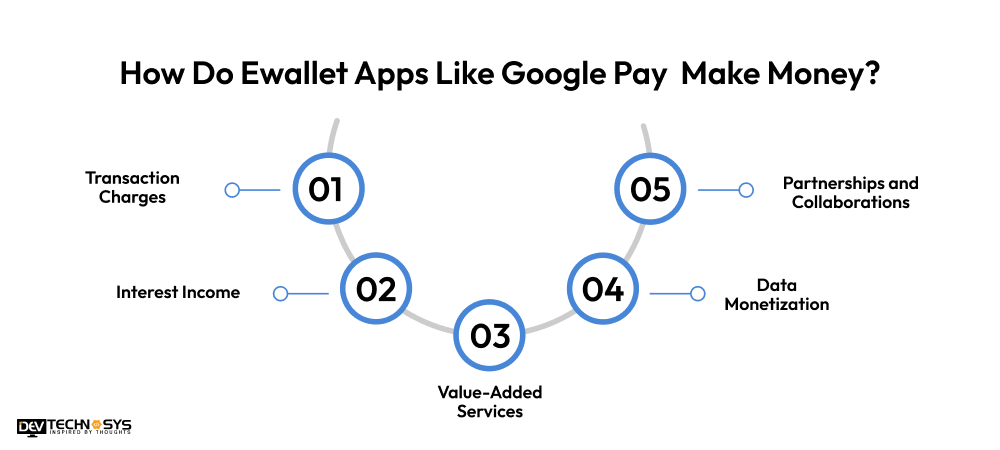
1. Transaction Charges
E-wallet apps usually earn money by charging merchants tiny fees for every transaction completed using their platform. This fee is usually expressed as a percent of the total transaction cost.
2. Interest Income
Many user coins are often stored in e-wallet programs. Users can earn interest by investing in short-term, low-chance securities like Treasury bills or government bonds.
3. Value-Added Services
By offering more offerings like loans, investments, insurance, and bill payment, e-wallet apps grow their earnings resources. These offerings receive charges or commissions.
4. Data Monetization
E-wallet apps accumulate vital user statistics, including demographics, spending trends, and transaction histories, during app development. Businesses can gain insights from this information by anonymizing and aggregating it, taking into account market studies and targeted advertising.
5. Partnerships and Collaborations
Banks, stores, and other economic corporations collaborate with e-wallet apps. These collaborations may also result in unique offers, revenue-sharing plans, and co-branded products, which might increase earnings.
Future Trends That Will Shape The Future Of E-Wallet App Development
Technology is advancing at a rapid rate, with many new trends and innovations emerging every now and then. Here are some of the future trends that are shaping the future of digital wallet app development.
1. Enhanced Integration
E-wallets will evolve into super apps, connecting multiple services under one roof. This creates a unified financial ecosystem for both consumers and merchants. E-wallet apps are used for more than just retail and bill payments. Build an app like Google Pay with:
- Integration of Public transport systems for ticketing and passes.
- Healthcare integration for paying consultation fees or insurance premiums.
- Retail loyalty programs syncing with wallet rewards.
2. Enhanced Security
Adaptive authentication that adapts to user behavior and device context. This ensures robust protection against fraud while keeping the user journey frictionless.
- Security innovations will go beyond biometrics:
- Zero-knowledge proof protocols to verify identities without revealing sensitive data.
- Decentralized identity management (DID) powered by blockchain.
3. AI and Machine Learning
Build an app like Google Pay with technologies like artificial intelligence and machine learning. AI and ML will make e-wallets smarter and provide better predictions. AI and ML integrate:
- Voice assistants for making/initiating payments.
- Dynamic credit scoring according to the users’ spending habits, enabling microloans.
- Predictive analytics for reminding users of bout recurring bills, and suggesting the best payment methods.
4. Cryptocurrency Integration
As regulations stabilize, you can expect an increase of cryptocurrency support in wallet:
- Stablecoin payments for reduced volatility in day-to-day transactions.
- Crypto-to-fiat conversion at point-of-sale for wider merchant adoption.
- DeFi (Decentralized Finance) integration, letting users lend, borrow, or stake assets directly from their wallets.
5. Global Expansion
Banking application like Chime benefits from the cross-border commerce expansion. The e-wallet apps are bridging the gaps with:
- Instant remittances with lower transaction costs.
- For Global reach, it possesses multi-language and multi-currency support.
- Compliance automation with local financial laws to ease international expansion.
6. IoT Integration
IoT-driven wallets will enable payments in everyday environments:
- Smart refrigerators reordering groceries and paying automatically.
- Connected cars handling tolls, parking, or EV charging seamlessly.
- Smart retail checkout (Amazon Go style) where payments are made automatically when you exit the store.
Conclusion
In the above blog, we explained how to build an ewallet mobile app like Google Pay to the best of our ability. We hope it clears any doubt or confusion you might have regarding how to build an e-commerce app. As digital payments continue to evolve, integrating technologies like AI, blockchain, cryptocurrency support, and IoT will be the next step in ensuring your e-wallet app stays competitive and future-ready.
If you are looking for a mobile app development company to build a market oriented e-wallet app, then turn to Dev Technosys. Our experts possess the knowledge and competencies to help you with every step of the development procedure.Contact us now to discuss your task and discover how we can help you remodel virtual bills.