
















Decentralized finance has completely changed the way people handle their money. It allows you to easily lend, borrow, earn, or trade without the need for a bank. But this freedom also brings new risks.
So, do you remember that time when a huge amount of data was hacked in DeFi?
According to Chainalysis’s 2023 Crypto Crime Report, DeFi protocols accounted for 82.1% (approximately $3.1 billion) of the total cryptocurrency stolen by hackers in 2022, compared to 73.3% in 2021.
That is precisely why security is absolutely essential to prevent cyberattacks and hacking.
Welcome to this information blog. We will discuss in detail about the DeFi security, key challenges, and how to overcome them.
This blog also helps businesses learn how to make a safer, more secure, and reliable DeFi application.
Let’s go down!
What Is DeFi Security?
Basically, DeFi security protects decentralized finance smart contracts, wallets, platforms, and user funds and transactions from fraud and hackers. DeFi security uses many advanced functionalities, such as access controls, monitoring, encryption, audits, secure coding, and more.
These decentralized finance security measures reduce the risk and help to prevent financial losses. Reliable DeFi security keeps the DEX development services trustworthy and offers seamless transactions.
Planning a Blockchain Project?
Get a tailored development cost estimate in a few simple steps.
- 3 quick steps
- 100% free
- Reply in 1 business day
2 Minutes Read
How Does Security Work in DeFi?
In this section, we discuss how security works in DeFi and the features it provides to ensure that transactions and financial data remain safe and secure. Let’s take a look at how security works in decentralized finance.
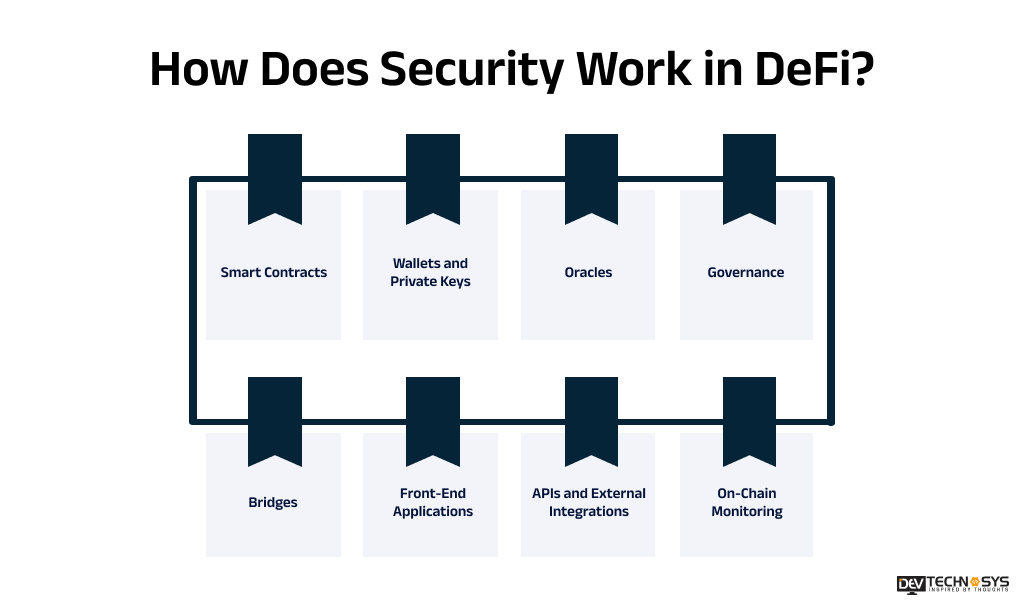
1. Smart Contracts:
Carrying out DeFi security audits, testing, and reliable programming of smart contracts allows the identification of flaws within them before bad actors can use these DeFi security vulnerabilities to take users’ funds.
2. Wallets and Private Keys:
The use of secure wallets, including hardware wallets, two-factor authentication (2FA), and secure private key storage, is crucial for preventing unauthorized access to assets of users.
3. Oracles:
The usage of secure oracles, verified through multiple methods and employing various sources of information, ensures that precise data is presented, while manipulations cannot affect the retrieval of incorrect information.
4. Governance:
The presence of secure voting technologies, proposal control over the outcomes of voting, time lock mechanisms, and governance processes ensures that users’ interests will not be overlooked.
Market Insights:
“As per the report of TRM Labs, in H1 2026, crypto attacks reached a record 207 incidents, while losses totaled $972 million, highlighting persistent security pressure.”
5. Bridges:
Secure bridges employ transaction verification technologies, validator governance limitations, and constant monitoring of transaction effectiveness to minimize risks associated with the transfer process.
6. Front-End Applications:
Secure user interfaces let users avoid phishing, dangerous transactions, and misleading information by implementing authentication, code review, and using trusted deployment methods.
7. APIs and External Integrations:
Secure Application Programming Interfaces protect against attackers who might target remote services or systems through authentication, encryption, access control, validation, and by monitoring the systems, ensuring that possible cyber incursions are blocked.
8. On-Chain Monitoring:
Continuous monitoring of blockchain technology allows one to detect transactions that appear to be suspect, peculiar movements occurring in wallets, abuse of smart contracts, and abnormal activities.
What Are the Biggest DeFi Security Challenges?
Cross-chain DeFi platforms also face security risks such as smart contract bugs, flash loans, front-running, bridge attacks, or oracle manipulation. Businesses must know about these DeFi security challenges to identify DeFi vulnerabilities early, protect user funds, and strengthen their protocols.
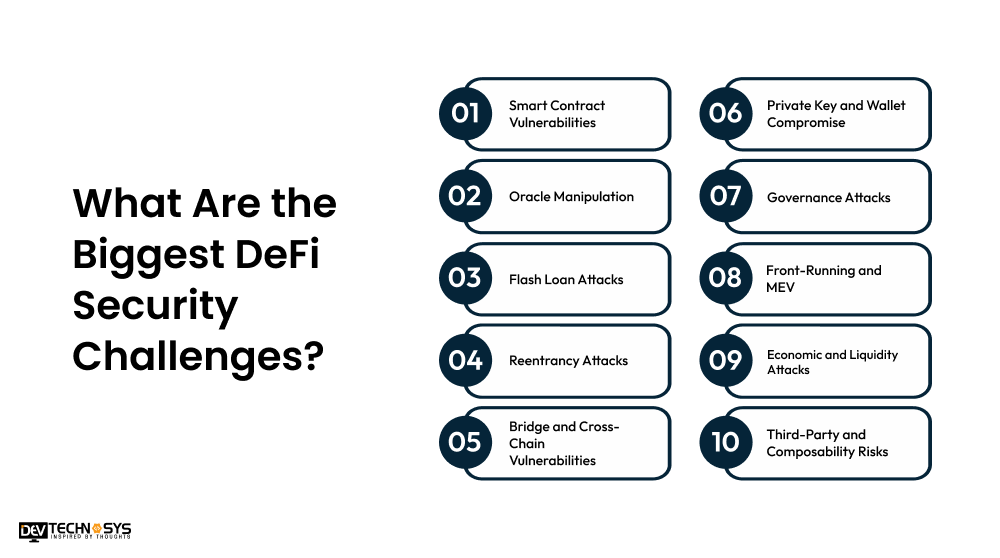
1. Smart Contract Vulnerabilities
Smart contract bugs allow attackers to bypass restrictions, steal funds, and alter the protocol’s behavior. Common and known issues include weak access controls, logic errors, unsafe external calls, reentrancy, poor input validation, and arithmetic mistakes.
OWASP reports $1.42 billion lost across 149 documented Web3 security incidents in 2024, with access-control and logic flaws among major attack vectors. To mitigate these DeFi risks, DeFi security best practices such as code reviews, automated testing, secure coding, and independent audits can be employed to identify vulnerabilities before the contracts go into production.
2. Oracle Manipulation
Decentralized finance networks require the use of oracles in order to connect different information, such as prices of financial instruments, to the blockchain. This gives scammers more opportunities to influence the prices, as they may rely on inaccurate or single-purpose data sources.
Chainalysis estimated that DeFi protocols lost $403.2 million across 41 oracle-manipulation attacks in 2022, highlighting the risk of unreliable price feeds.
The most effective DeFi security solutions to the problem are decentralized oracle networks, TWAP price averaging, validation of incoming information, and creation of fallback strategies.
3. Flash Loan Attacks
Flash loans make it possible to get massive amounts of crypto security without traditional forms of guarantee, as long as the loan is paid back in the same transaction.
This provides scammers with a chance to misuse the money for price manipulation, liquidity modification, or governance decisions. EBA and ESMA research found that approximately 20% of value theft from DeFi protocols was associated with flash-loan attacks.
To avoid these types of situations, companies can use strong oracle systems, with the help of slippage control, limits on the number of transactions, and invariant economic tests.
4. Reentrancy Attacks
A reentrancy attack happens when a hacker calls another contract many times before completing the first transaction. This can result in draining the funds repeatedly. Developers may minimize these kinds of DeFi attacks by following the checks-effects-interaction pattern.
A 2025 systematic academic review estimates that reentrancy attacks caused approximately $350 million in financial losses by 2023. Use a reentrancy guard, limit the number of external calls, and thoroughly test the contract interaction.
5. Bridge and Cross-Chain Vulnerabilities
Blockchain bridges can enable communication between multiple networks, but they have some vulnerabilities. Attackers can hack bridge contracts, manipulate or even hack validators and private keys, change messages that were communicated through the bridge, or attack some wrapped assets.
Chainalysis reported that cross-chain bridge attacks accounted for $2 billion stolen across 13 hacks, demonstrating the high risk of bridge infrastructure. The means to reduce cross-chain vulnerability risks are a robust message verification system, secure validator management, and multi-signature controls.
6. Private Key and Wallet Compromise
When the private key is compromised, this will allow the hacker to control anything that involves valuable DeFi assets. Common causes can be phishing attacks, using hot wallets, hacking seed phrases, and poor key management.
Chainalysis found that private-key compromises accounted for 43.8% of stolen cryptocurrency in 2024, making key security a critical priority. Ways to improve the smart contract security of wallets include using multisig wallets, hardware wallets, separation of functions, keeping keys safe, rotating keys frequently, and setting limitations on transactions.
7. Governance Attacks
It is possible to attack the governance system of DeFi protocols when attackers have enough voting rights to approve malicious proposals or changes in vital settings of the protocol.
Flash loans, concentrated token ownership, compromised governance keys, and weak voting rules are factors increasing the risk. In March 2026, an attempted Moonwell governance attack reportedly used only $1,800 in tokens to threaten approximately $1.08 million in protocol funds. Timelocks, quorum requirements, delegation, voting controls, and emergency response are methods that ensure blockchain security.
8. Front-Running and MEV
Front-running refers to a scenario whereby an attacker is able to gain knowledge of pending transactions and uses this to transact ahead of the original trade. MEV bots can perform a sandwich attacks whereby the bot places transactions before and after a transaction that someone else is trying to do.
DeFiLlama’s 2025 State of DeFi report identifies MEV and market integrity as major areas shaping the evolving DeFi trading infrastructure. Implementing slippage limits and transaction ordering DeFi protections, as well as having private transaction systems, may help reduce these cases.
9. Economic and Liquidity Attacks
Not all attacks on DeFi protocols are dependent on security holes but rather may include some sort of way by which the attacker can manipulate liquidity, token prices of the tokens, or withdrawals and trigger significant cascading liquidations or bad debt.
DeFiLlama highlights liquidity constraints, market volatility, collateral shortfalls, and liquidation risks as major sources of protocol-level financial risk.
It is important for every protocol to study economic risk before launching it to implement proper liquidity controls and monitor ongoing situations in the marketplace.
10. Third-Party and Composability Risks
DeFi protocols rely on other systems such as lending platforms, DEXs, bridges, oracles, stablecoins, and tokens introduced by external parties. DeFiLlama identifies composability and interdependency risks as key concerns because interconnected protocols can amplify failures across the ecosystem.
This composability is great since it gives more opportunities, but it also provides the attacker with additional attack vectors because if the third party is compromised, it significantly affects the entire chain of connected protocols.
Free App Idea Reality Check: Let's Stress-Test Your Concept
Share your app idea with us. Within 3 business days, we'll uncover UX gaps, feature opportunities, and potential development challenges, so you can build with confidence. No strings attached.
Common DeFi Attack Vectors at a Glance
Many forms of attack can jeopardize DeFi protocols, resulting in financial setbacks, service interruptions, and loss of trust among users. By understanding these kinds of DeFi security threats, developers and companies can reinforce DeFi security measures.
DeFi security risks involve exploitation of smart contracts, flash loan attacks, manipulation of oracles, reentrancy, phishing, governance attacks, bridge exploitation, and failures in access control.
Attack Vector |
What Happens |
Potential Impact |
Prevention |
| Reentrancy | Contract is called repeatedly | Fund theft | Reentrancy guards |
| Oracle Manipulation | Price data is distorted | Incorrect borrowing/liquidation | Decentralized oracles |
| Flash Loan Attack | Large temporary liquidity is abused | Price/governance manipulation | Invariant checks |
| Access-Control Attack | Unauthorized function access | Contract takeover | RBAC + multisig |
| Bridge Attack | Cross-chain verification is compromised | Asset loss | Strong formal verification |
| MEV Attack | Transactions are reordered | User losses | Slippage/MEV protection |
| Key Compromise | Admin credentials are stolen | Protocol takeover | Multisig + secure custody |
How to Improve DeFi Security?
The security of DeFi is not merely dependent on post-deployment bug-catching. Secure coding, automated testing, independent audits, access permissions, continual surveillance, and a valid emergency plan must be used. All these steps function to avoid weaknesses, identify irregularities quickly, safeguard vital processes, and decrease the losses coming from attacks.
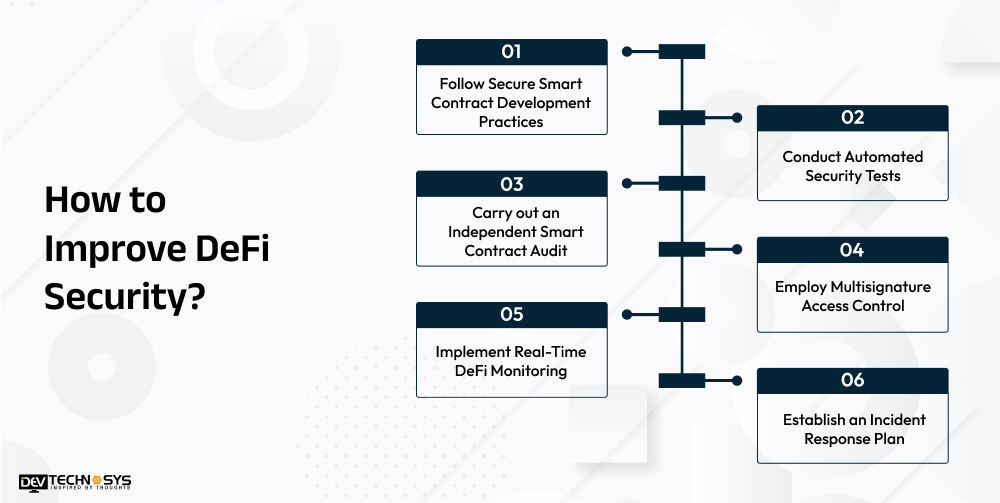
1. Follow Secure Smart Contract Development Practices
Begin with a straightforward design that is easier to comprehend, test, and manage. Always use version control to monitor every change made to the codebase and rely on trusted and widely used libraries.
Maintain strong access control of sensitive functions by implementing defensive programming. Avoid releasing code without going through the review process by various developers.
2. Conduct Automated Security Tests
Automated testing is capable of spotting DeFi security vulnerabilities before smart contracts are deployed. Static analysis assesses code without executing it, while dynamic analysis observes the code while an application runs it.
Fuzz testing sends unexpected inputs to the code, while symbolic execution looks at different execution routes. Invariant testing verifies whether critical security conditions continue to hold in new conditions once the code has been tested.
Industry Insights:
“According to the IMF, Tokenized finance is developing rapidly, making international coordination increasingly important for achieving reliable settlement and legally recognized transaction finality.”
3. Carry out an Independent Smart Contract Audit
A smart contract audit that is independent provides an added security layer before deployment. The auditors should perform manual code review, analyze business logic and economic risks, find out weaknesses, and offer solutions.
High-value protocols could be subject to several independent audits. After the errors are fixed, the smart contract development code should be tested again. A smart contract audit lessens risks but does not ensure a hundred percent security.
4. Employ Multisignature Access Control
It is expensive to rely on a single secret key for the majority of administrative actions. Multisignature access control needs approval from several stakeholders for important actions.
It lessens the effect of stolen wallets and insider attacks. Use multi-sig protection for tasks like contract upgrades, treasury transfers, changes in parameters, and emergency administrative actions.
5. Implement Real-Time DeFi Monitoring
Persistent monitoring can help in spotting any abnormal actions prior to any major loss. Get updates on significant transactions, strange withdrawals, price inconsistencies, transfer of liquidity, governance actions, contractual happenings, and odd wallet behavior.
Automated alerts could warn security units once any preset limit is exceeded or anything goes off the normal course. The real-time accessibility means that the troubleshooting teams will be able to manage the attack in no time.
6. Establish an Incident Response Plan
A DeFi protocol security team must have a properly developed incident response plan prior to an attack. All parties must have their roles assigned to each worker, channels for communication established, emergency authorizations provided, as well as recovery processes worked out in advance.
A good response process looks like the DeFi threat detection of any abnormal activities, confirmation of the hazard, restricting processes, safeguarding privileged accounts, and uncovering the reason for the incident.
DeFi Security Testing Checklist for Safer Protocols
Ensure you use this checklist prior to starting or enhancing a DeFi stacking platform development solution. Check to see if security testing covers any smart contracts, economic behavior, infrastructure, and cross-chain functionalities because something can be secure from a technical point of view yet still be vulnerable to an attack that is caused by market manipulation, dangerous keys, poor API, etc.
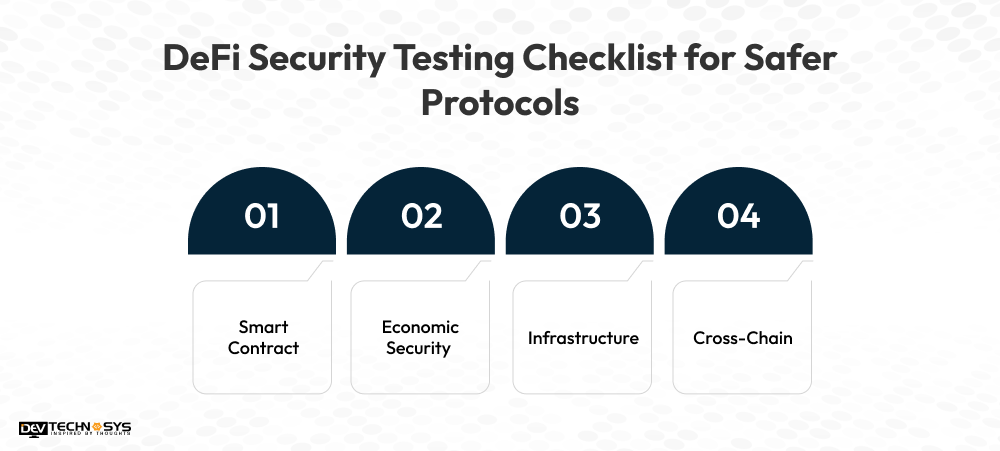
1. Smart Contract
i. Testing Access Control:
Ensure that sensitive operations such as upgrades, withdrawals, parameter alterations, and emergency procedures can only be executed by authorized addresses or roles.
Run tests to check for unauthorized calls, illicit elevation of roles, hacked administrators, and incorrect permissions to guarantee that such operations cannot be performed by unauthorized individuals or hackers.
i. Testing for Reentrancy:
Determine if third-party calls can be exploited to invoke a function again before its prior execution has been terminated. Run tests on withdrawals, token transfers, callbacks, and other important functions. Ensure that the code has been properly updated and the re-entrancy guards and checks-effects-interactions patterns are operational.
ii. Validation of Input:
Verify that all inputs made by users are checked for validity, abnormal, extreme, or malicious nature. Verify the validation of amounts, addresses, prices, deadlines, parameters, and numerical ranges.
2. Economic Security
i. Analyzing Price Manipulation:
Determine if attackers have the potential to modify the price determined by the system through trading on pools where liquidity is shallow, executing trades in the manner of a sequential trading activity, exploiting weaknesses in the oracle, or fluctuations in the market.
Confirm that the pricing mechanism captures data from authentic sources and is equipped with the necessary security features, making its design resistant to storage manipulation before executing swap operations.
ii. Testing Flash Loan Scenarios:
Investigate whether attackers manipulating prices can take a flash loan exploit and use it for several transactions or across multiple protocols without depositing any collateral upfront.
Determine whether flash loans can be used for any kind of negotiations, governance, collateral values, liquidity pools, and rewards. Moreover, check whether the protocol is vulnerable to temporary market manipulations.
iii. Conducting Liquidity Stress Tests:
Find out how the protocol behaves during sheer liquidity withdrawals, high trading volumes, large-scale deposits, and sudden changes in the market. Make sure that pools, lending markets, and withdrawal functions are working.
DeFi lending protocol development solutions find the beginnings of situations when there could be a lack of liquidity leading to unfair pricing and failed withdrawals.
3. Infrastructure
i. Wallet Security:
Assess wallets being used by end-users, administrators, treasury teams, and operational staff. Verify transaction authorization, phishing avoidance mechanisms, use of multiple signatures, session security, and recovery. High-value wallets need suitable security protocols to limit damage from account breaches.
ii. RPC Security:
Inspect blockchain RPC endpoints for unauthorized access, misuse of resources, rate limit issues, request manipulation, and availability issues. Secure private and administrative RPC endpoints against misuse. Also, monitor strange activity coming from RPC endpoints. Multiple reliable RPC systems may increase the resilience of RPC services.
iii. API Security:
Protect APIs that connect to front-end applications, dashboards, analytical platforms, and any external services. Check authentication, authorization issues, validation of inputs, rate limiting, data exposure, injection attacks, and endpoint abuse. Make sure APIs cannot be utilized to authenticate administrative access or acquire confidential data from internal systems.
4. Cross-Chain
i. Bridge Validation:
Examine bridges for problems in asset accounting, unauthorized minting and destruction, replay attacks, validation malfunctions, and message processing issues.
Ensure the correctness of deposit and withdrawal validation between various networks. Testing of bridge protocols has to account for instances of network congestion, unexpected messages, validators being compromised, or any anomalies with transactions.
ii. Message Verification:
Ensure the messages exchanged in a cross-chain manner are authenticated, correctly formatted, distinguished from one another, and processed in a single instance.
Test unauthorized messages and replayed messages, altered payloads, wrong chain identifications, or any unauthorized sender utilized by the attacker. Proper message verification minimizes the ability for one’s malicious acts of communication to trigger sensitive contract actions.
iii. Risks of Wrapped Assets:
RWA tokenization platform development solutions investigate the creation, backing, transferring, and redemption of wrapped or bridged assets. Test situations with examples of assets being inadequate, custodians being compromised, tokens being misidentified, de-pegging, or bridge failure. Make sure that the protocol does not treat an unbacked/wrapped asset as if it were its original asset.

DeFi Security vs Traditional Financial Security
Decentralized finance security and traditional financial security are based on entirely different models. Traditional financial systems rely on established crypto regulatory compliance controls as well as centralized institutions and regulated intermediaries. DeFi uses such things as smart contracts and blockchain networks along with money wallets and decentralized governance.
Factor |
DeFi |
Traditional Finance |
| Control | Smart contracts | Institutions |
| Transactions | Blockchain-based | Centralized systems |
| Transparency | Generally public on-chain | Often restricted |
| Reversibility | Often difficult | Usually possible |
| Main Risks | Code + economic + governance | Operational + cyber + fraud |
| Security Model | Decentralized | Centralized/hybrid |
Closing Thoughts!
Security in DeFi is not a matter of completing an audit once and forgetting about it. Because the protocols, markets, and attacks evolve, security must also evolve. A secure DeFi platform requires a robust architecture combined with proper testing of smart contracts, economic DeFi risk assessment key management, active monitoring, and a sound incident response plan.
Regular check-ups ensure that possible weaknesses are detected before an attack occurs. If you are determined to create or enhance security in DeFi, you should work with a verified CMMI Level 3 DeFi development company to protect your solution from possible technical and financial threats.
Frequently Asked Questions
Find answers to the most common questions related to this article.
DeFi is open to attacks because it brings together smart contracts, blockchain networks, wallets, oracles, bridges, and third-party systems. A minor error in coding or poor integration can give rise to an attack. Blockchain transactions are unique because they can’t be undone, unlike regular transactions. Once the money is stolen, one cannot reverse the effect of the attack.
The main threats faced by people in DeFi are vulnerabilities associated with smart contracts, reentrancy, flash loan attacks, manipulation of oracles, access control breaches, theft of private keys, bridge DeFi hacks, phishing, governance manipulation, and manipulation of the economy. Many of these threats are more likely to occur in cases of poor testing, weak integration, and lack of supervision.
Smart contracts are very important for the security of DeFi protocols. They perform many functions, such as executing DeFi trades automatically and enforcing rules of a protocol. Still, coding bugs, bugs in business logic, issues with external calls, and permissions can create a loophole for people to steal funds. Also, since blockchain transactions are not very easy to reverse, smart contracts need to undergo various tests, checks, audits, and monitoring.
DeFi protocols make flash loan attacks less likely by utilizing trustworthy price oracles, transaction-level mechanisms, limiting liquidity, implementing slippage controls, and strong money constraints. Developers should carry out tests against manipulations and keep an eye on suspicious borrowing and trading patterns. Independent audits and invariant testing can help in finding attack weak spots.
Protocols are capable of curbing manipulations with oracle by availing of several trustworthy sources of data, decentralized networks of oracle, as well as TWAP mechanisms along with deviation limits and circuit breakers whenever necessary. Price updates must be verified before influencing operational processes that occupy a sensitive position. Programmers must also analyze any situation involving the use of outdated prices or abrupt market fluctuations.
No. Audits can find weaknesses and improve smart contracts, but they will not guarantee full safety. After the launch of the contract, new threats, weaknesses, changes in configuration, as well as economic attacks and changes in the environment. Hence, audits should be combined with supervised monitoring, control measures, as well as regular upgrades and actions in case of incidents.