







Quick Grocery Delivery App Maintenance Cost Summary
Overall Cost Range: Grocery delivery app maintenance typically costs $1,000–$5,000 per month, depending on app complexity, platforms, integrations, and support needs.
Cost Breakdown by Complexity:
- Basic App Maintenance: $1,000–$2,000/month for bug fixes, security updates, backups, performance monitoring, and basic support.
- Mid-Level App Maintenance: $2,000–$3,500/month for API updates, payment integration support, server optimization, analytics, and feature updates.
- Advanced App Maintenance: $3,500–$5,000/month for real-time tracking, AI features, high-traffic optimization, advanced security, and continuous improvements.
Key Cost Factors:
App complexity, third-party integrations, cloud hosting, security, user traffic, platforms, and frequency of updates.
Maintenance Timeline:
Grocery delivery app maintenance is an ongoing process that begins after launch. Routine updates may be monthly, while security patches, bug fixes, API updates, and critical performance issues may require immediate attention.
Regional Cost Rates:
Maintenance costs vary by development location and support model. Offshore development teams may reduce ongoing maintenance expenses compared with equivalent in-house teams in the US or Western Europe.
Additional Costs:
Businesses may also need to budget for cloud hosting, API usage, security audits, and new feature development.
Grocery delivery is the fastest-growing sector in the modern world, and new functions and services are coming every day to enhance the user’s experience.
According to Mordor Intelligence, rising digital adoption is influencing grocery business owners to build a mobile app. The online grocery delivery market size is expected to grow at a CAGR of 21.68% by 2031.
So, every grocery ordering application needs regular maintenance to add new enhancements to increase user engagement and drive higher sales. With the help of maintenance services, businesses can fix existing bugs, modify UI/UX, support new devices, perform server maintenance, and integrate payment gateways.
U.S. businesses might not have an idea about grocery delivery app maintenance costs, the factors affecting cost, or ways to reduce it. This guide clearly explains app maintenance costs and how much a business can earn from a grocery delivery app.
What is Grocery Delivery App Maintenance?
Grocery delivery app maintenance is the continuing process of maintaining the app functioning, safe, and up to date. It includes regular updates, bug fixes, performance improvements, security patches, and ensuring the app is compatible with the most recent mobile operating systems. Server management, payment gateway integration, user assistance, and data backups are all part of the maintenance process. For grocery delivery app like Blinkit, maintenance includes ensuring that the app functions smoothly and effectively, responding quickly to issues, and expanding functionality.
How Much Does it Cost to Maintain a Grocery Delivery App?
The average annual grocery delivery mobile app maintenance cost ranges from $1,000 to $5,000. This covers scalability, customer support, payment gateway fees, bug patches, updates, and server hosting. With extra costs for scaling and infrastructure, the price might change based on variables like app complexity, traffic, and feature count. So, here we provide the weekly, quarterly, and monthly maintenance cost for a grocery delivery app:
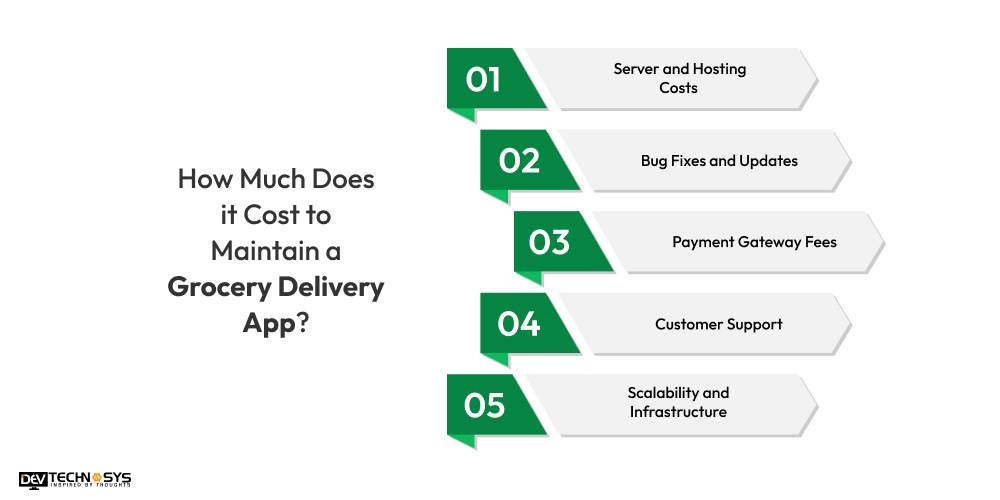
1. Server and Hosting Costs
These are essential for storing app data, processing transactions, and fulfilling consumer requests. Costs rise with increased app traffic and storage requirements.
2. Bug Fixes and Updates
Regular updates and bug fixes are required to ensure software stability, security, and compatibility with new mobile OS versions.
3. Payment Gateway Fees
These costs are charged for transaction processing and can increase with the number of orders.
4. Customer Support
As the user base expands, so does the demand for customer support, which may lead to increased costs.
5. Scalability and Infrastructure
As your business grows, you will need to scale your infrastructure to manage the increasing traffic, which may incur additional costs.
| Cost Component | Weekly Cost | Monthly Cost | Quarterly Cost | Annual Cost |
| Server and Hosting Costs | $20 – $100 | $80 – $400 | $240 – $1,200 | $1,000 – $3,000 |
| Bug Fixes & Updates | $40 – $100 | $160 – $400 | $480 – $1,200 | $1,500 – $4,000 |
| Payment Gateway Fees | $10 – $40 | $40 – $160 | $120 – $480 | $500 – $2,000 |
| Customer Support | $40 – $100 | $160 – $400 | $480 – $1,200 | $2,000 – $4,000 |
| Scalability & Infrastructure | $30 – $70 | $120 – $280 | $360 – $840 | $1,500 – $4,000 |
Free App Idea Reality Check: Let's Stress-Test Your Concept
Share your app idea with us. Within 3 business days, we'll uncover UX gaps, feature opportunities, and potential development challenges, so you can build with confidence. No strings attached.
Why Does Regular Maintenance Help Your Grocery Delivery App Succeed?
An outdated grocery delivery app takes a long time to load and creates errors when adding items to the cart or payment issues while checking out. With proper app maintenance services, its efficiency, security, and usability are improved. Here are five important reasons why frequent maintenance is necessary for your app’s success:
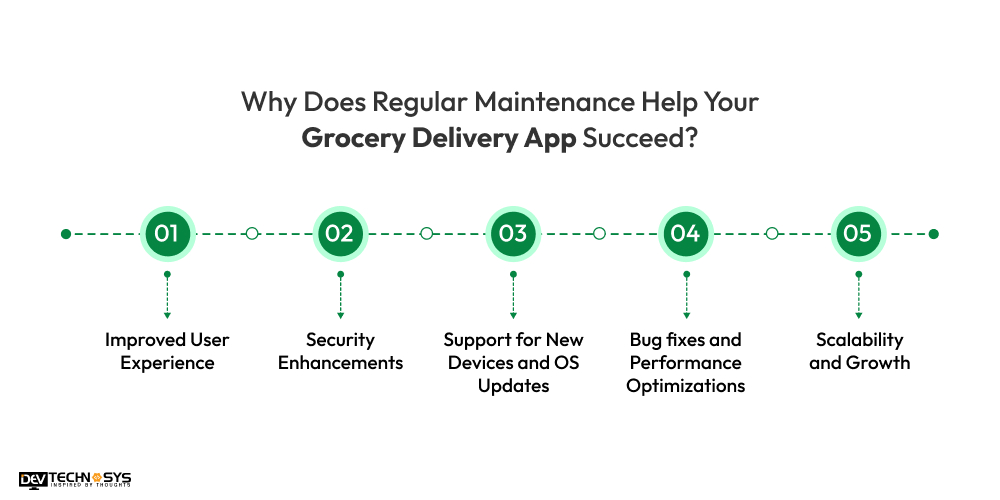
1. Improved User Experience
A well-maintained app offers a more seamless user experience, which is essential for customer retention. Hire mobile app developers to offer regular updates and bug fixes address issues such as crashes, poor load times, and errors, allowing users to simply browse product listings and place orders. If users face regular problems, they are more likely to switch to a competitor.
2. Security Enhancements
Security is a major consideration for any app, especially those that handle sensitive user and payment data. Regular maintenance protects the software against vulnerabilities by installing security updates, upgrading encryption mechanisms, and maintaining compliance with data protection standards. Neglecting security can result in data breaches, harming your brand and costing you money in legal fees.
3. Support for New Devices and OS Updates
Mobile operating systems such as iOS and Android provide regular updates. These updates may include new functionality or change the way programs interact with the operating system. Regular maintenance ensures that your program is compatible with these upgrades, which prevents crashes or malfunctions when users upgrade their devices or operating systems.
4. Bug fixes and Performance Optimizations
No application is perfect, and errors are unavoidable. Regular maintenance entails finding and resolving defects that can degrade app performance, such as problems with the shopping cart, checkout process, or payment gateway. Hire dedicated developers to ensure faster load times and enhanced app performance, which increases user satisfaction.
5. Scalability and Growth
As your business expands, your app’s infrastructure must expand to accommodate more users, transactions, and data. Regular maintenance enables you to analyze the app’s performance and modify resources accordingly, avoiding system crashes or slowdowns during peak demand periods such as vacations or promotions. A scalable app ensures that consumers have a consistent experience as your business grows.
Industry Insight
Dev Technosys has been recognized as the top grocery delivery app development company by Tynmagazine. Our real-time engineering and end-to-end development/maintenance support capabilities are highlighted.
What Are the Factors that Affect Grocery Delivery App Maintenance Cost?
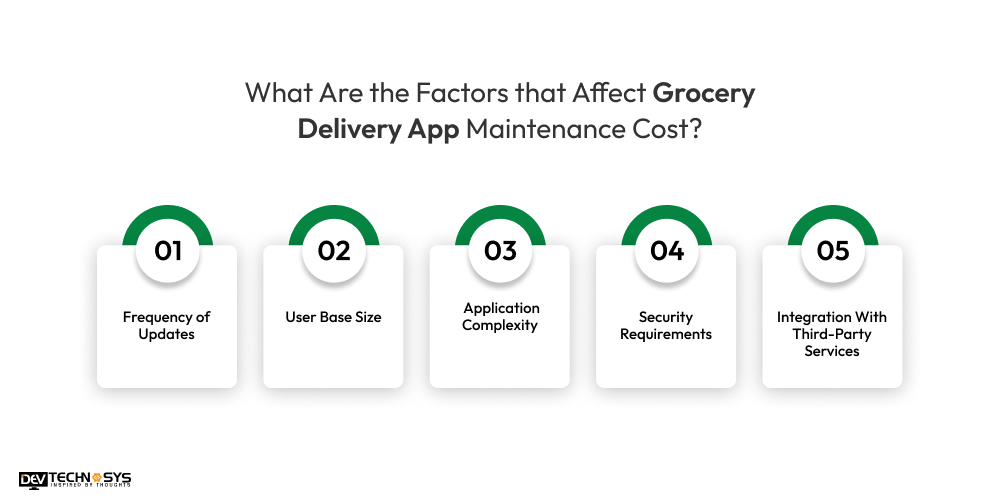
The maintenance costs of grocery delivery apps Like Shipt can be influenced by various factors. Features, user base, technological stack, security needs, scalability, and update and bug repair frequency determine grocery ordering app maintenance expenses. A robust maintenance strategy and early planning will help you manage and reduce these recurring expenditures.
1. Frequency of Updates
The grocery business app maintenance services are required for security, performance, and user experience enhancements. Apps requiring frequent feature enhancements or security patches have greater grocery app update cost. The more frequently an app is updated—whether for bug patches, OS compatibility, or new features—the more labor and resources are required to maintain it.
| Update Frequency | Estimated Cost Impact |
| Infrequent (Quarterly) | $500 – $1,000 monthly |
| Moderate (Monthly) | $1,000 – $2,000 monthly |
| Frequent (Weekly) | $2,000 – $4,000 monthly |
2. User Base Size
A growing user base increases server stress, transaction volume, and customer service needs. More users require more data management and infrastructure, which increases cost to fix bugs in a grocery delivery app. Furthermore, handling more user interactions frequently necessitates greater resources to ensure smooth operation and speedier troubleshooting.
| User Base Size | Estimated Cost Impact |
| Small (< 1,000 users) | $500 – $1,000 monthly |
| Medium (1,000 – 10,000) | $1,000 – $3,000 monthly |
| Large (> 10,000 users) | $3,000+ annually |
3. Application Complexity
Apps with advanced features, such as real-time tracking, tailored suggestions, or cross-platform compatibility, necessitate extra upkeep. These features require frequent upgrades, debugging, and performance optimization. The more complicated the app, the greater the development and maintenance work, which raises grocery ordering mobile app maintenance cost.
| App Complexity | Estimated Cost Impact |
| Simple App Complexity | $1,000 – $2,000 annually |
| Medium App Complexity | $2,000 – $4,000 annually |
| High App Complexity | $4,000+ annually |
4. Security Requirements
Grocery pickup and delivery apps handle sensitive client data, such as payment details and delivery addresses. Maintaining comprehensive security measures like as encryption, firewalls, and regulatory compliance incurs significant expenditures. Regular security audits and timely updates to protect against new threats are required, making security a critical component of the entire maintenance expenditure.
| Security Needs | Estimated Cost Impact | Explanation |
| Basic Security | $300 – $800 annually | To prevent common assaults, updates, and changes must be made often. |
| Moderate Security | $800 – $2,000 annually | Enhanced encryption and regular vulnerability testing. |
| Advanced Security | $2,000+ annually | Thorough security checks and strong data security. |
5. Integration With Third-Party Services
Many supermarket delivery apps use third-party services, including payment gateways, GPS tracking, and inventory management systems. These integrations require continuous monitoring, upgrades, and troubleshooting. As third-party services evolve or change, keeping compatibility with them increases the app’s overall grocery delivery app maintenance services costs.
| Third-Party Integration | Estimated Cost Impact | Explanation |
| Minimal Integrations | $200 – $500 monthly | Basic connectors, including payment gateways. |
| Moderate Integrations | $500 – $1,500 monthly | Maps, client data services, or API services. |
| Extensive Integrations | $1,500+ monthly | Numerous integrations with cloud, financial, and other services. |
Expert Advice
Grocery delivery apps need continuous maintenance to remain reliable. This helps to meet evolving market needs. Payment services and APIs should be consistently updated for iOS/Android or hybrid applications to prevent technical issues. Mobile app maintenance delivers a consistent shopping experience as the business scales while helping US businesses to manage operational costs.
–Mohit Nag, CTO, Dev Technosys
How to Reduce the Grocery Delivery App Maintenance Cost?
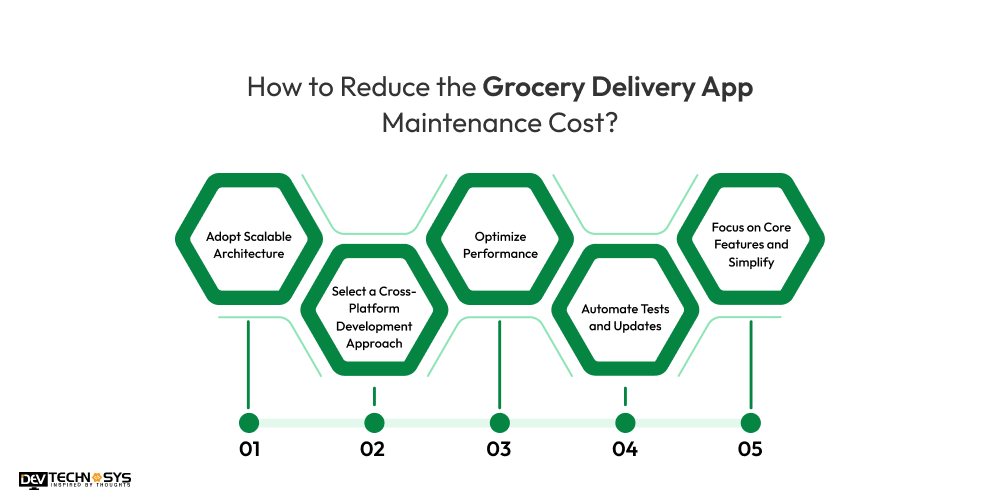
U.S. businesses want to reduce costs, prevent hidden errors, and ensure app compatibility with the latest versions of iOS/Android. Because routing & payment services change frequently, third-party APIs need consistent updates. Regular app maintenance helps businesses to stay competitive by improving user experience, security, and operability. By following these strategies, grocery ordering app owners can significantly reduce grocery management app support costs while ensuring a seamless user experience.
1. Adopt Scalable Architecture
Implementing a scalable design is vital for lowering maintenance expenses. Cloud platforms such as AWS, Google Cloud, and Azure allow you to pay only for the resources you use, allowing for cost-effective scaling as demand changes. Furthermore, employing a microservices architecture allows you to update or modify specific app components without affecting the overall system, decreasing downtime and the need for costly reworks.
2. Select a Cross-Platform Development Approach
Using cross-platform frameworks such as Flutter or React Native can drastically reduce grocery mobile app maintenance fees. These frameworks enable you to use a single codebase for both iOS and Android versions of your app. According to the mobile app development company, you can simplify the development process and save money on maintaining two separate codebases.
3. Optimize Performance
Efficient code can significantly save maintenance costs by reducing the need for frequent upgrades and bug fixes. Write clean, efficient code to ensure faster load times and lower server burden. Performance monitoring tools can assist in identifying problems before they disrupt the user experience. By addressing problems proactively, you can avoid greater, more costly problems in the future.
4. Automate Tests and Updates
Automated testing for your app can save both time and money. Automated unit tests, integration tests, and regression tests detect flaws early in the development process, saving time and effort on human testing throughout maintenance. As we discussed earlier with an on-demand app development company, implementing Continuous Integration and Continuous Deployment (CI/CD) pipelines helps ensure updates, bug fixes, and performance enhancements.
5. Focus on Core Features and Simplify
Focusing on the most important features and eliminating needless complexity helps lower grocery ordering app upgrade costs. Overloading the program with too many features may result in higher bug rates and more frequent upgrades. Regularly evaluate user feedback to identify underutilized features and delete or upgrade them, simplifying maintenance and ensuring that resources are directed toward high-impact areas.
Planning a Grocery Project?
Get a tailored development cost estimate in a few simple steps.
- 3 quick steps
- 100% free
- Reply in 1 business day
2 Minutes Read
Security and Compliance Standards for Grocery Delivery Apps
Following security best practices and compliance improves the credibility of a business. Since grocery delivery applications process sensitive payment and customer data, the app needs to be secured, considering all regions and state laws. That’s why, from architecture to deployment, we implement GDPR and CCPA to design secure solutions.
1. PCI DSS for Payment Protection
Most consumers prefer to pay with their credit/debit card to save time and to experience engaging discounts. Our approach to including PCI DSS begins from the build phase. It shields the CVV codes, numbers, and names from unauthorized users. Compliance allows engineers to detect vulnerabilities and resolve them at the earliest. If a business wants to include PCI DSS maintenance, then the cost will be 6% of the total implementation.
2. Building Trust with SOC 2
Our engineers implement SOC 2 to protect data accessed over a cloud infrastructure. Since multiple users access the same application, the information needs to be secured from vulnerabilities. Enterprises that have multiple outlets must implement SOC 2 for data confidentiality and privacy.
3. ISO 27001 for Data Security
Mid-level to large organizations need to comply with ISO standards to protect business data. This protects customer data, employee information, intellectual property details, and digital assets. We hold internal development to ISO 27001 standards as a baseline expectation, not a premium add-on.
How Dev Technosys Helps to Maintain a Grocery Delivery App?
We have built 150+ grocery delivery applications with more than 20 ongoing maintenance projects. Our solutions follow a privacy-first approach while keeping usability at the top. Our experts assist with UI/UX glitches, server scaling, and third-party API updates. We pay attention to detail before providing a maintenance solution. If you want to use app maintenance services for your project, contact us.
Real-World Case Study: On-Demand Grocery Delivery Platform “WANNA EAT”
At Dev Technosys, we developed “WANNA EAT,” an on-demand grocery delivery platform designed to handle high-volume transactions, real-time order tracking, product availability, vendor coordination, and fast checkout. The platform was built with a cloud-first architecture to support fluctuating demand during weekends, holidays, and other peak shopping periods.
Challenges Faced: The major challenge was creating a highly scalable grocery delivery ecosystem that could maintain performance during traffic spikes while providing real-time visibility to customers and vendors. The platform also needed efficient transaction processing, instant product availability, secure payments, and coordinated delivery operations.
Solution: Our engineers developed a multi-platform, cloud-based grocery delivery solution using Flutter, Node.js, PostgreSQL, AWS microservices, and Redis caching. Google Maps API enabled real-time delivery tracking and intelligent route management, while secure payment gateways, automated push notifications, and auto-scaling infrastructure helped maintain reliable performance as transaction volumes increased.
Project Highlights
Project Name: WANNA EAT
About Client: Grocery Delivery Platform
Industry: Grocery & On-Demand Delivery
Platform Type: On-Demand Grocery Delivery Platform
Technology: Flutter, Node.js, AWS, PostgreSQL, Redis, Google Maps API
Architecture: Cloud-Based Microservices
Key Features: Real-Time Order Tracking, Product Availability, Vendor Management, Fast Checkout, Secure Payments, Push Notifications, Intelligent Delivery Routing, Auto-Scaling Infrastructure
Business Impact: 50M+ Orders Delivered Successfully, 8M+ Active Monthly Users, 200K+ Partner Stores & Vendors, 120M+ Products Delivered Across Regions
Conclusion
Now, the blog comes to its final words. We offered detailed information about grocery delivery maintenance costs and why maintenance is necessary for an online grocery platform’s success. The grocery delivery app development and maintenance services provide the new trending functionalities, solve errors, new OS updates, and update older versions features. After that, we also provide cost-reducing ways to complete the maintenance services at a lower budget.
Are you looking to hire dedicated developers to maintain your grocery delivery mobile app? You can connect with a grocery delivery app development company to offer lower-budget maintenance services.
Frequently Asked Questions
Find answers to the most common questions related to this article.
The cost to update and maintain a grocery shopping app varies, typically ranging from $1,000 to $5,000 annually. Factors like app complexity, platform, features, user base, and third-party integrations influence the final cost.
App complexity, platform compatibility, user base size, feature set, technological stack, third-party integrations, security requirements, and update and bug fix frequency are all important considerations in determining a grocery shopping app's maintenance cost.
Yes, third-party integrations (such as payment gateways, GPS, or delivery tracking) can increase maintenance expenses. These systems require regular upgrades to be compatible and secure, and changes in external APIs may necessitate additional maintenance effort.
Yes, you can reduce maintenance costs by implementing scalable cloud infrastructure, cross-platform development, automating testing and updates, focusing on core features, optimizing app performance, and routinely monitoring security to avoid costly issues.