

















Key Takeaways
-
- Encrypt all information relating to payment, passport, ID, personal, and booking data in transit and at rest, while not collecting or retaining unneeded information.
- Adopt PCI DSS, tokenization, multi-factor authentication, secure payment gateways, fraud detection, and robust session management to prevent payment fraud and account takeover attacks.
- Secure airline API, hotel API, GDS API, KYC API, payment API, and map API using rigorous authentication, authorization, rate limiting, TLS, and webhook validation.
- Adopt threat modeling, OWASP recommendations, and continuous security testing/monitoring/response, as well as AI-based threat detection, rather than considering security a last-minute affair.
A famous American computer security expert and cryptographer, Bruce Schneier, once said, “Security is a process, not a product.”
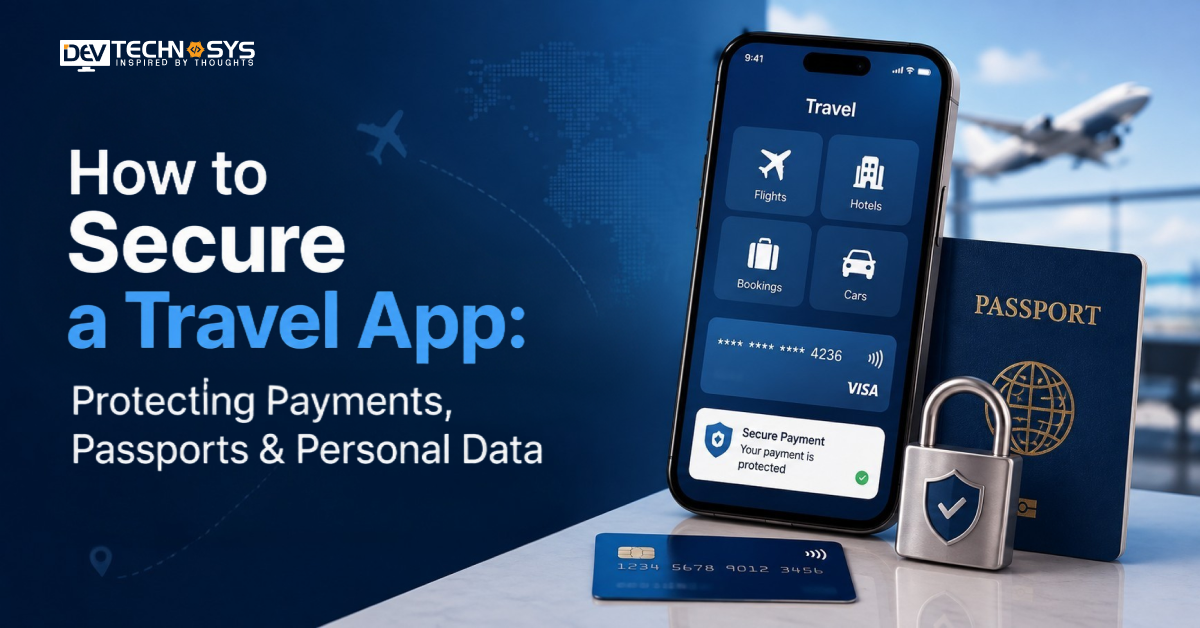
A modern-day travel app acts as a booking platform, payment gateway, digital identity storage, and personal itinerary manager all at once. This makes travel app security very complicated compared to the security of an ordinary mobile application.
Travel booking platforms often process card details, store passport & ID information, contact details, booking histories, and sometimes even real-time location data. These connections with users to payment gateways, hotels, airline systems, and GDS platforms make them prone to cyber threats. Even the smallest weakness could have serious ramifications such as leaking sensitive data, account takeover, or even fraud.
How to secure a travel app? This is what businesses need to understand before they start developing a travel app. It requires a seamless, layered approach to cover payment protection, passport and identity security, personal data protection, authentication, API controls, and regulatory compliance.
In this blog, we will examine every security layer related to travel and tourism apps, along with AI-powered threat detection, real examples of security failures, and how you can prevent them. Let’s get started!
Why Are Travel Apps High-Value Targets for Attackers?
Most of the travel booking apps combine transactions, identity information, booking records, and location data inside one digital ecosystem. This narrow focus means that travel app security is an essential component of business rather than a late addition.
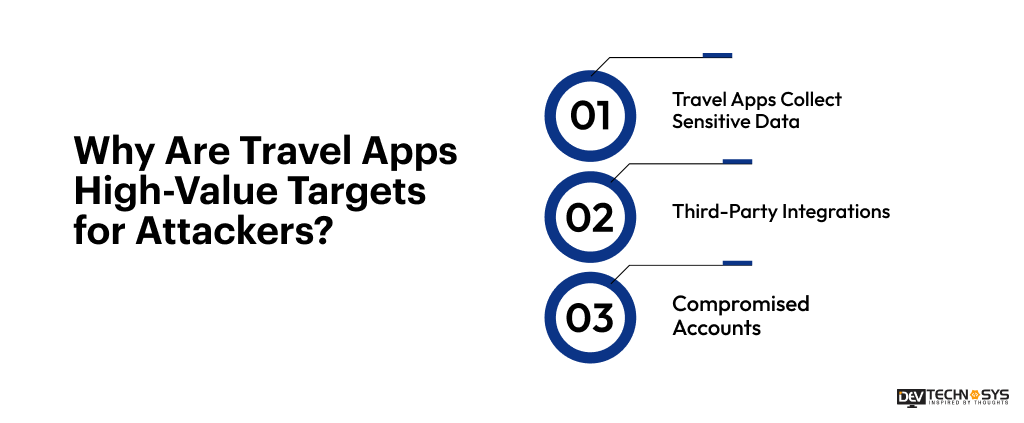
Travel Apps Collect Sensitive Data
A single account on any travel app can contain past transactions, payment details, passport & identification information, contact details, travel history, etc. If cyber attackers somehow gain access to it, the data can be used for identity theft, payment fraud, targeted phishing, or account takeover. Protection of the travel app data is therefore supposed to be effective and flexible enough to apply to every piece of information.
Third-Party Integrations
Travel apps are rarely isolated from other systems. They are integrated with payment gateways, airline and hotel APIs, GDS platforms, KYC providers, maps, and customer support systems. If an API is poorly implemented without proper security, it could provide overprivileged access and expose secrets, leading to major security breaches that could exist beyond the application’s source code. This makes travel app cybersecurity truly dependent on the security of the APIs and other third-party ecosystems.
Compromised Accounts
Cybercriminals don’t need to access a full database. A stolen account or API credentials can be used to quickly modify bookings, steal points, obtain access to personal information, or divert payment-related information. So, it’s vital to know how to secure a travel app. This includes protecting data on the mobile client, backend, APIs, integrations, and user accounts. Startups working with a travel app development company often gain this upper hand with knowledge of architectural requirements from the first sprint.
Insight
According to the OECD, hotels are prime targets for cyberattacks because they collect large amounts of personal and financial information, while airlines are also attractive targets because they rely heavily on digital systems.
Common Security Threats Facing Travel Apps
There are many threats that can cause harm to travel applications as they work around personal information, money transfers, location-based services, and interactions with third parties. It becomes essential to have information on risks to ensure effective travel app security.
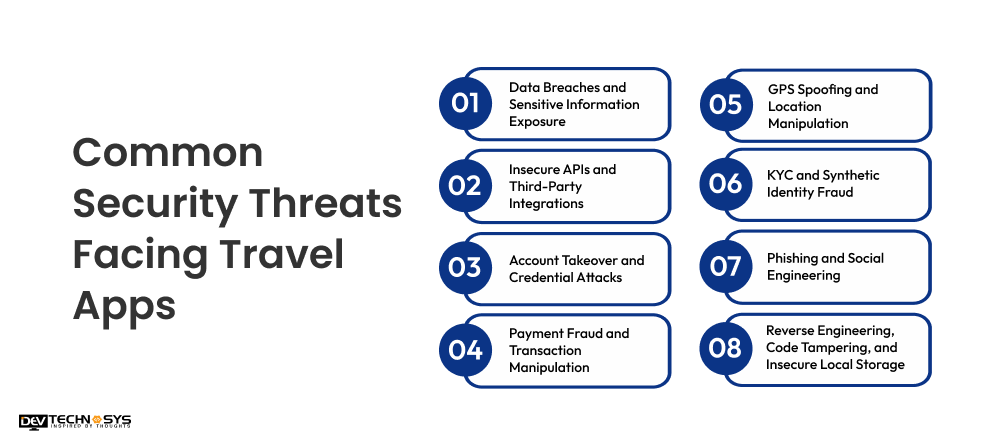
1. Data Breaches and Sensitive Information Exposure
A breached travel application can provide access to passports, customers’ information, transaction records, contact information, and information related to payments. This information may be used for identity theft, phishing, and account takeover purposes. Thus, secure travel application data protection is necessary to protect these areas.
2. Insecure APIs and Third-Party Integrations
Commonly used APIs for travel portals include airlines, hotels, GDS, payment, KYC, map, and analytics APIs. Incorrect authentication, overly permissive permissions, inadequate authorization, or credential exposure could result in vulnerabilities other than the mobile application itself. A robust travel app development solution should include API security and third-party access even at the architecture level.
3. Account Takeover and Credential Attacks
Potential password reuse, brute force attacks, token theft, and credential stuffing are some techniques that attackers use to hack into someone’s account. If the user account is breached, then there is a risk of leaking confidential information like booking details, personal information, loyalty points, and travel information.
4. Payment Fraud and Transaction Manipulation
Because travel apps handle valuable transactions, they become a target for card-not-present fraud, booking scams, payment diversion, and transaction manipulation. It is essential to have effective payment fraud protection within the app, payment gateway, and transaction process.
5. GPS Spoofing and Location Manipulation
Location features are used to search for nearby hotels, provide airport services, perform geofencing, make local offers, or prevent fraud. GPS spoofing may affect such features by interfering with the control mechanisms, thus presenting another threat to the mobile travel app security.
6. KYC and Synthetic Identity Fraud
Fraudulent identification may come in many forms for travel apps that have identity verification. These include forged IDs, stolen identities, falsified credentials, and synthetic identities. Poorly executed verification processes may enable fraudsters to easily bypass initial screening, highlighting the need for travel app cybersecurity.
7. Phishing and Social Engineering
Attackers can mimic travel brands through fraudulent booking confirmations, payment requests, support emails, and harmful links. The attacks can occur against customers despite the application itself remaining secure. Thus, good travel app security practices must take into consideration the issue of trustworthy communication channels.
8. Reverse Engineering, Code Tampering, and Insecure Local Storage
The attacker is able to use APK or IPA packages to find out endpoints, any secrets, and the app’s logic. Also, there is a chance that the modified package could bypass the client-side protection, and insecure local storage could provide access to any authentication token, credentials, and logs. Travel app security vulnerabilities demand protection from security threats within the application and backend environments.
Planning a Mobile App?
Get a tailored development cost estimate in 3 simple steps — app basics, features, timeline, and your contact details.
- 3 quick steps
- 100% free
- Reply in 1 business day
2 Minutes Read
How to Secure Payment Data in a Travel App?
Payment for air travel, hotels, packages, and other services takes place through travel apps, making the information about finances highly valuable. To learn how to secure a travel app, you need to protect the whole payment process, including checkout, authentication, and transactions.
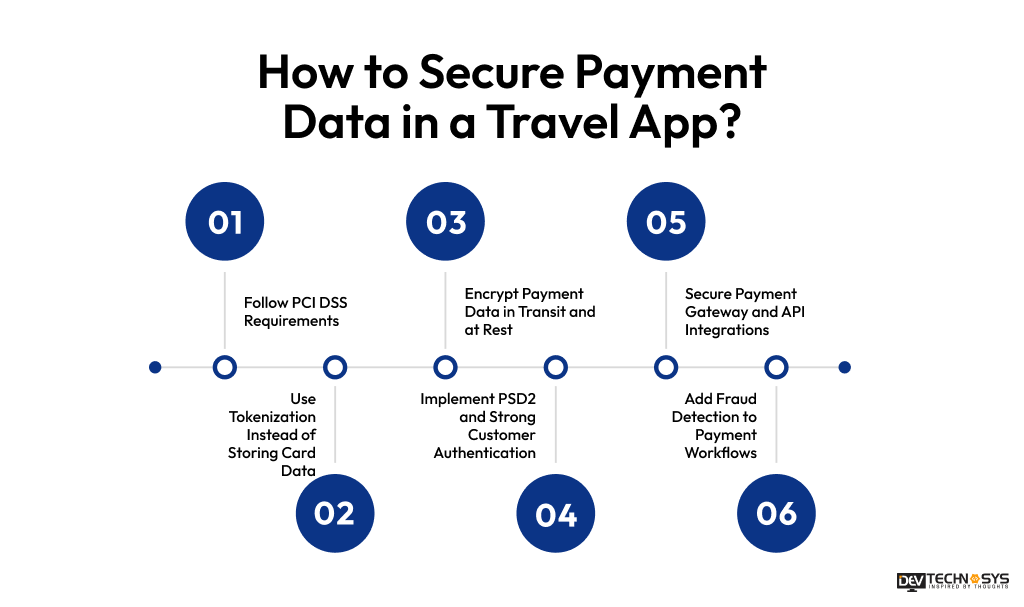
1. Follow PCI DSS Requirements
Travel apps that have to process cardholder data must follow the guidelines for PCI DSS compliance. PCI DSS 4.0 highlights the aspects of access control, authentication, vulnerability management, logging, monitoring, and periodic security assessments. Encrypting the cardholder information alone would not be enough, as we have to minimize its exposure.
2. Use Tokenization Instead of Storing Card Data
Tokenization substitutes sensitive card data with a payment token that does not have any value apart from the designated payment network. In this way, instead of storing plain card data, the travel app could use a payment service provider for tokenization of the payment credentials. This reduces the application’s exposure to cardholder data and strengthens financial data protection.
3. Encrypt Payment Data in Transit and at Rest
Employ TLS for the communication channel between the mobile application, backend service, and payment processor. The sensitive data related to payments that is stored in databases, backups, and logs must be encrypted while stored. The encryption keys and credentials must never appear in the application source code.
4. Implement PSD2 and Strong Customer Authentication
In the case where there are SCA obligations under PSD2 requirements for transactions, Strong Customer Authentication (SCA) is an additional level of security for payments that one can apply. This would depend on the type of transaction being conducted and any applicable exemptions, whereby MFA or 2FA can be applied using independent authentication methods.
5. Secure Payment Gateway and API Integrations
The security of payments will be influenced by how the application will interact with outside gateways. There is valuable knowledge that can be gained from fintech software development that can be applied to secure transactions, APIs, and proper payment workflow. Secure your application through proper API authentication, authorization, TLS, and webhooks to prevent unauthorized requests and transaction fraud. The back-end needs to verify the payment status by itself and not rely on the success notification sent from the mobile client application.
6. Add Fraud Detection to Payment Workflows
Encryption and authentication cannot prevent every instance of fraud. Deploy payment fraud detection systems through transaction velocity testing, device recognition, behavior detection, risk scoring, and booking anomalies. A high number of unsuccessful payments, sudden large-value bookings, or abnormal account and payment activity can necessitate further verification.
Insight
According to Verizon’s 2026 DBIR, breaches involving third parties increased by 60%, reaching 48% of all breaches in the reporting dataset.
How to Secure Passport and ID Data in a Travel App?
Travel documents are some of the most sensitive information that travel apps handle. It is necessary to learn how to secure a travel app since protecting the document begins from its uploading to deletion.
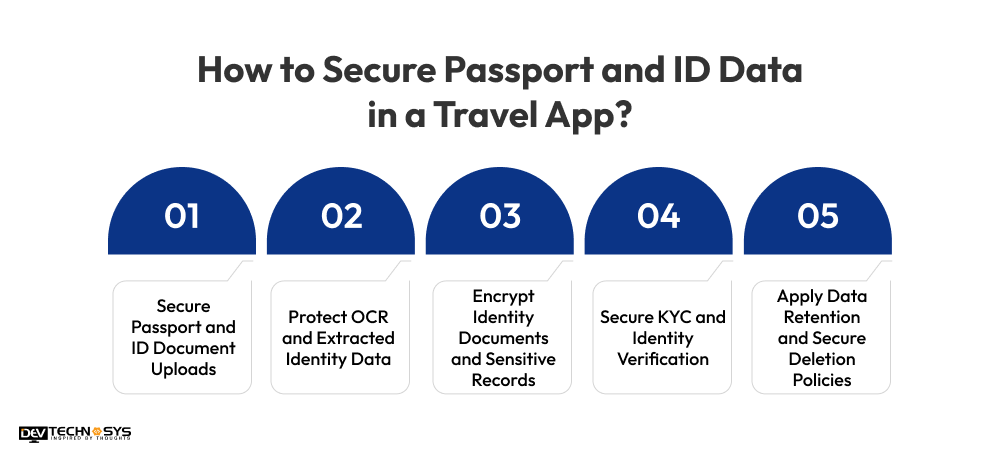
1. Secure Passport and ID Document Uploads
Use secure HTTPS connections for all uploads of documents and check the types, sizes, and formats of files on the server. Malware checking may also be done to identify any malware present in the uploaded files. Access control will help in ensuring that the user sees only his/her documents.
2. Protect OCR and Extracted Identity Data
OCR can automatically detect details such as names, passport number, date of birth, etc. Yet keeping the original document along with its extracted content is unnecessary and makes your data more vulnerable. Proceed with the fields needed only in the course of travel processing.
3. Encrypt Identity Documents and Sensitive Records
Encrypted passport photos and identities should be used when storing these records. Least privilege access should be granted, and administration privileges should be tightly controlled. A security approach to hotel booking app development should also involve segregating user identity information from application records whenever possible. The reason is that if any other application layer gets hacked, there will be no extra data revealed.
4. Secure KYC and Identity Verification
KYC processes carry new types of risks, such as forged documents, identity theft, tampered passports, and synthetic identities. Choose trusted identity verification vendors who can do document authenticity verification and, where necessary, liveness detection. Credentials and verification outcomes must also be secured using proper authentication and authorization mechanisms.
5. Apply Data Retention and Secure Deletion Policies
Never keep passport data indefinitely. Set out clear data retention policies that take into account business needs as well as legal and regulatory requirements. Upon expiration of the need for data, destroy it properly from live data storage, and deal with any copies found in backup storage, cache storage, or any other transient systems. Excellent travel app privacy decreases the chances of exposure of identity data in a potential breach.
Designing a Secure Travel App Architecture
Mobile app security for travel applications includes protection of both the mobile client and all the components connected to the mobile client: APIs, backend systems, databases, and external system integrations.
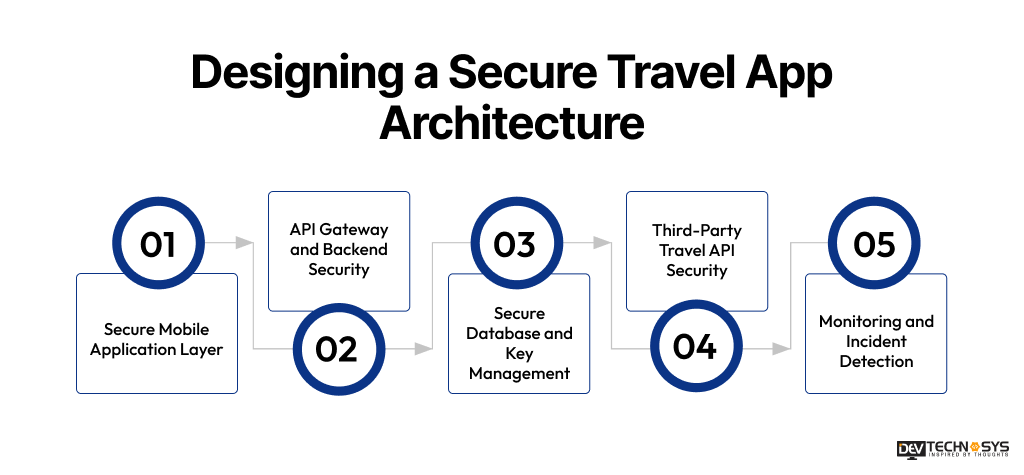
1. Secure Mobile Application Layer
Ensure that you adhere to best coding practices, certification checks, code obfuscation, runtime protection, and encryption of local storage. Avoid hard-coding API keys and secrets in your mobile application. Assume your mobile client is untrusted and provide authorization from the backend side.
2. API Gateway and Backend Security
An API gateway could restrict the number of requests, request rate, and access rules prior to forwarding them to the backend server. Make use of OAuth 2.0 as well as valid JWT tokens for the purpose of authentication. Authentication is about identifying who makes the request, while authorization defines what this specific user has access to.
3. Secure Database and Key Management
Databases and their backup should be encrypted during storage, along with the protection of encryption keys by using a specialized key management system. Secrets management can be used to protect the API keys and database passwords instead of storing them in the code.
4. Third-Party Travel API Security
The APIs that airlines, hotels, GDS, payments, KYC, and maps provide expand the attack surface. Secure authentication, restricted authorization scope, TLS usage, credential rotation, and validated webhooks are required in every integration. Security practices of the providers need to be audited before allowing access to their systems.
5. Monitoring and Incident Detection
Prevention cannot prevent all attacks from happening. Security logs that are centralized, SIEM software, API monitoring, anomalous behavior detection, and alerts are some of the ways to spot anomalies in access and transactions. Having an incident response plan in place will allow for faster containment and resolution.
Protecting Personal Data and Meeting Travel App Compliance Requirements
The security measures help secure information technologically, while compliance dictates the methods that can be used to collect, store, process, and transmit the personal, transactional, and identity information. The developers of travel apps need to look at the regulatory requirements and relate them to data flows instead of seeing compliance as something that is checked off a list. Compliance varies based on markets and data types.
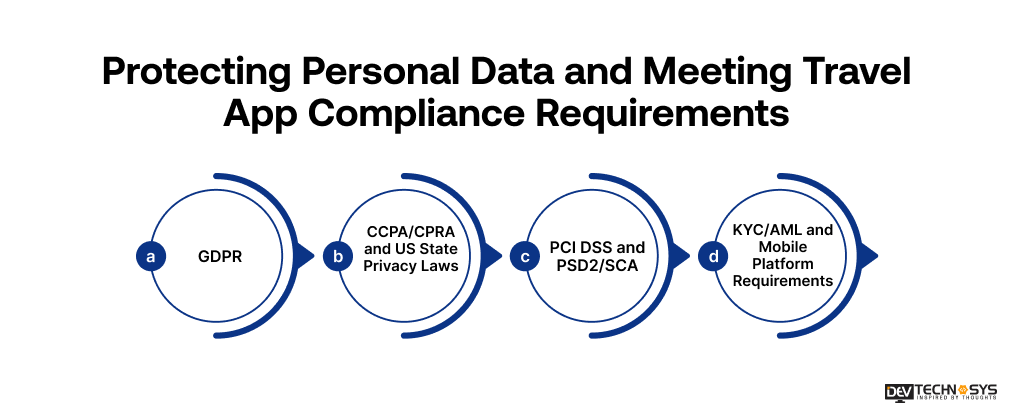
a. GDPR
Apply data minimization, lawful processing, user rights, appropriate security measures, and deletion processes when GDPR applies.
b. CCPA/CPRA and US State Privacy Laws
California and other states may provide consumers with rights involving access, deletion, correction, and opting out of certain data uses.
c. PCI DSS and PSD2/SCA
PCI DSS applies to relevant cardholder-data environments, while PSD2/SCA affects applicable European payment transactions and authentication requirements.
d. KYC/AML and Mobile Platform Requirements
KYC/AML obligations depend on the business model and applicable regulation. App Store and Google Play requirements also require accurate privacy and data-use disclosures.
Framework |
Applies To |
Key Requirement |
| GDPR | EU/EEA data processing | Privacy, minimization, user rights |
| UK GDPR | UK data processing | Privacy and data protection |
| CCPA/CPRA | California consumers | Access, deletion, opt-out |
| Virginia CDPA | Virginia consumers | Consumer privacy controls |
| Colorado Privacy Act | Colorado consumers | Data protection rights |
| PCI DSS | Card payments | Cardholder-data security |
| PSD2/SCA | Applicable European payments | Strong authentication |
| KYC/AML | Applicable regulated workflows | Identity and fraud controls |
| App Store/Google Play | Mobile apps | Privacy and data disclosures |
How Can AI Strengthen Travel App Security?
AI can enhance cybersecurity for travel applications through behavioral analytics, risk assessment, and rapid response to threats. Nonetheless, its effectiveness will be influenced by how well it complements existing security controls.
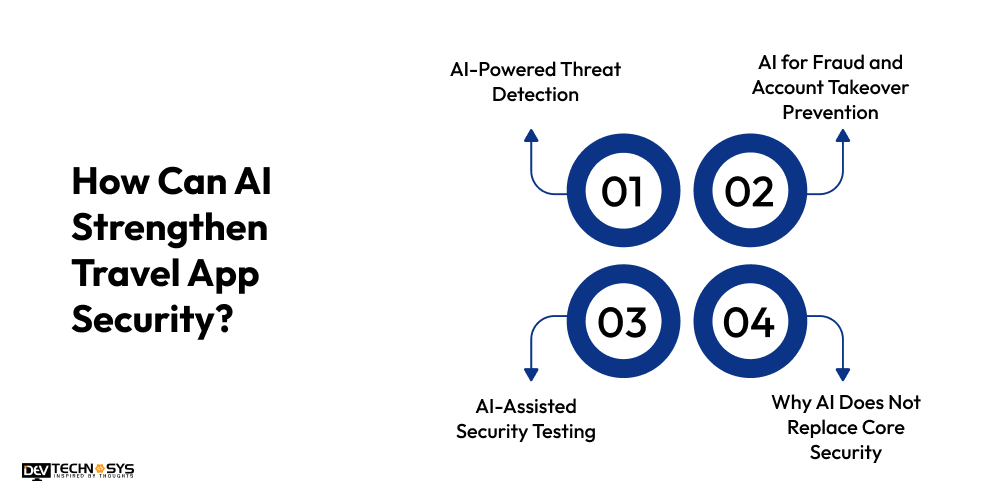
AI-Powered Threat Detection
AI models can detect behavioral patterns, strange login attempts, fraudulent activities, and any type of suspicious API requests. For instance, any attempt to make expensive bookings via an unknown device will be verified before processing.
AI for Fraud and Account Takeover Prevention
Risk scoring can utilize device intelligence, user behavior, login records, and booking information to detect the possibility of an account takeover or payment fraud. This can help provide intelligent travel experiences, as discussed under smart features any travel app should have, along with security-oriented decision-making.
AI-Assisted Security Testing
The capabilities of AI may help developers analyze code, detect vulnerabilities, test APIs, review dependencies, and carry out threat modeling. These will aid developers in detecting potential issues early enough, even though any detected security concerns need to be validated by competent developers or security experts.
Why AI Does Not Replace Core Security
AI needs to be used to supplement encryption, authentication, authorization, secure API development, and penetration testing. Despite the above measures to create effective travel app security measures, there is still a need for secure architecture and security analysis by humans. There is no way AI can make up for deficiencies in application architecture.
Insight
According to the OECD’s 2026 Tourism Trends and Policies report, tourism organisations using new data sources need robust data-governance and confidentiality measures because tourism data can be sensitive and carry privacy risks.
Step-by-Step Checklist: How to Secure a Travel App
The following is what one should know in order to make a travel application secure. It serves as an implementation guideline for those who need one.
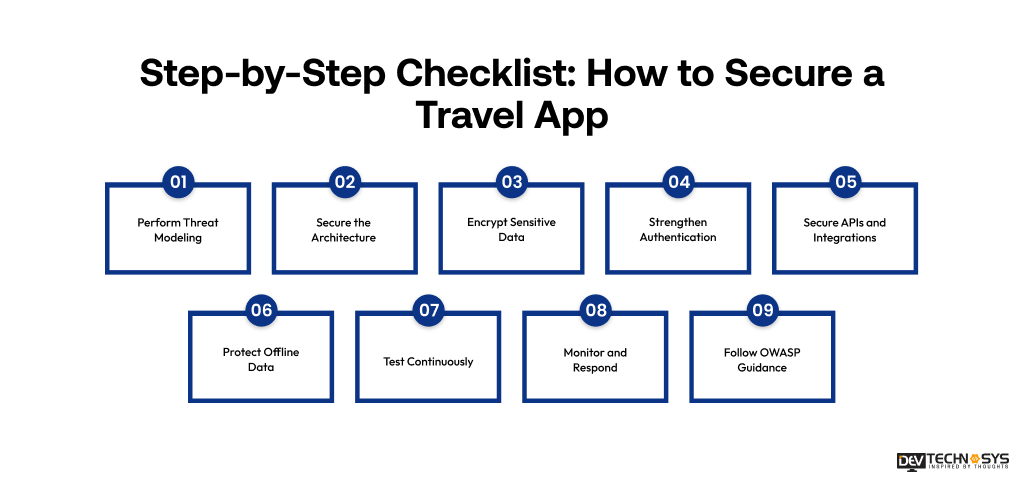
Step 1: Perform Threat Modeling
Identify sensitive assets, attack vectors, trust boundaries, and important procedures such as login, booking, payments, and identity verification.
Step 2: Secure the Architecture
Use least-privilege access, secure APIs, strong authentication, network controls, and security-by-design principles from day one.
Step 3: Encrypt Sensitive Data
Encrypt payment information, passport records, PII, credentials, and other sensitive information in transit and at rest.
Step 4: Strengthen Authentication
Use MFA or 2FA, biometric authentication when possible, OAuth 2.0, secure sessions, and proper token management.
Step 5: Secure APIs and Integrations
External services must implement rate limits, input validation, authorization constraints, restricted access scopes, and webhook verification.
Step 6: Protect Offline Data
Limit sensitive cached data and encrypt necessary local data. Ensure that authentication tokens kept on devices are secure.
Step 7: Test Continuously
Employ SAST, DAST, dependency scanning, API testing, vulnerability assessments, and continuous penetration testing throughout the development lifecycle.
Step 8: Monitor and Respond
Collect security logs and set up automated alerts, watch for suspicious activity, and have an incident response strategy in place in case of suspected breaches.
Step 9: Follow OWASP Guidance
Refer to the OWASP Mobile Top 10 and secure SDLC processes for continuous security evaluations, remediation, and developer training.
Real-World Travel App Security Failures and Lessons for Developers
Real-life examples have demonstrated that travel apps may experience security issues in the form of account compromises, access issues, and technological issues at the application level. Such challenges may also have an impact on customer credibility and the sustainability of travel guide-to-travel app development revenue models.

Booking.com: Reservation Data Used in Phishing Attacks
In 2023, breached hotel account credentials were exploited to gain access to booking details and launch phishing attacks. This case emphasizes the importance of securing partner accounts, restricting access to data, and protecting messaging and API pipelines.
Cleartrip: Travel Booking Platform Security Incident
Cleartrip faced a security threat in 2022 where an unauthorized entry into their systems took place. This case study clearly highlights the importance of having good access control, a monitoring system, and an incident response policy for travel websites, irrespective of mobile applications.
Qantas App: Customer Data Exposure Through a Technology Failure
In 2024, Qantas customers temporarily saw other customers’ data on their app due to a technological problem. Qantas confirmed that no cyber-attack had occurred during the time. The event illustrates why developers should properly test authorization, caching, sessions, and segregation of data.
Key lesson: Travel app security requires protection against both malicious attacks and application failures that can expose customer information.
How Much Does It Cost to Build a Secure Travel App?
The travel app development cost typically ranges from $25,000 to $95,000+, depending on the app’s complexity, security requirements, integrations, and development scope. A basic travel app may cost $25,000 to $40,000, while a mid-size solution can range from $40,000 to $65,000. Advanced platforms with extensive integrations, stronger security controls, KYC, payment systems, and compliance requirements may reach $65,000 to $95,000+.
Travel App Type |
Estimated Cost |
Typical Features |
| Basic Travel App | $25,000–$40,000 | User accounts, search, booking, profiles, notifications, basic security |
| Mid-Size Travel App | $40,000–$65,000 | Payment integration, GPS, API integrations, MFA, secure APIs, admin panel |
| Advanced Travel App | $65,000–$95,000+ | KYC, advanced fraud prevention, multiple APIs, AI security, encryption, compliance, advanced analytics |
Conclusion
Travel apps deal with payment processing, passports and personal information, and even information about locations and bookings. Understanding how to secure a travel app should involve the secure development of the whole life cycle of such an application.
Strong payment controls, encrypted identity data, secure authentication, protected APIs, third-party integration controls, and applicable privacy requirements should function as an ensemble and not be treated in isolation from one another. Continuous testing, monitoring, and threat detection using artificial intelligence could add another dimension to the security layer as threats change.
Security needs to be thought about during the architectural phase, not when the product is already live. Collaborating with a mobile app development company that has years of experience can ensure that teams are able to build security from the ground up.
Frequently Asked Questions
Find answers to the most common questions related to this article.
Employ payment controls consistent with PCI DSS requirements, encryption, tokenization, and secure payment gateways. Use 3D Secure and strong customer authentication as well. Monitoring fraud can assist in detecting suspicious transactions and mitigating risks associated with payments.
Based on the market and business model, appropriate requirements include GDPR, UK GDPR, CCPA/CPRA, PCI DSS, and PSD2/SCA. In addition, developers must consider OWASP Mobile Security to ensure proper application security.
Keep your passport information protected while in transit through TLS, encryption, access restrictions, secure storage, and controlled KYC integration. Minimize the usage and retention of the data wherever possible.
Implement MFA or 2FA, biometric verification, OAuth 2.0, session management, rate limiting, and device awareness. Monitoring strange login patterns may assist in detecting any attacks on the account.
Not necessarily; KYC depends on the business model and services of the app, and whether it does any regulated financial or identity-related activities. Travel companies need to identify their obligations in advance of identity verification procedures.
A secure travel app can cost approximately $25,000 to $95,000+. The final budget depends on features, integrations, payment systems, KYC, compliance requirements, security testing, and monitoring.