













Quick Summary:
- With growing digital wallet adoption, digital wallet fraud is growing faster. That’s why founders should build security from the start.
- The non-negotiable baseline is created by multi-factor authentication, tokenization, and encryption. Skipping any one of them can be very dangerous.
- PCI DSS compliance should never be an option. It must be a deciding factor in whether banks and payment processors will even partner with you.
- Audits and fraud detection are not one-time investments; they are continuous costs that scale with transaction volume.
- Security done right does not have to hurt user experience. Biometrics and smart session handling can make your app feel faster and safer at the same time.
A fintech startup launched a digital wallet with a slick UI and a quick onboarding flow. Thousands of users signed up in the very first month. Then a credential-stuffing attack hit, in which attackers used leaked credentials from another breach and logged into wallet accounts. The startup had to freeze its own app within 48 hours. They never fully recovered, as users lost trust, and they shut down within a year.
This is the same story of many startups in the fintech industry. But it is a sign to invest in digital wallet app security features from the start. In 2026, 26% of consumers worldwide reported losing money to digital fraud, while account takeover fraud rose 37% year over year.
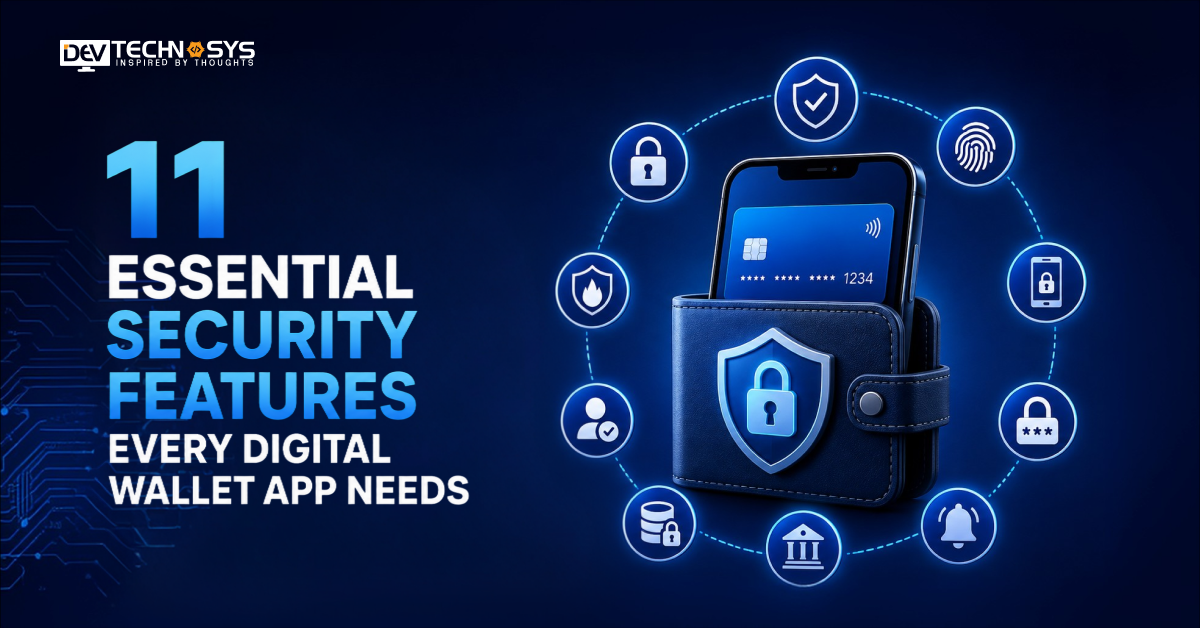
When developing a digital wallet app, the first priority is investing in essential security features. Digital wallet security features decide whether your app scales into a trusted product or becomes a cautionary case study.
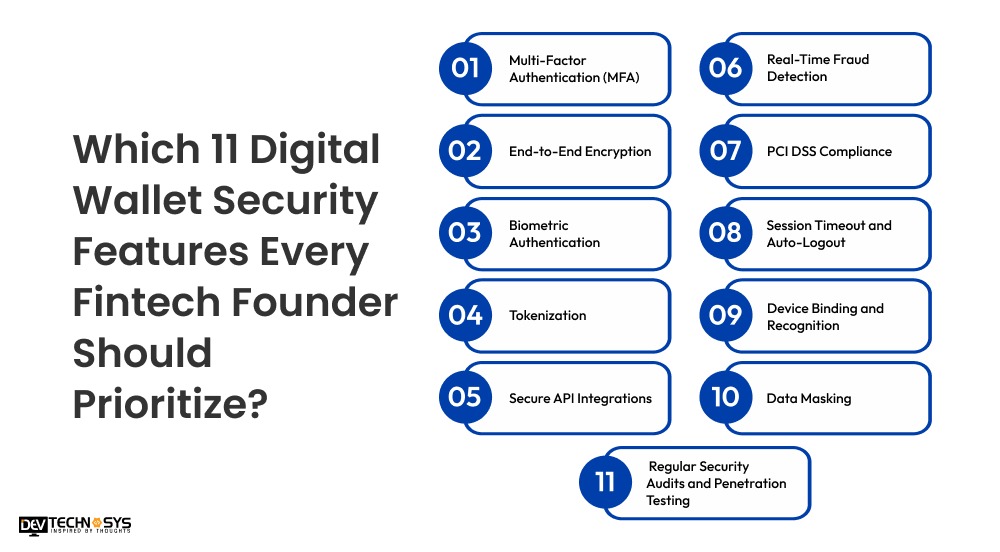
Which 11 Digital Wallet Security Features Every Fintech Founder Should Prioritize?
Encryption, MFA, audits, biometrics, and penetration testing are among the major wallet app security features. Understanding these features helps businesses develop digital wallet security solutions with stronger protection against fraud, unauthorized access, and breaches. More importantly, founders need to understand how these security layers work together. This helps them protect both user funds and sensitive financial data without creating unnecessary friction in the user experience.
1. Multi-Factor Authentication (MFA)
With MFA (Multi-factor authentication), users can verify their identity through two or more methods before accessing their wallet. This is the first line of defense against stolen passwords.
| MFA Method | User Friction | Security Strength |
| SMS OTP | Low | Moderate |
| Authenticator app (TOTP) | Medium | High |
| Push notification approval | Low | High |
| Hardware security key | High | Very high |
The founder decision here is not whether to add MFA. It is choosing the right mix so security does not tank your onboarding conversion.
MFA remains one of the strongest digital wallet app security features you can ship in version one. It also anchors most modern digital wallet app development solutions, since auditors check layered authentication first.
2. End-to-End Encryption
Encryption can scramble data so only authorized users can access it as it flows between servers and when it is stored. It even:
- Secures transaction data, personal information, and payment credentials that are stored
- Protects data while moving from point A to B (TLS 1.3) and when stored (AES-256 encryption).
- Sends a message to enterprise partners/banks about the seriousness of data protection
Without it, raw user data is at risk of being accessed in a database breach. With it, stolen data will be indistinguishable without the encryption keys. This characteristic is usually the key factor in whether banking partners will speak with you.
Proper SSL/TLS Encryption in transit, combined with strong digital wallet encryption, supports compliance and builds user trust. It is also the starting point for most of the custom fintech software development solutions we scope for founders who handle payment data.
3. Biometric Authentication
Biometrics are used to verify identification using fingerprints, face recognition, voice patterns, etc. Founders will know this is the one security feature that enhances the user experience, not detracts from it.
- Eliminates password fatigue and improves login and payment approval times.
- Minimizes drop-off in the initial adoption and everyday use
- Works well with secure enclaves of the device (Face ID, Android BiometricPrompt)
The compromise to consider is fallback. Not all devices support biometrics, so you need a backup option for those that don’t.
Mobile wallet security is increasingly beginning at the device level, rather than the server level. That’s why, in many mobile banking application development for financial institutions projects for financial institutions, biometrics is essential and not an add-on.
4. Tokenization
Tokenization substitutes sensitive card or bank info with a random, irreversible token. The data is not stored on your servers; it is stored in a secure token vault.
- Limits what attackers can steal even if your systems are breached
- Minimizes your PCI DSS compliance hassles
- Standard practice used by Apple Pay, Google Pay, and every major card network
Tokenization is a direct liability reducer for a founder. If your servers don’t store raw card numbers, then the ramifications of a breach are dramatically reduced both legally and financially.
This is the basis of digital wallet data security, as no raw card numbers are kept on your servers. It’s a pattern that we embed in each Custom banking software for financial services engagement where we interact with cards.
5. Secure API Integrations
Digital wallets don’t work in isolation. They connect to banks, card networks, KYC providers, and merchant systems via APIs. All the connections are potential backdoor points that can be attacked.
- Implement OAuth 2.0 and API key rotation for all third-party integrations
- Cap and track API usage to prevent abuse early on.
- Check each vendor’s security measures before including them.
A wallet is as secure as its weakest link. Often, it’s not until another vendor makes the news about a breach that founders realize this is an issue.
It combines OAuth 2.0 with internally enforced role-based access control (RBAC) to fill the gaps most teams miss. These are some of the most underutilized digital wallet app security features until the partnership goes wrong. Also, it forms the backbone of our approach to custom fintech app development for financial services.
6. Real-Time Fraud Detection
As transactions are made, fraud detection systems watch for irregularities and alert the processor before money is transferred.
- Leverages machine learning models based on transaction patterns, location, device, and velocity
- Alerts for abnormal activity such as big transfers to new recipients or logins from new countries
- Minimizes lost chargebacks and fraud, directly affecting your bottom line
| Detection Approach | Speed | Best For |
| Rule-based | Fast | Known fraud patterns |
| Machine learning | Fast, adaptive | Evolving fraud tactics |
| Hybrid (rules + ML) | Fast, layered | Most production wallets |
This is not a scale-appealing feature. When volume becomes large enough, manual review will not keep up, and if it is not automated, fraud losses will outpace revenue increases.
Layering risk-based authentication and continuous transaction monitoring can enhance digital wallet fraud prevention, much more than static rules. It is an essential capability in financial fraud prevention software for fintech. It directly supports the security of digital payments.
7. PCI DSS Compliance
PCI DSS is the world’s security standard for card data. If you’re using your wallet for card payments, it’s required.
- Discusses encryption, access control, network security, and the frequency of testing
- If banks and payment processors are to work with you, you must comply with this requirement.
- Failure to comply may lead to fines and even complete loss of payment processing privileges in severe cases.
Founders may not realize this until (and when) a partnership deal goes sideways because you lack compliance documents. Don’t wait until the day before a partner audit to build in compliance; do it in the roadmap.
One of the easiest digital wallet security best practices is to get it right early. It is also essential for future banking CRM software for customer management that you integrate with your wallet.
8. Session Timeout and Auto-Logout
This function, which logs users out after a short time without activity, is an easy-to-overlook security flaw.
- Safeguards users when their app is left open on a lost or stolen phone
- Minimizes risk on shared devices or on public Wi-Fi sessions
- If timeouts are based on scale sensitivity, then short for sensitive transactions
It is not very expensive to set up, and addresses a weakness that attackers exploit. Some founders do not do this as it’s a trivial part of the process, until it’s the one that triggers a genuine incident.
Over time, such small features like this combine to create real digital wallet app security. The same discipline is applied to the development of our Buy Now, Pay Later (BNPL) app development solutions.
9. Device Binding and Recognition
Device binding links a user’s account to known, trusted devices and warns or denies logins from unfamiliar ones.
- Identifies logins that are from unknown or unusual devices
- Provides an extra layer of security in case a password is compromised
- Can automatically verify unrecognized devices
This does just that to counter one of the fastest-growing fraud categories in digital payments today. It is a solid counter against just the kind of attack that doomed the start-up in the opening narrative of this guide.
This, along with MFA, is one of the digital wallet app security features with the greatest ROI on engineering hours. Cross-border logins are more common in wallets tied to international money transfer app development solutions, making robust digital wallet authentication crucial.
10. Data Masking
Data masking hides sensitive information, showing only partial details like the last four digits of a card number, even to internal staff and support teams.
- Limits exposure during customer support interactions
- Reduces insider risk from employees who do not need full data access
- Simplifies audits by minimizing who can see complete sensitive records
For founders managing a growing support team, this feature protects users from your own staff’s mistakes, not just external attackers.
Digital wallet privacy features matter just as much outside pure payments. We apply the same masking discipline in Insurance management software for insurance companies handling sensitive policyholder data, as part of broader digital wallet security solutions.
11. Regular Security Audits and Penetration Testing
Audits and penetration tests help your system discover vulnerabilities in time, before criminals do.
- Should occur at least once a month, and following each major feature release
- Combines automated vulnerability scanning with manual penetration testing
- The length of a list that must be included in compliance certificates and enterprise partnerships.
Security is not a build. New risks emerge constantly as new features and integrations are introduced. When founders treat the audit as a recurring budget line item, they can catch issues early, when it’s still inexpensive.
One lesser-recognized aspect of digital wallet cybersecurity is periodic testing, which requires the same diligence as any secure payment app development initiative. It is equally important for other related domains such as stock trading platform development for online trading.
Conclusion
Security isn’t the attribute people talk about at a product launch. It is the component that will make or break your wallet app year after year. The features mentioned here are a real, documented form of fraud that remains an ongoing threat to wallet adoption. Together, these digital wallet app security features make one wallet more scalable than another.
From building a new secure wallet application from the ground up to strengthening an existing application’s security, embed digital wallet security features. That’s what we do for fintech founders: digital payment app development for secure transactions.
Pursuing a plan to create a digital wallet without this isn’t the quick way. It’s borrowing debt you haven’t earned yet, and fraud is a debt you’ll always have to pay back.
Frequently Asked Questions
Find answers to the most common questions related to this article.
No, there is no need to add all 11 security features in an MVP. You can simply start with MFA, encryption, and tokenization because they are non-negotiable. Businesses can even add PCI DSS compliance if the app handles card data. You can add fraud detection, device binding, and other advanced features after launch, once you have real transaction data to improve them.
PCI DSS compliance has to be the first one, before anything else. Also, you can go for encryption standards and tokenization practices. Many companies get rejected because of incomplete security and compliance documentation, not weak technology. Therefore, it is recommended to get the paperwork audit-ready before approaching partners.
Features that are compliance-heavy, such as PCI DSS, encryption, and fraud detection, usually carry huge and real liability. If built wrong, this will create big consequences for the platform as well as the business. That’s why most founders bring in a partner with prior fintech security experience. It is a much safer option rather than learning it live on a production app handling real money.
Yes, digital wallets that operate globally require different security standards for different countries. Usually, PCI DSS applies globally for card data, but data residency, consent, and reporting rules vary by region. For example, GDPR in the EU, DPDP in India, and similar frameworks elsewhere. Businesses that are planning to expand cross borders plan their budget according to compliance review per market.
To determine whether your existing digital wallet app is secure enough to scale, businesses should run a penetration test and compliance gap audit. Perform these tests and audits before any major growth push, new market, new funding round, or partnership. Scaling multiplies whatever gaps already exist. Founders who audit before scaling catch cheap fixes. Founders who wait find out during an incident instead.