



















Key Takeaways
- Investing in building apps like Strava can be a good business venture. With the fitness app market growing steadily, this has become a prime target for startups and investors.
- Key features of Strava include real-time GPS tracking, workout analytics, social interactions, gamification, leaderboards, wearable integrations, and many more.
- The cost of building an app like Strava starts from $30,000 to $150,000, depending on the app’s complexity, design, platform choice, backend, and third-party integrations.
- Strava-like apps earn from multiple monetization models such as freemium subscription, in-app purchases, ads & sponsorships, and data insights & analytics.
According to Business of Apps, approximately 540 million people used fitness apps in 2025, and are actively looking to grow to 1 billion in 2026. Strava is a leading fitness tracking app with over 180 million users across more than 185 countries, according to its 12th Annual Report 2025. This led many investors, startups, fitness brands, and healthcare businesses to build an app like Strava to capitalize on the growing demand for fitness enthusiasts.
But unlike traditional fitness applications, Strava goes beyond simple tracking and recording of runs, cycling, and workouts. There, people can share achievements, compare performance with others, join challenges, and connect with fellow athletes. Its compatibility with wearables and fitness devices from brands like Garmin and Apple further enhances user engagement and long-term retention.
Developing an app like Strava requires a deep concept of GPS tracking, route mapping, activity analytics, social networking features, wearable integrations, customizable user dashboards, and a scalable cloud infrastructure. While GPS tracking is a core component, features such as challenges, leaderboards, and personalized performance insights often play a greater role in retaining users and driving recurring revenue.
In this blog, you will explore how to develop an app like Strava. From its core functionality and key features to choosing the right technology stack and development costs, learn how you can earn from an app like Strava. So, let’s dive into the world of Strava fitness tracking in 2026!
What is Strava and why is it Popular?
At its core, Strava is just like other fitness apps. It is a GPS-based tracking app that measures and records workout metrics, including distance, pace, speed, and calories. But the main feature that distinguishes it from others is Strava’s ability to combine fitness tracking with social networking features. Users on Strava can record and upload their workouts in the app for others to see and participate in community events and challenges.
Key Factors Behind Strava’s Success
Strava’s success didn’t come just with advanced GPS tracking and workout recording. It differentiates itself from other apps by creating an ecosystem that keeps users engaged long after their activities are completed. Unique features such as social feeds, group challenges, leaderboards, and performance comparison create a highly interactive experience that not only drives user retention but also attracts new users. Aside from its seamless wearable integrations and customized fitness insights, it helps people stay committed to their health and fitness journey. As a result, millions of users rely on Strava to monitor workouts, track progress, and achieve fitness goals.
Industry Insight
According to Strava’s 2025 Year in Sport Report, Gen Z users are increasingly choosing fitness communities and real-world activities over passive social media consumption.
What Are the Market Stats of Fitness Tracking Apps?
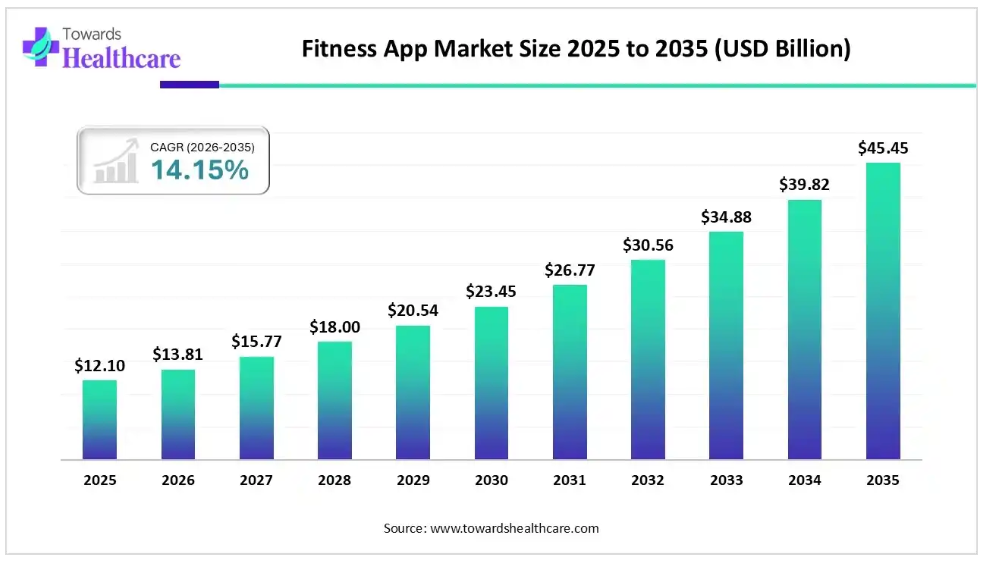
The fitness tracking application market is gradually increasing with the mainstreaming of mobile fitness and wearable devices. According to the Towards Healthcare Report:
- The global fitness application market size was estimated at more than $12.10 billion in 2025 and is expected to reach $45 billion in 2035.
- CAGR of the market is around 15% in the period 2025 to 2030.
- The growth is supported by smartphones, the adoption of wearables like smartwatches, and the necessity to possess personalized information on personal fitness.
- North America held the biggest market share of above 28% in 2025, and its revenue reached approximately 2 billion USD.
Key Features Essential For an App Like Strava in Q3 2026
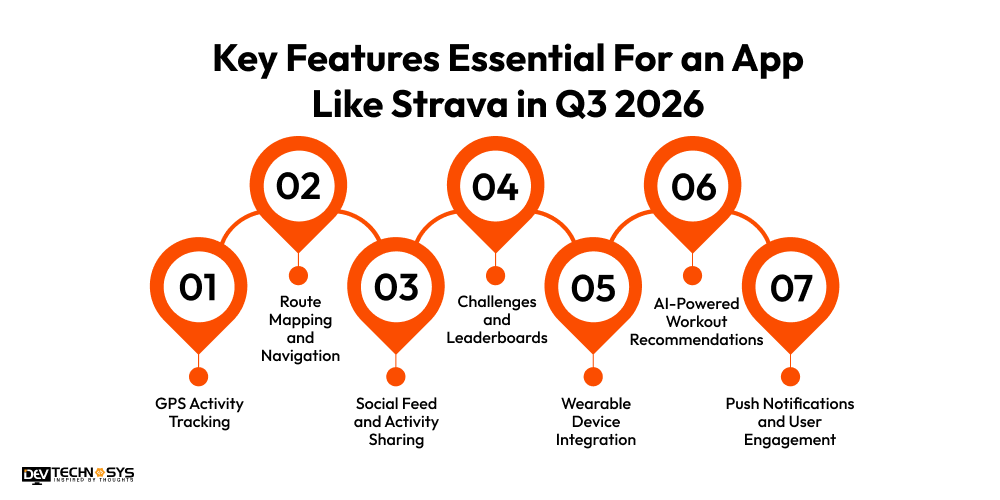
When businesses plan to build an app like Strava, it is crucial to select the best and most appropriate features to achieve a successful project result. A successful sports fitness tracking app combines GPS-based activity monitoring, route mapping, social engagement, wearable connectivity, and advanced analytics.
Feature |
Purpose |
Priority |
| GPS Activity Tracking | Record workouts and routes | Core |
| Route Mapping & Navigation | Visualize activity paths | Core |
| Performance Analytics | Measure progress | Core |
| Social Feed & Sharing | Increase engagement | Core |
| Challenges & Leaderboards | Improve retention | Core |
| Wearable Integration | Sync fitness data | Core |
| AI Workout Recommendations | Personalize user experience | Advanced |
| Push Notifications | Boost engagement | Advanced |
-
GPS Activity Tracking
GPS activity tracking is a fundamental feature of any Strava-like app. It enables users to track distance, pace, speed, elevation gain, calories burned, and workout duration in real time. When you start Strava app development, developers need to integrate GPS sensors, location services, and route-tracking algorithms to ensure accurate activity recording while minimizing battery consumption during extended outdoor sessions.
-
Route Mapping and Navigation
With the help of this feature, users can visualize their activities and plan new training paths using maps. This typically relies on mapping technologies such as Mapbox or Google Maps APIs for route rendering, geolocation processing, and navigation support. A combination of GPS and route mapping provides accurate location tracking and route visualization, which is implemented during Strava-like fitness app development.
-
Social Feed and Activity Sharing
A social feed in Strava enables fitness enthusiasts and athletes to share activities, follow friends, post achievements, and interact through likes and comments. To integrate this feature in your app requires user profile management, activity feeds, content delivery systems, and engagement-focused architecture.
-
Challenges and Leaderboards
Challenges and leaderboards introduce competition into the platform through rankings, achievement badges, milestone rewards, and community events. This gamification of the app helps you in daily engagement and retention rates. For startups looking to build an app like Strava, implementing features like a leaderboard has become a new norm and a core feature of successful sports software development.
-
Wearable Device Integration
With the help of wearable integration, your sports tracking app can seamlessly synchronize with devices such as the Apple Watch, Garmin, Fitbit, and other fitness trackers. Your developers need to implement APIs, health data synchronization protocols, and secure data transfer mechanisms to provide a unified activity-tracking experience across multiple devices and platforms.
-
AI-Powered Workout Recommendations
AI-powered recommendations analyze user activity history, fitness goals, performance metrics, and workout patterns and provide them with personalized training suggestions. AI has shaped the modern fitness apps; thus, businesses are actively incorporating machine learning models and NLP to improve engagement, retention, and user satisfaction.
-
Push Notifications and User Engagement
Push notifications assist users and keep them engaged with workout reminders, challenge invitations, achievement alerts, and personalized updates. With the help of a well-planned notification strategy, you can encourage regular app usage while communication remains relevant and valuable without a disruption.
How Does an App Like Strava Work?
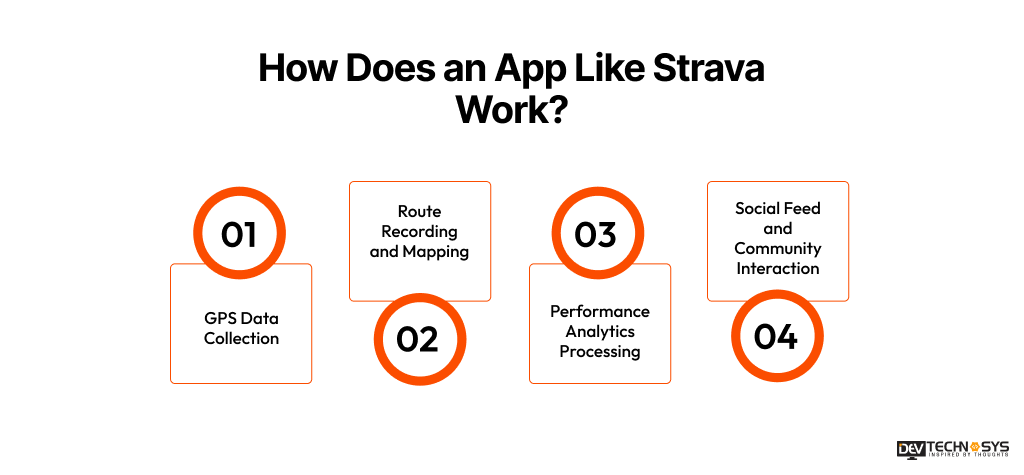
To build an app like Strava, you need to combine multiple functionalities, including GPS tracking, route mapping, analytics processing, cloud storage, and social networking into one single platform. A Strava-like app needs to collect data in real-time, transform it into meaningful performance insights, and assist users in sharing their achievements with a community of fitness enthusiasts.
-
GPS Data Collection
The app starts working when users engage in an activity such as running, cycling, or walking. It uses GPS sensors and location services to record real-time movement, including distance, speed, pace, duration, and elevation changes.
-
Route Recording and Mapping
Once location data is collected, Strava records geographical coordinates and renders them on an interactive map. It uses technologies like Mapbox and Google Maps to visualize routes, display workout history through maps, and support route discovery in the future. This helps in reviewing past activities and identifying new training planning on this basis.
-
Performance Analytics Processing
After the workout is completed, Strava’s analytics engine processes raw activity data and converts it into actionable fitness insights. Users can track progress and achieve fitness goals through analyzed metrics such as pace trends, calories burned, distance covered, and elevation gain. These data-processing workflows are implemented during a fitness mobile app development process to transform large datasets into meaningful user experiences.
-
Social Feed and Community Interaction
This is the final stage focusing on engagement. Users share completed activities, interact through likes and comments, challenges, and complete on the leaderboard. This social function differentiates Strava from traditional fitness tracking apps, turning workouts into a community-driven experience.
Stage |
Function |
Technologies Used |
| GPS Tracking | Captures activity data | GPS Sensors, Core Location, Android Location Services |
| Route Mapping | Visualizes workout routes | Mapbox, Google Maps API |
| Analytics Engine | Processes fitness metrics | Python, Node.js, Apache Kafka |
| Cloud Storage | Stores user activity data | AWS, Google Cloud, PostgreSQL |
| Social Feed | Enables user engagement | Firebase, WebSockets, GraphQL |
Why Businesses & Startups Are Investing in Fitness Apps Like Strava?
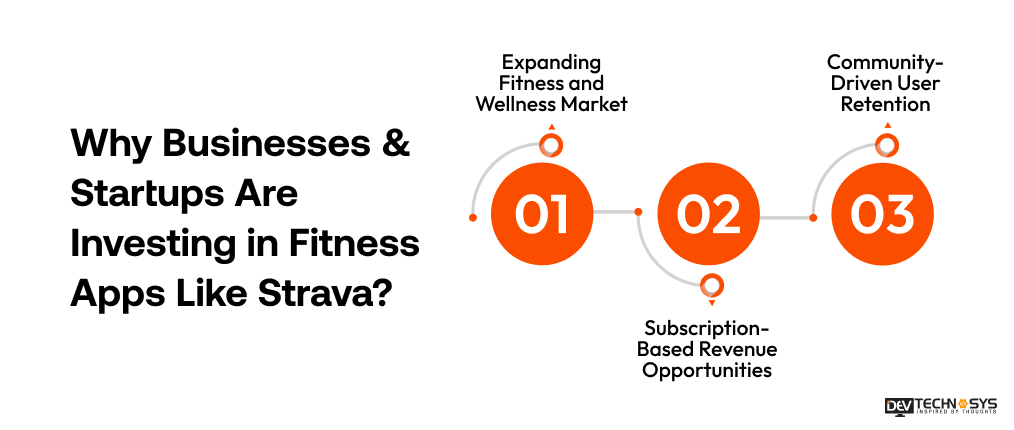
Fitness apps like Strava have proved that combining technology, social life, and fitness workouts can create a healthy and profitable business model. This not only helps them grow as a business but also as a community of like-minded enthusiasts for health and fitness. Below are a few reasons why startups are investing in Strava-like fitness tracking app development:
-
Expanding Fitness and Wellness Market
The fitness industry has rapidly shifted toward connected experiences, where users expect real-time activity tracking, personalized insights, and seamless synchronization across multiple devices. Access to fitness tracking is higher than ever due to the emergence of smartphones and wearable gadgets. This trend has increased the demand for fitness tracking apps that help users monitor workouts, set goals, and maintain healthier lifestyles through data-driven experiences.
-
Subscription-Based Revenue Opportunities
One of the biggest reasons businesses build an app like Strava is the potential for recurring revenue. Premium subscriptions can unlock advanced performance analytics, personalized training plans, exclusive challenges, and enhanced tracking capabilities. Strava’s subscription model demonstrates how fitness applications can generate sustainable long-term revenue while continuously delivering value to users.
-
Community-Driven User Retention
Unlike traditional workout applications that focus solely on activity tracking, Strava has proven that community engagement is a powerful retention driver. Features such as social feeds, leaderboards, group challenges, and achievement sharing encourage users to stay active and return to the platform regularly. Many businesses investing in running app development prioritize community-building features because they increase engagement, strengthen user loyalty, and improve long-term customer retention.
Step-by-Step Process to Build an App Like Strava in 2026 – 2027
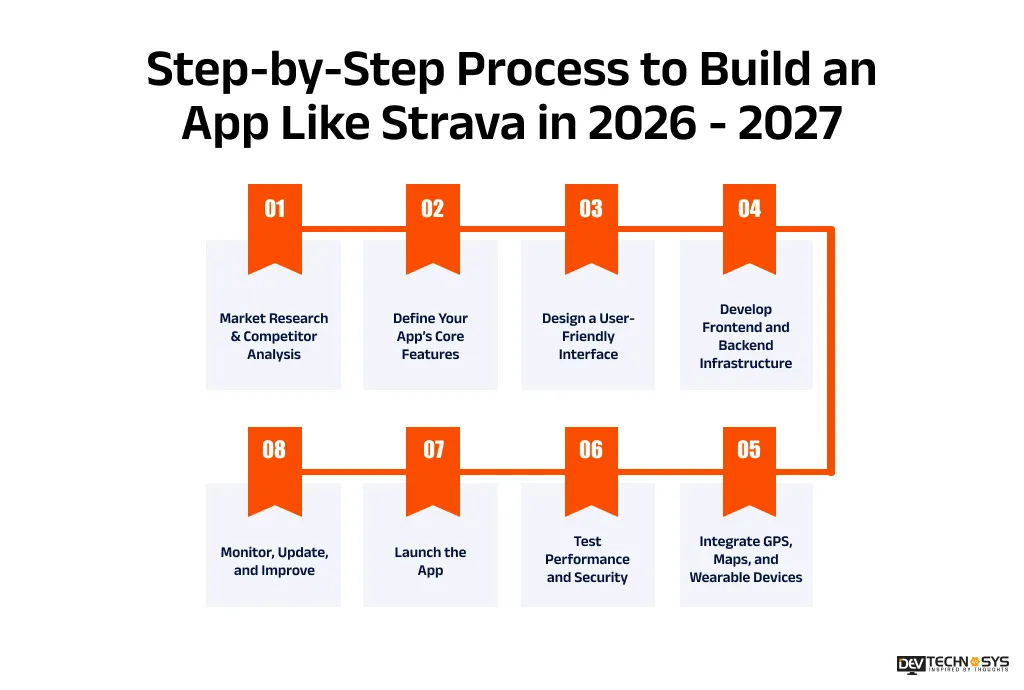
To develop an app like Strava takes a measured approach and broad knowledge of the technical, functional, design aspects, and backend of the app. By following a semantic approach, you can not only reduce development risks but also ensure scalability ofthe app with a user-friendly fitness tracking platform.
Development Stage |
Objective |
Estimated Timeline |
| Market Research | Validate the idea and the target audience | 1–2 Weeks |
| Feature Planning | Define MVP requirements | 1 Week |
| UI/UX Design | Create user-centric interfaces | 2–4 Weeks |
| App Development | Build frontend and backend systems | 8–16 Weeks |
| Integrations | Connect GPS, maps, and wearables | 2–4 Weeks |
| Testing | Ensure performance and security | 2–3 Weeks |
| Deployment | Launch the application | 1 Week |
| Maintenance | Continuous optimization and updates | Ongoing |
1. Market Research & Competitor Analysis
The first step in Strava app development is to study the fitness app market and competitors. Analyze and record their main characteristics, UI, and user feedback from app stores and websites. This research helps to define a unique value proposition and ensures that your app addresses real fitness user needs rather than replicating existing solutions.
2. Define Your App’s Core Features
After having all the information on the market, establish your main functionality. Hire mobile app developers to strategize the development of features like GPS activity tracking, route mapping, performance analytics, user profiles, activity sharing, social feed, leaderboards, wearable compatibility, and workout analytics.
3. Design a User-Friendly Interface
One of the keys to the success of your fitness app is to create an attractive and engaging UI/UX that will allow people to use the app without any issues. Dedicated designers from UI/UX design services can create wireframes, user flows, dashboards, activity-tracking screens, and onboarding journeys that simplify interactions.
4. Develop Frontend and Backend Infrastructure
The development phase involves building both the user-facing interface and the backend systems that power the application. Technologies such as Flutter or React Native are commonly used for cross-platform development, while Node.js, Python, and PostgreSQL support backend operations. Here, you can hire a mobile app development company that can accelerate development while ensuring scalability, performance, and secure data management.
5. Integrate GPS, Maps, and Wearable Devices
For any Strava-like app, GPS tracking and mapping integrations are essential. Mobile fitness app development typically encourages Mapbox or Google Maps APIs for route visualization and navigation. Additionally, integrating Apple Health, Google Fit, Garmin, and Fitbit enables users to synchronize workout data seamlessly across multiple devices and fitness ecosystems.
6. Test Performance and Security
Comprehensive testing ensures the application functions reliably under real-world conditions. Quality assurance teams validate GPS accuracy, route tracking, wearable synchronization, application responsiveness, and overall performance. Security testing is equally important because fitness applications handle sensitive location and health-related user data.
7. Launch the App
After being convinced about the performance of the app, it is time to launch the app on the Google Play Store and the App Store. You must pay attention to the marketing plan, with the emphasis on social media, influencer marketing, and app store optimization.
8. Monitor, Update, and Improve
Once the app launches, it is important to monitor its performance. Monitor the user feedback and the market trends, and conduct regular bug fixes & new features. This is how you can develop a fitness app like Fitbit or Strava.
Industry Insight
According to WiseGuyReports, the wearable app development market is expected to grow from $20.7 billion in 2025 to $45 billion by 2035.
Technology Stack Required for Strava App Development
Choosing the right technology stack is critical when planning to build an app like Strava. The choice directly impacts the app performance, GPS tracking accuracy, scalability, wearable integrations, and long-term maintenance costs. A modern fitness tracking app development typically combines cross-platform frameworks, cloud infrastructure, mapping APIs, analytics tools, and secure databases to deliver a seamless user experience.
Technology Layer |
Recommended Technologies |
Purpose |
| Mobile App Development | Flutter, React Native | Build cross-platform iOS and Android applications |
| Frontend Development | Dart, JavaScript, TypeScript | Create responsive and interactive user interfaces |
| Backend Development | Node.js, Python, Express.js | Handle APIs, business logic, and user management |
| Database | PostgreSQL, MongoDB | Store user profiles, activities, and analytics data |
| GPS & Location Tracking | Core Location, Android Location Services | Capture real-time location and workout data |
| Route Mapping | Mapbox API, Google Maps API | Display workout routes and navigation features |
| Wearable Integrations | Apple HealthKit, Google Fit, Garmin API, Fitbit API | Synchronize health and activity data |
| Cloud Infrastructure | AWS, Google Cloud Platform, Microsoft Azure | Manage hosting, scalability, and data processing |
| Authentication & Security | OAuth 2.0, JWT, Firebase Authentication | Secure user accounts and sensitive data |
| Push Notifications | Firebase Cloud Messaging, OneSignal | Deliver activity reminders and alerts |
| Real-Time Features | WebSockets, Socket.IO | Enable live activity updates and interactions |
| Analytics & Monitoring | Firebase Analytics, Mixpanel, Google Analytics | Track user behavior and app performance |
| AI & Personalization | TensorFlow, OpenAI APIs, Python ML Libraries | Generate personalized workout recommendations |
| DevOps & Deployment | Docker, Kubernetes, GitHub Actions | Automate deployment and infrastructure management |
What is the Cost to Build an App Like Strava?
The cost to develop a fitness app such as Strava will typically begin at $30,000 and may extend to over $150,000, depending on your needs. Simple MVP fitness applications are cheaper than advanced applications that have a wide scope of functions. The breakdown of the cost to build an app like Strava is provided in the table below:
App Type |
Estimated Cost |
Key Features Included |
| Basic App (MVP) | $30,000 – $50,000 | User registration, GPS activity tracking, route recording, workout history, basic analytics dashboard, user profiles, and essential UI/UX design |
| Mid-Level App | $50,000 – $100,000 | Advanced GPS tracking, route mapping, performance analytics, social feed, activity sharing, challenges, push notifications, third-party API integrations, and enhanced user experience |
| Advanced App | $100,000 – $150,000+ | Real-time activity tracking, leaderboards, wearable integrations (Apple Watch, Garmin, Fitbit), AI-powered recommendations, cloud synchronization, premium features, gamification, advanced analytics, and scalable architecture |
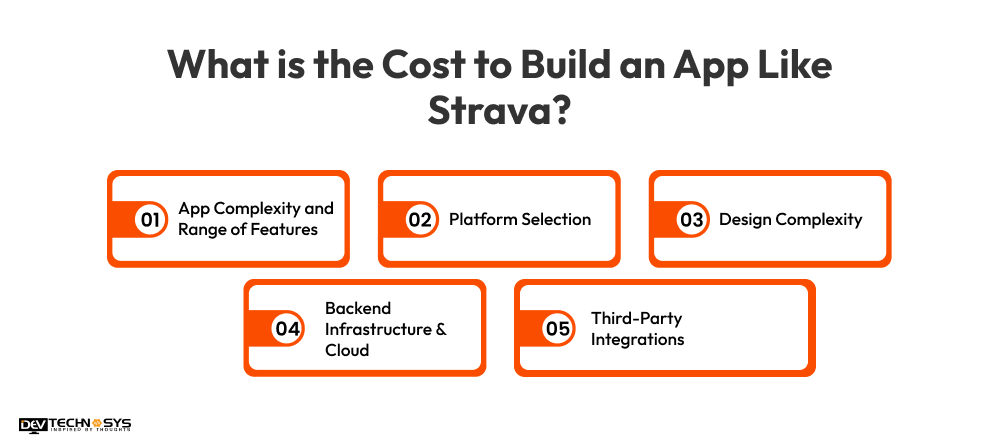
There are multiple factors that affect the Strava app development cost, which are given below:
App Complexity and Range of Features
The more developed features you decide to incorporate, the more expensive it is. Simple features, such as the ability to log in and do simple tracking, are cheap, but features such as the leaderboard and AI analytics make it more complex, which makes it costly.
Feature Type |
Cost Impact |
Examples |
| Basic Features | $2,000 – $8,000 | Login, user profiles, activity history, basic tracking |
| Core Features | $8,000 – $25,000 | GPS tracking, route mapping, activity analytics, notifications |
| Advanced Features | $25,000 – $50,000 | AI insights, leaderboards, gamification, wearable integrations |
Platform Selection
Native apps on the two platforms are very costly to develop because they need two codebases. This requires more development time and is more expensive. Meanwhile, the development of a cross-platform app is slightly cheaper since only one codebase is needed to develop apps in Android and iOS. This offers greater coverage and requires much less time and money than Native apps.
Platform Choice |
Cost Impact |
Impact |
| Single Platform (iOS or Android) | $5,000 – $15,000 | Faster development and lower cost |
| Cross-Platform Development | $10,000 – $25,000 | Wider reach with a shared codebase |
| Native (iOS + Android) | $20,000 – $40,000 | Better performance but higher development effort |
Design Complexity
Simple UI templates are cheaper, whereas complicated UI/UI raises the price because they need personalized UI components like input, navigation, etc. This adds mobile app development time, and more resources are consumed.
Design Level |
Cost Impact |
Description |
| Basic UI | $2,000 – $5,000 | Standard layouts and essential screens |
| Custom UI/UX | $5,000 – $12,000 | Interactive design and improved user experience |
| Premium UI | $12,000 – $25,000 | Advanced dashboards, animations, and personalized interfaces |
Backend Infrastructure & Cloud
With the improvement in the backend infrastructure, the task of developers is to develop systems that would support many users and operate without any problems. Scalable architecture construction will need sophisticated cloud settings, load balancing, sophisticated cloud settings, and load balancing. They must also take security measures in order to remain in accordance with such standards as GDPR or HIPAA.
Backend Type |
Cost Impact |
Features |
| Basic Backend | $3,000 – $10,000 | User management, APIs, and data storage |
| Scalable Backend | $10,000 – $20,000 | Real-time synchronization and analytics |
| Advanced Backend | $20,000 – $35,000 | AI processing, large-scale data management, and high scalability |
Third-Party Integrations
Third-party integrations add to the fitness tracking app development cost to enhance the functionality and user experience of the app. The developers will need extra time to develop and integrate with third parties. It is also costly in terms of budget to secure a license for such tools, which are to be integrated and used. These are recurrent costs, and in order to utilize third-party integration, a subscription must be acquired.
Integration Type |
Cost Impact |
Examples |
| Basic APIs | $1,000 – $5,000 | Maps, GPS, authentication APIs |
| Medium Integrations | $5,000 – $12,000 | Payment gateways, social login, notifications |
| Advanced Integrations | $12,000 – $25,000 | Apple HealthKit, Google Fit, Garmin API, Fitbit integration |
Challenges Occur When You Make an App Like Strava
There are many challenges that can occur during health and fitness app development. Businesses need to address several challenges, including location accuracy, device compatibility, performance optimization, data security, and scalability. The table below explains the fitness app development challenges that can occur during development and how they can be solved.
Challenge |
Impact on Development |
Solution |
| GPS Accuracy | Inaccurate workout and route data | GPS optimization and location filtering algorithms |
| Battery Consumption | Faster battery drain during activities | Efficient background processing and location updates |
| Wearable Synchronization | Data inconsistencies across devices | Robust API integrations and data validation |
| Data Privacy & Security | Compliance and security risks | Encryption, secure authentication, and access controls |
| Scalability | Performance bottlenecks with user growth | Cloud-based architecture and load balancing |
How Monetization Models Work for Fitness Tracking Apps?
The development of an app is not merely a show business; companies must be able to make money on them constantly. Fitness applications, such as Strava, generate income in a variety of ways and include subscriptions, in-app purchases, advertising revenue, and others.
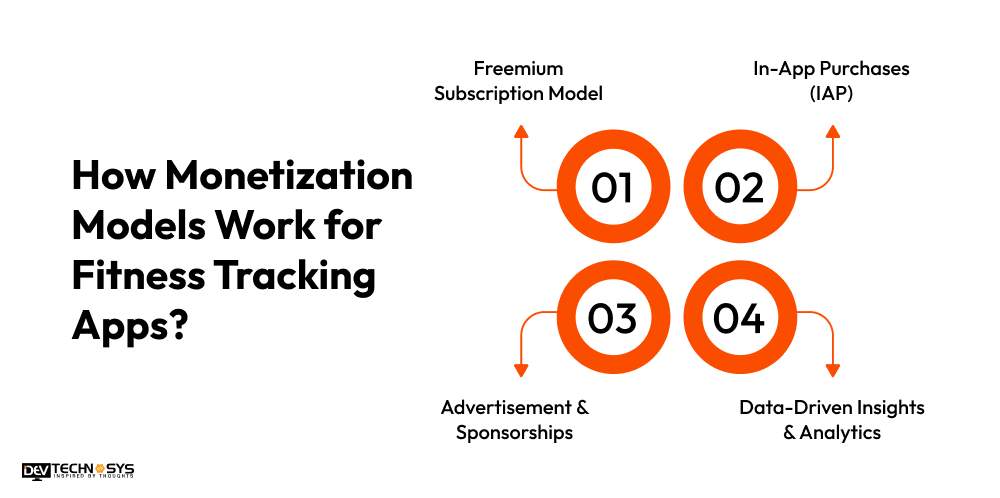
1. Freemium Subscription Model
This model operates by offering users the basic features free of charge, whereas the advanced features are paid for. This assists in making revenue on a continuous basis since it is a recurrent payment. This model has been able to attract a large number of users through its free services and gain new subscribers who are hooked to the app.
2. In-App Purchases (IAP)
People can purchase additional features, content, and virtual items within the app. These include nutritional guides and health information. With this, customers are able to purchase what they require without incurring extra cost for it all.
3. Advertisement & Sponsorships
Mobile apps make heavy use of advertisements for monetization. It is a model that works by incorporating advertisements in your application with other brands and other related content. You will be able to add videos, banners, sponsored events, and brand collaboration with fitness brands and nutritional products.
4. Data-Driven Insights & Analytics
This model works by offering aggregate anonymized user data in order to carry out market research and partner with brands. Included are trends that startups can sell to brands of fitness equipment, gym insights, or health. This gives it a source of revenue without imposing charges.
What are the Top Fitness Apps Similar to Strava in 2026?
In search of an app such as Strava alternatives? These are a few of the applications that are similar to Strava and have revolutionized the usage of fitness trackers. The following are fitness apps that you can select:
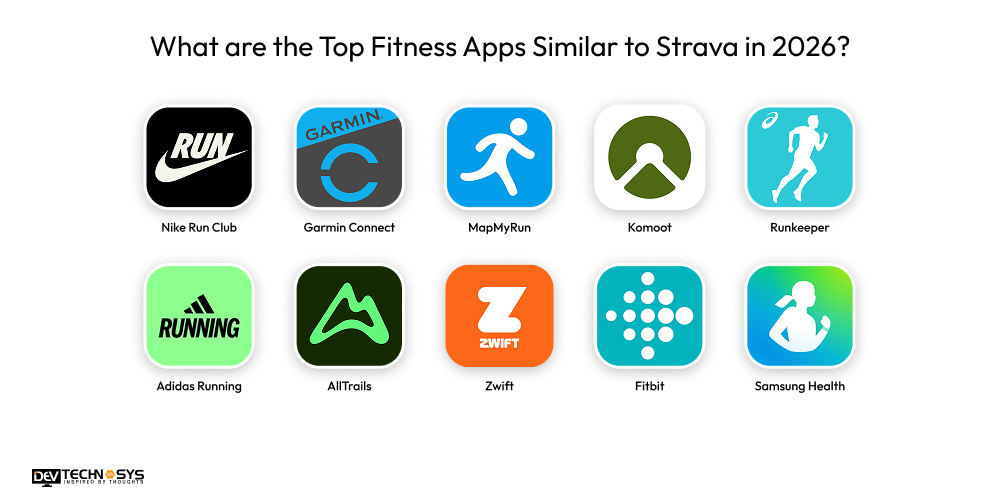
App Name |
Launch Year |
Core Strength |
Approx. User Base |
Platform Availability |
| Nike Run Club | 2010 | Coaching & guided runs | 50M+ | Android, iOS |
| Garmin Connect | 2011 | Wearable analytics | 10M+ | Android, iOS, Web |
| MapMyRun | 2007 | Route tracking | 10M+ | Android, iOS |
| Komoot | 2010 | Navigation & outdoor fitness | 10M+ | Android, iOS |
| Runkeeper | 2008 | Simplicity & training plans | 10M+ | Android, iOS |
| Adidas Running | 2009 | Multi-sport tracking | 50M+ | Android, iOS |
| AllTrails | 2010 | Hiking & trail discovery | 10M+ | Android, iOS |
| Zwift | 2014 | Virtual fitness & cycling | 5M+ | Android, iOS, Windows, macOS |
| Fitbit | 2009 | Health tracking ecosystem | 50M+ | Android, iOS |
| Samsung Health | 2012 | Device-integrated tracking | 1B+ | Android |
1. Nike Run Club
Nike Run Club is suitable for novice and non-professional runners who need guided and encouraged running. The app enables users to get guided runs and coaching, with the help of which the user can develop and work on their performance initially.
2. Garmin Connect
Garmin Connect assists athletes who train with extensive information and wearable gadgets. Through this app, they are able to obtain advanced analytics that assist them in analyzing and optimizing their efficiency in the workouts.
3. MapMyRun
MapMyRun is known to provide powerful route planning and discovery features to runners. Through this application, one will get to monitor gear usage, such as running shoes, and this is effective in streamlining their performance.
4. Komoot
Komoot targets adults who are outdoor enthusiasts and are interested in activities that involve adventure-fitness concerns. It has excellent route guidance and turn-by-turn navigation in order to give a smooth experience. It enables the user to download offline maps, which means that it would act as a constant tracker in distant locations.

5. Adidas Running
Adidas Running not only favors running but also other activities like cycling, hiking, and any other exercise. The app offers a broad spectrum of features, including streaks, challenges, and coaching plans to keep users busy at all times.
Future Trends in Fitness Tracking App Development Beyond 2026
The future of fitness tracking apps extends far beyond activity monitoring and route tracking. Emerging technologies such as artificial intelligence, predictive analytics, and advanced wearables are revolutionizing the way consumers monitor their health and fitness. Businesses that are planning to create an app like Strava should consider these developments to stay competitive and fulfill the changing expectations of users.
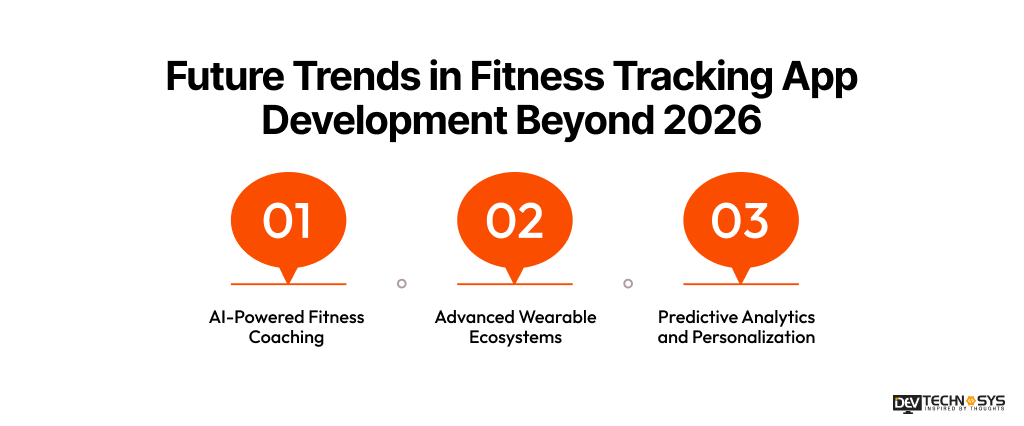
AI-Powered Fitness Coaching
AI is the future; it is making fitness apps more personalized and effective. By analyzing user activity, goals, and performance history, it can generate personalized workout plans, training suggestions, and recovery recommendations that adapt to your fitness levels and progress.
Advanced Wearable Ecosystems
Wearable electronics keep evolving beyond simply measuring your activity. Today, you can track your heart rate, sleep quality, blood oxygen levels, and other health data in real-time with smartwatches and fitness tracker app development. These features help fitness apps create more accurate insights and enhance overall user experiences.
Predictive Analytics and Personalization
Fitness applications are also using machine learning and predictive analytics to deliver improved recommendations and health insights proactively. With sophisticated AI app development, businesses can learn user behavior trends, forecast performance trajectories, and design intensely customized fitness experiences that increase engagement, motivation, and long-term retention.

Case Study: FitConnect
Client: Smith, USA
Team Size: 9 People
Timeline: 28 weeks
CTO: Mohit Nag
Project Scope: Develop a community-driven fitness application that enables users to track workouts, join fitness challenges, connect with other fitness enthusiasts, and monitor performance in real time.
Key Features: Activity tracking, social feeds, fitness challenges, workout analytics, user profiles, and push notifications.
Technologies Used: Flutter, Node.js, PostgreSQL, Firebase, and Google Maps API.
Challenge: Building a scalable platform capable of handling user interactions, activity data synchronization, and real-time engagement features without affecting app performance.
Our Solution: Our team implemented a cloud-based architecture, optimized database queries, and integrated real-time data processing to ensure a seamless user experience.
Outcome: Successfully delivered a scalable fitness platform with strong community engagement and performance-focused features.
Planning a Fitness Project?
Get a tailored development cost estimate in a few simple steps.
- 3 quick steps
- 100% free
- Reply in 1 business day
2 Minutes Read
Conclusion
Creating an app like Strava is not only a matter of evolving GPS tracking and workout programs. Developing a complete fitness application needs a proper strategy that consists of appropriate technological advancement and entrepreneurial thinking.
Apps such as Strava are important in understanding the working of fitness apps that are critical to success. A clear goal, a niche, the right technology stack, a good development team, and monetization strategies will ensure your fitness application is successful in the long run.
Effective fitness apps do not merely record the workouts; they also offer everything-you-need functions as well as establish communities. You will be able to attain the same success that Strava has had with proper planning and implementation. Hiring a workout app development company to create an app like Strava will reduce your worries manyfold.
Get in touch with us and achieve your dream. Dev Technosys has been serving the industry for 15+ years. You just need to come up with your idea, and our developers will help you fulfill it.
Frequently Asked Questions
Find answers to the most common questions related to this article.
The Strava app development cost is between $30,000 and $150,000. An MVP fitness tracking app costs less with essential features such as GPS positioning and rudimentary analytics. However, more advanced applications with interactive AI and wearables, all-inclusive analytics, and social inclusion are found in the upper tier of the cost.
It normally requires between 3 and 9+ months to develop a fitness tracking application such as Strava. The minimum MVP application will apply between 3 and 4 months, whilst the full-fledged premium application will take between 7 and 9+ months, since they have to have advanced features and integration.
The most important characteristics that constitute Strava include real-time GPS, activity analytics, social sharing, leaderboard, wearable integration, and customized goals. These are some of the characteristics that form the foundation of successful fitness tracking applications like Strava.
React Native or Flutter are frameworks employed by developers in the frontend. The backend programming languages include Node.js or Django, and GPS tracking includes Google Maps API or Mapbox. Integrations with cloud platforms, as well as wearables, help in making a high-quality app like Strava.
To make your fitness app more interactive, you can add such functions as gamification, social interaction, and personalized insights. Such features, along with the precise real-time updates, activity feed, and the leaderboard, retain the audience and create a base of loyal users.