




















Quick Summary:
The cost to develop a fintech app like Wise typically ranges from $8,000 to $30,000+, depending on app complexity, security layers, integrations, and scalability requirements. A basic MVP may cost $8,000 – $15,000, mid-level apps range from $16,000 – $25,000, while advanced fintech platforms with AI, multi-currency support, and compliance systems can exceed $30,000+.
Cost Breakdown by Development Complexity:
-
- Basic / MVP Fintech App: Includes simple money transfers, limited currency support, basic UI, and standard payment integrations.
- Mid-Level Fintech App: Adds multi-currency wallets, real-time tracking, notifications, third-party API integrations, and enhanced UI/UX.
- Advanced / Enterprise Fintech App: Includes AI-driven insights, fraud detection, global payment systems, compliance (KYC/AML), analytics dashboards, and scalable architecture.
Key Factors Influencing Cost:
-
- Feature Complexity: Multi-currency wallets, automation, analytics, and AI-based insights significantly increase development costs.
- Security & Compliance: Implementation of KYC, AML, encryption, and fraud detection systems adds substantial cost.
- Third-Party Integrations: Payment gateways, banking APIs, and currency conversion APIs increase both development and operational expenses.
Development Timeline:
-
- Basic Fintech App: 2 – 4+ months
- Mid-Level Fintech App: 5 – 7+ months
- Advanced Fintech App: 8 – 10+ months or longer
Fintech App Development Cost by Region:
-
- North America (USA & Canada): $30 – $50 per hour
- Western Europe (UK, Germany, France): $45 – $85 per hour
- Eastern Europe (Poland, Ukraine, Romania): $40 – $70 per hour
Money isn’t simply counted anymore; it is experienced.
Apps make it possible to earn money, simplify, invest, lend, and grow wealth in seconds. If you are considering creating a fintech app like WISE, you are entering a market that is not only changing but also booming.
According to the forecast, the worldwide fintech market will grow to more than $400 billion by 2027, fueled by the increasing desire for fast and easy digital payments as well as cross-border transactions.
But here comes the main question: how much does it actually cost to build such a powerful platform? Each feature, from secure payment gateways to real-time currency conversion and compliance layers, adds a strategic cost layer.
In this blog, we will reveal the real cost to develop a fintech app like Wise so you will be able to plan better, not just on a larger scale.
What is a Wise App?
Wise, a popular fintech platform, specializes in low-cost currency exchange and international money transfers. Users can send money overseas, receive money, store multiple currencies in their digital wallet and make international payments at competitive rates with minimal fees.
Wise is known for its transparent pricing and commitment to offering a cheaper alternative to traditional banks when it comes to cross-border transactions.
Cost To Develop a Fintech App Like Wise
Types of FinTech App |
Approximate Budget |
Time Duration |
| Basic | $8,000 to $15,000 | 2-4 Months |
| Average | $16,000 to $20,000 | 5-7 Months |
| Complex | Above $30,000 | 9 Months |
Cost to develop a fintech app like Wise are estimated to range from $8,000 up to $30,000. The cost is dependent on the project complexity and the technology.
The fintech app development cost is also heavily influenced by the platform and hourly rate you choose, as well as the complexity of your project.As a result, we developed a formula to help you estimate the cost to develop a fintech app like wise.
Estimated development hours * Developer’s hourly cost = Total mobile app development costs
The cost to create an app is highly variable and depends on many factors. These include the complexity of the application, the experience of your custom fintech app development services team as well as the location of where you are developing the app.
However, if you create an MVP, the cost To build a fintech app like Wise will be lower. It takes less time to develop a full-featured social media app. You’ll need to hire a fintech software development services provider that has expertise building social networking applications or photo-sharing apps.
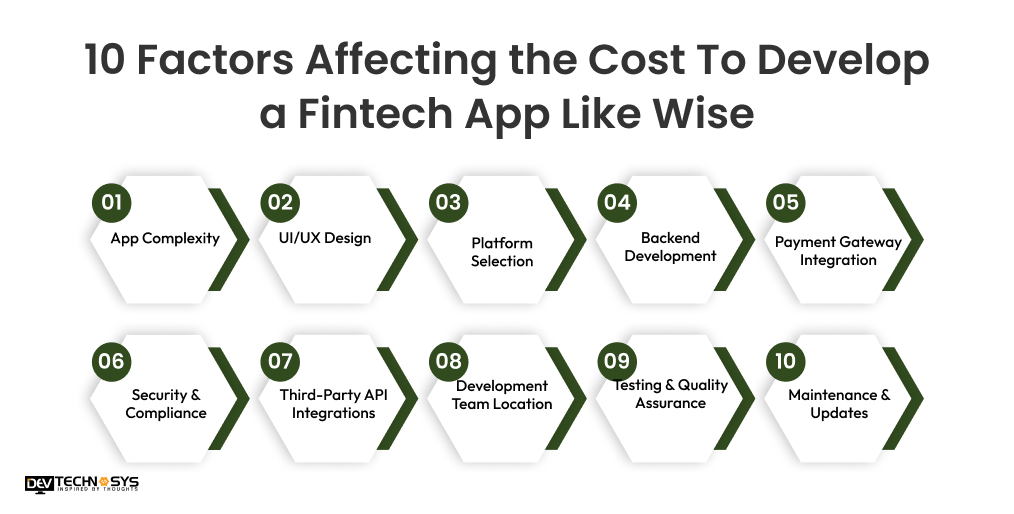
10 Factors Affecting the Cost To Develop a Fintech App Like Wise
Do you know what the main reasons are behind the cost of building a fintech app similar to Wise? And why do some businesses end up spending too much while others manage to scale wisely?
It all comes down to the details. Feature-wise, security-wise, and so on: each choice affects your finances. On the whole, let us examine the key components that influence your total cost to develop a fintech app like Wise.
1. App Complexity
The app’s complexity level determines both your budget and your scalability potential. An elementary app may be able to process a few transactions, but when you add multi-currency wallets, automation, and analytics, the mobile banking app development work increases significantly. Having more features means more layers of code, integrations, and testing cycles, which will increase the cost to build a fintech app like Wise.
Feature Level |
Included Capabilities |
Estimated Cost |
| Basic | Simple transfers, limited currencies | $1,000 |
| Moderate | Multi-currency wallet, tracking | $2,000 |
| Advanced | Automation, analytics, AI insights | $3,000 |
2. UI/UX Design
The reliability and ease of use of a fintech app are essential to winning users’ confidence. Simple navigation, attractive dashboards, and effortless user visits suffer from a lack of profound studies, wireframes, and usability testing.
Spending money on top-notch UI/UX design will lead to higher user engagement, fewer users leaving the app, and increased sales. It is considered an important cost component in the development of international money transfer apps.
Design Type |
Elements Included |
Estimated Cost |
| Template-Based | Pre-designed layouts | $800 |
| Custom UI | Brand-specific visuals | $1,500 |
| Premium UX | Interactive, user-tested design | $2,000 |
3. Platform Selection
The choice of a platform strategy that aligns with your needs will be a determining factor not only for your expenses but also for your market reach. With only one platform, investment will be low, whereas cross-platform development is a better cost-audience compromise.
Multi-platform solutions are the most likely to be accessible to anyone, but they also require more resources, testing, and optimization, resulting in higher costs and longer development time for the money transfer app.
Platform Type |
Coverage |
Estimated Cost |
| Single Platform | iOS or Android | $800 |
| Cross-Platform | Both with shared codebase | $1,800 |
| Multi-Platform | iOS, Android, Web | $2,500 |
4. Backend Development
Any fintech app is essentially a product of its backend development. That is why only the best fintech app development company, capable of delivering top-notch, high-quality backend, should be trusted. The backend is responsible for managing transactions, user data, and integrations.
Scalable backend ensures good performance even during the app’s rush hours, whereas enterprise-level systems come with a highly secure, distributed architecture and optimized databases that significantly increase the Wise app development cost.
Backend Type |
Features |
Estimated Cost |
| Basic | User management, simple APIs | $1,000 |
| Scalable | Real-time transactions, databases | $2,500 |
| Enterprise | High security, load balancing | $3,500 |
5. Payment Gateway Integration
One of the most fundamental elements of making your fintech financial operations work smoothly is facilitating payment integration for routine activities such as deposits, withdrawals, and transfers.
With the addition of several payment gateway development solutions and countries, the integration process becomes more complicated. To ensure transactions are seamless, secure, and fast, you will need reliable application programming interfaces (APIs) and conduct compliance checks.
Integration Type |
Capabilities |
Estimated Cost |
| Basic | Standard payment APIs | $700 |
| Advanced | Multi-method payments | $1,500 |
| Enterprise | Global, multi-currency support | $2,000 |
6. Security & Compliance
Most fintech applications need the highest level of security. Compliance with KYC and AML regulations, along with a robust encryption mechanism implemented as layers, will increase the cost of Wise app development.
Incorporating biometric identification, authentication, and fraud detection systems as additional security features raises trust but calls for lots of forex transfer app development time and expertise
Security Level |
Features |
Estimated Cost |
| Standard | Basic encryption | $1,000 |
| Advanced | KYC, AML compliance | $2,000 |
| High-End | Fraud detection, biometric security | $3,000 |
7. Third-Party API Integrations
Integrating APIs connects an app to additional functionalities through external services. APIs for live currency conversion and direct banking transactions are just examples of how each one brings in more features and, at the same time, more complexities.
Having several APIs to manage means you will be required to keep them in sync, handle their errors, and also you will have to account for security issues. All this stuff goes into making up the final cost of the P2P lending app development.
API Type |
Functionality |
Estimated Cost |
| Basic APIs | Notifications, basic services | $600 |
| Financial APIs | Currency rates, banking | $1,000 |
| Advanced APIs | AI insights, automation | $1,500 |

8. Development Team Location
Outsourcing to a Fintech app development agency abroad is a much more affordable option than onshore teams, which tend to charge higher rates. A mixture of both, in terms of location, is a means to maintain a balance between cost and quality and, hence, attractively positioned for companies focusing on cutting down costs to create a fintech app like Wise.
Region Type |
Cost Efficiency |
Estimated Cost |
| Offshore | Highly cost-effective | $800 |
| Hybrid | Balanced cost and quality | $1,800 |
| Onshore | Premium pricing | $2,500 |
9. Testing & Quality Assurance
Using a test put-through is necessary if you want your fintech app to work efficiently without any glitches. The only way of being sure that your newly built and launched fintech app will perform as expected and you will not get any errors is regular and thorough testing. Testing various aspects of the system, including but not limited to functionality, security, and performance, helps in increasing the trust of the users.
Testing Level |
Scope |
Estimated Cost |
| Basic QA | Functional testing | $600 |
| Advanced QA | Automation, performance | $1,000 |
| Full QA | Security, load, usability testing | $1,500 |
10. Maintenance & Updates
Post-launch maintenance keeps your app functional and competitive. Regular updates, bug fixes, and feature enhancements ensure long-term success. As user expectations evolve, continuous improvements become necessary, making maintenance an ongoing investment rather than a one-time mobile application development cost.
Maintenance Type |
Services Included |
Estimated Cost |
| Basic | Bug fixes | $700 |
| Standard | Updates, monitoring | $1,200 |
| Advanced | Feature upgrades, scaling | $1,500 |
Top 5 Most Popular Fintech Apps Like Wise: Cost Breakdown
In this section, we have covered some of the most popular Fintech apps like Wise, which you must know about for better market research. We have also covered these fintech app development costs to get you an idea about cost accuracy.
App Like |
Estimated Cost (USD) |
| MoneyLion | $12,000 – $28,000 |
| Robinhood | $15,000 – $30,000 |
| Chime | $10,000 – $25,000 |
| Revolut | $18,000 – $30,000 |
| Venmo | $8,000 – $22,000 |
1. MoneyLion
MoneyLion is an all-in-one financial application that offers customers banking, lending, investing, and credit-building capabilities. The means of delivering such personal finance management are through automated processes, cash advances, and real-time financial insights for users.
Cost:
Estimated fintech app development cost ranges from $12k-$28k, depending upon the complexity of the lending systems required, AI insight capabilities, integration, and compliance infrastructure required for scalable operations in the Fintech sector.
2. Robinhood
Robinhood is an online trading platform with zero-commission trading. Through Robinhood, users can trade stocks, ETFs, and other cryptocurrencies. They provide a user-friendly trading platform and the tools necessary for beginners to get started, as well as retail investors of all types to make their investment decisions.
Cost:
Estimated development costs for building a similar trading application range from $ 15k to $30k, depending on the complexity of the trading engine, the use of real-time data APIs, and the incorporation of security systems and regulatory compliance integrations.
3. Chime
Chime is a mobile banking application that primarily offers customers no-fee accounts,early direct deposit options, automatic savings, and credit-building tools. Chime is focused on simplifying banking processes while also providing helpful tips for making financial decisions.
Cost:
Estimated development costs for an app like Chime range from $10k-$25k, depending on the complexity of the banking systems and the user experience (UX), as well as the extent of automation in the finance portion of the application.
4. Revolut
Revolut is a simple banking application that allows customers access to various currencies and global banking solutions such as multi-currency accounts, international transfers, investments, cryptocurrency trading, and budgeting tools integrated in one app.
Cost:
The cost to build an app like Revolut typically ranges between $18,000 to $30,000, depending on multi-currency support, investment modules, APIs, and global compliance infrastructure.
5. Venmo
Venmo is a social payment app that allows users to send money, split bills, and share transactions socially, combining financial transactions with a social networking experience for engagement.
Cost:
The estimated cost to build an app like Venmo ranges from $8,000 to $22,000, depending on social features, payment integrations, scalability, and secure transaction systems.
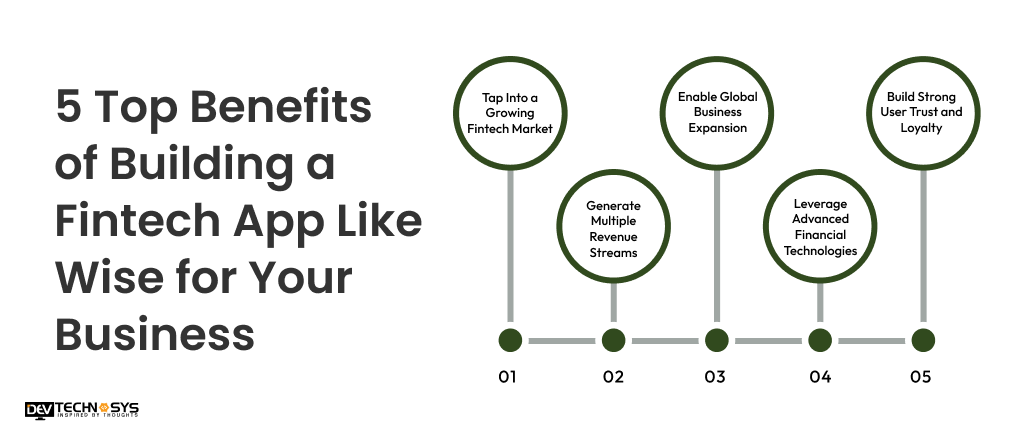
5 Top Benefits of Building a Fintech App Like Wise for Your Business
If you want your app to simplify global payments while generating consistent revenue, you must know something important. Building Wise clone apps unlocks growth, trust, and innovation, helping businesses scale faster in today’s competitive digital finance ecosystem.
1. Tap Into a Growing Fintech Market
Building an e-wallet app like Google Pay allows you to enter a rapidly expanding digital payments market. With increasing global transactions and demand for seamless money transfers, businesses can capture a large user base and scale revenue opportunities efficiently.
2. Generate Multiple Revenue Streams
There are a variety of ways in which mobile apps can generate revenue, including via transaction fees, currency conversion fees, subscription fees, and through partnerships with banks and other financial institutions.
Multiple revenue channels give companies a source of steady revenue while also allowing them to maximize their profits by providing a service to several different segments of customers/markets.
3. Enable Global Business Expansion
A peer-to-peer payment app enables companies to conduct cross-border transactions and reach international customers without an office. With this capability, an app removes many barriers to expanding into new geographic locations or entering new markets, and allows small start-ups as well as large corporations to reach their goal of attracting a different type of customer and developing a larger ecosystem.
4. Leverage Advanced Financial Technologies
Fintech software developers can also leverage emerging technologies such as Artificial Intelligence, Blockchain, and Real-time Analytics to deliver better user experiences, make smarter business decisions, and gain a competitive advantage in the fast-paced, evolving digital financial marketplace.
5. Build Strong User Trust and Loyalty
Fintech app development solutions that are transparent, quick, and secure will create an identity for themselves in the financial services industry. Fintech users are more likely to use a service if they can trust that the provider will deliver on its promises; therefore, users who trust a fintech service tend to remain loyal to the company longer.
Want a chatbot demo or pricing? Fill the form and talk to our experts today.
Pick what you need below — you can select more than one — then tap Get detail to continue.
-
Chatbot demo dashboard
-
Cost to develop an app
-
Industry report
-
Case study
5 Hidden Charges In Cost To Develop A Fintech App Like Wise
Have you thought through your budget for building your Fintech app? Not very likely! You’re probably overlooking hidden costs that could significantly increase your overall fintech app development costs.
Before moving forward with the development of your app, you should identify all additional direct and indirect costs you may incur that could improve or detract from your overall financial strategy.
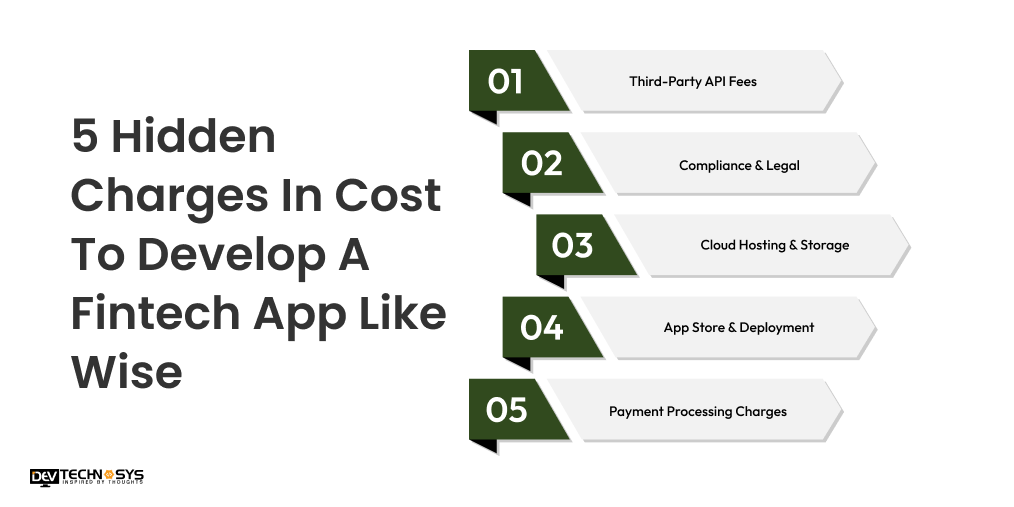
Hidden Factor |
Estimated Cost |
| Third-Party API Fees | $500 – $2,000 |
| Compliance & Legal | $800 – $2,500 |
| Cloud Hosting & Storage | $400 – $1,500 |
| App Store & Deployment | $200 – $800 |
| Payment Processing Charges | $500 – $1,500 |
1. Third-Party API Fees
Third-party APIs are frequently incorporated in fintech apps for a variety of functions, including currency conversion, payment processing, and banking services.
Although the initial integration will appear to be budget-friendly, the ongoing subscription or pay-per-use fees will greatly increase operational costs as the number of users increases.
2. Compliance & Legal Costs
Wise clone apps are subject to strict regulations such as KYC, AML, and data protection. Legal consultation services, documentation requirements, and certification fees are often overlooked at the outset of an app’s life cycle, but as your app grows and enters new markets or processes sensitive financial data, these expenses will become unavoidable.
3. Cloud Hosting & Storage
The expenses associated with hosting your application vary depending on the number of transactions your app processes, the transaction volume, and the amount of data that needs to be stored.
As your app scales, the amount of server time needed will also increase, leading to a higher monthly hosting fee. A secure, high-performing cloud service will enable you to conduct business quickly, reliably, and safely.
4. App Store & Deployment Fees
An app developer pays a one-time registration fee and an annual subscription to use Google Play or Apple App Store’s services. In addition, developers may incur costs for creating developer accounts on the Google Play and Apple App Store (if applicable), as well as for testing tools and compliance checks before deploying their apps.
5. Payment Processing Charges
There are two primary types of provider fees: transaction processing and transaction gateways. Transaction processing has an associated processing fee per transaction.
Transaction gateways have an associated fee for entering into an agreement with the provider and a per-transaction fee for use of the gateway. Fees are low per transaction, but can quickly accumulate if there is a large number of transactions.
5 Ways to Reduce the Cost To Develop a Fintech App Like Wise
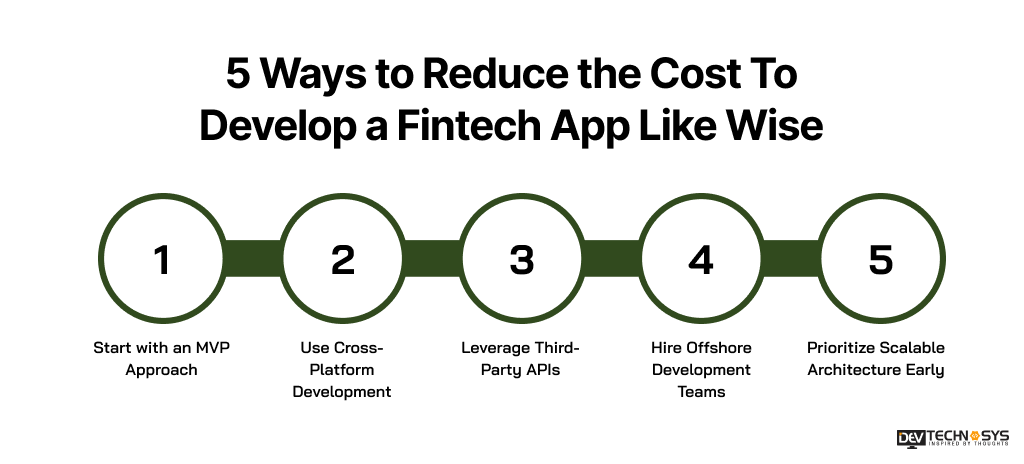
1. Start with an MVP Approach
Why start with a full app when you can begin with just the must-haves? Launch early, see what users want, then add features based on real feedback. That cuts down upfront spending fast.
2. Use Cross-Platform Development
Use Flutter or React Native to write one code that runs on both Android and iOS. Same codebase means less time spent coding, fewer bugs, and lower cost to create a fintech app like Wise without sacrificing performance.
3. Leverage Third-Party APIs
Skip building payment, KYC, or currency systems from zero. Pull in proven third-party services. They handle the heavy lifting. Saves effort, avoids mistakes, and keeps expenses down.
4. Hire Offshore Development Teams
Outsource to a fintech app development agency where hourly rates are lower. This strategy helps maintain quality while significantly reducing overall project costs without compromising on technical expertise.
5. Prioritize Scalable Architecture Early
Build a scalable yet simple banking app architecture from the beginning to avoid expensive rework later. Proper planning ensures smooth upgrades and prevents unnecessary costs associated with redesigning systems as your app grows.
5 Ways to Monetise an App Like Wise
What if your Wise alternatives could generate income through every transaction, currency conversion, and user interaction, without your customers running away? The real trick isn’t to charge more; it’s to charge smartly. So, let’s reveal some great monetization tactics that will help make your Wise-like app a scalable revenue generator.
1. Transaction Fees on Transfers
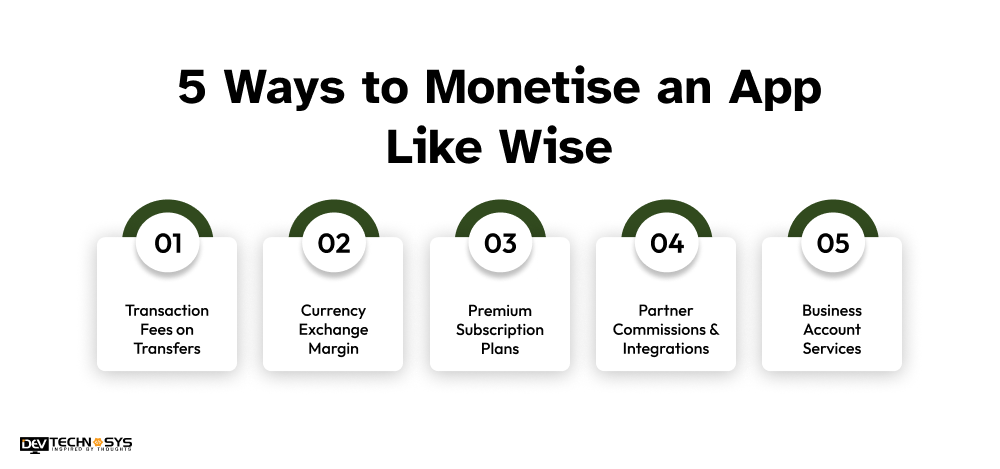
Charge a small percentage or flat fee on every cross-border transaction. Maintain pricing that is clear and competitive to enhance trust while at the same time generating steady revenue from high-volume transfers across different currencies and countries.
2. Currency Exchange Margin
Wise alternatives generate revenue by simply adding a small margin to live exchange rates. Even tiny spreads may yield a lot of revenue if the users are constantly changing currencies for international payments, travelling, or business purposes.
3. Premium Subscription Plans
Sell subscription plans for a month or a year with bonus features like cheaper fees, transfers made in no time, support that is given first, and transaction limits that are increased. Besides generating recurring revenue that is highly predictable, you will also be building customer loyalty and enhancing the overall user experience.
4. Partner Commissions & Integrations
Work together with banks, fintech companies, or payment app development solutions to make money from commissions on referrals and integrations. You can also use your strategic partnerships to broaden your service offerings, whilst at the same time creating other sources of income that are separate from your main transactions.
5. Business Account Services
Give business clients options that best fit their needs, such as making multiple payments at once, paying staff, providing invoicing tools, and giving access to systems via APIs.
You can either charge a fee for the service or offer a subscription plan. Your main targets will be startups and big companies that need a smooth global financial operation.
Ready to Build Your Wise-Like Fintech App? Here’s Your Strategic Next Move
Creating a fintech product like Wise isn’t just about writing software. It’s about picking the right tools at the right moment. How you plan spending, which features to include, and where hidden costs hide – all of it shapes final outcomes. The real issue is: are you simply crafting an app, or are you creating a robust financial platform?
That’s exactly the point where the ewallet app development company comes on board. Helping you turn your concept into a powerful, market-ready solution, they rely on their profound knowledge of remittance app development, secure integrations, and user-focused design.
Whether you are a startup or a multinational, joining forces with the most suitable Fintech app development firm means you are not only releasing your product but becoming a leading innovator in the competitive fintech industry.
Frequently Asked Questions
Find answers to the most common questions related to this article.
The fintech app development cost varies from $8000 to $30000; it always depends on features, security, and scale. A simple version can start around $ 8,000, whereas more sophisticated apps might cost up to $30,000.
The time of wise clone app development depends on how complex the project is, and it can be from 2 to 6 months. Using an MVP approach, you could get a product out the door faster, but implementing more sophisticated features like real-time currency conversion and compliance systems would, of course, prolong development time.
Absolutely. Fintech startups can reduce costs by starting with an MVP, leveraging third-party APIs, and scaling gradually. Working out a plan in the best way and focusing on the necessary features will definitely help you develop a fintech app without sacrificing long-term growth potential.
Security, compliance, and seamless user experience are the biggest hurdles. Managing regulations like KYC and AML while ensuring fast transactions requires expertise. Overcoming these challenges is key to building a trustworthy and scalable fintech platform.
Revenue comes from transaction fees, currency exchange margins, subscriptions, and partnerships. The key is balancing monetization with user trust charge smartly, not heavily, so users continue to rely on your platform for everyday financial needs.