







“Know and use dApps as your personal wallet for digital crypto exchanges.”
Do you know what is a decentralized application? How dApps work? There are many questions like these that occur in the mind of a user. But, unfortunately they do not get any reliable source to know about such platforms in detail. A dApp not only allows users to store digital assets but offer multiple other services like exchange, transactions and investing.
Several dApps like Trust, Uniswap, and PancakeSwap provide safety, privacy, and flexibility in transferring digital assets such as tokens and coins. So, it is an important task for users to know how dapp works.
In this blog, we will provide all the information in detail starting from the dApp definition and working to future expectations. So, let’s get started.
What is a dApp?
Do you know what are DApps? A digital program that runs on a peer-to-peer network or blockchain rather than centralized servers is known as a decentralized application (dApp). These blockchain platforms provide more security, transparency, and user control.
To guarantee automated and trustless interactions, businesses should avail blockchain development services at lower rates. For using dApps in the supply chain, social media, gaming, and finance industries, you must know how decentralized applications function.
- Decentralization: Operates on a distributed blockchain network.
- Smart Contracts: Executes automated logic using code-based agreements.
- Open Source: Many dApps are publicly auditable, encouraging transparency.
Working Principle of dApps
We have seen what are decentralized applications and its 3 main features. So, are you aware how dApps work? A dApp working mechanism is that it operates on a decentralized blockchain network with smart contracts powering the backend code.
Without a central authority, these contracts independently carry out logic and transactions according to predetermined norms. The blockchain guarantees data confidentiality, immutability, and integrity as users engage with the dApp through a user interface.
A Web3 development company may help businesses to easily track and convert the earnings through dApps. Transparency in the recording of all acts allows for peer-to-peer interactions that are free from middlemen and can be trusted.
How AI Can Impact dApps Working?
Have you considered what is blockchain app development without AI? By facilitating more intelligent automation, predictive analytics, and adaptive user experiences, artificial intelligence may greatly improve the usefulness and efficiency of dApps.
Additionally, it is beneficial to know how blockchain powers dApps by combining with AI. This combination can enhance decision-making, security, and scalability, resulting in more intelligent and customized decentralized ecosystems.
- Enhances smart contract automation through intelligent decision-making.
- Detects fraud and anomalies using real-time data analysis.
- Optimizes transaction processing and network efficiency.
- Personalized user experience with behavior-based recommendations.
- Facilitates autonomous governance through predictive modeling.
Major Components of a Decentralized Application
Before knowing how do dApps work, you must study its components. A dApp is made up of several parts that allow peer-to-peer communication that is essential to maintain security and decentralization:
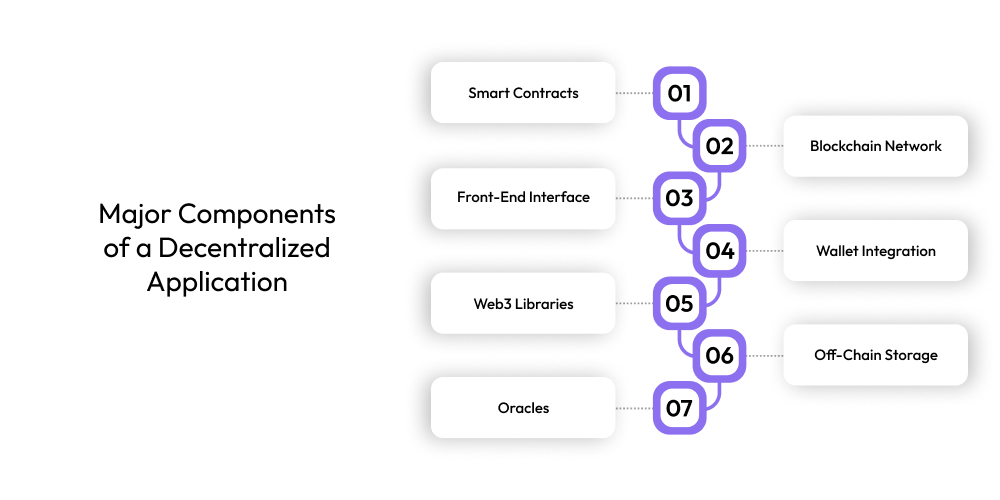
1. Smart Contracts
Blockchain deploy self-executing code that automates and enforces regulations without the need for outside intervention. With Smart Contract development, you can manage dApp’s basic transactions.
2. Blockchain Network
It is the decentralized system that permanently saves transaction history and data. Decentralized applications guarantee everyone’s agreement, security, and transparency.
3. Front-End Interface
This component is the part that communicates with the smart contracts and is visible to the user. Users can interact with the dApp through a web or mobile application.
4. Wallet Integration
The app connects the dApp to users’ cryptocurrency wallets, such as MetaMask, for transactions and authentication. It makes it possible to maintain and access digital assets securely.
5. Web3 Libraries
These frameworks enable communication between the front end and the blockchain, such as Web3.js or Ethers.js. They make data retrieval and smart contract calls easier.
6. Off-Chain Storage
It is used to store data that is too big or unnecessary to maintain on-chain. To lessen blockchain load, use Ethereum development company services with IPFS or cloud services.
7. Oracles
Smart contracts are fed real-world data from external data sources. For dynamic execution, they provide a link between off-chain and blockchain systems.
How dApps Work?
Do you know how dApps work? With the use of smart contracts and blockchain networks, dApps enable user interaction. To process user activities and collect data, their workflow is as follows:
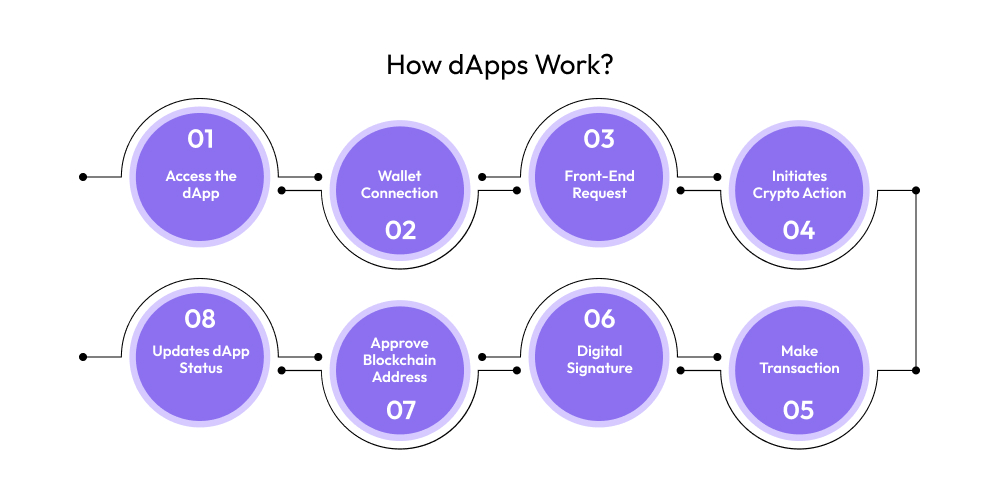
1. Access the dApp
Like regular apps, dApps are usually accessed by users via a web or mobile interface. The decentralized protocol that powers the dApp is typically loaded from a server or IPFS. When it opens, the user is prompted to link their cryptocurrency wallet.
2. Wallet Connection
To communicate with the dApp, the user connects a cryptocurrency wallet such as MetaMask. Their digital assets are stored in this wallet, which also serves as their blockchain identity. To initiate transactions businesses must use Binance Smart Chain development services.
3. Front-End Request
The smart contract receives a request from the front end when a user clicks “Buy” or “Swap.” A predetermined function that is stored on the blockchain is triggered by this. After preparation, the request is sent to the wallet for processing.
4. Initiates Crypto Action
Token transfers and swaps are examples of crypto-related operations that are started by the smart contract function. The contract parameters, user input and dApp architecture determine the course of action. It gets data ready for a transaction on the blockchain.
5. Make Transaction
All required information, including the sender, recipient, amount, and function to call, is included in the transaction. The blockchain network receives this transaction and is awaiting confirmation. In this phase, gas prices are estimated and added.
6. Digital Signature
The user must use the wallet to digitally sign the transaction with their private key before it is broadcast. This guarantees authenticity and validates their consent. To prevent invalid transactions due to lack of digital signature, businesses must use Solana Blockchain development services at lower rates.
7. Approve Blockchain Address
After being signed, the network verifies the transaction and confirms it in a block. By knowing how do coins and dApps work, users may link their assets with the blockchain address. This approval is transparently and permanently stored on the blockchain.
8.Updates dApp Status
Following verification, the dApp modifies its user interface to reflect the updated blockchain state. Real-time updates, such as token balances or transaction success, are visible to users. The user, dApp, and blockchain interaction cycle is thus closed.
Want a chatbot demo or pricing? Fill the form and talk to our experts today.
Pick what you need below — you can select more than one — then tap Get detail to continue.
-
Chatbot demo dashboard
-
Cost to develop an app
-
Industry report
-
Case study
Various Types of dApps
Decentralized apps are used in different industries and customized for certain use cases. Various types of dApps explained in this section use blockchain technology to provide transparency and user control:
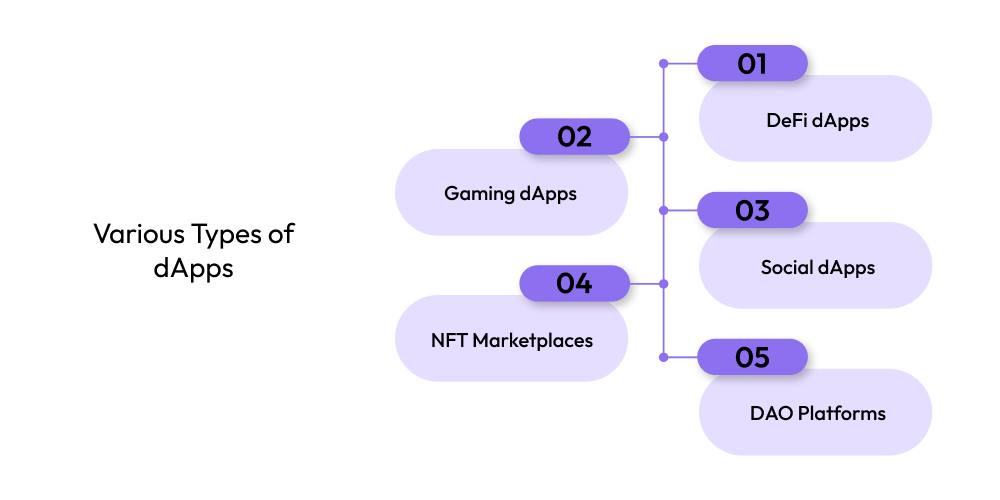
1. DeFi dApps
Peer-to-peer financial services like lending, borrowing and yield farming are made possible by a decentralized application. They use smart contracts on blockchains like Ethereum.
- Decentralized Lending & Borrowing
- Decentralized Exchanges (DEXs)
2. Gaming dApps
Players can acquire, exchange, and possess in-game items using blockchain-based apps. In order to create real-world value through gameplay, items are frequently tokenized as NFTs.
- Play-to-Earn (P2E) Models
- Digital Asset Ownership
3. Social dApps
Social dApps are decentralized networks where users own their data and may communicate and share content. They want to lessen the platform control and censorship seen in conventional social networking.
- Decentralized Social Media
- Content Creator Monetization
4. NFT Marketplaces
These NFT marketplace development solutions are used to create and trade on these platforms. They offer a decentralized setting for digital asset exhibition and revenue generation for artists and collectors.
- Digital Art Sales
- Virtual Real Estate & Gaming Items
5. DAO Platforms
Community voting and smart contracts regulate Decentralized Autonomous Organizations (DAOs). Users take part in decision-making, encouraging openness and group control.
- Investment & Fund Management
- Protocol Governance
Top 10 Decentralized Apps
Decentralized apps (dApps) are enhancing user engagement with digital assets, gaming, and banking. These are the top ten dApps that have had a big influence on different blockchain ecosystems:
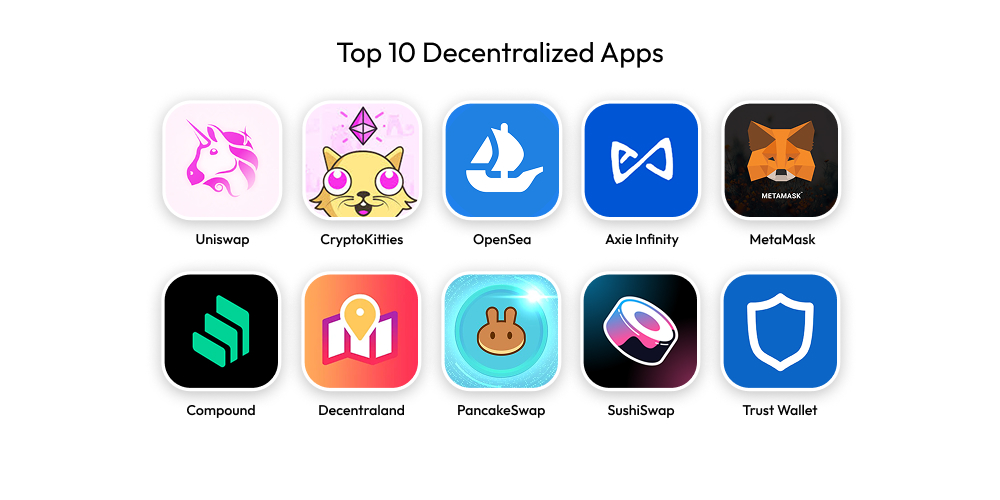
1. Uniswap
It is one of the top Ethereum dApps that facilitates peer-to-peer token exchanges without middlemen and is known as Uniswap. It keeps pricing and liquidity stable by using an automated market maker (AMM) mechanism.
- Automated Market Maker (AMM)
- Permissionless Token Listing
2. CryptoKitties
One of the first blockchain-based games, CryptoKitties lets users breed, trade, and collect exclusive virtual cats, or NFTs. It illustrated how blockchain technology could be used in collectibles and games.
- Breedable NFTs
- True Asset Ownership
3. OpenSea
Users can generate and trade digital assets such as music, art, and domain names on OpenSea, the biggest NFT marketplace. The decentralized app explained gives producers extensive exposure and supports several blockchains.
- Multi-Chain Support
- NFT Minting
4. Axie Infinity
In the play-to-earn blockchain game Axie Infinity, users engage in combat, breed, and exchange virtual animals known as Axies. Through gameplay, it offers genuine economic incentives by fusing NFTs with DeFi components.
- Play-to-Earn Mechanics
- NFT-Based Economy
5. MetaMask
MetaMask is a browser extension and cryptocurrency wallet that lets users communicate with dApps built on Ethereum. A Cryptocurrency development company helps businesses in token storage, dApp access, and safe transactions.
- Wallet & dApp Browser
- Private Key Control
6. Compound
Compound is a DeFi technology that enables decentralized cryptocurrency lending and borrowing. Smart contracts are used to dynamically modify interest rates according to supply and demand.
- Decentralized Lending & Borrowing
- Algorithmic Interest Rates
7. Decentraland
Users can purchase, sell, and build digital land and assets as NFTs in the virtual realm known as Decentraland. It is a significant force in the metaverse market, fusing blockchain technology with social interaction.
- Virtual Land Ownership
- Immersive 3D Experience
8. PancakeSwap
On the Binance Smart Chain (BSC), PancakeSwap is a decentralized exchange that provides yield farming, staking, and token swapping. It has cheap fees and a gamified UI with NFTs and lotteries.
- Yield Farming & Staking
- Low Transaction Fees
9. SushiSwap
After splitting from Uniswap, SushiSwap is a community-driven DEX that offers yield farming incentives and governance. It provides a range of DeFi tools and works with several chains.
- Multi-Chain DEX
- SUSHI Governance Token
10. Trust Wallet
A variety of coins and dApps are supported by the mobile crypto wallets for dApps like Trust Wallet. It has staking for many cryptocurrencies, safe storage, and an integrated Web3 browser.
- Multi-Currency Support
- Built-In dApp Browser

Centralized vs Decentralized Apps
A business investor may study differences of dApp vs traditional apps. But applications that are centralized or decentralized differ in many ways. It is also crucial to find out differences between public vs private blockchain for better results. You must select the best architecture for scalability, security, and user trust.
Aspect |
Centralized Apps |
Decentralized Apps (dApps) |
| Control | Managed by a single authority or organization | Operates via smart contracts on a blockchain |
| Data Storage | Stored on centralized servers | Distributed across nodes on a blockchain |
| Security | Prone to single point of failure and hacks | More secure due to decentralized architecture |
| Transparency | Limited visibility of internal processes | Transactions and logic are publicly auditable |
| User Identity | Requires traditional login credentials | Uses blockchain wallets for access and authentication |
Pros and Cons of dApps
There are multiple benefits of decentralized applications as they eliminate central control and increase digital engagement. But they also present technical and user-related difficulties:
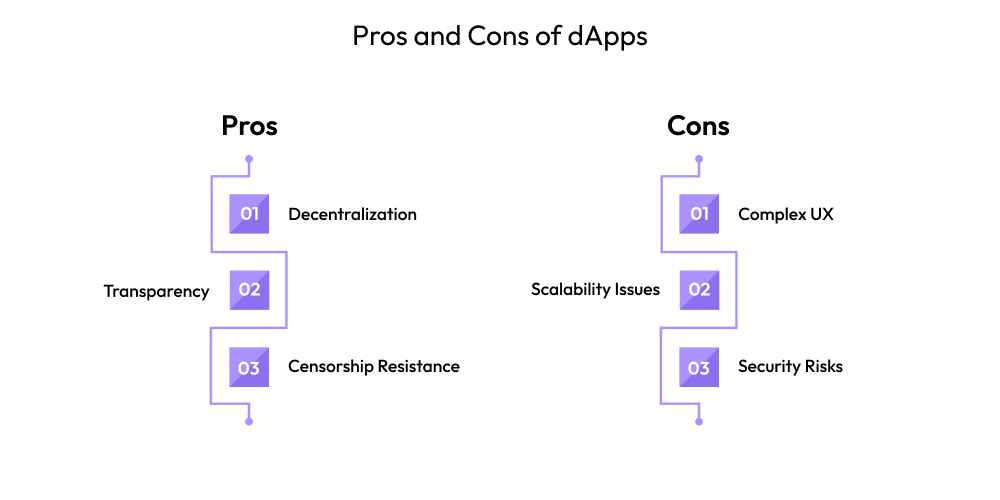
1. Pros:
i. Decentralization
dApps do not require central authorities because they function on distributed blockchain networks. This guarantees greater user ownership, fewer single points of failure, and more democratic governance.
ii. Transparency
As every operation and transaction is documented on a public ledger, auditability and trust are increased. These blockchain benefits for business allow them to check data and logic execution.
iii. Censorship Resistance
dApps are challenging to censor or shut down since they are housed on decentralized networks. More freedom of speech and continuous service availability are made possible by this.
2. Cons:
i. Complex UX
Understanding wallets, gas fees, and blockchain procedures is frequently necessary in order to interact with dApps. This hinders widespread adoption by creating a steep learning curve for non-technical users.
ii. Scalability Issues
Most blockchains have slow transactions and expensive fees due to low capacity and complex Hyperledger Blockchain development services. It affects dApp performance with a lot of traffic.
iii. Security Risks
Since smart contracts cannot be changed, errors or flaws could result in irreversible losses. dApps are vulnerable to hacking and abuse in the absence of appropriate audits and security procedures.
Primary Tech Stack for dApp Development
A tech stack that facilitates smart contracts and safe blockchain communication is necessary to understand how dApps interact with blockchain. We have seen how dApps work, so it is important to know that a tech stack consists of front-end, back-end, and blockchain integration tools. The below table is used by a dApp development company for making safe wallets:
Component |
Tools/Technologies |
| Smart Contract Language | Solidity, Vyper |
| Blockchain Platform | Ethereum, BNB Chain, Polygon |
| Front-End Framework | React.js, Vue.js |
| Web3 Integration | Web3.js, Ethers.js |
| Wallet Integration | MetaMask, WalletConnect |
| Backend Server | Node.js, Express.js |
| Database | MongoDB, Firebase |
| IPFS/Decentralized Storage | IPFS, Filecoin |
| Testing Framework | Truffle, Hardhat, Ganache |
| Deployment & Monitoring | Infura, Alchemy, Moralis |
How are dApps Monetized?
Do you know how do dApps make money? Innovative monetization techniques are used by dApps. These techniques preserve user sovereignty and decentralization while guaranteeing money generating:
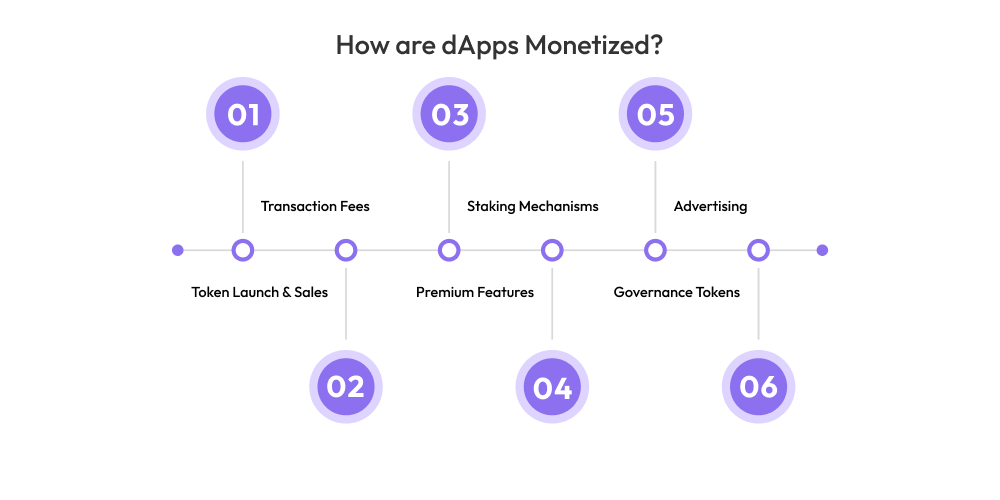
1. Transaction Fees
dApps frequently impose nominal fees in exchange for carrying out transactions or communicating with smart contracts. By rewarding validators or node operators, these fees offer a steady flow of income and support network upkeep.
2. Token Launch & Sales
Numerous dApps produce their own native tokens and use initial token offers (ICOs and IDOs) to raise money. While early sales aid in development and community growth, these tokens can be used for utility, governance, or incentive purposes.
3. Staking Mechanisms
In order to receive benefits, users must lock tokens on the platform; dApps may receive a percentage of commission or staking fees. Staking increases liquidity, encourages sustained use, and brings in money for the app.
4. Premium Features
Upgrades that cost money could include better tools, quicker transaction times, or more customization options. The OTC crypto exchange development cost gets balanced with revenue earned through premium features.
5. Advertising
Relevant advertisements can be shown by dApps through direct collaborations or decentralized advertising services. In addition to protecting user privacy and avoiding centralized tracking, this offers a non-intrusive means of generating income.
6. Governance Tokens
Governance tokens are mainly used for voting, but they can also be made money via staking, listing on exchanges, or providing exclusive rights. As platforms are used, their value frequently increases, which is advantageous to both users and dApp developers.

Key Security Considerations for dApps
In decentralized apps, security is essential since flaws can result in irreversible data and money losses. To know how dApps work, it is necessary to have the idea of security and privacy issues:
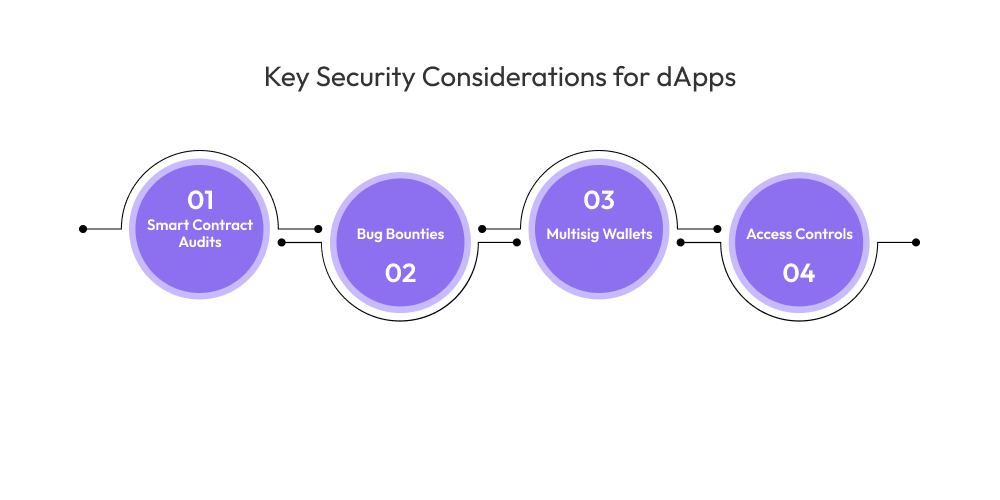
1. Smart Contract Audits
Before deployment, smart contracts in dApps can be audited to find vulnerabilities, logical mistakes, or exploitable defects. To guarantee contract integrity and stop hacks, these audits which are usually carried out by outside security companies are essential.
2. Bug Bounties
Establishing a bug bounty program encourages ethical hackers to find and disclose security vulnerabilities. By identifying edge-case vulnerabilities early on, this community-driven strategy improves the dApp environment’s overall security.
3. Multisig Wallets
By requiring several private key permissions for transaction execution, multisignature wallets lower the possibility of illegal fund transfers. This reduces the blockchain app development cost and provide an extra degree of security for governance and treasury-related operations.
4. Access Controls
Strict access permissions guarantee that sensitive operations can only be carried out by authorized people or systems. Permission levels and role-based access control (RBAC) reduce internal risks and stop accidental contract modifications.
Future Expectations From dApps
Various decentralized app use cases improve usability and scalability with development. Bridging the gap between decentralization and widespread adoption will be the key goal of the upcoming innovation wave:
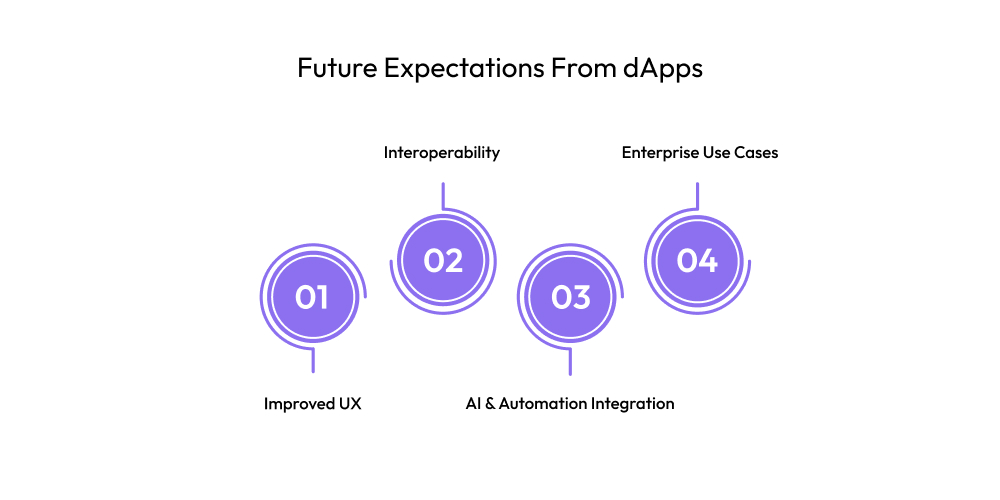
1. Improved UX
It is anticipated that future dApps would provide more seamless, user-friendly interfaces that are on par with those of conventional apps. Attracting non-technical users will require streamlined onboarding, abstracted blockchain intricacies, and easy wallet integration.
2. Interoperability
Cross-chain functionality will become commonplace, enabling dApps to run seamlessly across several blockchains. This will make it possible for dApp ecosystems to have more flexibility, wider user access, and smooth asset transfers.
3. AI & Automation Integration
By using AI, dApps will be able to offer predictive analytics, smarter smart contracts, and tailored experiences. A Blockchain development company helps to improve dynamic decision-making, fraud detection, and security in decentralized settings.
4. Enterprise Use Cases
To increase efficiency and transparency, more businesses will use dApps for supply chain management, finance, human resources, and logistics. Customizable smart contracts and permissioned blockchains allow companies to take advantage of decentralization while retaining control.
In a Nutshell!!
Now, you have understood how dApps work by going through a lot of specified content discussed in this blog. If you are a business investor, then contacting a blockchain app development company like Dev Technosys is necessary as they offer:
- The idea of how does a dApp work.
- Additional information on how do ethereum dApps work.
- Methods to control investment and make revenue.
- Use cases to identify core features.
- Experienced team of developers who are skilled and reliable.
Almost all entrepreneurs search for a partner that offers the same points as mentioned above. So, you must start the development process and improve the digital experiences of your audiences.
FAQs
Q1. What is the Difference Between a dApp and a Traditional App?
A centralized server under the management of a business or organization powers a typical app. A dApp, on the other hand, uses smart contracts to function on a decentralized blockchain network. A dApp is more open-source and transparent to censorship.
Q2. Do I Need Cryptocurrency to Use a dApp?
To communicate with the blockchain, the majority of dApps need cryptocurrency, mostly for gas cost payments. Ethereum-based dApps require ETH in order to perform transactions. Certain dApps or Layer 2 solutions provide customers with gasless or subsidized experiences.
Q3. How do Users Interact With dApps?
- Users access the dApp with a browser.
- They connect a crypto wallet to manage transactions.
- Various actions are performed because of smart contract functions.
Q4. Are dApps Safe to Use?
If dApps are developed on proven blockchains and certified smart contracts, they are usually secure. But the ecosystem is still vulnerable to threats like phishing attempts, frauds, and bugs. Use secure wallets, reputable platforms, and confirm contract providers before engaging.
Q5. What Blockchain Platforms are Commonly Used for Building dApps?
- Ethereum – The most widely used platform for smart contracts.
- Solana – Known for high-speed transactions.
- BNB Chain – Scalable alternative for developer ecosystems.
Q6. Can I Build a dApp Without Knowing Blockchain Development?
Various dApp development tools are now available on low-code and no-code platforms. However, creating sophisticated dApps usually necessitates familiarity with Web3 libraries, blockchain logic, and smart contracts.