




















“Discover a new eco-tech combination by developing Green Blockchain platforms.”
Are you a person that loves both nature and technology? If yes, then green Blockchain is for you and your business. It is the technology that helps to decrease energy consumption and carbon emission in the environment. It is known as the tech for future, encouraging businesses to develop a green Blockchain platform and contribute to the surroundings.
There are multiple benefits of investing money to create a green Blockchain platform in the present time that a business investor must know. Additionally, it is also profitable to find out how you can make money with an eco-friendly blockchain solution.
So, to develop green blockchain projects, we are discussing a complete development process in this guide. Let’s move forward to grab more.
Stats on Sustainable Blockchain Market
The investment in cryptocurrency development with green energy is expanding quickly due to decentralization and sustainability. With growing user demand and strong financial statistics, its market potential has increased.
- Global blockchain market: Valued at around $13.1 Billion, with a projected growth to over $63.9 Billion by 2034 with a 27.3% CAGR rate.
- Green Energy Forecast: Expected to grow from $4.4 Billion in 2025 to $142.3 Billion by 2035, reflecting a 41.6% CAGR rate between 2025 and 2035.
- Blockchain in the renewable energy: Estimated at $2.98 Billion in 2024, projected to reach $50.5 Billion by 2032, with a 42.0% CAGR rate.
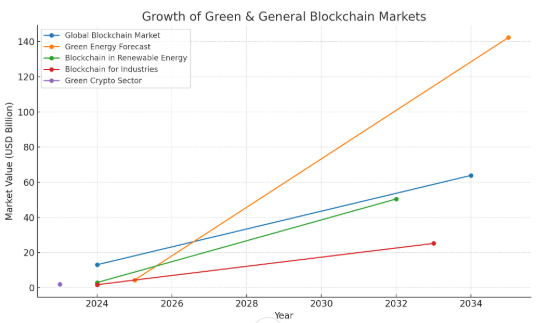
- Blockchain for Industries: Market size was about $1.77 Billion in 2024, forecasted to hit $ 25.23 Billion by 2033 at a 32.7% CAGR rate.
- Green crypto sector: It reached over $2 Billion in total value. Blockchain-based carbon credit platforms raised over $100 Million in the same year.
What is Green Blockchain?
Green blockchain is blockchain technology that was created with sustainability in mind, utilizing eco-friendly infrastructure, renewable energy sources, and energy-efficient consensus processes. Its objective is to preserve decentralization, security, and scalability while reducing the negative effects on the environment.
Different green Blockchain solutions promote global environmental goals and encourage responsible innovation. It depends on decentralized systems by lowering carbon emissions and resource usage.
- Facilitating carbon credit trading with transparent tracking.
- Powering renewable energy marketplaces.
- Enabling sustainable supply chain verification.
Why Invest in Green Blockchain Development?
Green blockchain technology lessens the environmental impact of digital transactions through decentralization. You can develop a green Blockchain platform to balance sustainability and innovation:
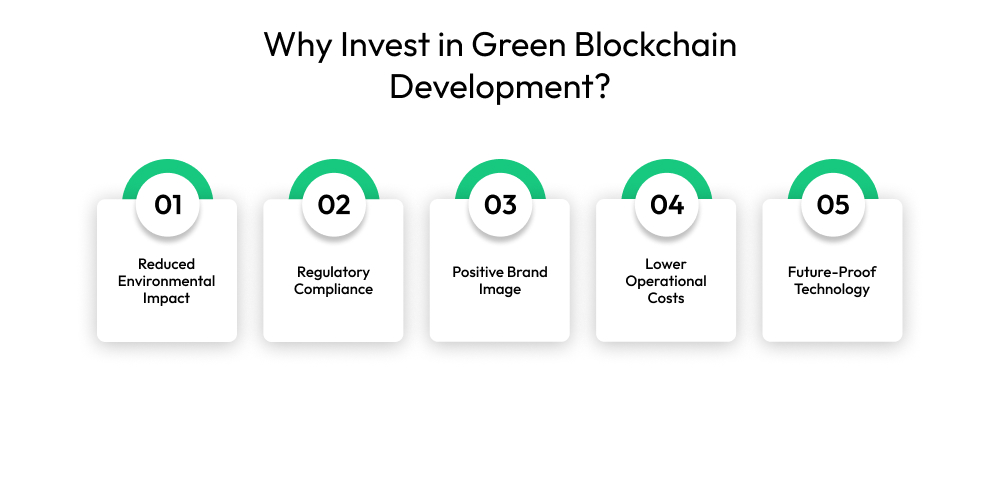
1. Reduced Environmental Impact
Green blockchains require approximately 90% less energy because of energy-efficient consensus algorithms like PoS. This lessens dependency on fossil fuels and greenhouse gas emissions. So, you must use green Blockchain platform development services that promote use of renewable energy sources.
2. Regulatory Compliance
Businesses using green blockchain may guarantee compliance with ESG (Environmental, Social, and Governance) standards and regulations. In addition to avoiding legal problems, compliance increases stakeholder trust. Verification and auditing are made simpler by green blockchain reporting tools.
3. Positive Brand Image
Utilization of Blockchain development services with sustainable resources is beneficial for the environment. This helps businesses to partner with consumers, domain experts, and other partners. Such positioning might be a key differentiation in a market that is highly competitive.
4. Lower Operational Costs
You can reduce the cost to build a green Blockchain platform by using energy-efficient systems. Using renewable energy sources can also protect companies from changes in the price of fossil fuels. Costs are further decreased by efficient blockchain design, which significantly lessens hardware wear and tear.
5. Future-Proof Technology
Green blockchain solutions are widely used as environmental sustainability gains international attention. Businesses can keep ahead of regulatory and technological changes by making early investments. Long-term relevance and competitiveness in the market are guaranteed by future-proofing.
Role of AI in Making Eco-Friendly Blockchain
You can streamline procedures and cut down energy waste by using AI that contributes to the sustainability of blockchain platforms. These networks can function more effectively, adjust to demand in real time, and reduce their carbon footprint with AI.
A mobile app development company with experience can help you to combine Blockchain and Artificial Intelligence. This can generate eco-friendly solutions and makes the process to develop a green Blockchain platform easy.
- Optimizing node energy consumption through real-time load balancing.
- Predicting and preventing hardware inefficiencies.
- Automating carbon footprint monitoring and reporting.
- Enhancing consensus algorithms for faster, energy-efficient processing.
- Enabling predictive scaling to match network demand and reduce waste.
Top Examples of Green Blockchain Platforms
Eco-friendly solutions are used by a number of blockchain networks that lower energy consumption. It is beneficial to make a green Blockchain platform that provide standard energy-efficient services:
1. Algorand
Algorand’s Pure Proof of Stake (PPoS) technique allows for quick transactions while using less energy. Through collaborations with ClimateTrade for emission offsetting, it is also carbon-negative.
- Uses a Pure Proof-of-Stake (PPoS) consensus mechanism, ensuring low energy usage.
- Achieves carbon-negative operations through verified carbon offset programs.
2. Chia Network
Chia uses spare storage space to substitute energy-intensive mining with Proof of Space and Time (PoST). This method lowers power consumption and increases accessibility to blockchain participation.
- Employs Proof of Space and Time, which consumes significantly less energy than PoW.
- Incentivizes unused storage space utilization, reducing hardware waste.
3. Cardano
Cardano uses a lot less energy because it uses an energy-efficient Proof of Stake algorithm called Ouroboros. It is a cross chain DeFi platform that is sustainable, scalable, and interoperable.
- Runs on an Ouroboros Proof-of-Stake protocol that minimizes power consumption.
- Built with a layered architecture for scalability and energy efficiency.
4. Tezos
Utilizing a liquid Proof of Stake mechanism, Tezos reduces energy consumption without sacrificing network security. Decentralized apps and environmentally concerned NFT marketplaces favor it.
- Uses Liquid Proof-of-Stake to reduce energy demand by over 99% compared to PoW.
- Supports self-amendment, allowing network upgrades without high-energy hard forks.
How to Make Green Blockchain Platforms?
As a business investor, you must know the process to develop a green blockchain platform. This helps in managing the exceeding budget and plan for resources. Let’s study the development steps in detail:
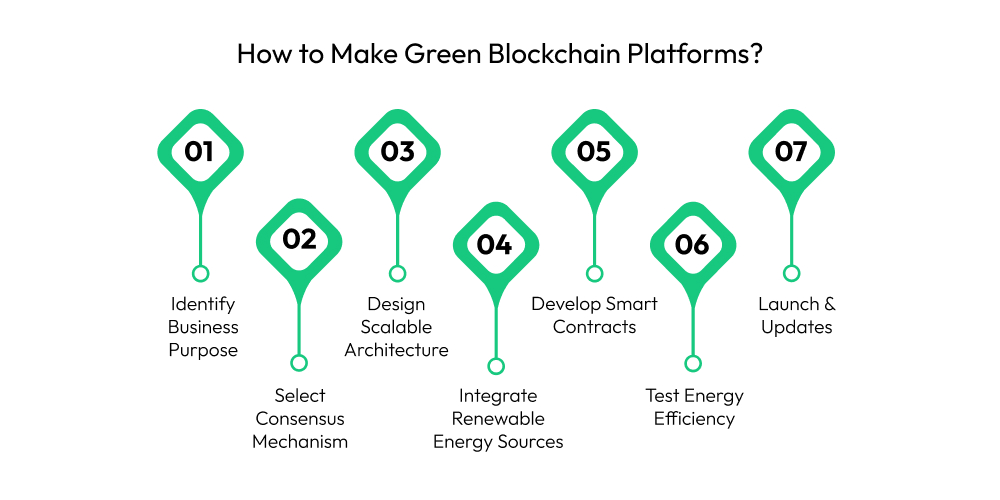
1. Identify Business Purpose
First, you must establish the primary goal of your green blockchain project, such as tracking a sustainable supply chain, trading carbon credits, or exchanging green energy. To build a green Blockchain platform, choose between public, private, or hybrid, as this affects scalability and security.
It is beneficial to select Web3 development services for eco-friendly Blockchain design. Additionally, this stage helps in early stakeholder and investor support acquisition.
2. Select Consensus Mechanism
To create a green Blockchain platform, select a consensus algorithm that uses less energy. This includes Proof of Stake, Delegated Proof of Stake, or Proof of Space and Time. Energy consumption is significantly lower with the proper mechanism than with Proof of Work.
Your decision will be influenced due to transaction speed requirements, decentralization objectives, and security considerations. The environmental impact of your blockchain is based on this choice.
3. Design Scalable Architecture
Create a blockchain architecture that is energy-efficient without sacrificing speed or security. To increase efficiency, apply strategies like sidechains, sharding, or lightweight nodes. To reduce resource waste, hire a green Blockchain platform development company to track transaction intervals and block sizes.
To enable smooth interaction, incorporate green Web3 development modules. Low environmental impact and long-term scalability are guaranteed by a well-designed architecture.
4. Integrate Renewable Energy Sources
Use sustainable energy sources like solar, wind, hydro, or others to power data centers and blockchain nodes. You can hire a Blockchain development company that guarantees a consistent growth in green energy suppliers. This reduces reliance on non-renewable grids to make vital infrastructure.
Use Internet of Things-based monitoring to track energy usage in real time. Through this connection, the platform’s activities are guaranteed to be in line with its environmentally conscious goal.
5. Develop Smart Contracts
You must create sustainable smart contracts that can automate procedures and minimize manual interaction. They handle carbon credits, green energy transactions, and eco-friendly supply chains, but affect the overall cost to make a green Blockchain platform.
To reduce computational load, energy-efficient coding techniques must be used. With token rewards, smart contracts can also encourage environmentally beneficial behavior.
6. Test Energy Efficiency
Perform thorough testnet trials before launch to ensure network performance and energy consumption per transaction. To track your blockchain carbon footprint in real time, use specialist software. For best results, modify settings like node operations, consensus parameters, and block time.
Testing helps in identifying errors that can raise expenses or have an adverse effect on the environment. Frequent testing cycles guarantee that the platform maintains its energy efficiency over time.
7. Launch & Updates
Launch the mainnet while emphasizing its ecological credentials and using a clear communication plan. For early adoption, you can target environment-friendly businesses and consumers. Contact a Cardano blockchain development company to increase security and efficiency of blockchain platforms.
You must study user feedback to maintain the platform’s alignment with environmental objectives. Continuous optimization with changing green technologies are necessary for sustainable growth.
Want a chatbot demo or pricing? Fill the form and talk to our experts today.
Pick what you need below — you can select more than one — then tap Get detail to continue.
-
Chatbot demo dashboard
-
Cost to develop an app
-
Industry report
-
Case study
Essential Features of Eco-Friendly Blockchain
Sustainable platforms reduce environmental effects and ensure security have multiple features. They guarantee that blockchain innovation is in line with international green technology objectives:
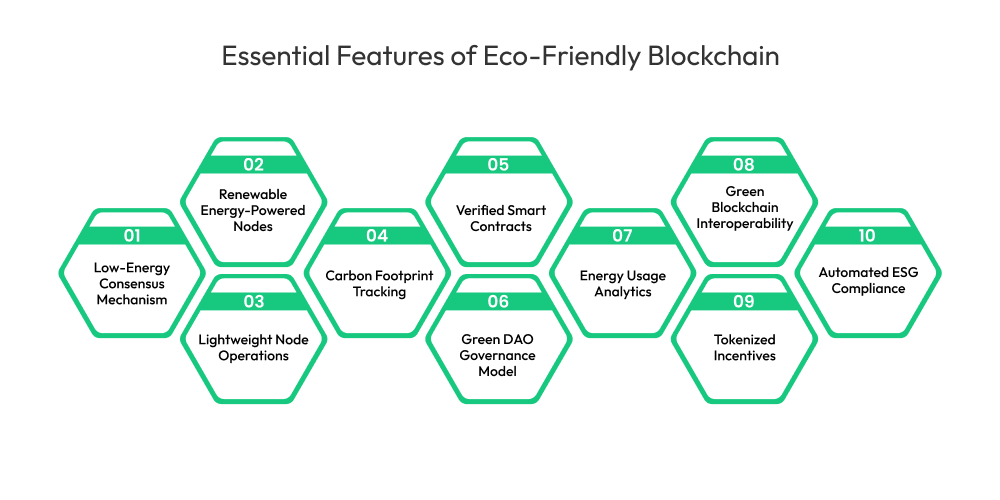
1. Low-Energy Consensus Mechanism
Uses protocols like Proof of Stake or Proof of Space and Time to cut energy usage compared to Proof of Work. You must build polygon tokens to easily conduct sustainable blockchain operations.
2. Renewable Energy-Powered Nodes
Blockchain nodes are powered by solar, wind, or hydro energy sources, reducing reliance on fossil fuels. This ensures sustainable energy use for network operations.
3. Lightweight Node Operations
Optimizes network design so nodes can run efficiently on low-power hardware. The blockchain for sustainable supply chain reduces both energy consumption and operational costs.
4. Carbon Footprint Tracking
Includes on-chain tools to measure and display energy usage and emissions in real time. This creates transparency for users and stakeholders.
5. Verified Smart Contracts
Smart contracts are audited for security and energy efficiency with low-power blockchain algorithms. This prevents unnecessary computational waste while ensuring safe transactions.
6. Green DAO Governance Model
Community decisions are made with sustainability as a core priority. Voting mechanisms encourage eco-conscious proposals and long-term green policies.
7. Energy Usage Analytics
Various decentralized green energy platforms provide dashboards and reports showing transaction energy costs. These insights help optimize network performance and efficiency.
8. Green Blockchain Interoperability
To green DeFi platforms support integration with other eco-friendly blockchain networks. This expands sustainable use cases and promotes a global green ecosystem.
9. Tokenized Incentives
It rewards users, validators, or miners for eco-friendly actions. A DeFi yield farming platform provides incentives to encourage sustainable behavior within the network.
10. Automated ESG Compliance
Generates sustainability reports in line with environmental, social, and governance standards. A carbon-neutral blockchain platform simplifies audits and regulatory compliance.
What is the Cost to Develop a Green Blockchain Platform?
A number of different factors affect the cost to develop a green blockchain platform. The average Blockchain app development cost is between $8,000 to $30,000 or may exceed due to these factors. Planning and resource allocation are improved by having a better understanding of these cost drivers:
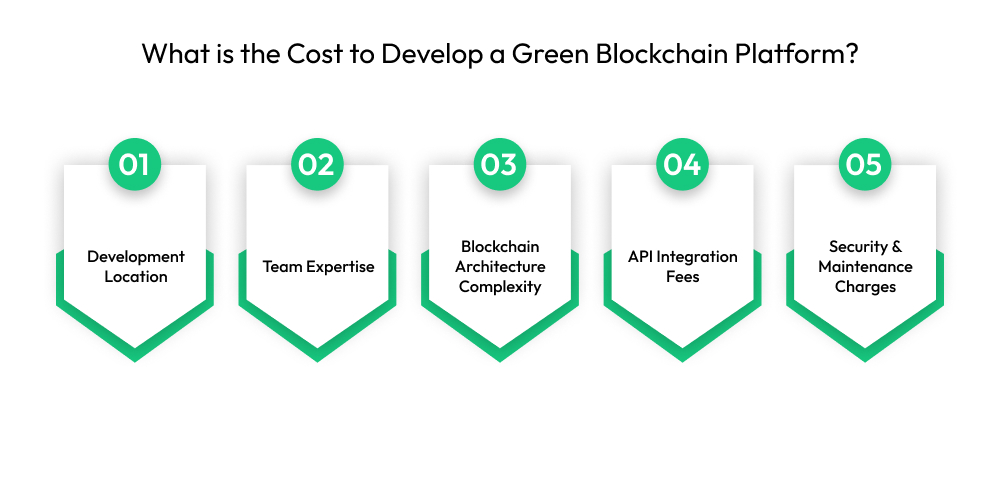
1. Development Location
The cost to build a green Blockchain platform increases in regions like the USA or Western Europe. Eastern European or Asian offshore teams may be able to provide more affordable prices. Time zones, communication, and the availability of green tech knowledge are impacted by location.
Development Location |
Estimated Cost |
| USA | $25000-$30000 |
| Australia | $20000-$25000 |
| India | $5000-$12000 |
| UK | $15000-$20000 |
| UAE | $8000-$15000 |
| Brazil | $12000-$16000 |
2. Team Expertise
The overall sustainable Blockchain development rate is affected by the cost to hire a blockchain developer. Better and more energy-efficient code can be produced by skilled developers. They have higher integration charges, but are able to lower long-term operating expenses.
Team Expertise |
Cost Estimation (USD) |
| Junior/Entry-Level | $8000-$12000 |
| Mid-Level/Experienced | $12000-$16000 |
| Senior/Expert | $16000-$20000 |
| Professional | $20000-$24000 |
3. Blockchain Architecture Complexity
The green blockchain development cost is less for a basic PoS-based blockchain, as compared to multi-layered protocol. More time and qualified professionals are needed to construct complex architectures. These elements raise the overall green Blockchain platform development cost.
Component |
Estimated Cost |
| Consensus Mechanism Development | $15,000 – $40,000 |
| Smart Contract Deployment & Testing | $10,000 – $25,000 |
| Node Infrastructure & Network Setup | $20,000 – $50,000 |
| Scalability & Interoperability Features | $15,000 – $35,000 |
4. API Integration Fees
Various subscription fees are associated with APIs for sustainability reporting, carbon offset verification, or tracking renewable energy. Depending on the amount of transactions, third-party APIs may affect the crypto wallet development cost. These expenses may mount up as the network grows.
Component |
Estimated Cost |
| Renewable Energy Data APIs | $5,000 – $15,000 |
| Carbon Credit Trading APIs | $8,000 – $20,000 |
| Payment Gateway Integration | $4,000 – $12,000 |
| IoT Device Data Integration | $7,000 – $18,000 |
5. Security & Maintenance Charges
Eco-friendly blockchain networks require constant security procedures and ongoing monitoring. Continuous maintenance guarantees standard regulations and defense against online attacks. The platform’s long-term visibility depends on the green Blockchain platform development cost.
Component |
Estimated Cost |
| Smart Contract Security Audits | $5,000 – $15,000 |
| DDoS & Intrusion Prevention Systems | $4,000 – $10,000 |
| Regular Protocol & Consensus Updates | $3,000 – $8,000 |
| 24/7 Node & Network Monitoring | $6,000 – $12,000 |
Tech Stack Required for Making a Green Blockchain Platform
Businesses need an advanced and latest tech stack to build a green Blockchain platform. It must have energy-efficient blockchain technology and tools that can reduce carbon emission with increased efficiency.
Top Smart Contract development solutions are made by using similar tools that offer fast and low-powered benefits. So, you must go through the below table to get an idea of the tech stack:
Component |
Tools / Technologies |
| Blockchain Framework | Hyperledger Fabric, Corda, Energy Web Chain |
| Consensus Mechanism | Proof of Stake (PoS), Delegated PoS, Proof of Authority (PoA) |
| Smart Contract Development | Solidity, Vyper, DAML |
| Programming Languages | Go, Rust, JavaScript/TypeScript, Python |
| Database | MongoDB, PostgreSQL, BigchainDB |
| Frontend Development | React.js, Vue.js, Angular |
| Backend Development | Node.js, Express.js, Django |
| Cloud & Hosting | AWS Green Cloud, Microsoft Azure Sustainability, Google Cloud Carbon-Neutral Services |
| Monitoring & Analytics | Prometheus, Grafana, Elastic Stack |
| Security Tools | OpenZeppelin, MetaMask Integration, SSL/TLS, Ledger Hardware Wallets |

How to Monetize Green Blockchain Solutions?
You should make a green Blockchain platform with new sources of income. Businesses can grow and improve the environment by balancing eco-friendly activities with profitability:
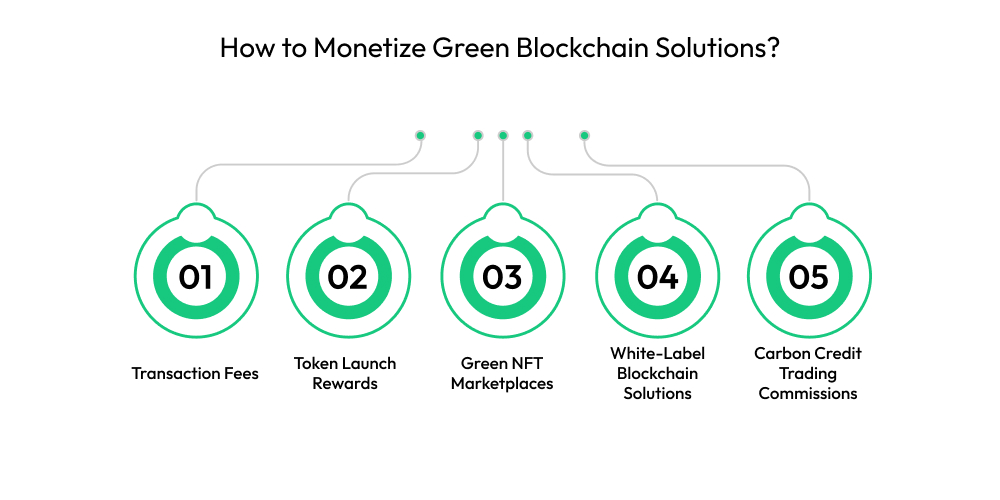
1. Transaction Fees
Fees should be kept low but constant for every network transaction. High transaction volumes can yield substantial revenue even at lower rates. Both public and enterprise green blockchain platforms benefit from this strategy and help to balance the cost to develop a green Blockchain platform.
2. Token Launch Rewards
To enable staking and generate rewards, issue a native token for your green blockchain. The demand for tokens may rise in tandem with adoption, increasing their value. Long-term holding and sustainable apps promote tokenomics by managing the cost to create a green Blockchain platform.
3. Green NFT Marketplaces
Earn commissions from sales by hosting NFT collections on your environmentally conscious blockchain. You must avail NFT marketplace development services to attract more customers and artists to the platform. This specialized strategy sets you apart from conventional NFT platforms.
4. White-Label Blockchain Solutions
Give other businesses looking for ESG-compliant platforms a license to use your green blockchain infrastructure. Setup, customization, and continuing support generate recurring income. It is a model that targets different industries and helps to balance the cost to build a green Blockchain platform.
5. Carbon Credit Trading Commissions
Encourage the trading of tokenized carbon credits and profit a little from each transaction. This supports sustainability initiatives while generating a consistent income. The use of blockchain for carbon credit trading helps to get financial gain and environmental compliance that are advantageous to businesses.
Major Challenges in Developing Green Blockchain
The green blockchain technology comes with a lot of benefits, but there are some development challenges to consider. Early resolution of these issues guarantees both commercial and environmental success:
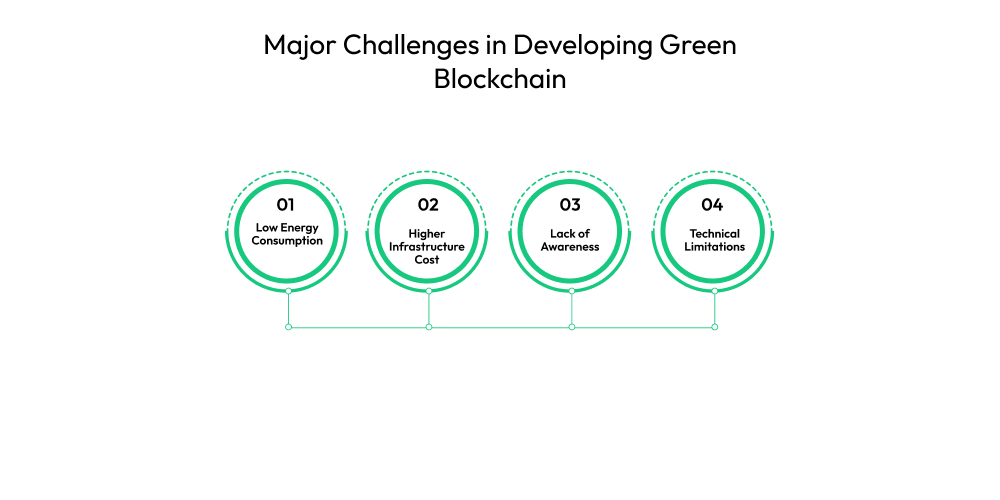
1. Low Energy Consumption
It might be challenging to strike a balance between network performance, scalability, security, and sustainability. Performance may be impacted by excessive energy efficiency improvement.
Solution: Use hybrid consensus models that maximize transaction throughput and energy consumption.
2. Higher Infrastructure Cost
Installation of data centers with renewable energy sources. The use of energy-efficient hardware might be expensive, increasing the price to build a green Blockchain platform.
Solution: Implement infrastructure gradually and look for grants or subsidies for green technologies.
3. Lack of Awareness
The advantages of using blockchain for renewable energy are not well known. There are many prospective users and investors.
Solution: Start educational initiatives and case studies emphasizing the financial and environmental benefits of the technology.
4. Technical Limitations
It can be challenging to integrate interoperability and carbon footprint statistics. Additionally, renewable energy tracking is also difficult.
Solution: For smooth hardware and API integration, collaborate with professional green tech providers.
Future Trends in Sustainable Blockchain Development
With advancements that increase effectiveness and scalability, sustainable blockchain development is rapidly growing. The future of green blockchain adoption across industries will be shaped by new trends:
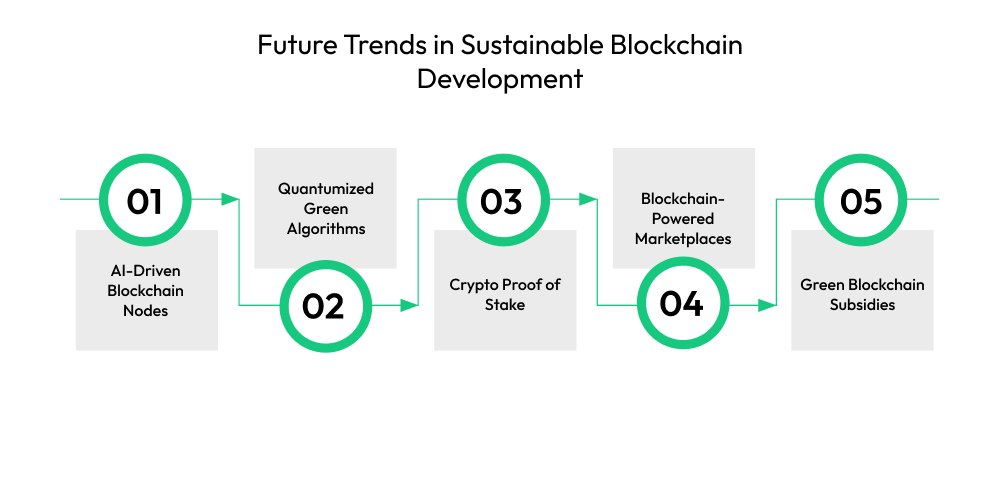
1. AI-Driven Blockchain Nodes
By modifying processing loads in response to real-time demand, artificial intelligence will maximize node performance. This lowers wasteful energy use without sacrificing speed. To prevent hardware issues, you must develop a green Blockchain platform with AI to forecast maintenance requirements.
2. Quantumized Green Algorithms
Developments in quantum computing will allow low-energy consensus algorithms. These will improve encryption security and reduce computational inefficiency. So, you must create a green Blockchain platform on a broad scale that may become more viable with the help of such algorithms.
3. Crypto Proof of Stake
In popular crypto networks, Proof of Stake (PoS) is highly used to deliver transparent blockchain solutions. You can develop a DeFi staking platform that eliminates default mining and lowers carbon footprints. It is a favored green consensus model due to its efficiency and scalability.
4. Blockchain-Powered Marketplaces
Blockchain technology will be used by decentralized marketplaces to exchange carbon credits and renewable energy. Transparency and confidence in transactions will be guaranteed via smart contracts. This model establishes a clear link between profitable company models and sustainability activities.
5. Green Blockchain Subsidies
Various governments and non-governmental organizations are using green ledger technology for developing eco-friendly blockchain platforms. It is beneficial to build a green Blockchain platform that can provide concessions. Adoption in the public and private sectors will quicken as a result.
In a Nutshell!!
Now, you have understood that investment in green blockchain startups is beneficial for modern users and businesses. An experienced blockchain development company like Dev Technosys may help you to get the advantage of this system in the following way:
- Provide methods to adjust the cost to develop a green Blockchain platform.
- Affordable Algorand Blockchain development services for making smart green Blockchains.
- Different models to guide through the process to make a green Blockchain platform.
- Certified methods to identify the revenue scope of eco-friendly Blockchain platforms.
You can grab all these benefits by first preparing a detailed plan and discussing it with the consulting partner. With this, you can easily target multiple industries that can be changed through green-tech solutions.
FAQs
Q1. Which are the Top Green Blockchain Platforms in the USA?
A. In the USA, trending green Blockchain platforms are:
- Algorand – Known for its Pure Proof-of-Stake consensus.
- Chia Network – Reduce energy needs compared to traditional mining.
- Cardano – Operates on an eco-friendly and robust PoS protocol.
Q2. How Does a Green Blockchain Platform Work?
A. A sustainable Blockchain platform works in the following manner:
- Uses low-energy consensus mechanisms like Proof-of-Stake.
- Integrates renewable energy sources.
- Employs energy usage tracking tools.
Q3. What is the Time Range to Develop a Green Blockchain Platform?
A. Average breakdown of the development time is:
- Developing a basic platform requires 3 to 4 months.
- To make a scalable blockchain with advanced features may take 6 to 9 months.
- For complex blockchain ecosystems it takes more than 12 months.
Q4. How Sustainable Blockchain Ensures User Data Security?
A. To protect user data, green Blockchain apps:
- Uses end-to-end encryption to secure transactions.
- Maintains decentralized storage for reducing centralized breaches.
- Incorporates verified smart contracts to prevent fraud.
Q5. What is the Process to Maintain Green Blockchain Platforms?
A. Various eco-friendly Blockchain apps are maintained as:
- Regularly update consensus protocols.
- Monitor energy usage and carbon footprints.
- Remove vulnerabilities to optimize node performance.
Q6. Which Industries Use Green Blockchain Solutions?
A. A few of the multiple industries are listed here:
- Renewable Energy – For energy grid management.
- Finance & Banking – For sustainable cryptocurrency transactions.
- Supply Chain – For eco-friendly product tracking.