






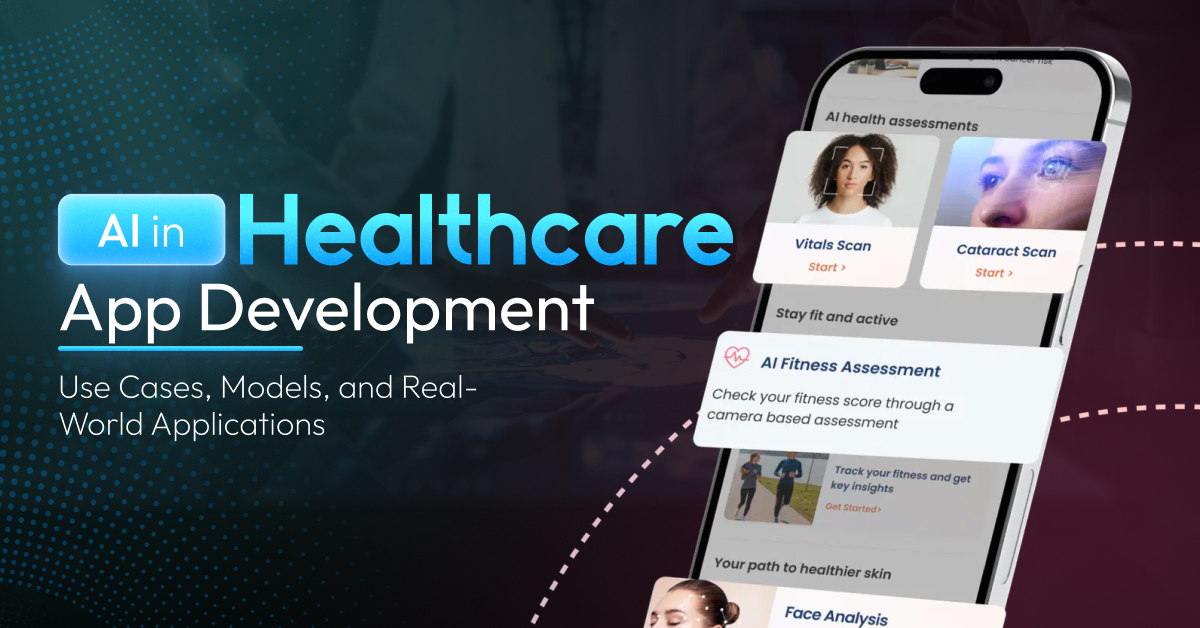
Healthcare apps today rely on smart technology to assist doctors, nurses, and patients in making informed decisions. Healthcare AI app development refers to creating mobile apps to assist doctors in early disease detection, treatment recommendations, and record management. AI technology can be used to help patients monitor their health, receive reminders, and consult doctors online.
Using various AI models, including but not limited to machine learning in healthcare apps and deep learning, healthcare apps are able to achieve higher efficiency. AI technology healthcare apps help hospitals in optimizing their time, minimizing mistakes, and enhancing patient care. With the advancement of technology, AI will contribute to the safe and easy access to healthcare services.
In this blog, we will explore AI in healthcare app development, use cases, real-world examples, models, and more.
What is the Role of AI in Healthcare App Development?
It is a must to know what the exact role of AI in healthcare app development and how it has transformed their operations. It includes drug discovery, personalized recommendations, predictive analysis, remote monitoring, natural language processing, and more. Let’s explore the various role of AI in healthcare app development:
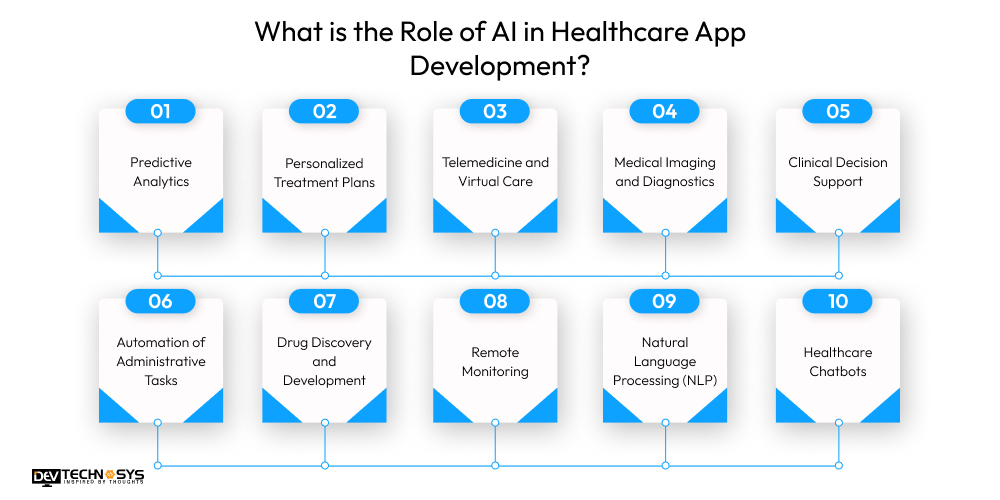
1. Predictive Analytics
Using data to predict potential health concerns, AI can also help healthcare providers foresee patient care issues before they arise by analyzing patterns associated with the patient’s medical history and lifestyle habits.
Predictive analytics in healthcare apps allows for better management of chronic illnesses and improved health outcomes over time by allowing clinicians to identify risks or disease progression, and by allowing for the implementation of preventative measures, using timely interventions.
2. Personalized Treatment Plans
Using patient data, AI provides customized treatment plans for patients with a particular health problem. With large datasets, AI can process large amounts of information to give clinicians accurate recommendations that help improve patient outcomes and decrease mistakes caused by humans. AI in fitness app development provides each patient with care that best fits their medical history and individual needs.
Also Read: What is Healthcare App Development?
3. Telemedicine and Virtual Care
In addition to providing access to patients using telemedicine technology, AI has been an important aspect of this growing field by developing virtual consultations and diagnostic tools. AI-powered chatbots can assist patients in completing a basic assessment of their overall health by guiding them through the assessment process and providing easy-to-follow instructions to facilitate access to care.
4. Medical Imaging and Diagnostics
The role of mobile app development in healthcare assists doctors in diagnosing medical conditions faster and with higher accuracy. By analyzing X-rays, MRIs, and CT scans, AI can detect abnormalities like tumors, fractures, or infections, sometimes identifying issues that human eyes might miss. This speeds up diagnosis and ensures more precise treatment.
5. Clinical Decision Support
AI aids healthcare professionals in decision-making by analyzing complex medical data, research, and guidelines. AI tools provide real-time recommendations, suggest treatment options, and flag potential risks, supporting doctors in making well-informed decisions. This leads to improved patient care, reduced errors, and more efficient use of medical resources.
6. Automation of Administrative Tasks
AI streamlines administrative tasks like appointment scheduling, billing, and patient record management, reducing the burden on healthcare staff. By automating routine tasks, healthcare providers can focus more on patient care and less on paperwork. AI and blockchain in healthcare app development improve operational efficiency, reduce errors, and speed up the delivery of services.
7. Drug Discovery and Development
AI accelerates drug discovery by predicting how different compounds interact with the human body. Using machine learning, AI can analyze biological data to identify promising drug candidates and predict their effectiveness. This speeds up the development process and can lead to the creation of life-saving drugs faster and more cost-effectively.
8. Remote Monitoring
AI-powered wearable devices and sensors allow continuous monitoring of patients’ vital signs, such as heart rate and glucose levels. Healthcare apps like HealthTap provide real-time data to healthcare professionals, enabling remote monitoring and early intervention when abnormalities are detected. This technology is particularly useful for managing chronic conditions and elderly patients.
9. Natural Language Processing (NLP)
AI utilizes Natural Language Processing to analyze and interpret unstructured data, like doctors’ notes or patient records. NLP helps extract meaningful insights from medical literature and patient interactions, enabling better diagnoses and personalized care. It also supports transcription and document management, reducing administrative workloads for healthcare professionals.
10. Healthcare Chatbots
AI chatbots provide instant responses to patient inquiries, offering health advice, appointment scheduling, and medication reminders. Hire healthcare app developers to integrate bots to reduce the need for patients to wait for human assistance, improving accessibility and patient satisfaction. They can also gather important health data and direct patients to appropriate healthcare providers based on their symptoms.
What are the Key Use Cases of AI in Healthcare Applications?
Explore the wide variety of use cases of Agentic AI in healthcare apps that help patients and healthcare providers perform seamless operations and daily tasks. So, here we provide several use cases:
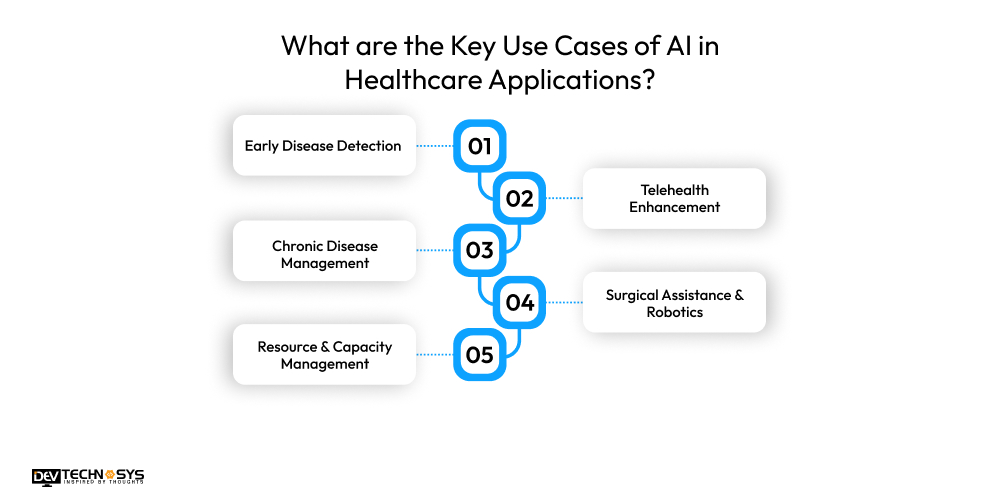
1. Early Disease Detection
AI in HIPAA-compliant software development analyzes or observes the patient’s simple and complex health data, such as medical history, genetics, and more, to detect disease at an early stage. By identifying these patterns, humans can get early treatment, and it reduces the additional treatment cost. Early disease detection can improve the survival rates and time to interventions.
2. Telehealth Enhancement
AI in healthcare industry improves telemedicine by interpreting patient inputs, analyzing patients’ vital signs, and providing proper clinical services. The virtual or remote healthcare providers are more accurate and scalable to offer health services to underserved or remote areas. With the help of Artificial Intelligence in healthcare apps, it can enhance patient engagement while maintaining high-quality standards.
Also Read: Healthcare App Development And Company Selection Guide
3. Chronic Disease Management
Artificial intelligence in the mobile app development process for healthcare monitors chronic diseases such as asthma, diabetes, and hypertension via connected devices.
Predicting flare-ups, suggesting interventions, and personalizing care plans empower patients and clinicians to manage conditions more effectively. This reduces hospitalizations, improves adherence to treatment, and enhances long-term quality of life for individuals with ongoing health challenges.
4. Surgical Assistance & Robotics
AI guides robotic-assisted surgeries by analyzing imaging data and real-time intraoperative metrics. It enhances precision, reduces human error, and predicts potential complications. Surgeons receive AI-driven insights during procedures, improving outcomes, shortening recovery times, and supporting minimally invasive techniques across various surgical specialties.
5. Resource & Capacity Management
AI predicts hospital occupancy, staff requirements, and equipment usage by analyzing patient inflow patterns and operational data. This enables dynamic scheduling, reduces bottlenecks, and ensures efficient utilization of critical resources. Hospitals can respond proactively to surges, emergencies, or seasonal demand, maintaining quality care while reducing operational strain and costs.
5 AI Models Commonly Used in Healthcare App Development
Artificial intelligence models are transforming the healthcare AI development process by enabling smarter diagnostics, personalized treatment, and efficient operations.
From supervised and unsupervised learning to NLP, reinforcement learning, and deep learning, these technologies help developers build data-driven, secure, and scalable healthcare solutions that improve patient outcomes and clinical decision-making worldwide today effectively.
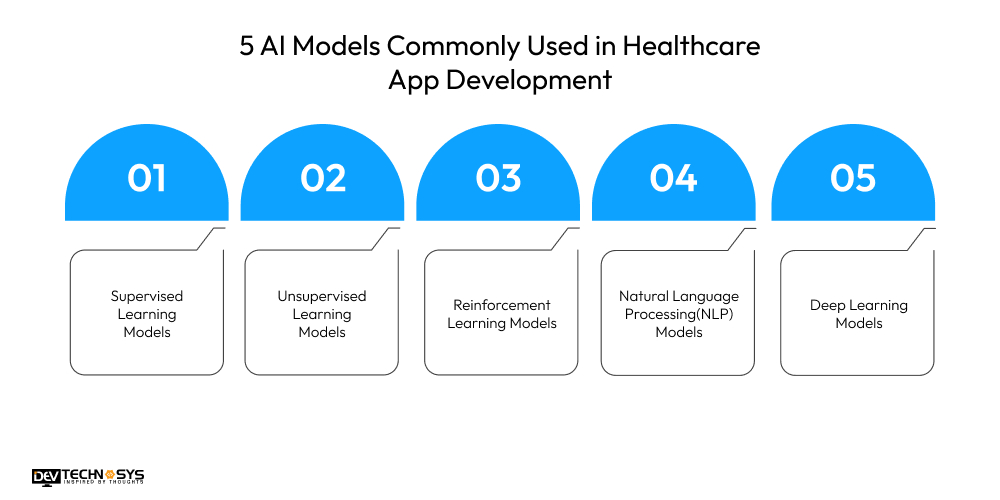
1. Supervised Learning Models
The supervised learning models use labeled datasets to predict the outcomes and classify the data. The healthcare applications use supervised learning models to predict patient readmissions, help diagnose disease, and identify high-risk individuals.
These models, learning from the past health data, such as medical history, lab results, medical imaging, and more, use supervised learning to ensure accurate, evidence-based predictions.
2. Unsupervised Learning Models
The unsupervised learning models observe unlabeled data to find patterns, anomalies, and clusters without knowing predefined outcomes. The healthcare applications use unsupervised learning models to detect unusual health events, segment patient populations, and identify the hidden trends of datasets. This methods help to build a scalable healthcare SaaS platform to identify early disease, personalize interventions, risk stratification, and more.
Also Read: Healthcare App Development Cost in 2026
3. Reinforcement Learning Models
Reinforcement learning trains AI systems to make sequential decisions by maximizing rewards from outcomes. In healthcare, it is applied to optimize treatment plans, dosage adjustments, and care pathways. By continuously learning from patient responses and clinical results, reinforcement learning improves decision-making accuracy over time, enabling adaptive, personalized interventions that enhance patient outcomes.
4. Natural Language Processing(NLP) Models
The Natural Language Processing(NLP) models in healthcare applications interpret and generate human language. It helps healthcare providers to understand the language of clinical insights, patient queries, and electronic health records.
The NLP mainly translates the complex language into simple or human language. HL7 & FHIR integration in healthcare apps reduces manual or human work and enhances patient communication.
5. Deep Learning Models
Deep learning models use multi-layered neural networks to process complex, high-dimensional healthcare data. They excel in medical imaging, genomics, signal processing, and predictive analytics. In healthcare apps, deep learning powers image recognition, disease detection, speech analysis, personalized treatment recommendations, and real-time monitoring with high performance on large-scale datasets.
7 Real-World Healthcare Applications That Use AI
There are various types of healthcare applications that use artificial intelligence to streamline their healthcare operations and tasks. Let’s take a look at the AI-powered healthcare applications:
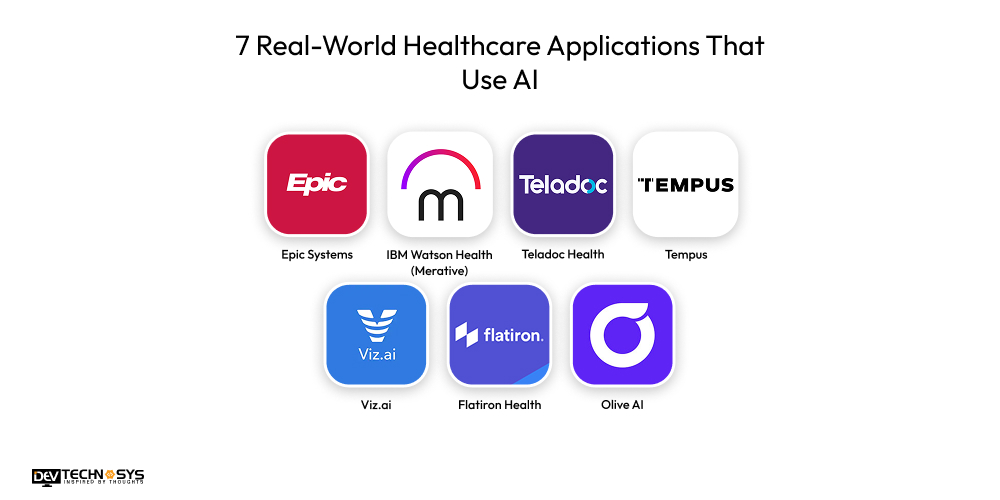
1. Epic Systems
Epic integrates AI into its electronic health record platform to support clinical decision-making, risk prediction, and workflow automation. Used by major U.S. hospitals, Epic’s AI helps detect patient deterioration, predict readmissions, streamline documentation, and enhance personalized care through MyChart patient-facing applications and analytics tools.
2. IBM Watson Health (Merative)
IBM Watson Health applies AI to analyze clinical data, medical literature, and imaging to support diagnostics and treatment planning. In the U.S., it assists providers with oncology insights, population health analytics, and clinical decision support. Hire dedicated developers who help clinicians process complex medical data faster and make evidence-based care decisions.
3. Teladoc Health
Teladoc Health uses AI to support virtual care, symptom checking, and chronic disease management across the U.S. Its AI enhances triage, personalizes treatment pathways, and monitors patient progress remotely. The platform improves access to healthcare, reduces unnecessary visits, and supports mental health and chronic condition programs.
Also Read: Healthcare MVP to Enterprise SaaS Roadmap: A Complete Guide
4. Tempus
Tempus is a U.S.-based precision medicine company using AI to analyze clinical and molecular data, especially in oncology. Its platform helps doctors personalize cancer treatments by identifying patterns in genetic data, imaging, and patient records. Tempus supports data-driven decisions and advances personalized healthcare in clinical settings.
5. Viz.ai
Viz.ai uses AI to analyze medical imaging and detect critical conditions like stroke in real time. Widely adopted in U.S. hospitals, it alerts care teams quickly, reducing treatment delays. Hire mobile app developers to improve clinical coordination, accelerate decision-making, and enhance outcomes for time-sensitive neurological and cardiovascular emergencies.
6. Flatiron Health
Flatiron Health applies AI and machine learning to transform oncology data into actionable insights. Used across U.S. cancer centers, it extracts structured data from clinical notes to support research, treatment evaluation, and outcomes analysis. The platform helps clinicians and researchers improve cancer care quality and effectiveness.
7. Olive AI
Olive AI automates administrative and operational healthcare workflows using artificial intelligence. Deployed in U.S. healthcare systems, it reduces repetitive tasks such as billing, scheduling, and insurance verification. According to an AI development company, Olive AI allows healthcare professionals to focus more on patient care and clinical priorities.

What Challenges are Occurring When Integrating AI in Healthcare App Development?
When integrating AI in healthcare app development, it consists of various challenges, and it poses difficulties for businesses. It includes data quality, security, model accuracy, reliability, high development and maintenance costs. So, let’s explore the various challenges that are occurring when integrating AI healthcare app development:
1. Data Quality and Availability
Healthcare AI relies heavily on accurate, diverse, and well-structured data. However, medical data is often incomplete, inconsistent, or siloed across systems. Poor data quality leads to biased or inaccurate models, limiting AI effectiveness.
To create a mobile app powered by AI in healthcare, ensuring clean, representative datasets requires significant effort, resources, governance frameworks, and collaboration between providers, data engineers, vendors, and regulatory stakeholders.
2. Data Privacy and Security Concerns
Integrating AI in medical app development can raise privacy and security concerns, which means patients’ sensitive medical data can be leaked and accessed by unauthorized members.
Businesses must ensure that patients’ data is secured with proper measures and protected from misuse and data breaches. Compliance with regulations like HIPAA and GDPR requires developers to implement strong security measures such as biometrics and authentication.
3. Integration with Legacy Systems
Most healthcare organizations still depend on outdated legacy systems that are not designed for AI-based solutions. Integrating AI into these systems creates interoperability challenges, fragmented data formats, and a lack of standardized APIs.
To overcome these issues, android app development services must focus on careful planning, seamless workflow integration, and close collaboration with IT experts and healthcare staff to ensure successful AI adoption.
4. Model Accuracy and Reliability
AI models in healthcare must achieve extremely high accuracy to be trusted. Small errors can have serious clinical consequences. Variability in patient populations, data drift, and changing medical practices affect model performance.
Continuous monitoring, retraining, validation, and human oversight are necessary to ensure AI systems remain reliable, safe, and clinically relevant over time.
5. High Development and Maintenance Costs
Building AI-powered healthcare applications can incur additional costs, including training, compliance, infrastructure, and ongoing maintenance. Mid-sized or smaller organizations may struggle to integrate artificial intelligence without defining ROI and a clear roadmap.
Partnering with a doctor-on-demand app development company can help manage financial pressure, streamline development cycles, and ensure scalable, efficient AI healthcare solutions.
Want a chatbot demo or pricing? Fill the form and talk to our experts today.
Pick what you need below — you can select more than one — then tap Get detail to continue.
-
Chatbot demo dashboard
-
Cost to develop an app
-
Industry report
-
Case study
What are the Future Trends of AI-Powered Healthcare Applications?
As we look at the future trends of AI-based healthcare apps, they might be more advanced in the form of technical and automation workflows. So, let’s take a look at the future trends of AI-powered healthcare apps:
1. Generative AI in Clinical Workflows
The Generative AI in clinical workflows provides more automated services such as documentation, summarizing, assisting clinical decision making, patient records, and more. These Generative AI models reduce the burden on healthcare providers and staff, enabling them to focus more on patient care. Based on the accuracy and trust, Generative AI will become a more trusted productivity tool in hospitals, clinics, and telehealth platforms.
2. Multimodal AI Models
Future healthcare applications use Multimodal AI models to combine text, images, sensor data, and signals. With these models, healthcare providers can analyze data in detail for accurate diagnoses and holistic patient insights.
Consulting with a mobile app development company enables the creation of AI-powered apps that provide predictive health insights, personalized treatment planning, and a better understanding of complex medical conditions.
3. Digital Twins for Personalized Care
AI-based digital twins encourage individual patients’ care using real-time medical or clinical data. These digital models help healthcare providers to offer personalized therapies and predict disease outcomes.
The digital twins support precision medication by enabling proactive and data-driven decisions to reduce cost, risk, and trial error approaches. So, digital twins are one of the most used trends in future healthcare applications.
4. Predictive and Preventive Healthcare
AI-based healthcare applications shifted from reactive treatment to predictive care. By observing the patient’s past medical reports and advanced analytics, we can identify the forecast disease, early risk factors, and recommend timely interventions. This proactive prevention methods or approaches reduce the hospitalization cost, improve long-term outcomes, and much more.
5. AI-Augmented Clinical Decision Support
Clinical decision support systems will evolve into AI-augmented assistants that provide real-time insights during care delivery. These systems analyze patient data, guidelines, and outcomes to suggest personalized treatment options. AI-augmented support improves diagnostic accuracy, reduces variability in care, and assists clinicians in complex decision-making scenarios.
Conclusion
Finally, it’s time to say goodbye. Before that, we share the final thoughts about AI in healthcare app development. In this blog, we discussed in detail key use cases, modern healthcare app development using AI, real-world applications that already integrate AI, challenges, future trends, and more. We hope that you have cleared all your doubts and issues regarding why AI integration is necessary in healthcare applications.
Do you have your own digital healthcare platform? Want to integrate AI to streamline operations? Then you must connect with an AI-based healthcare app development company to integrate AI in your existing healthcare application at a lower cost.
Frequently Asked Questions
Find answers to the most common questions related to this article.
There are various benefits of artificial intelligence in healthcare mobile apps. Here we provide the list of benefits:
24/7 virtual assistance
Improved diagnostic accuracy
Remote patient monitoring
Predictive and preventive care
Scalable healthcare delivery
The cost of developing AI healthcare apps ranges from $10,000 to $30,000, depending on the personalized requirements. The total development cost mainly depends on the various key factors such as features, functions, project complexity, backend infrastructure, deployment platforms, tech stacks, integrations, and AI development team.
Let’s explore the various operations of AI in healthcare app development, so here is the list:
Symptom analysis and virtual triage
Medical image analysis and diagnostics
Personalized treatment recommendations
Clinical decision support systems
Remote patient monitoring via wearables
There are different types of data used in AI-powered healthcare apps, such as patient-generated data, wearable devices, electronic health records, medical imaging, clinical reports, lab reports, and many more. This type of data helps healthcare providers to get accurate patient health data, predict and forecast diseases, and provide personalized care.
Developing AI healthcare apps involves challenges such as poor data quality, privacy and security risks, regulatory compliance, integration with legacy systems, model bias, lack of explainability, high development costs, and clinician adoption barriers. Ensuring accuracy, trust, ethical use, and continuous validation is essential for safe and effective deployment.