




















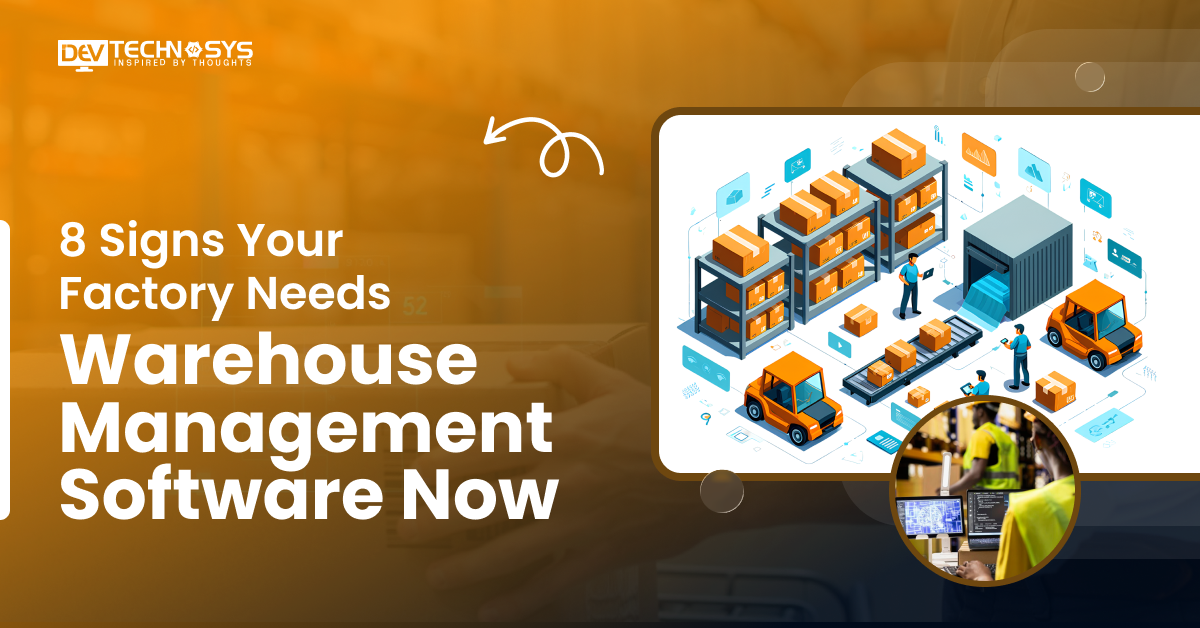
Walk into a busy factory on a regular day, and you can feel the pressure. Despite all the efforts, there is a lot of chaos. Believe it or not, many factories face these issues on a regular basis. The outcome? Productivity drops. Costs rise. Customers lose trust.
This is exactly where a solid Warehouse management software starts to change the game. It’s about way more than just tallying boxes; it’s about controlling every single move from the second a shipment hits the dock until it’s out the door.
Most factories are still stuck using basic tools that only track raw numbers. But with the right software, you know exactly where every pallet is tucked away, what’s next on the picking list, and how to keep the floor moving without the usual bottlenecks.
If you’re still on the fence about whether your facility actually needs this, these next few points should clear things right up. Let’s dive in.
8 Warning Signs Your Factory Needs Warehouse Management Software Now
Discover 8 clear warning signs your factory needs warehouse management software. Including inventory errors, slow fulfillment, poor visibility, manual inefficiencies, scaling issues, compliance risks, shrinkage losses, and outdated systems.
Sign 1: You’re Struggling With Inaccurate Inventory Counts
Issues such as overstocking, stockouts, and frequent confusion are sure to arise with manual tracking and spreadsheets. With reliable warehouse inventory management software, you have real-time visibility. You know exactly what you have, where it is, and how much is available. No guessing. No last-minute surprises.
How WMS Solves Inventory Accuracy Issues?
Modern warehouse management software development solutions uses barcode scanning and RFID. This tracks every movement as each item is linked to a specific bin location.
Cycle counting becomes automated. This means quick confirmations instead of annual audits.
This level of control reduces human errors. Your team stops double-checking everything and starts trusting the system.
Sign 2: Your Order Fulfillment Is Slow and Error-Prone
Late shipments and wrong orders never work well with customers. If you are still using paper lists, mistakes will happen.
A strong warehouse management software (WMS) regulates how orders are picked and packed. With easy and step-by-step instructions, efficiency gets multiplied even with small warehouse inventory management software.
WMS Picking Strategies That Speed Up Fulfillment
With these softwares, you can use zone picking, batch picking, or wave picking, depending on your operation.
Zone picking assigns workers to specific areas, reducing travel time. Batch picking groups similar orders together. Wave picking organizes tasks based on shipping schedules. These strategies improve speed and accuracy at the same time.
Sign 3: You Have No Real-Time Visibility Into Your Warehouse
If you have no idea about your current stock levels, pending orders, or how your team is performing, then you are running a warehouse without real-time data. Decisions are based on outdated reports or assumptions.
Software for warehouse management solves this by providing live dashboards. You can see what is happening on the floor at any moment.
This visibility helps managers make the right decisions at the right time. It also prevents small issues from turning into larger problems.
Sign 4: Your Warehouse Staff Is Overwhelmed by Manual Processes
Are your workers spending more time on paperwork than moving products? If yes, then there is a problem.
A well-designed management software warehouse system removes these bottlenecks. Not only does it automate repetitive tasks, but it also gives clear instructions through mobile devices.
How Does Automation in WMS Reduce Labor Costs?
By using auto-replenishment and directed put-away, you can store and move products efficiently. Task interleaving enables workers to complete multiple tasks in a single trip, reducing unnecessary movement.
With warehousing software and smart warehouse management systems, large volumes can be handled with the same team. This directly lowers labor costs and improves productivity.
Sign 5: You’re Struggling to Scale Operations or Add New SKUs
If your current system is not aligned with your growth, then you can get into trouble.
An adaptable warehouse management platform scales alongside your company. It manages expanding SKU counts, surging orders, and heightened complexity, sparing you from total system overhauls. This versatility ensures you grow with certainty, rather than constantly scrambling to stay ahead of your own operations.
Sign 6: Your Compliance and Traceability Are at Risk
In various sectors, monitoring inventory is mandatory. You must pinpoint item origins, handling history, and final destinations. Without rigorous logs, audits turn chaotic and high-stakes. Warehouse platforms deliver total visibility. Use lot, batch, or serial tracking to follow every unit from the loading dock straight through to delivery.
This ensures compliance and gives you the ability to respond quickly if issues arise.
Sign 7: You’re Losing Money to Shrinkage and Misshipments
Losses from theft, damage, and incorrect shipments can quietly drain your profits. A strong inventory and warehouse management software for small businesses can set up tracks for every action at the user level. You know who handled each item and when.
Discrepancies are flagged immediately. This allows you to mend the mistakes before it is too late
Sign 8: Your ERP or Legacy System Can’t Keep Up
Many factories rely on ERP systems with basic warehouse modules. While useful, they often lack the depth needed for complex operations.
A dedicated warehouse software management system focuses entirely on warehouse efficiency. It offers advanced features that ERP modules usually do not provide.
The good news is you do not have to replace your ERP. Modern systems integrate easily through APIs.
ERP vs Dedicated WMS: What’s the Right Choice for Your Factory?
Basic ERP modules suit straightforward, low-stakes tasks. Yet, purpose-built warehouse tools offer far richer depth, smoother scaling, and granular oversight. When facilities expand or juggle tangled workflows, opting for specialized tech pays off. You secure a level of operational mastery that generic enterprise suites just can’t replicate.
How to Choose the Right Warehouse Management Software for Your Factory?
Don’t just grab the trendiest software when thinking about how to choose a warehouse management system . Instead of chasing trends, focus on what actually works for your day-to-day operations.
- Spot the biggest pain points like stock errors, delays, or too much manual work
- List the features you truly need, such as automation, reports, and room to grow
- Choose between cloud or on-premise based on your budget and tech setup
- Look for vendors that clearly solve your specific challenges
- Make sure it connects easily with your current systems like ERP or accounting tools
- Ask for demos and try it out with real tasks before deciding
- Check if the software is simple to use and can be customized
- Go with a provider that offers solid training and ongoing support
What to Look for in Warehouse Management System Software (WMS)?
Demand livestock updates and multi-site visibility. Your crew needs mobile or RF tool compatibility to actually move fast on the floor. Don’t skip rugged analytics; they drive smart calls. Grab a suite with built-in compliance and tight ERP links.
Every platform has its quirks; pick the one that fits your factory’s specific grind. Also consider how much a warehouse management system costs and compare quality with price.
The Real Cost of Running a Factory Without a WMS
Without a proper software warehouse management setup, factories can face both excess stocks and stockouts. This is largely because they can not rely completely on the system they are currently using. This often leads to increased labor costs, unnecessary delays, and getting in the bad books of your customers.
Studies across manufacturing show that operational inefficiencies can increase costs by up to 20%. This makes a warehouse management software system not just an expense but an investment that reduces waste, improves accuracy, and helps your factory run at full capacity.
Why Dev Technosys Is the Warehouse Management System Partner Factories Trust?
Dev Technosys builds custom warehouse tech specifically for factory floors. We don’t force you to fit into a fixed system; instead, shape the solution around how your team actually works every day.
Our team takes care of the tough parts, custom coding, connecting with your existing software, and setting up cloud tools that can scale as you grow. For companies in the US and those working globally, they focus less on buzzwords and more on simple, practical solutions that deliver real results.

Conclusion
Eliminating these bottlenecks leads to faster workflows, better operational control, and a more consistent client experience. If your facility is already facing even a few of these warning signs, waiting longer will only increase inefficiencies and operational costs. The right solution can bring real-time visibility, accountability, and structure back to your daily floor operations.
Frequently Asked Questions
Find answers to the most common questions related to this article.
A WMS is basically the brain of your warehouse. It’s way more than counting boxes; it’s about making the floor flow. By ditching manual grunt work, you slash labor costs and ship faster. With real-time stock data, Dev Technosys builds custom tools so you can run lean without the guesswork.
Losing track of stock or falling behind on shipping is a massive red flag. Don’t wait for a total meltdown to fix your workflow. Setting up a WMS early prevents future chaos. At Dev Technosys, we help you nail the timing, building custom systems that actually scale as you grow.
Modern WMS platforms use APIs to "talk" directly to your ERP, keeping everyone in sync. Say goodbye to messy spreadsheets and manual entry. Dev Technosys specializes in these seamless connections, ensuring your warehouse and office operate as one unit. It’s about making sure your data flows exactly where it needs to.
It all comes down to speed and accuracy. By leaving manual paperwork and using automation, you get rid of those "human errors" that slow things down. When picking, packing, and shipping happen faster and more accurately, the whole supply chain gets a boost. Dev Technosys creates smart WMS solutions that clean up your workflows and help you hit your delivery targets every single time.