














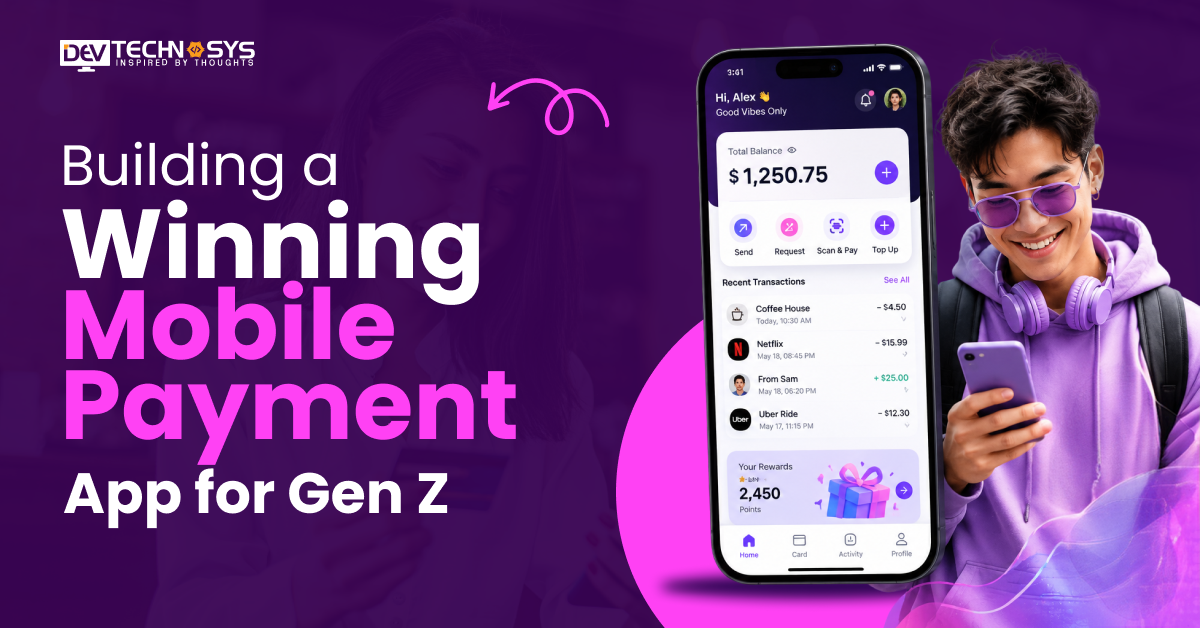
For Gen Z, sending money is more than just a financial transaction. It’s a digital experience intertwined into their social lives, their daily lives, and their identity. This generation doesn’t go into bank branches. They settle bills via apps, tip creators quickly, and expect their financial tools to be as easy to use as browsing through a feed.
To Gen Z, sending money isn’t just a financial transaction. It’s a digital experience that’s embedded into their social lives, their day-to-day lives, their identity. This generation does not go to bank branches. They pay bills through apps, tip content creators on the spot, and want their financial services to be as straightforward as scrolling through a feed.
Gen Z fintech app development is more than just functioning payments. It needs speed, customization, social interaction, and total confidence in security.
This guide on how to build a mobile payment app for Gen Z includes everything from basic features and tech stack to security, development process, pricing, and revenue tactics that work for this generation.
Gen Z Financial Behavior & Payment Expectations
Gen Z is changing the game of financial engagement. Understanding how this generation thinks, spends, and trusts is the first step to building a payment app that they will actually use.
-
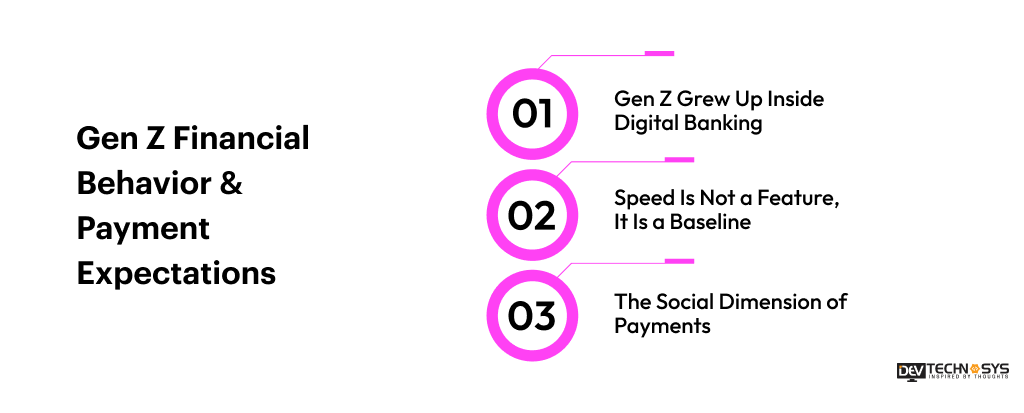
Gen Z Grew Up Inside Digital Banking
Gen Z didn’t understand digital banking. They were raised in it. Smartphones were not new to this generation. They were the standard. It’s completely natural for them to use an app to manage their money, whereas walking into a physical branch is a real inconvenience.
This mobile-first attitude is the basis of all Gen Z fintech app development decisions, and organizations that miss this point are building solutions that feel immediately antiquated.
-
Speed Is Not a Feature, It Is a Baseline
Speed is not a Gen Z trait. That’s an expectation at a baseline. They benchmark every financial product against real-time payment processing. A program that sends money instantly, in seconds, feels regular.
A two-business-day transfer is broken. Zero-wait experiences, fast notifications, and frictionless onboarding are not luxury extras. This is the lowest possible entry point into this market.
-
The Social Dimension of Payments
Most fintech companies misunderstand the social aspects of Gen Z payments. This generation is introduced to financial products via creators, peer groups, and online communities considerably more than by advertising or brand reputation.
Trust comes first, then usability and transparency. Mobile banking solutions that overlook community-driven adoption are missing the most effective distribution channel in existence.
What is a Mobile Payment App?
A mobile payment application is a platform for digital transactions that allows users to transfer money, pay to merchants, operate digital wallets, and perform financial transactions directly from their smartphones. Traditional banking applications were developed around managing your account, while new payment apps are built around speed, simplicity, and frictionless payment solutions for everyday occasions.
Today, the mobile payment app category includes various kinds of products. Digital wallets hold payment credentials and allow you to tap to pay. People can transfer money to each other instantly using P2P payment apps. QR-based apps allow consumers to scan codes at merchants to pay. Contactless payment apps rely on NFC technology to make proximity payments.
How a Mobile Payment App Works?
It involves a sequence of related procedures to move money accurately and instantly in a mobile payment app. For the users, it looks like the whole process takes seconds, but there are many layers of validation and processing happening behind the scenes to make sure every transaction is done right.
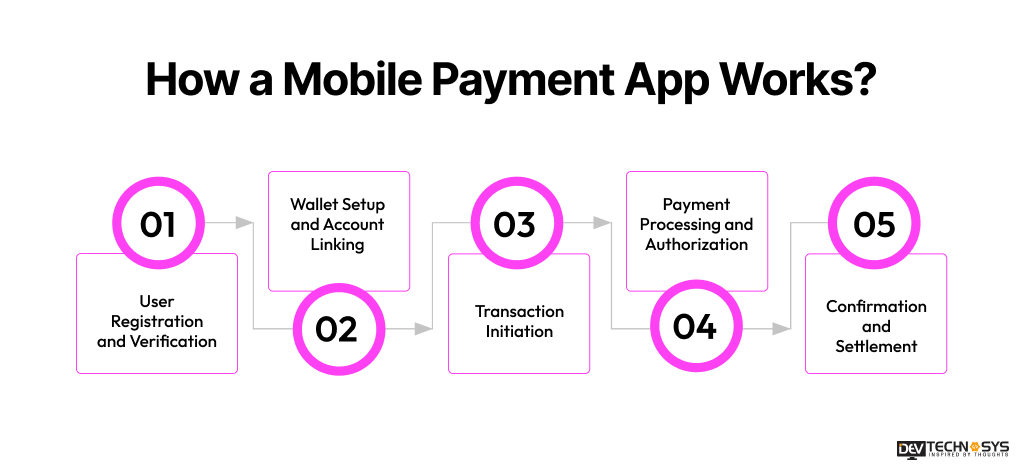
1. User Registration and Verification
All payment apps begin with identification verification. Users sign up, provide personal details, and go through KYC verification to prove their identity. This stage is to verify regulatory compliance and protect the platform from fraudulent accounts before any financial activity is carried out.
2. Wallet Setup and Account Linking
Once validated, customers then link their bank accounts, debit, or credit cards to the app. This generates a personal digital wallet containing payment credentials and serves as a foundation for any future transactions on the platform.
3. Transaction Initiation
The user picks a recipient, inputs an amount, and selects a payment method. Today, several platforms are QR code payment apps that allow users to scan a merchant or peer code and pay instantaneously, without the need to key in human details.
4. Payment Processing and Authorization
The software checks the transaction through a secure online payment infrastructure. Before any money moves, security checks are done automatically, funds are validated, and the payment is allowed by the connected payment gateway.
5. Confirmation and Settlement
Once approved, the sender and receiver will be notified immediately. Digital receipts are generated, and balances are updated in real time. This smart payment system closes the transaction loop cleanly and increases consumer confidence through transparency at every step.
Must-Have Features of a Gen Z Mobile Payment App
To build a successful product, you need to understand what Gen Z really want from a payment experience. These consumers don’t separate financial tools from social experiences, and the mobile payment app features that score for Gen Z in this market precisely reflect that fact.
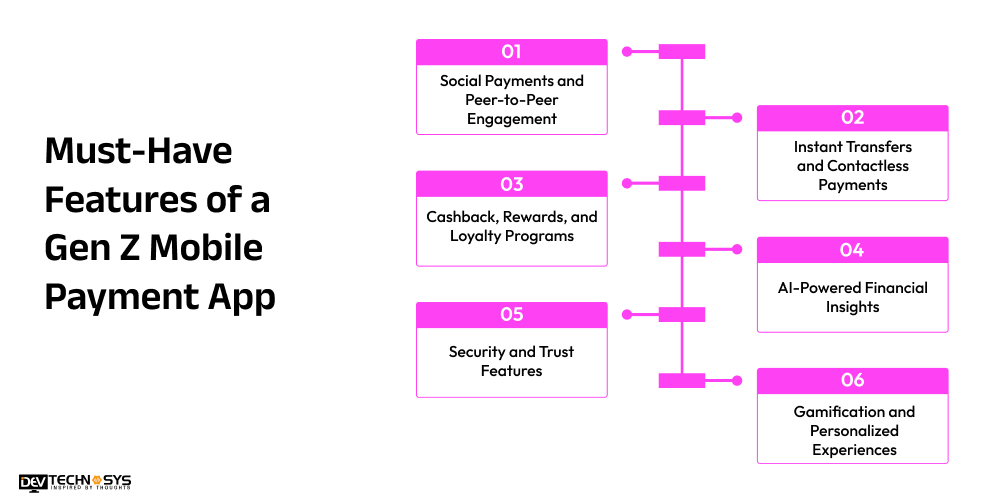
i. Social Payments and Peer-to-Peer Engagement
Payments are social interactions for Gen Z. Social payment app development that features payment notes, emoji replies, shared transaction feeds, and group payment visibility delivers the community-driven experience this generation wants. Splitting a restaurant check or repaying a pal should be as easy as sending an SMS.
ii. Instant Transfers and Contactless Payments
Speed and ease of use are a must. A contactless payment app that offers tap-to-pay NFC, real-time transfers, QR-based checkout and one-tap payment confirmation takes away all of the friction points that Gen Z won’t tolerate. Any delay in this experience is seen as a product failure.
iii. Cashback, Rewards, and Loyalty Programs
For Gen Z, rewards are not a bonus; they are an expectation. Cashback on daily purchases, referral bonuses, merchant-specific offers, and tiered spending rewards build true loyalty and promote consistent app engagement considerably better than traditional marketing campaigns.
iv. AI-Powered Financial Insights
The development of AI-powered payment software allows capabilities that go beyond transactions. Gen Z customers get the financial insight they want without the complexity they avoid thanks to personalized spending analytics, smart budget advice, automatic expense categorization, and proactive financial notifications.
By partnering with a trusted mobile app development company, you can be sure that these AI capabilities will be designed with the infrastructure needed to scale with the growth in user data.
v. Security and Trust Features
Security that is transparent, responsive, and trusted. Biometric login, real-time transaction warnings, device verification, and quick fraud monitoring provide users with confidence that their money is safeguarded. Gen Z will bail on any program that seems unclear regarding security, so surface-level reassurances will never be enough.
vi. Gamification and Personalized Experiences
Gamified payment apps encourage habitual participation through spending milestones, tracking savings objectives, achievement badges, and personalized challenges. It turns a utilitarian software into a daily experience that customers go back to freely, not only when they have a payment to make.
Having a product mindset is key to building mobile payment app features for Gen Z. It means recognizing that every encounter is not just a transaction, but also an opportunity to generate value.
The following features aren’t nice-to-have improvements. This is the baseline expectation of a generation that has never known a world without smartphones and instant digital experience.
Popular Gen Z Payment Apps: What They Do Right
No single payment app has nailed the entire Gen Z experience. Each dominant platform owns a particular facet of fintech innovation, and knowing what they get right is one of the wisest places to start if you’re working in this sector.
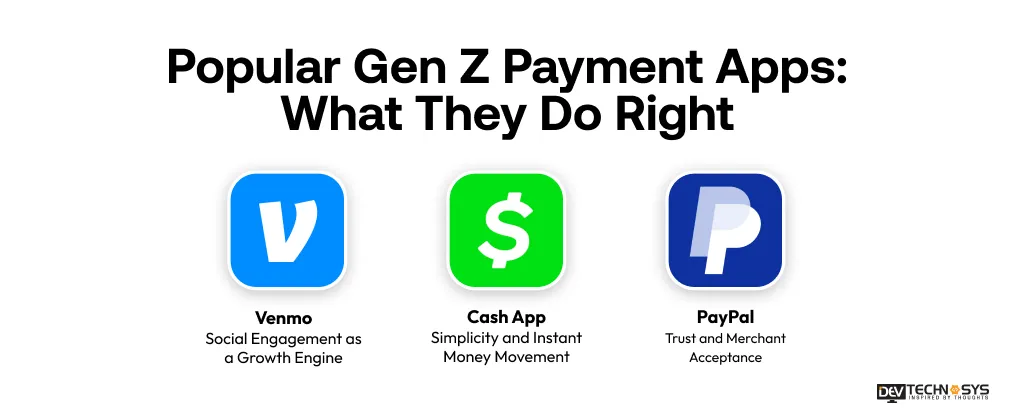
1. Venmo – Social Engagement as a Growth Engine
Venmo put payments into a social stream. No typical banking software could recreate the community experience produced by public transactions, emoji reactions, and visible payment activities.
Gen Z users also used Venmo to pay friends. For organizations wishing to emulate this engagement model, a good first step is to explore Venmo-like app development.
2. Cash App – Simplicity and Instant Money Movement
Cash App revealed that faster adoption comes from smooth onboarding and a clean interface, not quantity of features. The takeaway for product teams is simple: simplicity is not a design choice. If you want to be able to compete in this sector, you need to learn how to build an app like Cash App before investing in your product architecture.
3. PayPal – Trust and Merchant Acceptance
PayPal proved that trust is a long-term competitive advantage. It offered a level of confidence to its consumers with its global network of merchants and its buyer protection policies that newer apps couldn’t instantly match. A PayPal app development shows how a layered trust foundation is not just a clean UI; it creates lasting user loyalty across demographics.
The major takeaway across all four platforms is obvious. No app that combines social, quick, trust and ecosystem all together. And that’s exactly the gap a well-built Gen Z payment platform can fill, particularly since next-gen payment apps have a real shot at bringing all four experiences into one product.
Want a chatbot demo or pricing? Fill the form and talk to our experts today.
Pick what you need below — you can select more than one — then tap Get detail to continue.
-
Chatbot demo dashboard
-
Cost to develop an app
-
Industry report
-
Case study
Step-by-Step Process to Build a Mobile Payment App for Gen Z
Building a mobile payment app for Gen Z is more than just writing code. It takes a clear understanding of your consumers, a product strategy based on their expectations, a compliance framework that protects the business, and an infrastructure that’s designed to scale.
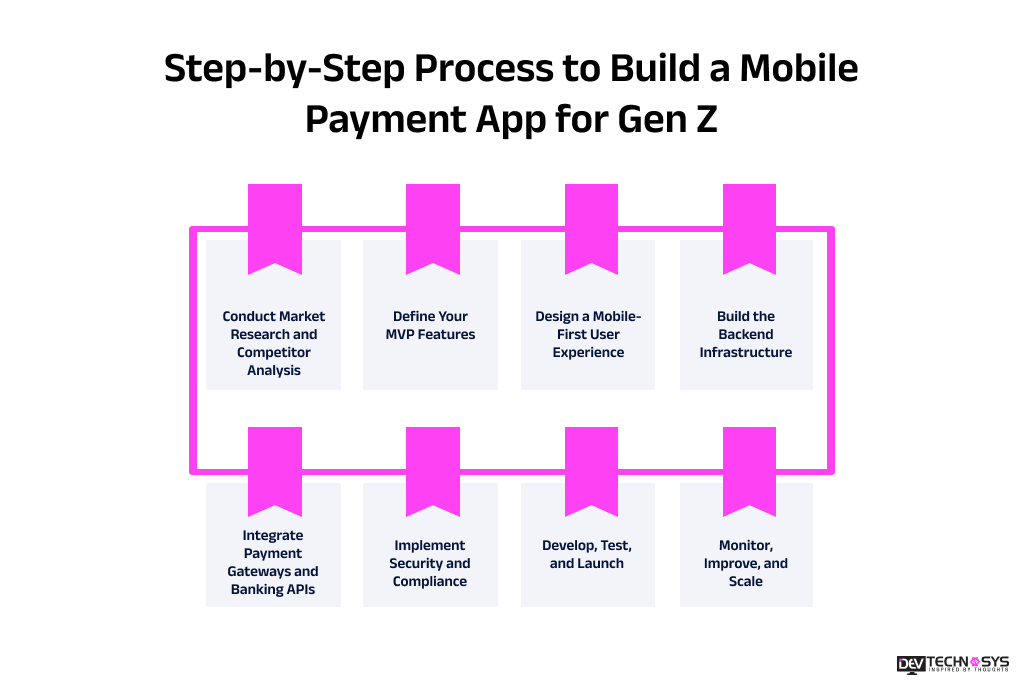
1. Conduct Market Research and Competitor Analysis
Wireframes are not the starting point of every successful Gen Z financial app development project. Understand how your target audience is handling their money today, where existing apps are frustrating them, and what behavioral gaps still exist. The best payment apps arise from solving problems that competitors have overlooked, not from perfecting functionality that they already have.
2. Define Your MVP Features
There is no substitute for a lean MVP vs a bloated first release. Follow a clear digital payment app development path, and you should have your Version 1 with P2P transfers, digital wallet capabilities, basic rewards, streamlined onboarding, and transaction history.
Resist the need to create everything at once. Gen Z is eager to accept apps but equally quick to drop them when the main experience feels bloated or sluggish. Get lean, and validate fast. Scale based on real user behavior.
3. Design a Mobile-First User Experience
Gen Z judges a payment app like they judge any social product within seconds of opening it. The screens should be intuitive. The actions should have a minimum number of stages. The onboarding should be less than two minutes.
The experience is accessible, supports dark mode, and includes micro-animations that acknowledge user activities. Partnering with a team of Android app development services, you can be assured that the design is optimized for the device ecosystem where most of the Gen Z users are found.
4. Build the Backend Infrastructure
Payment apps win or lose at scale on the backend. Your infrastructure needs to properly maintain wallets, process transactions in real-time, authenticate users, and store data for millions of concurrent users.
You need to have a cloud-based architecture and be able to scale horizontally from day one. Building for today’s traffic and ignoring future growth is one of the most expensive mistakes a financial firm can make.
5. Integrate Payment Gateways and Banking APIs
Your application’s financial heart is the payment gateway integration services. Card processing, linking to bank accounts, wallet funding, and fast settlement all rely on solid API connections into the financial system.
Select your gateway partners by speed of transaction, fees, regional presence, and quality of developer documentation. This phase involves working with a professional iPhone app development company that will ensure the testing of gateway integrations across all iOS environments before launch.
6. Implement Security and Compliance
KYC verification, AML monitoring, PCI DSS compliance and end-to-end encryption are not optional extras. They are fundamental expectations of regulators and users alike.
Build compliance into the design from the start, not as an afterthought after launch. It’s much easier to design a secure mobile payment app if security is a product need, rather than a post-launch duty.
7. Develop, Test, and Launch
What separates trustworthy payment apps from ones that fail publicly is rigorous QA testing across devices, operating systems, and network circumstances. A cross-platform development company with fintech expertise can conduct this testing step for both iOS and Android at the same time, which reduces the time for launch without sacrificing quality.
8. Monitor, Improve, and Scale
Measure transaction success rates, user drop-off points, support ticket patterns, and retention curves on an ongoing basis. Continuous iteration is as crucial as the first launch, given the fast-changing Gen Z expectations. Build feedback loops into the product from day one, and use every data signal as a mandate for the next cycle of progress.
Tech Stack for Mobile Payment App Development
The payment app’s technology stack directly affects the transaction speed, scalability, security, and future feature growth. Selecting the correct stack from the start saves technical debt, speeds up development timeframes, and assures the platform can handle increased transaction volumes without expensive rebuilds.
If you want to build at scale, you want to check with a team that has proven native mobile app development services experience before you go into a full development cycle to validate your stack selections.
Technology Layer |
Recommended Technologies |
Frontend |
Flutter, React Native |
| Backend | Node.js, Python, Java |
| Database | PostgreSQL, MongoDB |
| Cloud Infrastructure | AWS, Google Cloud Platform |
| Payment Integrations | Stripe, PayPal, Plaid, UPI APIs |
| Security | OAuth 2.0, Multi-Factor Authentication, End-to-End Encryption |
| Analytics & Monitoring | Firebase Analytics, Mixpanel, Datadog |
Security & Compliance Requirements
Financial apps handle sensitive personal data and real money, making security and compliance foundational requirements rather than optional additions. A payment app that fails on either front does not just lose users. It loses the business entirely.
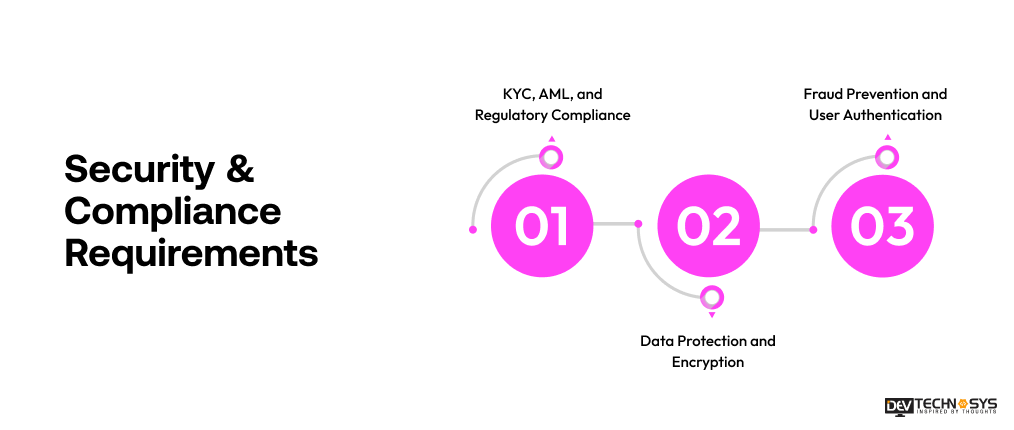
1. KYC, AML, and Regulatory Compliance
Every payment platform must implement KYC verification to confirm user identities before any financial activity begins. AML monitoring runs continuously in the background to detect suspicious transaction patterns and flag activity that falls outside normal behavior.
Regulatory compliance requirements vary by region, but ignoring them is never an option for any platform handling real funds.
2. Data Protection and Encryption
End-to-end encryption protects transaction data as it moves between users, servers, and payment gateways. Secure data storage practices ensure that sensitive credentials are never exposed through breaches or infrastructure vulnerabilities. PCI DSS compliance is a mandatory standard for any platform processing card-based payments and must be built into the architecture from day one.
3. Fraud Prevention and User Authentication
AI fraud detection in payment apps monitors transactions in real time, identifying anomalies and flagging suspicious activity before damage occurs. Biometric authentication payment app features, including fingerprint login and facial recognition, add a critical layer of identity verification that passwords alone cannot provide.
Together these systems create a security environment that protects users without creating unnecessary friction.
Security failures can destroy user trust overnight, making compliance, fraud prevention, and data protection essential pillars of every successful payment platform.

What is the Cost to Build a Mobile Payment App for Gen Z?
Payment app development cost depends on several variables, including feature complexity, security requirements, third-party integrations, regulatory compliance, and the development approach your team chooses.
A basic MVP and a full enterprise payment platform are fundamentally different investments, and understanding that difference early prevents budget miscalculations that derail projects mid-development.
App Version |
Estimated Cost |
Key Features |
| MVP Payment App | $30,000 – $60,000 | P2P transfers, digital wallet, basic onboarding, transaction history |
| Mid-Level Payment App | $60,000 – $100,000 | Rewards, AI insights, QR payments, KYC, payment gateway integrations |
| Enterprise Payment Platform | $100,000 – $150,000+ | Full compliance, fraud detection, multi-currency, social payments, analytics |
Major Cost Factors
i. Feature Complexity:
P2P transfers, AI-powered spending insights, rewards systems, and social payment features each add development time and cost. Every feature added to the MVP increases both build time and testing requirements significantly.
ii. Security and Compliance:
KYC verification, AML monitoring, and PCI DSS compliance require specialized development work and ongoing maintenance. These are non-negotiable costs for any platform handling real user funds.
iii. Third-Party Integrations:
Banking APIs, payment gateways, and analytics platforms all carry integration costs that vary based on provider pricing, documentation quality, and the complexity of implementation required.
iv. Platform Choice:
Building natively for Android and iOS separately costs more than a cross-platform approach. The right choice depends on your target audience distribution and long-term product roadmap.
How to Reduce Development Costs:
The most effective way to manage the cost to develop a payment app is to launch an MVP first, validate core features with real users, and scale functionality based on actual demand rather than assumptions.
Prioritizing the features Gen Z uses most frequently in the first version keeps initial investment focused and measurable. Understanding the full scope of mobile app development cost before committing to a budget helps businesses plan realistically and avoid expensive scope changes mid-project.
Businesses that focus on solving a specific Gen Z payment problem first typically achieve faster market validation and lower development costs than those attempting to build a full fintech ecosystem from day one.
Monetization Strategies for Mobile Payment Apps
The most successful payment platforms monetize transactions without creating friction for users. Rather than relying on a single revenue stream, they combine several complementary models that generate income while continuing to deliver genuine value.
Working with experienced enterprise mobile app development teams during the product strategy phase helps businesses identify which monetization models align best with their audience and growth goals.
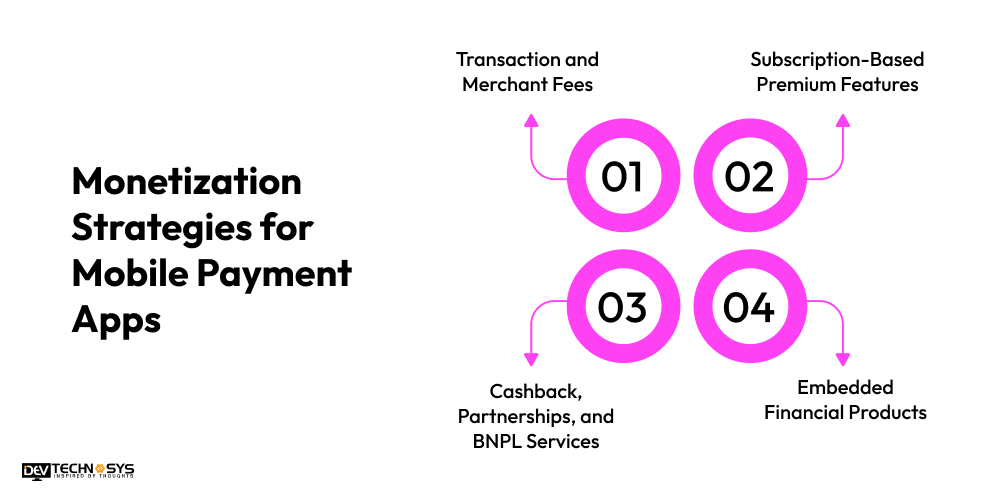
1. Transaction and Merchant Fees
Processing fees on business payments and optional premium transfer fees for instant settlements represent the most reliable baseline revenue. This model scales directly with transaction volume and requires no additional product complexity.
2. Subscription-Based Premium Features
A free core experience with paid premium tiers covering advanced analytics, enhanced rewards, and exclusive financial insights creates predictable recurring revenue. Gen Z responds far better to value-based monetization than direct user fees.
3. Cashback, Partnerships, and BNPL Services
Merchant partnerships, sponsored cashback offers, and BNPL app development integrations create diversified income streams that simultaneously increase user engagement and platform stickiness.
4. Embedded Financial Products
Embedded finance app development transforms a payment app into a full financial ecosystem by layering in insurance, micro-investments, savings tools, and lending services.
The strongest payment platforms diversify revenue sources early, reducing dependence on transaction fees while creating additional value for users and merchants alike.
Future of Mobile Payment Apps Beyond 2026
The future of digital payments 2026 and beyond points toward one clear direction. Payment apps are evolving from transaction tools into intelligent financial ecosystems that manage, predict, and automate money experiences entirely.
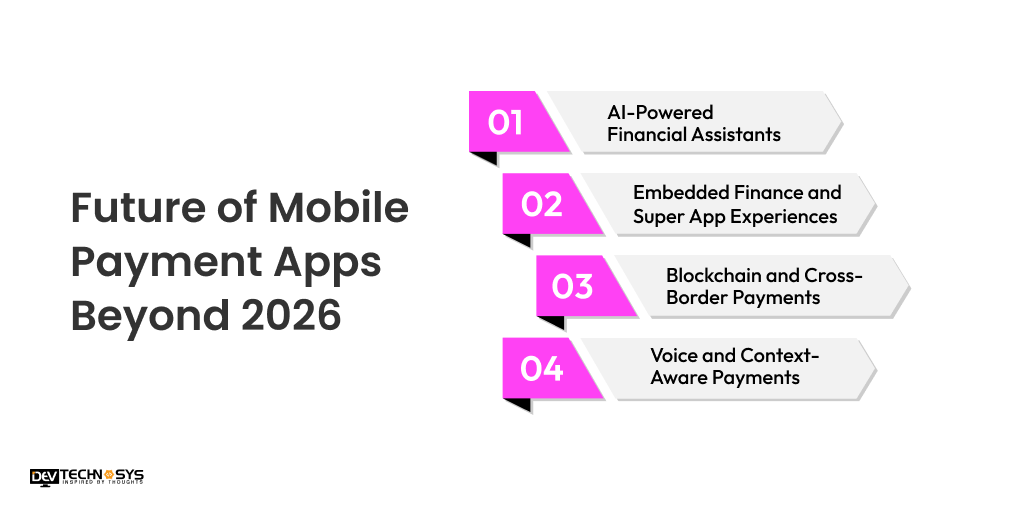
1. AI-Powered Financial Assistants
AI fintech app solutions are moving beyond spending categorization into proactive financial guidance. Predictive budgeting, personalized savings recommendations, and automated financial decisions will become standard expectations rather than premium features.
The biggest shift will not be faster payments but smarter payments that anticipate user needs before transactions even occur.
2. Embedded Finance and Super App Experiences
Super app payment integration will blur the line between payments, savings, insurance, and investments inside a single platform. Users will manage their entire financial life without leaving one app. Businesses building toward this vision should hire dedicated developers with embedded finance expertise from the earliest planning stages.
3. Blockchain and Cross-Border Payments
Blockchain payment app development will enable faster international settlements, greater transaction transparency, and reduced dependency on traditional banking intermediaries. This is particularly relevant for Gen Z users operating across global digital economies.
4. Voice and Context-Aware Payments
Voice-enabled payment apps and wearable payment integrations will make transactions invisible in everyday moments. Paying through a smartwatch, speaker, or voice command removes the app entirely from the equation.
As Gen Alpha and Gen Z fintech tend to continue reshaping consumer expectations, next-generation payment apps will increasingly prioritize personalization, automation, and seamless financial experiences over standalone transaction functionality.
Why Businesses Should Invest in Gen Z Payment Apps
Gen Z is not a future market. They are an active, growing, and increasingly influential consumer segment that is already reshaping how money moves digitally.
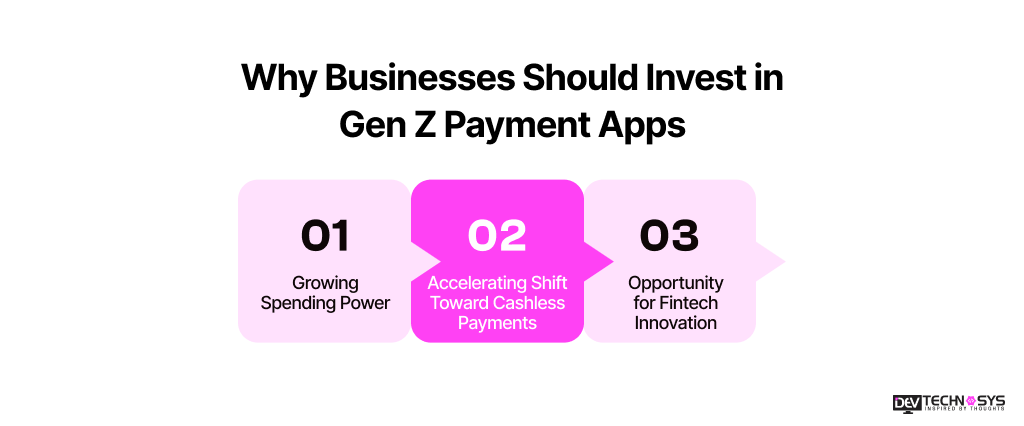
1. Growing Spending Power
Gen Z is entering the workforce in significant numbers, bringing rising disposable income and long-term purchasing potential with them. Youth-focused fintech apps that capture this audience today are not just winning transactions. They are building customer relationships that can last for decades, making early investment far more valuable than the initial numbers suggest.
2. Accelerating Shift Toward Cashless Payments
Cashless payment solutions are no longer a preference for Gen Z. They are the default. Digital wallets, contactless payments, and mobile commerce are growing consistently across every major market, and businesses without a credible mobile payment presence are already losing ground to competitors who moved earlier.
3. Opportunity for Fintech Innovation
Significant market gaps remain in personalization, social payments, and embedded financial tools. Fintech innovation in these areas is still early enough that well-executed products can capture meaningful market share before the space becomes saturated with competing platforms.
Businesses that invest in mobile finance solutions targeting Gen Z now can establish loyalty and brand trust before the market tightens. Evaluating experienced mobile app development companies with proven fintech portfolios is a practical first step toward turning that opportunity into a real product.
Conclusion
Gen Z has transformed mobile payments from a simple financial function into a personalized digital experience. Businesses exploring how to build a mobile payment app for Gen Z must focus on more than transactions alone. Speed, social engagement, seamless usability, security, and intelligent financial tools now define what this generation expects from every payment platform they choose to trust.
Partnering with the right team is equally critical, and businesses serious about entering this market should hire Android app developers with proven fintech experience from the earliest stages of product planning.
As digital payment adoption continues to accelerate globally, the opportunity for next-generation payment apps remains substantial. Companies that prioritize user-centric design, scalable technology, continuous iteration, and genuine alignment with Gen Z values will be best positioned to build lasting relationships with the consumers who are actively shaping the future of finance.
Frequently Asked Questions
Find answers to the most common questions related to this article.
The most important mobile payment app features for Gen Z include instant transfers, social payment experiences, cashback rewards, AI-powered spending insights, and frictionless onboarding. This generation expects financial tools to feel as intuitive as social apps. Platforms that prioritize speed, personalization, and convenience consistently achieve stronger engagement and retention.
Every payment app should implement KYC verification, AML monitoring, end-to-end encryption, biometric authentication, and real-time fraud detection. These measures ensure secure online payments while protecting both user data and financial transactions. Security infrastructure must be built into the architecture from day one rather than added after launch.
Yes. Startups compete effectively by targeting underserved audiences and solving specific problems that larger platforms overlook. Fintech innovation thrives in niche markets where speed of execution and specialized features matter more than brand recognition. Competing feature-for-feature with Venmo or Cash App is unnecessary when a focused product solves one problem exceptionally well.
Most fintech mobile app services rely on Flutter or React Native for frontend development, Node.js or Python for backend infrastructure, PostgreSQL for database management, AWS for cloud hosting, and Stripe or Plaid for payment API integrations. The right stack depends on your product requirements, target platforms, and scalability goals.
Secure mobile payment app development requires building PCI DSS compliance, KYC verification, AML monitoring, and data protection regulations into the product architecture from the beginning. Regular security audits and compliance reviews should be scheduled throughout the development lifecycle. Treating compliance as a foundational requirement rather than a final checklist item significantly reduces regulatory risk.