




















Key takeaways:
-
- To build an app like Revolut, follow key steps such as market analysis, collecting app needs and features, choosing tech stacks, designing UI/UX, development, testing, release, and maintenance.
- Adding features in fintech apps like Revolut, such as real-time payments, budgeting tools, instant account opening, multi-currency accounts, stock trading, and more.
- Offering popular Revolut alternatives such as Monzo, SoFi, PayPal, Wise, Chime, N26, Monese, Cash App, and many more.
- Generating higher revenue streams from mobile banking apps through monetization techniques such as subscription plans, freemium model transaction fees, and advertising.
You may have noticed that many people around the globe are now able to transfer money, plan for future expenses, and travel without any hassle at all.
This change in people’s behaviors is due to the growth of mobile application technology, which has transformed how they manage their finances.
Building an application similar to Revolut can be an exciting experience if you take the time to learn about its core elements.
From creating an easy-to-use interface to adding functionalities such as payment processing, budgeting, and fraud protection, it is just like working through a fun jigsaw puzzle.
In this blog, we will explore how to build an app like Revolut, similar apps, cost, benefits, monetization techniques, features, and so on.
What is Revolut?
Revolut is a popular digital banking platform in the UK. Users can manage their financial services, such as sending or receiving money and exchanging currency.
It offers virtual or physical cards, budgeting tools, supports cryptocurrencies, and allows users to track expenses in real-time. Users can also send money internationally with lower fees and also enter different card numbers to transfer funds.
Founded: 2015
Founders: Nik Storonsky and Vlad Yatsenko
Headquarters: London, United Kingdom
Type: Fintech / Digital banking app
Users: 50+ million globally (approximate recent figure)
Availability: Operates in many countries across Europe, the US, and beyond
Planning a Payment App Project?
Get a tailored development cost estimate in a few simple steps.
- 3 quick steps
- 100% free
- Reply in 1 business day
2 Minutes Read
How Do Digital Banking Platforms Compete in Today’s Market?
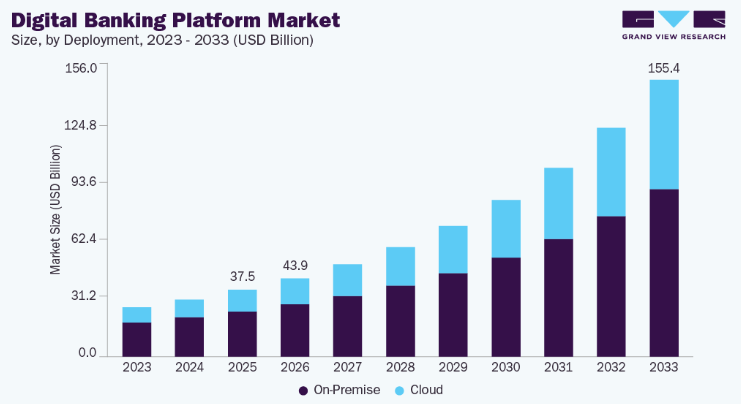
- As per the Grand View Research, the digital banking applications market was valued at around $37.49 billion in 2025. It is projected to grow to around $155.44 billion by 2033.
- Look at the region-wise, the Asia-Pacific region dominates the global digital banking market and generates a higher revenue share of around 32.5% in 2025.
- Observing via deployment, the on-premise charging segment holds the market revenue share of 67.5% in 2025.
- According to Statista, the digital banking apps market’s net interest income is projected to hit around $1.66 trillion in 2026.
- As per the news of Grand View Research, the digital bank apps market is expected to increase with a CAGR of 19.8% during the forecast period from 2026 to 2033.
Why Businesses Want to Invest in Fintech App Development?
Money transfer app development is changing the way businesses conduct payments by providing faster, more efficient, and more secure solutions than ever before.
Companies are investing in fintech applications to take advantage of the rapid growth of digitization worldwide to improve customer service and increase profitability.
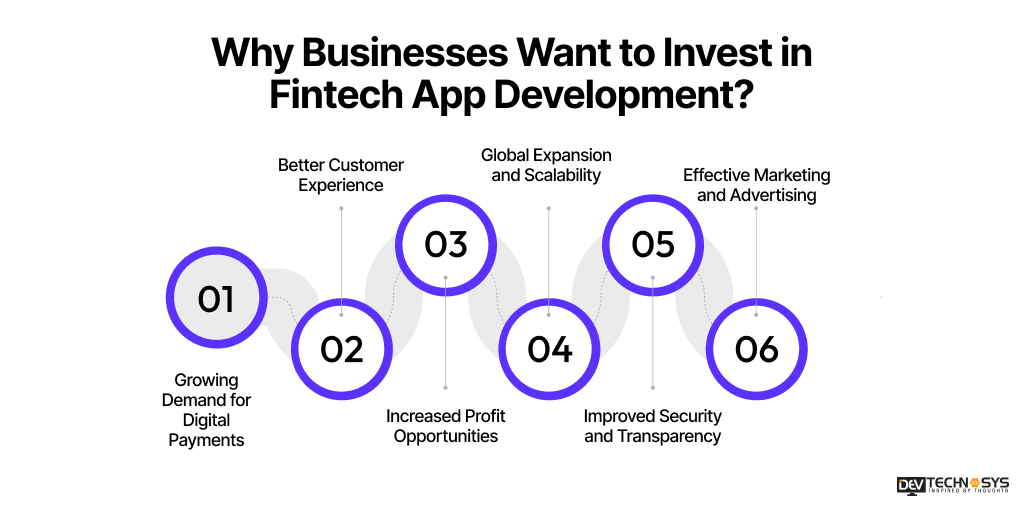
1. Growing Demand for Digital Payments
An increasing number of people today are opting to use a mobile app rather than cash to make payments. The quick, easy, and secure way of paying with a fintech application has led businesses to invest in fintech as they want to attract new customers, provide faster service, and keep up to date with modern technology that is already widely used by customers on a daily basis.
2. Better Customer Experience
Payment app development solutions provide users with easy, smooth, repeatable services such as the ability to transfer funds instantaneously, budgeting tools for managing money, and alerting users when transactions have occurred. Businesses are focused on providing their customers with a ‘best in class’ consumer experience.
3. Increased Profit Opportunities
Fintech applications provide businesses with multiple opportunities to generate revenue; for example, through transaction fees, subscription fees, premium services, etc.
Fintech businesses can grow their revenues by attracting and retaining users who regularly use their applications. this makes fintech an excellent long-term investment opportunity for any company that seeks to grow and be successful.
4. Improved Security and Transparency
The latest fintech mobile app development solutions utilize advanced security features, such as encryption and authentication, to protect the security of the user’s data.
Businesses are embracing fintech applications so that they can provide their customers with a safe means of conducting transactions, thereby building trust with their customers. Transparent record-keeping helps users monitor their financial transactions, enhancing their confidence.
5. Global Expansion and Scalability
Business owners can tap into global markets through the creation and implementation of fintech applications. This enables them to open up their businesses into previously untapped geographic territories without having the expense of establishing a physical presence there. As a result, companies can grow more quickly than before and reach more people than ever before.
Industry Insights:
According to Reuters, in 2025, Revolut achieved £4.5 B revenue and £1.7 B pretax profit, driven largely by fees, FX, and expanding credit products.
What are the Major Steps to Build an App Like Revolut?
From the beginning of this blog, you have been waiting for this section. Building a digital banking app like Revolut requires various steps and following every step strictly.
It includes market research, collecting app requirements, technologies, designing, backend development, testing, deployment, and post-maintenance services. So, here is the banking app development guide:
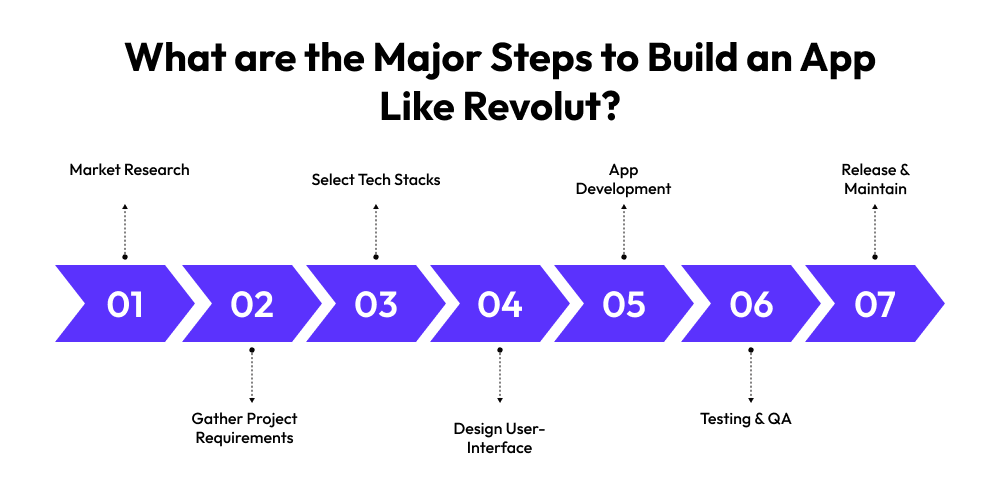
1. Market Research
Before beginning the development process. You will need to ask yourself some questions. Is your idea valid? Is it successful in today’s market? Have you checked the latest market trends?
To answer all these queries, need to research the market where your project idea stands and how it can become successful in the digital market. Observe the existing digital banking apps to know their reasons for success and how their working processes work with users.
2. Gathering Project Requirements
After the idea validation. Hire a digital banking app development company to collect the project requirements and needs that you actually want to add to your mobile banking application.
Make an organized sheet of features that must be integrated, such as user registration, multiple currency support, adding debit or credit cards, push notifications, currency exchange, and many more. Identify the primary and secondary users for your app.
3. Select Tech Stacks
Choosing tech stacks is one of the most crucial stages for the Revolut clone app development process. It includes various types of robust tech stacks:
Frontend: AngularJS, JavaScript, HTML, CSS
Backend: SpringBoot, Django, Laravel, Ruby on Rails
Database: PostgreSQL, MYSQL, MongoDB
Cloud Services: AWS, Google Cloud, Oracle Cloud
Designing Tools: Figma, Sketch, Marvel, Adobe XD
4. Design User-Interface
It’s time to design and customize a user interface with high-quality UI elements to increase user engagement and make it easy to navigate all specifications.
It includes various types of UI elements such as layouts, templates, fonts, styles, textures, wireframing, themes, icons, and many more. Hire designers from an on-demand app development company to design a simple UI and use tools like Farmer, Zeplin, Figma, and more.
5. App Development
Move to the fifth stage to create an app like Revolut, employ skilled backend programmers to start the backend processes, and integrate various tools and applications.
Developers need to perform various operations such as building application logic, API development, user authentication, managing databases, server management, caching, and optimization. Implement third-party tools like communication platforms, analytics, reporting, social media platforms, and more.

6. Testing & QA
In the sixth mobile banking app development process, test the application’s features and services and make sure all are working perfectly. There are various testing techniques are conducted, such as integration, functional, security, and unit testing. After testing, solve all the errors that are discovered in testing. Ensure that features and services are performing at their peak.
7. Release & Maintain
Publish the app on the selected stores, such as the Play Store and App Store. After publishing, monitor their performance and check their daily visitors.
Conduct post-maintenance services to manage the working process of the app. Include several maintenance services such as fixing security patches, solving bugs or glitches, regular updates, upgrading to the latest OS version, backups, performance optimization, and more.
Case Study: How We Built a Multi-Currency Payment App
We built Uabpay for our client, Gary Chen, over a period of 16 weeks. The key issues we faced were multi-currency conversion integration, real-time transaction accuracy, and strict security compliance. We overcame these challenges by using scalable microservices, robust API integration, and advanced encryption protocols. As a result, we delivered a high-performing, secure payment app that provides seamless payments globally, improves user experience, and successfully launched with strong initial adoption.
Client Name: Gary Chen
Timeline: 16 Weeks
Team Size: 6 People
Mohit Nag
– CTO
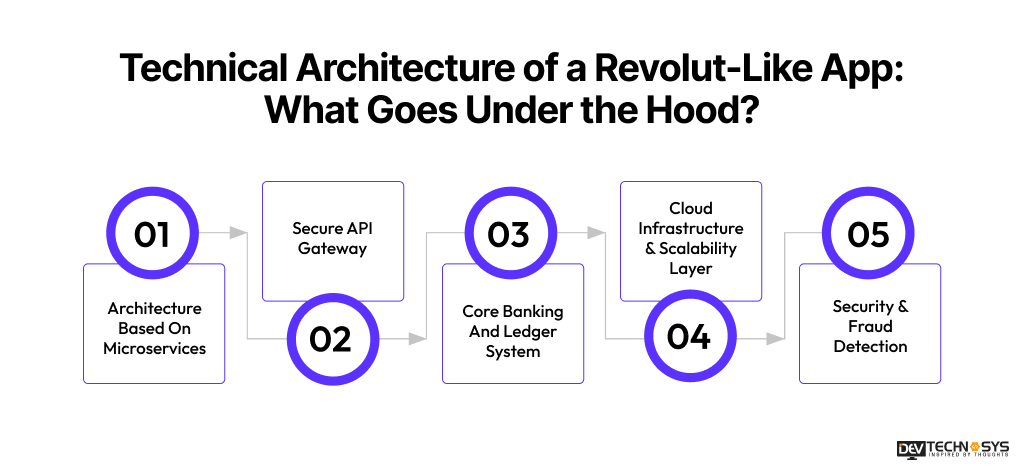
Technical Architecture of a Revolut-Like App: What Goes Under the Hood?
A Revolut-like app consists of microservices, secure API gateways, real-time ledgers, cloud platforms, and fraud detection services. The combination of all these components provides the necessary scalability, security, rapid transaction processing speed, regulatory compliance, and seamless global financial operations for all users.
1. Architecture Based On Microservices
A mobile application similar to Revolut would split its key functionalities, such as payments, accounts, and transactions, into smaller independent services referred to as microservices.
this microservice-based architecture not only allows for horizontal scalability, but the separation and isolation of each service from other services allow for easier maintenance, faster deployment, and fault isolation, but most importantly allow the application to be used by millions of users efficiently and reliably.
2. Secure API Gateway
an api gateway is responsible for managing all incoming requests from the mobile application to the back-end services. The api gateway will control things such as authentication, rate limiting, encryption, and routing, and serve as a secure entry point to the application. It protects sensitive data and provides performance and stability for all transactions.
3. Core Banking And Ledger System
The ledger system is in charge of maintaining and recording all financial transactions made in real-time to ensure that all transactions are accurate and consistent with each other.
This ledger system will implement a double-entry accounting system, balance accounts after every transaction instantly, and allow integration with banking partners. Finally, establish a foundation of trust and financial integrity for the entire mobile application.
4. Cloud Infrastructure & Scalability Layer
Cloud platforms are typically elastic, scalable, with high availability capabilities, and disaster recovery implemented in the event of a client losing connectivity.
Fintech mobile applications use distributed databases and load-balancers to handle their peak network traffic. While providing consistent system availability and performance for global users without the need to invest in infrastructure.
5. Security & Fraud Detection
The advanced security systems of the financial technology industry will use encryption, tokenization, and an artificial intelligence-based fraud detection system to continuously monitor transactions for any suspicious activity.
It provides monitoring services in real time by analyzing each transaction’s pattern. This advanced security system may appear to provide safeguards against unauthorized access and financial fraud, and to guarantee compliance.
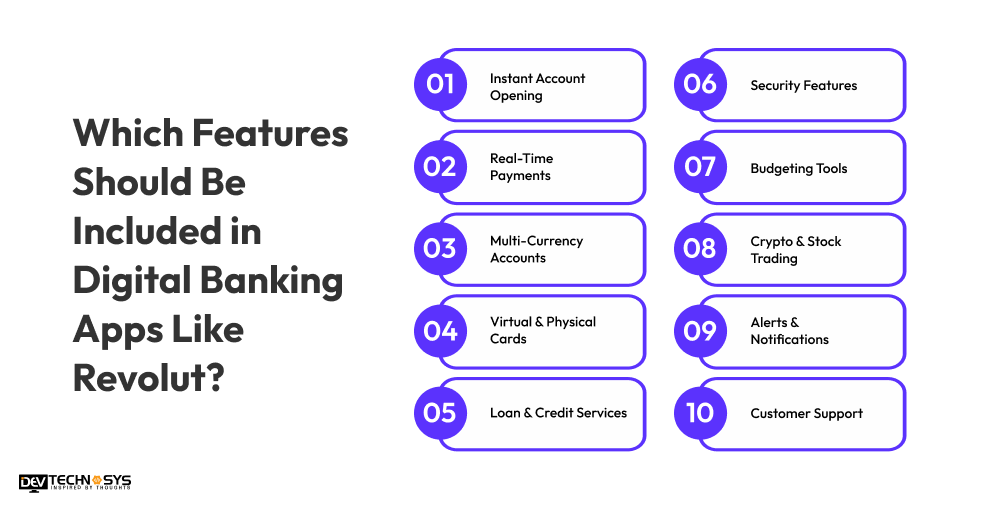
Which Features Should Be Included in Digital Banking Apps Like Revolut?
Features are one of the most important concerns when developing an application, because they can increase user engagement and help to gain a competitive advantage. There are different types of banking apps features available to integrate.
1. Instant Account Opening
The online banking platform enables users to open their instant account with minimal documentation and offers digital KYC without visiting a physical branch.
2. Real-Time Payments
Revolut alternatives can instantly transfer funds both internationally and domestically, also offering peer-to-peer payments and confirmation receipts.
3. Multi-Currency Accounts
Apps like Revolut have the ability to hold, exchange, and transfer multiple currencies at lower fees for international users or travelers.
4. Virtual & Physical Cards
Fintech banking apps offer virtual cards for online usage and allow users to apply for physical cards with security controls, customized limits, and contactless payments.
5. Loan & Credit Services
A virtual banking app offers instant loan services for users, they can access the personal loans, instant approval, transparent agreements, and tracking repayment.
6. Security Features
E-banking applications implement strong security methods such as two-factor authentication, end-to-end encryption techniques, biometrics, transaction monitoring, and fraud alerts.
7. Budgeting Tools
Mobile finance apps offer budgeting tools that allow users to manage their spending habits and track their spending in real-time. This can easily optimize users’ financial habits.
Industry Insights:
According to McKinsey & Company, in emerging markets, digital banking penetration has caught up with developed economies, with adoption rates rising sharply over recent years.
8. Crypto & Stock Trading
Peer-to-peer payment app integrates cryptocurrency and stock trading platforms with real-time market data, portfolio tracking, and educational resources for informed investing.
9. Alerts & Notifications
Smartphone banking solutions send alert messages to users for upcoming bills, low-balance alerts, suspicious activity, and more.
10. Customer Support
In-app 24/7 live chat support, AI-assisted FAQs, and a ticketing system to resolve user queries quickly can increase the overall performance of the app.
Planning a Ewallet Project?
Get a tailored development cost estimate in a few simple steps.
- 3 quick steps
- 100% free
- Reply in 1 business day
2 Minutes Read
What is the Cost to Build an App Like Revolut?
The cost to develop an app like Revolut is around $8,000 to $25,000 or higher. The total cost can fluctuate due to various factors such as features, functions, project size, complexity, backend infrastructure, deployment platforms, development team, and more.
The main impact is fintech application types; each type has different functionality and services, which is why the cost can be different or higher. It also includes additional factors such as maintenance, security, testing, designing, third-party integrations, and tech stacks.
App Level |
Features Included |
Estimated Cost (USD) |
| Basic MVP | Account signup, KYC, simple transfers, balance tracking | $8,000 – $15,000 |
| Mid-Level App | Wallet, analytics, multi-currency, APIs, security layers | $15,000 – $20,000 |
| Advanced (Revolut-like) | Full banking features, cards, crypto, investments, and AI fraud detection | $20,000 – $25,000+ |
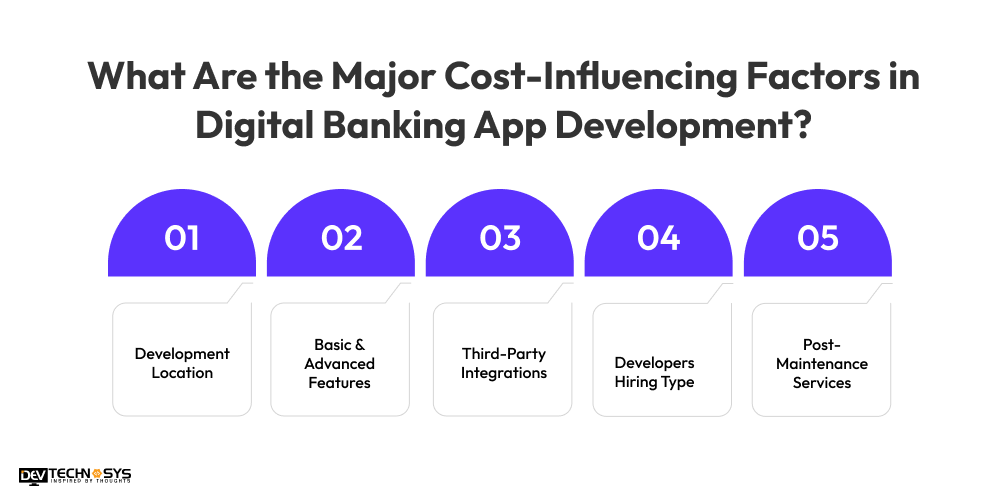
What Are the Major Cost-Influencing Factors in Digital Banking App Development?
Building a mobile wallet within a fixed budget is a difficult task because there are various types of factors that impact the total P2P lending app development cost. It involves features, design UI/UX, integrations, backend infrastructure, platform choice, and many more.
1. Development Location
The development team location is one of the most well-known factors that can easily affect the digital banking app development cost. Development teams from North America and Europe have a higher cost due to the high living costs and higher hourly charges.
Hiring a development team from the Asia-Pacific region can result in a cheaper cost and maintain the overall Revolut app development cost.
Location Tier |
Cost Impact |
| Low-cost regions (Asia, Eastern Europe) | $2,000 – $6,000 |
| Mid-cost regions (Latin America, parts of Europe) | $4,000 – $7,000 |
| High-cost regions (USA, UK, Western Europe) | $5,000 – $8,000 |
2. Basic & Advanced Features
The type and number of features greatly influence the Revolut app development cost. Basic features like account management and fund transfers are less expensive, while advanced features such as AI-driven insights, biometric authentication, and real-time analytics require complex coding, integrations, and testing. More sophisticated features demand longer development cycles, increasing overall budget and resource allocation.
Feature Level |
Cost Impact |
| Basic (login, account view, transfers) | $2,000 – $3,000 |
| Moderate (notifications, budgeting tools) | $3,000 – $4,000 |
| Advanced (AI insights, biometrics, analytics) | $4,000 – $5,000 |
3. Third-Party Integrations
The digital wallet platforms are mainly based on third-party integrations such as payment gateways, KYC verification, analytics tools, fraud detection, communication tools, and more.
These integrations help users to increase their accessibility. Some of the integrations have higher licensing fees, and developers consume more time to integrate. This can directly impact the total cost to build a mobile banking app like Chime.
Integration Level |
Cost Impact |
| Minimal (payment gateway only) | $500 – $800 |
| Standard (KYC, analytics, notifications) | $800 – $1,000 |
| Extensive (fraud detection, multiple APIs) | $1,000 – $1,200 |
4. Developers Hiring Type
There are various ways to hire developers, including freelancers, in-house teams, and outsourced agencies. Freelancer developers are cheaper, but they lack skills and reliability in premium projects.
An in-house team is a better option for a long-term project, but they charge higher salaries and infrastructure costs. Outsourced agencies offer a higher quality of development and faster delivery, but at a higher cost, which can raise the cost to build an app like Revolut.
Hiring Model |
Cost Impact |
| Freelancers | $2,000 – $4,000 |
| In-house Team | $5,000 – $7,000 |
| Development Agency | $7,000 – $9,000 |
5. Post-Maintenance Services
Post-maintenance services are important for a long-term running project to maintain its services and features. It includes various services, such as solving security patches, fixing bugs or glitches, regular updates, backups, adding design enhancements, upgrading OS versions, performance optimization, and more. Some of the maintenance services can take longer for developers, and this can increase the overall cost of fintech app development services.
Maintenance Level |
Cost Impact (Annual) |
| Basic (bug fixes, minor updates) | $500 – $1,000 |
| Moderate (performance monitoring, updates) | $1,000 – $1,200 |
| Advanced (security patches, feature upgrades) | $1,200 – $1,500 |
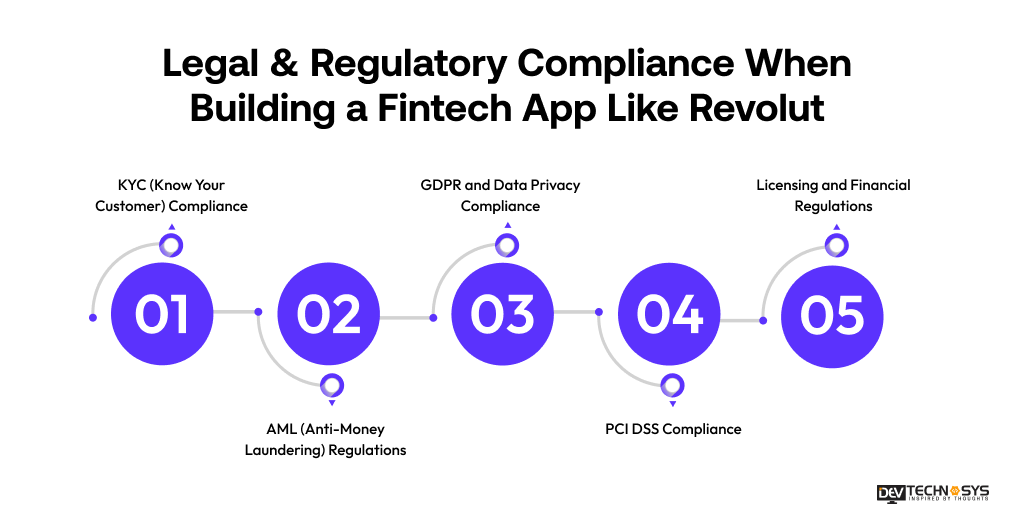
Legal & Regulatory Compliance When Building a Fintech App Like Revolut
In fintech software development, certain regulatory compliance obligations must be adhered to in order to deliver a secure application experience for users. The KYC, AML, GDPR, PCI DSS, and Financial Licensing regulations establish a framework for properly verifying user identity, preventing fraud, and ensuring data, payment, and legal compliance.
1. KYC (Know Your Customer) Compliance
Fintech applications such as Revolut must put in place KYC processes to confirm users’ identity through documentation, biometrics, and risk assessments in order to reduce the occurrence of fraud, money laundering, or identity theft. While also ensuring that they receive all required regulatory approvals from relevant financial authorities across regions.
2. AML (Anti-Money Laundering) Regulations
Ewallet app development solutions must comply with AML regulations to be able to identify and report suspicious transactions. Financial institutions are required to continuously assess all transactions and screen incoming and outgoing transactions for risk to prevent illegal activity and meet compliance requirements established by international banking and finance regulators.
3. GDPR and Data Privacy Compliance
One of the key components of GDPR compliance for fintech applications is the need to adequately protect customers’ data as well as ensure that users have full transparency regarding how their data is being managed, that they have given consent for their information to be used, and that they are able to access or delete their data from an application.
In order to meet these requirements, strong encryption and strict handling of all user data have to be enforced to minimize the risk of incurring a fine for noncompliance, as well as to maintain users’ trust in apps.
4. PCI DSS Compliance
All fintech applications accepting card payments must comply with PCI DSS requirements for securing the storage, processing, and transmission of any payment cardholder data. Methods of securing these types of information include the implementation of encryption technologies, maintaining secure networks, and limiting access to sensitive information. Through the use of access control, and performing regular audits on all systems and processes utilized to protect the card payment data.
5. Licensing and Financial Regulations
Applications such as Revolut must acquire licensing, such as banking licenses, e-money licenses, etc., from the appropriate authorities based on the region. They provide services in order to legally operate, protect consumers, and be subject to regulatory oversight in each jurisdiction in which they provide financial services.
Top 10 Apps Like Revolut
Do you think that Revolut is the only solution for digital banking services? No, there are many popular Revolut alternatives that have reached global users and made their own kingdom in the fintech industry. Check out each app one by one:
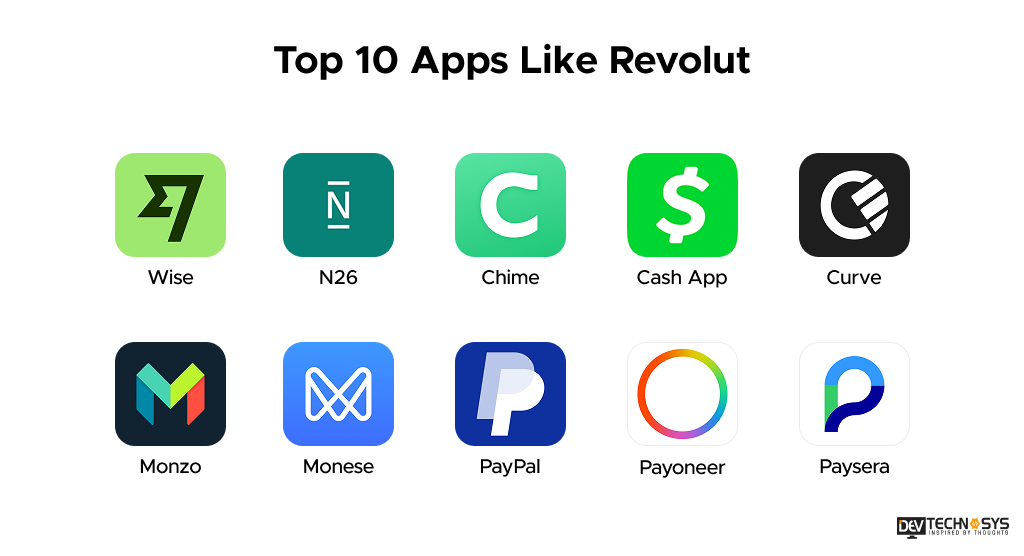
App Name |
Approx Downloads |
Rating (App Store / Play) |
Launch Year |
Platforms |
| Wise | 10M+ | 4.5 | 2011 | Android, iOS, Web |
| Monzo | 10M+ | 4.3 | 2015 | Android, iOS |
| N26 | 7M+ | 4.2 | 2013 | Android, iOS, Web |
| Monese | 5M+ | 4.0 | 2015 | Android, iOS |
| Chime | 15M+ | 4.4 | 2013 | Android, iOS |
| PayPal | 500M+ | 4.6 | 1998 | Android, iOS, Web |
| Cash App | 80M+ | 4.5 | 2013 | Android, iOS |
| Payoneer | 8M+ | 4.2 | 2005 | Android, iOS |
| Curve | 5M+ | 4.0 | 2016 | Android, iOS |
| Paysera | 3M+ | 4.1 | 2004 | Android, iOS, Web |
1. Wise
Wise is a digital banking platform where users can send or receive money through their mobile phones. Wise is mainly designed for transferring international funds at lower fees, and users can convert multiple currencies in real-time. It can holds the 40+ multiple currencies in one account and is basically used for cross-border payments.
2. Monzo
Monzo is a UK-based mobile banking application that enables customers to manage their spending habits and transfer funds instantly to other accounts.
It has a user-friendly interface that enhances users’ experience to use services quickly and easily. Monzo offers various features like bill splitting, budgeting tools, account management, and more.
3. N26
N26 is one of the best European digital banks that was launched in 2013 and is available on iOS and Android. This application offer various types of digital financial services such as real-time transactions, multi-currency accounts, fee-free spending abroad, and more. N26 mainly focuses on financial transparency and simplicity.
4. Monese
Monese is an online banking platform, and it is mainly for European residents. Users can send or receive money without having a local address or credit history.
This platform is popular for travelers for easy international banking and managing their budget. Users can directly set up their banking account through a smartphone.
5. Chime
Chime is a US-based internet banking service provider that enables users to check and manage their savings accounts. It offers fee-free banking services through a specific banking partner, and it includes automatic savings features. Chime is popular for its everyday usage as a digital banking platform because users do not need to maintain a minimum balance.
Comparison Between: Revolut vs Wise vs N26
Are you still confused about which digital banking app is best for you? This section provides a detailed comparison of the Revolut competitors apps and finds out which is perfect as per the specific demand.
Feature / Criteria |
Revolut |
Wise |
N26 |
| Core Focus | All-in-one financial super app (banking, trading, budgeting) | International money transfers & multi-currency accounts | Mobile-first digital banking |
| Account Fees | Free tier + paid plans | Free account, pay per transfer | Free basic account + premium tiers |
| Currency Support | 25+ currencies | 40+ currencies | Limited (mainly EUR) |
| Exchange Rates | Near interbank with some markup | Mid-market rates (transparent) | Real rate via Mastercard, small margin |
| Transfer Fees | Variable, depends on plan & usage | Low, transparent percentage fee | Low within SEPA; higher outside |
| ATM Withdrawals | Free up to a limit, then fees apply | Limited free withdrawals, then charges | Free within limits, then small fees |
| Investment Options | Yes (stocks, crypto, commodities) | No | No |
| Ease of Use | Feature-rich, slightly complex | Very simple and transparent | Clean and minimal interface |
| Availability | Global presence | Widely available globally | Primarily Europe |
| Best For | Users wanting multiple financial services in one app | Low-cost international transfers | Everyday banking in Europe |
How to Make Money From Digital Banking Apps Like Revolut?
Unlock earning potential with Revolut and similar apps by leveraging cashback, smart currency exchange, investments, referrals, and budgeting tools. These digital banking platforms transform everyday financial activities into opportunities to save and grow money, making them powerful tools for building wealth in a simple, accessible, and modern way.
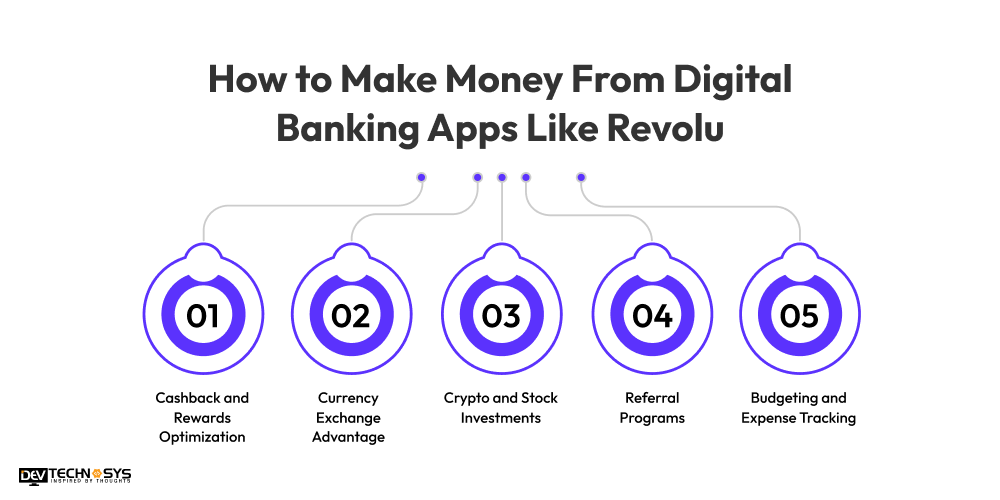
1. Cashback and Rewards Optimization
Use Revolut’s cashback opportunities strategically to make the most out of the cashback and partner discounts that you are using daily. The little returns that you get through the app eventually add up and will help you save money without having to change how you normally spend.
2. Currency Exchange Advantage
You can save on currency exchange fees by using Revolut as the middleman. They charge low fees when converting your currencies; therefore, when you get good rates, you can use these good rates to convert your currencies when you are travelling or sending money to another country.
3. Crypto and Stock Investments
The app like CITI Mobile, allows you to invest in cryptocurrencies as well as stocks directly from the app. If you do a little bit of research on the markets and are disciplined in your investing over many years, you can turn this app into a way to make money in addition to just completing banking transactions.
4. Referral Programs
Revolut regularly offers referral bonuses when you refer friends to use the app. This is one of the simplest ways to earn money with little effort, and can be highly effective for those with large social networks because they can refer more people.
5. Budgeting and Expense Tracking
You can use Revolut’s analytics tools to keep track of what you spend and where you spend it. Recognizing expenses that you do not have to pay is a way to save indirectly by creating a budget that is based on this. In other words, the more discipline you have in managing your finances, the more opportunity you will have in investing.
Conclusion
In the final section of this blog. We share our final thoughts about how to build an app like Revolut. We think that you have clarified all your doubts regarding the development process and why it is a lucrative opportunity for businesses. Also discussed were the functionalities that are necessary to integrate to increase user engagement.
Are you interested in making an app like Revolut? Who is stopping you from progressing? Reach out to an experienced fintech app development company in Houston, USA, to receive customized fintech solutions at a lower cost.
Frequently Asked Questions
Find answers to the most common questions related to this article.
The cost to develop an app like Revolut lies between $8,000 and $25,000, based on the project's demand and needs. Cost can go up or down because of crucial factors such as features, functions, project complexity, backend infrastructure, deployment platforms, development team, API integrations, and tech stacks.
To make an app like Revolut with simple features, it can take around 2 to 4 months. Developing a complex or AI-powered fintech app like Revolut takes around 6 months or more. The timeline can be longer due to project complexity, number of features, designing, integrations, and more.
A Revolut clone app features must include instant money transfers, multi-currency accounts, real-time spending notifications, budgeting tools, crypto and stock trading, card management, security features like biometric login, bill splitting, and 24/7 customer support to ensure seamless, secure, and convenient financial management.
To make money from Revolut alternative apps, it includes various types of monetization techniques:
Subscription plans
Freemium model
Transaction fees
Advertising
Partnerships & collaborations
It includes various technologies that are used to build an app like Revolut:
Java
Python
JavaScript
HTML
CSS
PHP