




















Key takeaways:
-
- Stablecoins issued by banks marry regulated banking with blockchain settlement, allowing digital dollar transfers, programmable payments, and processes involving institutional transactions.
- Cross-border transfers have been identified as one of the key institutional applications of stablecoins, showing how banks can use blockchain payments for faster settlements, treasury transfers, and management of liquidity.
- Compliance with regulation is one of the important factors of stablecoin creation, which requires the issuer to implement all necessary licensing, reserves, client identification, AML regulations, redemption mechanisms, and transaction monitoring.
- Stablecoins are closely related to tokenized deposits as blockchain-based currencies, but they vary in terms of issuer, liability, regulation, transferability, and the truth that stands behind them.
In 2026, the banking sector is starting to enter a new era of digital currencies, as stablecoins are moving from being used exclusively in cryptocurrency exchanges to being adopted by the banking system. For example, in September 2026, U.S. Bank conducted a successful trial of cross-border transactions with its own USBDC stablecoin, which enabled the transfer of funds between the U.S. and Europe via the Stellar blockchain.
Moreover, it was announced that 21 leading international banks will begin working on stablecoin production, reaching a significant milestone regarding the implementation of a stablecoin pegged to the U.S. dollar. While also planning future bank-issued stablecoin development connected to a stablecoin based on one of the G7 currencies.
While this is happening, U.S. regulators are also working on the corresponding implementation rules under the GENIUS Act, which include the requirements for identifying customers of payment stablecoin issuers.
Quick Answer: What Is a Bank-Issued Stablecoin?
A bank-issued stablecoin is a digital currency designed to maintain its value by being pegged to a fiat currency, such as the US dollar. Such a token is backed by reserves and can be redeemed based on the terms of the issuing institution.
Since banks are able to combine blockchain technology with compliance mechanisms. These stablecoins can be used for payments, settlements, and treasuries for businesses.
Market Insights: “Visa announced in April 2026 that its stablecoin settlement pilot had reached a $7 billion annualized settlement run rate, representing 50% quarter-over-quarter growth.”
How Does a Bank-Issued Stablecoin Work?
Stablecoins issued by banks integrate banking systems with blockchain technology. Banks receive deposits in fiat currencies, allocate the required reserves, create the tokens, carry out the transfer of tokens through the blockchain, and finally redeem the tokens in fiat currencies. This entire process gives banks a way to transfer digital assets while ensuring accountability and regulations are followed.
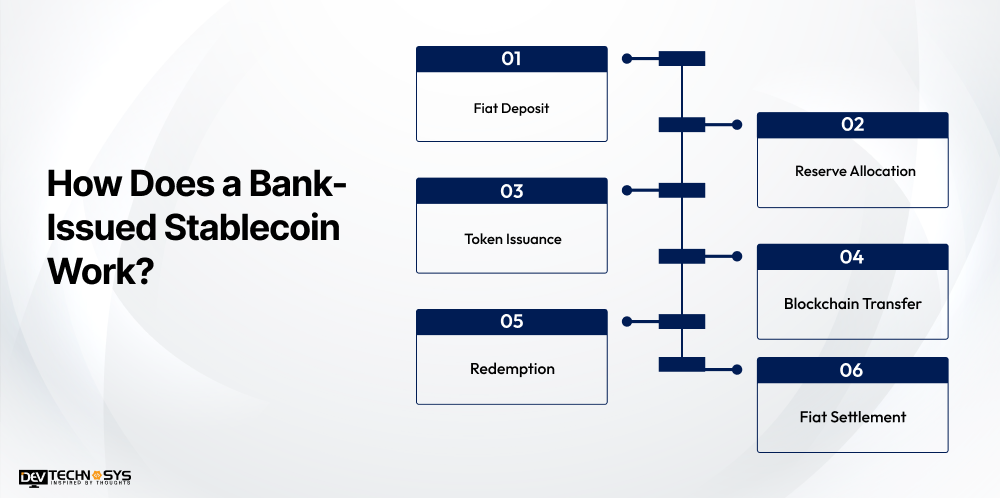
1. Fiat Deposit
An individual makes a deposit of fiat currency in a bank licensed to issue stablecoins. Thereby making the necessary deposits that are used by the bank for the issuance of stablecoins and the maintenance of the value of stablecoins.
2. Reserve Allocation
The bank reserves the deposits made by customers, which are used by the bank to acquire the right backing reserves for the issuance of stablecoin tokens and to meet the redemption requirements of the tokens.
3. Token Issuance
After verifications are completed, the bank issues the stablecoins equivalent to the deposited fiat money of the customers.
4. Blockchain Transfer
The stablecoin holders are now able to transfer the stablecoins over the blockchain network.
5. Redemption
The holder of stablecoins returns the stablecoins to the issuer of tokens, which checks ownership of the tokens and destroys the stablecoins.
6. Fiat Settlement
After redemption, the bank credits the corresponding account of the client with fiat funds.
Planning a Stablecoin Project?
Get a tailored development cost estimate in a few simple steps.
- 3 quick steps
- 100% free
- Reply in 1 business day
2 Minutes Read
Why Are Banks Building Their Own Stablecoins in 2026?
In 2026, the banking sector is starting to take an interest in stablecoins for various functions, including improving payment infrastructure, increasing the speed of cross-border transactions, providing 24/7 payment services, lowering operational friction, making payments programmable, and enhancing the institutional experience with digital assets.
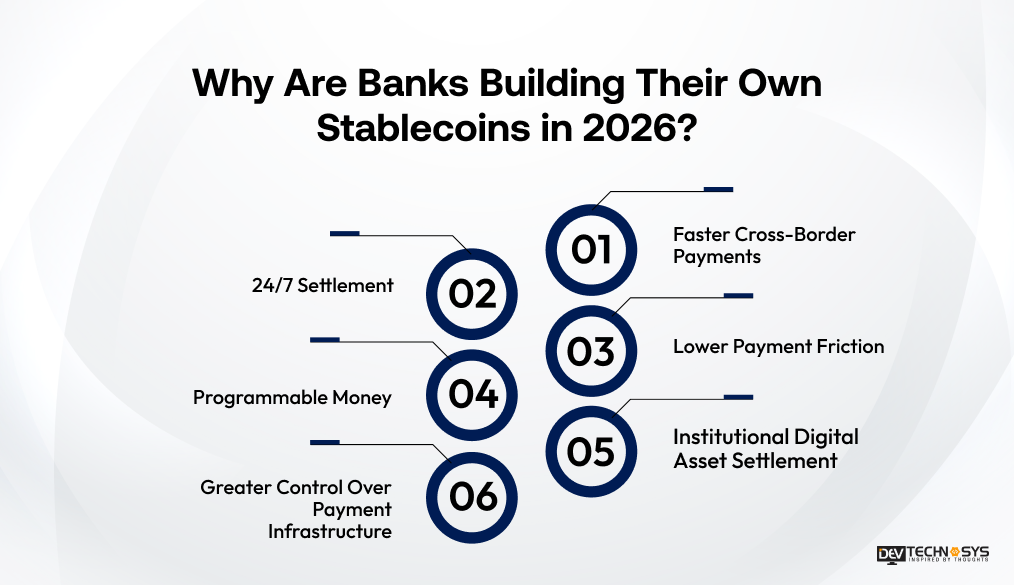
1. Faster Cross-Border Payments
Bank-backed stablecoins can transfer resources between blockchain networks without fully relying on customary correspondent-banking systems. By having fewer intermediary transfers, banks can further the quickness of international transfers, enhance visibility, and improve settlement processes with some institutions.
However, precise speed, readiness, and effectiveness depend on the network infrastructure, regulations, liquidity arrangements, and counterparties involved in this transaction.
2. 24/7 Settlement
Standard payment systems may operate only during banking hours, clearing schedules, national holidays, and settlement windows, thus limiting their operational timeframes.
The compliance management software development solutions can operate 24/7 so that payment transactions can take place on weekends and holidays. However, this is only possible due to the network of jurisdictions and relevant bank regulations.
3. Lower Payment Friction
Stablecoins could lower payment friction since they reduce the reliance on intermediaries, facilitate reconciliation, and offer a communal record of transactions on the blockchain.
Less number of intermediaries might mean faster processing times, but economies of scale are however not guaranteed, as banks will still need to factor in compliance, custody, transaction network fees, liquidity management, infrastructure, and integration issues.
4. Programmable Money
Issuing stablecoins brings with it the possibility of programmable payments, which are made available through smart contracts and designed payment protocols on the blockchain.
Financial institutions can potentially automate payments through smart contracts, automate conditional payments, start settlements automatically, establish escrow accounts, as well as automate treasury management.
5. Institutional Digital Asset Settlement
Build an RWA tokenization platform can be used by banks as a mechanism of transaction settlement among institutions engaged in digital assets, including exchanges, custodians, financial institutions, and those dealing in tokenized assets.
The issuance of a stablecoin by a bank can establish an essentially unified digital settlement layer for transactions eligible for it, although the effectiveness of such a solution depends on the state of regulation, interoperability, and the willingness of partners to adopt it.
6. Greater Control Over Payment Infrastructure
By issuing their stablecoins, banks can exercise more control over payment infrastructure and the design of transactions. They can determine the transaction policies, build in compliance controls, manage the settlement infrastructure, attract liquidity, influence the customer experience, as well as ensure integration with certain blockchains. It is also a way to minimize reliance on the external payment infrastructure in certain cases.
Bank-Issued Stablecoin Development: Step-By-Step Process
Launching a bank-based stablecoin is more than just the process of executing the necessary smart contracts. There are many other aspects, such as creating a strategy compliant with regulations and developing a reserve, blockchain, integration with banks, security assurance, and compliance controls, to name a few.
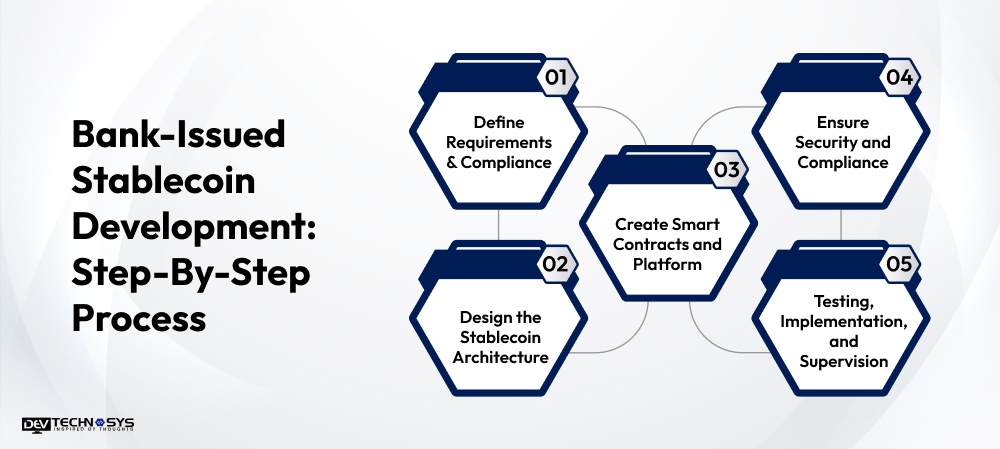
1. Define Requirements & Compliance
In this first step to build a bank-issued stablecoin, define the objective of the stablecoin, its users, approved currency to be utilized, reserves model to be employed, conduct of transactions, and redemption methods.
Hire a blockchain development company to make sure to analyze the different banking, payment, security, AML, KYC, and stablecoin regulations to apply. Establish a control framework, risk management system, anti-money laundering and other compliance activities, and IT framework before choosing a blockchain environment.
2. Design the Stablecoin Architecture
Manage the design of the sections shaping the blockchain infrastructure, smart contract capability, digital wallets, safekeeping, reserves management, APIs, databases, identity tools, and governance system. Define the process of token issuance and redemption, access rights model, surveillance needed for transactions, and any interoperability requirements.
3. Create Smart Contracts and Platform
Smart contract development for the token minting, burning, transferring, freezing, and redemption of stablecoins in line with the prescribed rules of business. Create backend services, banking APIs, wallet infrastructure, dashboards, and compliance systems. Use secure coding, access control, encryption, and key management on the way.
4. Ensure Security and Compliance
According to the KYC and AML workflows, implement the process of monitoring transactions, screening sanctions, tracking reserves, reporting, authenticating, and controlling user access. Perform a number of activities such as reviews of smart contracts, penetration testing, assessment of infrastructure, and independent security auditing.
5. Testing, Implementation, and Supervision
Move to the last stage to build a yield-bearing stablecoin. Conduct functional, integration, load, security, and blockchain tests in all areas of the stablecoin ecosystem. Confirm the processes of minting, redeeming, transferring, holding, and following compliance procedures, and connecting to the bank.
After testing is finished successfully, roll out everything according to the controlled release procedure, and keep an eye on all transactions, infrastructure, reserves, security incidents, and compliance alerts.
How Do Bank-Issued Stablecoins Work Technically?
Stablecoins issued by banks integrate the value of tokens, enterprise blockchain systems, compliance measures, custodianship under regulatory compliance, and banking services.
There are various technical types of layers working out the transfer, conversions, validation, accounting measures, and verification before the bank digital dollars are received and sent by users.
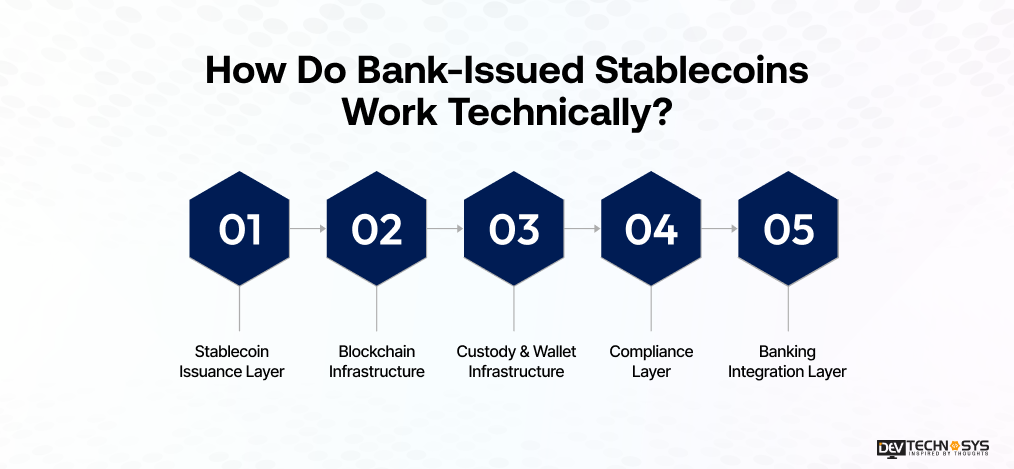
1. Stablecoin Issuance Layer
The issuance layer is responsible for controlling the minting and token burning processes of the stablecoin, thereby managing its lifecycle. Banks set limits on the amount of coins to issue and approve token issuance against supported reserves.
With the aid of reconciliation of the active money quantity, banks track the amount of money in circulation and monitor the reserve situation to ensure transparency and readiness for token redemptions.
2. Blockchain Infrastructure
Banks can issue stablecoins on blockchain networks: public, private, or Layer 2, depending on scalability, confidentiality, and regulatory requirements. There are protocols that allow connecting various networks, which makes the issuing process more flexible.
3. Custody & Wallet Infrastructure
Institutional wallets protect the funds, using MPC custody, multisignature authorization, and hot/cold wallet separation. Banks can use a number of methods to ensure the security of stablecoin funds by making role-based decisions regarding key management, transaction policy, and approval processes.
4. Compliance Layer
The compliance layer integrates KYC and KYB verification, AML monitoring, sanctions checks, transaction monitoring, and wallet checks with stablecoin operations. Through these measures, banks can detect suspicious transactions, block prohibited activities, keep tracking records, and follow the rules that govern digital processes.
5. Banking Integration Layer
Stablecoins that are issued by banks start with a connection to core banking systems, payment processing systems, treasury solutions, APIs, ERP solutions, and data reconciliation solutions.
Such a connection allows banks to manage stablecoins in line with their banking operations in terms of balances, settlements, liquidity, transactions, and accounting.
Industry Insights: “McKinsey and Artemis estimated that actual stablecoin payments were approximately $390 billion annually, based on December 2025 activity. McKinsey says this was more than double 2024 levels, while representing approximately 0.02% of global payments volume.”
What Are Banks Using Stablecoins For: Use Cases
Banks are looking at the possibility of using stablecoins for payments, treasury management, settlement, and digital assets infrastructure. With uses ranging from cross-border transfers and corporate liquidity to payments from retail merchants. The bank-issued stablecoin development provides a framework for the legal transfer of money between institutions, enterprises, and consumers.
1. Cross-border Payments
Stablecoins can be implemented by banks for the purpose of making cross-border payments possible using blockchain networks, which in turn can help reduce both time of settlement and dependency on intermediaries.
With this model in place, banks can achieve faster payments and higher transaction speed, besides improving visibility, programmability, and settlement systems.
2. Corporate Treasury
With the help of cross-chain DeFi platforms, it becomes possible to draw funds for liquidity and other transfers to accounts, which work well for corporate treasury operations. Additionally, banks can integrate stablecoin capabilities into treasury operations, which can facilitate their payments.
3. Institutional Settlement
In terms of settlement of transactions with the help of stablecoins, institutions become equipped with sufficient technologies to cope with all facets of institutional settlements, such as being able to process transactions at any time.
4. Remittances
With the help of stablecoins, banks could offer remittance services by facilitating digital payments internationally before converting them into local currency. The use of this structure could result in easier settlements, more efficient transaction tracking, and lower complexity of operations in international remittances.
5. Merchant Payments
Using stablecoins, merchants can accept payments in bank-issued digital dollars through payment systems based on blockchain technology. Banks could offer conversion, settlement, compliance, and reconciliation services along with these transactions, allowing merchants to get programmable digital payments without changing the already existing payment and accounting systems.
6. Tokenized Asset Settlement
Stablecoins could serve as the means of settlement of tokenized assets, including securities, funds, deposits, and other financial instruments. Different smart contracts could be used for organizing settlement-by-delivery processes and automating the settlement conditions.
Free App Idea Reality Check: Let's Stress-Test Your Concept
Share your app idea with us. Within 3 business days, we'll uncover UX gaps, feature opportunities, and potential development challenges, so you can build with confidence. No strings attached.
Real-World Bank-Issued Stablecoin Development in 2026
In the year 2026, banks are progressing from the experimental phase of cryptocurrencies through different live projects, joint initiatives involving multiple banks, and the development of appropriate regulatory mechanisms.
The bank-issued stablecoin developments show that financial institutions are trying out various uses of blockchain technology, such as blockchain-based payments, settlements for large firms, and digital currencies backed by reserves.
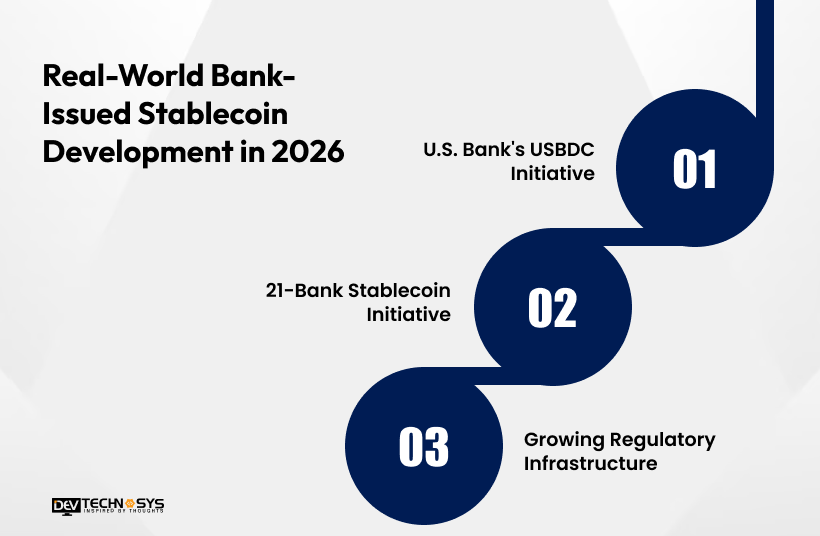
1. U.S. Bank’s USBDC Initiative
In September 2026, U.S. Bank announced the launch of the live USBDC pilot project regarding cross-border payments between North American and European organizations.
The transaction has been carried out on the basis of the Stellar blockchain while testing the minting, redemption, freezing, and clawback capabilities, and linking blockchain activities with finance, risk, compliance, and operations activities.
2. 21-Bank Stablecoin Initiative
The consortium consisting of 10 banks was started in October 2025 and has grown to 21 entities that create a USD-denominated reserve-backed stablecoin.
The participants of the initiative include Bank of America, Citi, Goldman Sachs, Deutsche Bank, UBS, MUFG, and Standard Bank. The project is expected to be established in 2026 and be launched in the first half of 2027.
3. Growing Regulatory Infrastructure
The regulations regarding stablecoins have started to gain momentum in 2026. According to the provisions of the GENIUS Act, the OCC has come up with the requirements related to AML/CFT and sanctions compliance, while the reporting requirements include currency, transaction amounts, and quarterly obligations of the issuer.
Global Stablecoin Regulations and Compliance Requirements in 2026
In 2026, stablecoin regulations are being implemented across different jurisdictions and vary by jurisdiction according to the requirements for licensing, reserves, redemption, AML/KYC features, and consumer protection.
Banks and issuers that operate internationally must make sure the stablecoin infrastructures comply with local compliance requirements, as well as cross-border compliance and operational mandates.
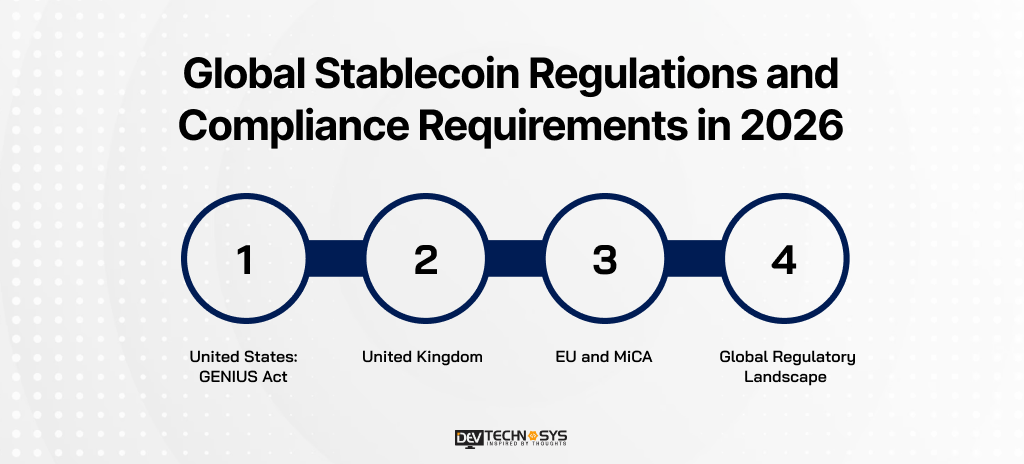
1. United States: GENIUS Act
Updated: June 2026. The GENIUS Act bank stablecoin creates a federal framework for payment stablecoin issuers. The act covers all eligible issuers, as well as reserve management, redemption, custody, audits, reporting, and oversight.
The 2026 implementation proposals also cover BSA obligations, AML/CFT controls, sanctions compliance, and customer-identification procedures of the covered issuers.
Note: Covers payment stablecoins, the GENIUS Act, reserve backing, 24/7 blockchain payments, and differences between payment stablecoins and tokenized deposits
2. United Kingdom
Updated: June 2026. The United Kingdom is working on a two-part stablecoin framework. The FCA regulates those stablecoins issued in the UK that qualify, while those designated as systemic stablecoins can be regulated jointly by the FCA and the Bank of England after recognition by HM Treasury. The proposals by the Bank of England in June 2026 cover prudential safeguards, backing assets, redemption, disclosures, and financial stability.
Note: The FCA says its 2026 stablecoin sprint examined retail payments, remittances and trade finance use cases.
3. EU and MiCA
Updated: September 2026. MiCA considers stablecoins as either electronic money tokens or asset-referenced tokens. Issuers must have the necessary authorization and must comply with the following requirements: ensuring the appropriate amount of reserves, governance of the token, disclosures, redemption, and providing protection to consumers. Reserves of ARTs should ensure coverage of both liquidity and asset risks and be held separately from other assets.
4. Global Regulatory Landscape
Updated: September 2026. Cross-border operations of stablecoins necessitate compliance with a wide variety of regulations such as AML/CFT compliance, customer identification, sanction screening, application of the Travel Rule, reserve disclosures, consumer protection laws, data protection, and transaction monitoring.
Hence, banks have to create regulatory and compliance subsystems for each jurisdiction in which they operate instead of relying on a universal regulatory approach.

Risks and Challenges of Bank-Issued Stablecoins
When build a stablecoin, it comes with challenges related to operations, technology, finance, and regulation, along with their advantages. The issuers must contend with changing rules and regulations, reserve liquidity, smart contract security, blockchain interoperability, data breaches, and transaction control in order to achieve secure and efficient settlement and preserve a reputation in the world of online finance.
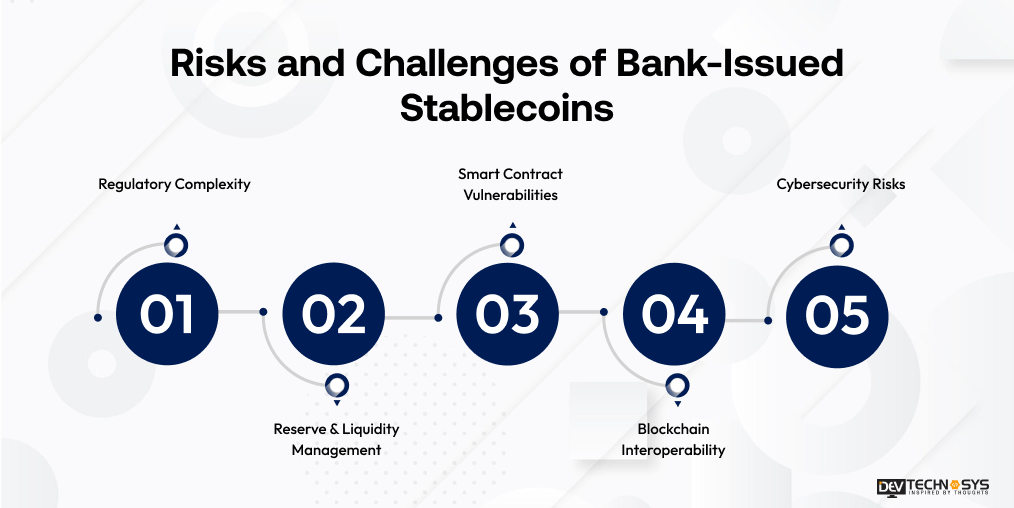
1. Regulatory Complexity
Bank stablecoins may have to operate in jurisdictions with different licensing, reserve, reporting, AML, and customer protection rules. Such changes in regulations create a need to constantly keep up with compliance monitoring, leading to more legal complexity, higher costs of implementation, etc.
2. Reserve & Liquidity Management
Having an adequate amount of quality reserves is necessary for the stablecoin to function properly. Incorrect liquidity planning, mismatched reserve assets, or spikes in redemptions can create financial pressure that might interfere with settlement activities.
3. Smart Contract Vulnerabilities
Smart contracts are responsible for many key functions, including minting, burning, transferring, and giving access to funds. Mistakes in the code, bad authorization logic, or weaknesses in the system can result in risky transactions.
4. Blockchain Interoperability
Stablecoins that function on various blockchain systems have to deal with issues relating to compatibility, messaging, settlement, and liquidity. Lack of effective interoperability can lead to transaction delays, fragmented liquidity, inconsistent transaction statuses, or extra security requirements that make it difficult for the companies to carry out cross-network payments and institutional settlement processes.
5. Cybersecurity Risks
Bank-issued digital currency adds more digital points of attack to the wallets, API, smart contract, custody systems, and blockchain infrastructure. Phishing, private key compromise, API attacks, or breaches of infrastructure may result in unauthorized transfers, disruption of operations, unauthorized access to data, and great financial losses.
Bank-Issued Stablecoins vs CBDCs vs Tokenized Deposits
Stablecoins issued by banks, CBDCs, and tokenized deposits are different methods for digital money. Analyzing their issuance mechanisms, reserve structures, legal frameworks, settlement methods, programmability, and access methods gives companies a better idea of which solution suits their purposes.
Parameter |
Bank-Issued Stablecoins |
CBDCs |
Tokenized Deposits |
| Issuer | Commercial banks / regulated institutions | Central banks | Commercial banks |
| Underlying Value | Reserve-backed digital asset | Central-bank money | Commercial-bank deposit |
| Blockchain Infrastructure | Public, private, or permissioned | Central-bank infrastructure | Usually permissioned networks |
| Primary Use Cases | Payments, treasury, cross-border settlement | Digital payments and monetary infrastructure | Institutional payments and settlement |
| Redemption / Conversion | Redeemable under issuer and regulatory rules | Convertible according to CBDC design | Convertible into conventional deposits |
| Programmability | Smart-contract enabled | Depends on system architecture | Programmable through banking infrastructure |
| Key Regulatory Focus | Reserves, AML/KYC, redemption, supervision | Monetary policy, privacy, financial stability | Banking, deposit, AML/KYC, and consumer rules |
What Technology Stack Do Banks Need to Build Stablecoins?
A stablecoin that the bank issues will only be successful if it is built on secure and reliable blockchain infrastructure. Moreover, it is very important to have smart contracts, custody systems, application programming interface (API) gateways, compliance tools, encryption, cloud services, real-time activity in real time, etc., in the technology stack to ensure the institutions can provide scalability and integrity of transactions.
Technology Layer |
Technologies |
Description |
| Blockchain | Ethereum, Besu, Polygon | Secure transaction infrastructure. |
| Smart Contracts | Solidity, OpenZeppelin, Hardhat | Automates token operations. |
| Backend | Node.js, Java, Go, Python | Handles core application logic. |
| Database | PostgreSQL, MongoDB, Redis | Stores operational data securely. |
| APIs & Integration | REST, GraphQL, Webhooks | Connects banking systems and platforms. |
| Wallet & Custody | MPC, HSM, Multi-Signature | Protects digital assets and keys. |
| Security | AES-256, TLS, OAuth 2.0, MFA | Secures data and access. |
| Cloud | AWS, Azure, Google Cloud | Provides scalable infrastructure. |
| Compliance | Chainalysis, TRM Labs, Sumsub | Supports KYC, AML, and monitoring. |
| DevOps & Monitoring | Docker, Kubernetes, Grafana | Enables deployment and performance monitoring. |
Fact: According to the BIS, More than 70% of fiat-to-stablecoin conversions originated from non-USD currencies, according to BIS analysis.
How Much Does It Cost to Develop a Bank-Issued Stablecoin?
The cost to build a bank-issued stablecoin is between $30,000 and $120,000 or even more, depending on the chosen blockchain technology, how smart contracts are created, how many banking integrations are needed, how safe the storage of the coin is, whether compliance measures are taken, and which safety regulations are set.
Companies that ask for sophisticated banking IT solutions, which have a high level of compliance and security, and involve managing reserves, might have to invest more.
Complexity Level |
Estimated Cost |
Typical Scope |
| Basic | $30,000–$50,000 | Token issuance, smart contracts, wallet, basic dashboard |
| Medium | $50,000–$80,000 | Banking APIs, KYC/AML, custody, admin panel, monitoring |
| Advanced | $80,000–$120,000+ | Multi-chain support, automated compliance, reserve management, advanced security |
Note: As per our blockchain expert, the total bank-issued stablecoin development cost is based on the features, security measures, integrations, blockchain selection, compliance requirements, and bank-issued stablecoin development scope.
What Does the Future Hold for Bank-Issued Stablecoins?
Stablecoins from banks are developing together with blockchain fundamentals like tokenized deposits, institutional blockchain networks, and programmable financial systems.
The future of blockchain in banking industry will depend more on other factors, including regulations, interoperability standards, reserve models, security standards, and seamless integration.
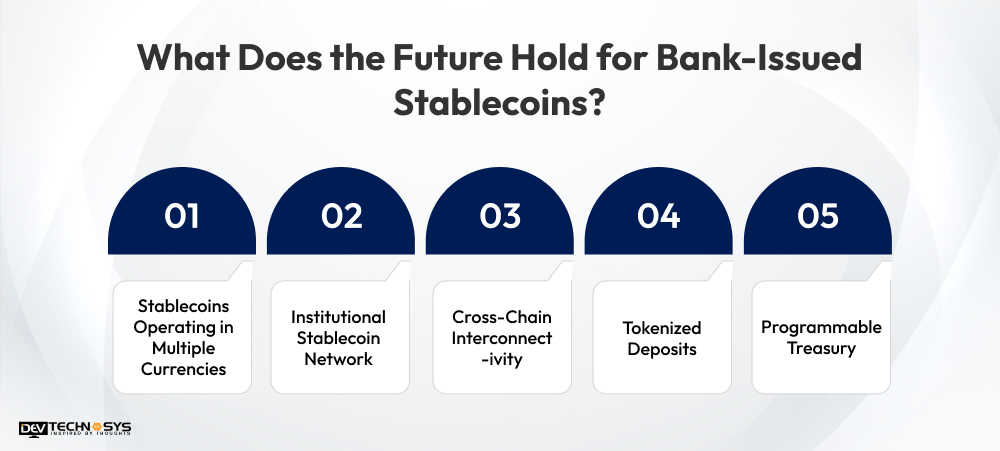
1. Stablecoins Operating in Multiple Currencies
Banks could also create stablecoins representing different fiat currencies, allowing institutions to operate various currencies efficiently via a common infrastructure.
Such systems can support treasury operations, international settlements, and liquidity management using highly efficient currency controls, reserve systems, and compliance and interoperability of currency-specific token networks.
2. Institutional Stablecoin Network
Banks and financial institutions can create permissioned stablecoin networks designed for institutional transactions on these networks. These networks can allow institutions to receive and send liquidity and conduct their transactions.
3. Cross-Chain Interconnectivity
The stablecoin infrastructure has the potential to interconnect several blockchain systems by creating interoperable protocols and messaging systems. With the help of cross-chain capabilities, organizations can transact or settle tokens on compatible networks while upholding the security, compliance, and verification processes.
4. Tokenized Deposits
Tokenized deposits might be created at the same time as the issuance of stablecoins by banks. Tokenized deposits represent the money provided by the bank on the programmable digital infrastructure.
Adoption of tokenization might allow for faster transactions and the automation of treasury activities while ensuring that banking relationships are maintained.
5. Programmable Treasury
Programmable treasury technology empowers financial institutions and corporations to execute their financial functions more effectively by utilizing smart contracts and policies.
There are many possible implementations, including managing liquidity, conditional payments, reconciliation, collateral management, and settlements. The success of implementation will depend on regulations, integration capabilities, and governance rules.
Conclusion
The growing importance of bank-backed stablecoins in digital finance has sparked interest among banks in exploring the merits of speedy settlement, programmable payments, and tokenization. In practice, the bank-issued stablecoin development comes with a number of issues that have to be taken into account, including compliance and regulation, reserves, safety, interoperability, and the incorporation of banking structures.
Organizations interested in pursuing this innovative avenue of development can rely on the support of a reputable stablecoin development company, which will offer them effective and secure solutions tailored to their business needs.
Frequently Asked Questions
Find answers to the most common questions related to this article.
Banks have begun venturing into the world of stablecoins in order to facilitate quicker transactions, operate on a 24/7 basis, carry out overseas transactions, send programmable money, as well as benefit from other types of blockchain-enabled services. Each bank decides how it will operate in a particular country depending on a variety of factors, such as regulatory environment, reserves, and technology.
The backing of a stablecoin largely depends upon the issuer, issuing process, and product. A stablecoin issued by a bank can be backed by cash, deposits, short-term government securities, or any other asset that qualifies under the relevant law. Necessary details concerning the backing of the given stablecoin, the right of redemption, reserves, and disclosure will depend on the laws that are applicable in a particular jurisdiction.
The bank stablecoin is usually produced and controlled by a regulated banking body, while USDC is produced by Circle. The differences between the two may include issuer model, reserve arrangements, regulations applied, distribution model, blockchain type, redemption type, possible use in financial markets, and other uses, if any.
Yes, businesses can use bank stablecoins for eligible payments if the issuer supports their use along with applicable regulations, counterparties, and platforms. Some of the common applications of bank stablecoins include supplier payments, treasury transfers, cross-border payments, and business-to-business transactions.
The regulation of bank-issued stablecoins depends on various factors, including regulatory jurisdiction, issuer, nature of the stablecoin, and more. The regulations surrounding these stablecoins may involve issues around licensing, reserve deposits, redeemability, consumer protection, AML compliance, reporting, cybersecurity, and governance requirements.