















Key takeaways:
-
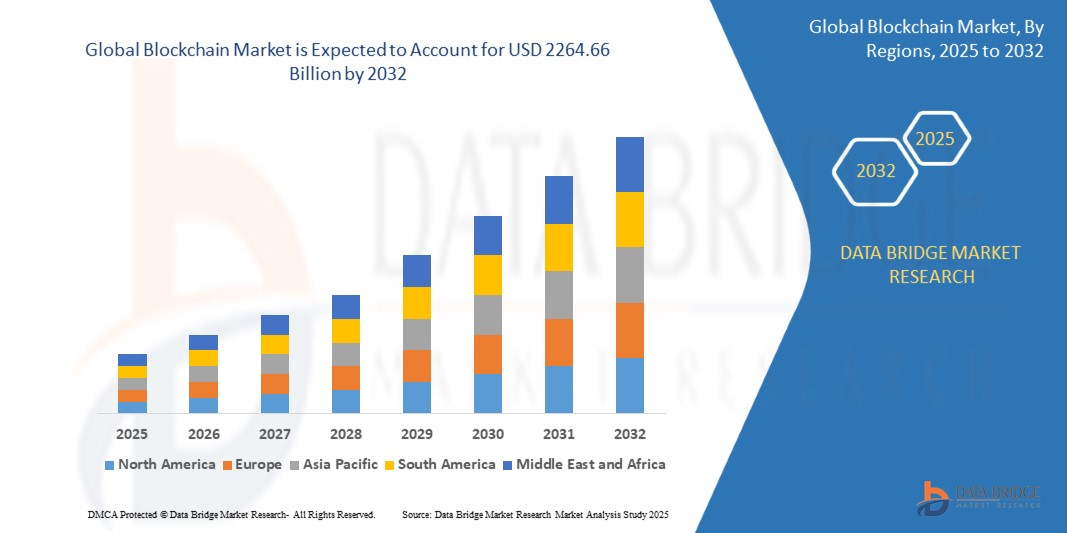
- The global blockchain market is expected to reach USD 2264.66 billion by 2032.
- The cost to develop a token on base blockchain is around $8,000 to $30,000+. The total pricing range is determined by the market strategy and technological design.
- Monetization plays a crucial role, as Base tokens can generate revenue through transaction fees, staking models, premium utilities, and DeFi integrations.
- Feature-rich token ecosystems drive success, including capabilities like staking, governance, vesting, cross-chain compatibility, and DeFi integrations, which enhance utility and user engagement.
“Accelerate your business growth by developing a custom base token.”
Base blockchain is among the most compelling options for developing and launching your own tokens in 2026. It comes with low fees and little traffic because it is an ERC20 Layer 2 blockchain created by Coinbase.
The Block reports that in early 2026, Base handled more than 8 million deals every day. By traffic, this makes it one of the busiest EVM Layer 2 networks. Base blockchain is great for developers and companies because it has low gas fees, can be scaled up easily, and works perfectly with Ethereum.
Whether you want to launch a utility token, governance coin, or NFT project, Base blockchain helps simplify the entire development process. In this guide, you’ll learn how to develop a token on base blockchain in simple steps.
What is Base Blockchain?
Ethereum Layer 2 (L2) blockchain Base is safe and cheap. Coinbase built it in 2023, and the network is not controlled by any one entity and is free to all. It was created using the open-source OP Stack in collaboration with Optimism. It makes it easy for developers to make decentralized apps (dApps) that operate quickly. Base blockchain offers widespread use, Ethereum-level security, and much cheaper and faster transactions.
The Key aspects of base blockchain include:
- Layer 2 Security
- Built by Coinbase
- No Native Token
- EVM Compatibility
- Superchain Vision
- Mass Adoption Focus
Global Blockchain Market Stats
- The global blockchain market is expected to reach USD 2264.66 billion by 2032.
- During the forecast period of 2025 to 2032, the market is likely to grow at a CAGR of 71.96%, primarily driven by growth in cryptocurrency and digital assets.
- The U.S. holds a significant share due to the active integration of blockchain for data protection, cybersecurity, and financial transactions by businesses.
- This growth is driven by factors such as institutional adoption, mainstream acceptance, use cases, and technological advancements.
Why Choose Base Blockchain for Token Development?
The success or failure of your project depends on the selection of the right blockchain. Base stands out as a powerful Layer 2 solution that ensures faster, cheaper, and more scalable token deployment without compromising on security. Here are the 5 reasons to pick a base blockchain for token development:
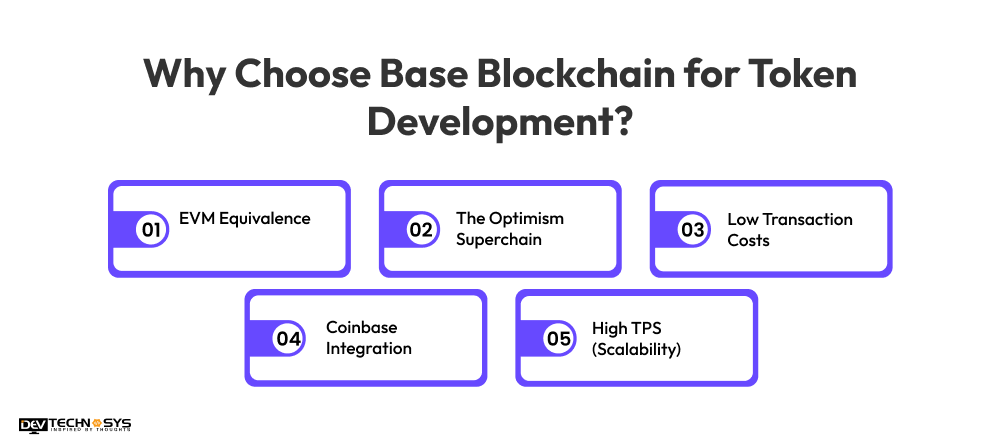
1. Evm Equivalence
Base is fully EVM-equivalent, which means your smart contract development company can make Ethereum-powered smart contracts without making any changes. Tools like Hardhat, Solidity, and MetaMask that you already know can be used. The addition of these tools reduces development time and complexity.
2. The Optimism Superchain
Base is part of the Optimism Superchain, a network of connected Layer 2 chains built on the OP Stack. You can develop a token on base blockchain for shared infrastructure & interoperability and future scalability across multiple chains within the ecosystem.
3. Low Transaction Costs
One of the main benefits of developing a token on a base blockchain is the lower gas fees. They are much cheaper than the Ethereum mainnet. This enables cheaper base network native token creation, transfers, and smart contract interaction, perfect for startups and high-volume platforms.
4. Coinbase Integration
Base is designed by Coinbase to offer seamless integration with one of the largest crypto ecosystems. Using a base blockchain to build tokens ensures better accessibility, user onboarding, and potential exposure for your token project.
5. High TPS (Scalability)
Base blockchain token development provides high transaction speed (TPS) for faster processing and better scalability. It is important for use cases like DeFi, gaming, and NFT token development that require real-time interactions and a seamless user experience.
Industry Insights: According to CoinGecko, Tokenized real-world assets (RWAs) have surged to around $19.3 billion in early 2026, showing strong institutional participation and adoption momentum.
5 Different Types of Tokens You Can Build on Base
Base supports a wide range of token standards, enabling developers to create everything from simple utility tokens to advanced hybrid assets. Here’s a breakdown of different types of tokens you can build on a base blockchain:
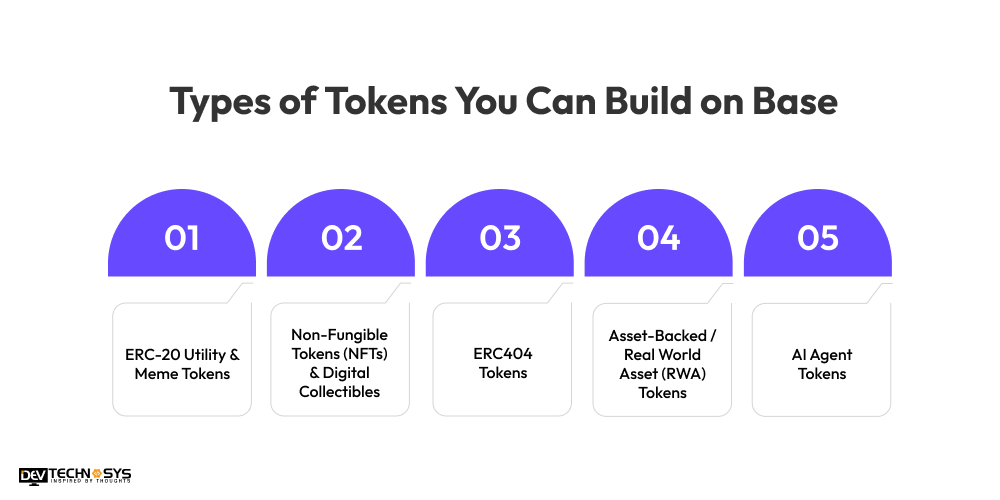
1. ERC-20 Utility & Meme Tokens
Create ERC20 Token for dApps, governance, and community projects, while meme tokens are designed to ensure engagement and virality. To create an ERC-20 token on Base Layer 2, developers deploy a Solidity smart contract Base blockchain, defining token supply, name, and symbol using tools like Remix or Hardhat.
To know more about this type of token development, you can refer to the base blockchain ERC-20 token development tutorial or contact token development experts.
2. Non-Fungible Tokens (NFTs) & Digital Collectibles
NFTs built on ERC-721 or ERC-1155 standards represent unique digital assets like art, collectibles, or in-game items. They give creators, brands, and game ecosystems ways to make money, show ownership, and make things scarce.
3. ERC404 Tokens
Real estate, gold, or fiat cash are all examples of physical or financial assets that RWA tokens stand for. Businesses looking for Base blockchain token development can make sure that fractional ownership, openness, and global access are all met by developing asset tokenization platforms. It links traditional financial systems to digital asset ecosystems built on blockchain.
4. Asset-Backed / Real World Asset (RWA) Tokens
RWA tokens are the physical or financial assets, such as real estate, gold, or fiat currency. Through asset tokenization platform development, businesses can ensure fractional ownership, transparency, and global accessibility. It connects traditional finance systems with blockchain-based digital asset ecosystems.
5. AI Agent Tokens
AI agent tokens boost autonomous digital agents that interact, transact, and make decisions on their own. They are becoming more common in markets where agents trade with each other, making it possible for automated services, decentralized intelligence, and new ways to use them in Web3 settings.
If you are thinking of creating an AI agent token, then reach out to a reliable AI token development company.
What You Need to Create a Token on Base Blockchain?
Before learning how to create a token on the Base blockchain, let’s review the essential tools and configurations you need to set up for a smooth deployment. These prerequisites help developers interact with the network securely and build smart contracts efficiently.
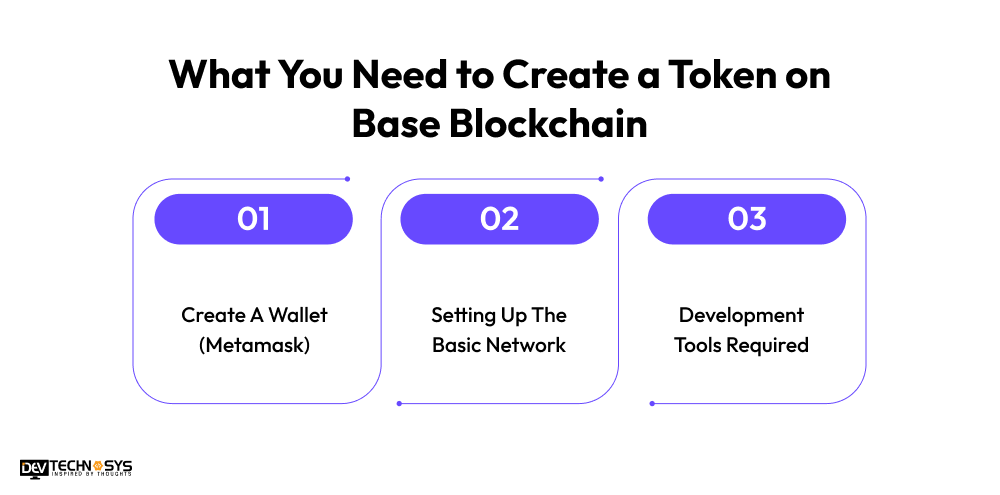
1. Create A Wallet (Metamask)
To store, organize, or use your coins, you need a cryptocurrency wallet such as MetaMask. Experts in crypto wallet development use MataMsk to work safely with the Base blockchain and smart contracts while they are being built and put into use.
2. Setting Up The Basic Network
To develop token on Base chain, your blockchain development company needs to add the RPC URL, chain ID, and explorer information to your wallet’s Base network settings. This lets you connect to and work with the Base Layer 2 blockchain environment without any problems.
3. Development Tools Required
Solidity for smart contracts, Remix or Hardhat for base blockchain token development and deployment. Web3 libraries like Ethers.js for interacting with the blockchain and testing before the mainnet launch are all necessary tools.
Industry Insights: According to CoinLaw, DeFi Total Value Locked (TVL) is estimated at $130-140 billion in 2026, indicating steady recovery and continued adoption growth.
How to Develop a Token on Base Blockchain: Step-by-Step Guide
It’s easy to make a coin on Base blockchain, which lets developers release digital assets that are scalable, cheap, and work with Ethereum. You can quickly make and use your own Layer 2 ticket if you have the right tools and set up your smart contract. From setting up to deploying on Base, this step-by-step Base network token creation guide will show you how to do it all.
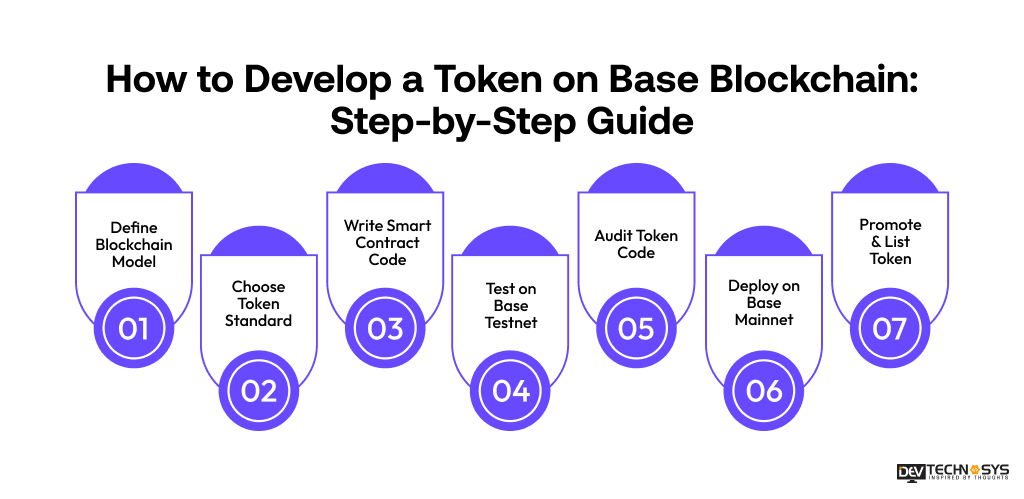
1. Define Blockchain Model
To create a token on the base blockchain, you must first decide what it will do and what kind of blockchain it will be, such as an NFT, a utility token, or a stablecoin. Make it easier to understand use cases, distribution methods, quantity limits, and tokenomics.
This framework helps with both technical and business choices. Find out if your market fits your needs and who you want to reach before you look for blockchain app development options. Look at competing coins and coins that are similar to Base.
2. Choose Token Standard
The next step in Ethereum development services involves hiring the right developers to build and deploy token on Base chain. These experts will select the appropriate code standard based on your goals. ERC-20 is great for fungible tokens, ERC-721 is great for non-fungible tokens, and ERC-1155 is great for mixed use cases.
Because it works with Ethereum, Base Blockchain supports these standards. This makes it cheaper to make a base coin. Make sure that the standard you choose works with the DeFi wallets, apps, and exchanges that you want to use it with. Look at what the best practices are for that level.
3. Write Smart Contract Code
Create a Base blockchain smart contract token that outlines the rules and behavior of your coin. Hire experts who develop a token on base blockchain to incorporate features for managing supplies, exchanging tokens, and communicating with other contracts. Make use of Solidity to develop a token on a base that works with Ethereum. To avoid common vulnerabilities, use secure coding methods. For maintenance and upgrades, modularize your code.
4. Test on Base Testnet
After you develop a token on base blockchain, thoroughly test your token on Base’s testnet prior to deploying on the mainnet. Verify gas efficiency, stress test contract logic, and simulate transactions. Testing guarantees smooth interaction with the Base ecosystem and aids in finding issues. To find edge cases, use a variety of testers at a base token development company. Test the integration of dApps, DEXs, and wallets. Examine the outcomes and make iterations to your code.
5. Audit Token Code
Perform a thorough security assessment of your smart contract with a low cost to create a token on base. Hire qualified blockchain auditors who are familiar with Base’s architecture. Vulnerabilities, inefficiencies, and possible attack routes are found during an audit. For openness, keep an audit report, particularly if you’re aiming for ICO token development services. Credibility is increased, and post-launch exploitation risks are reduced with a well-audited token.
6. Deploy on Base Mainnet
Release your token to the Base mainnet after testing and auditing are finished. Establish the starting parameters, including the admin roles, token supply, and any locks or vesting schedules. Verify the deployment transaction. The strategic base blockchain token deployment process helps in the reduction of the cost. Inform your community about the deployment. After launch, keep a watchful eye on on-chain activity. A seamless deployment reduces launch-related problems and guarantees trust.
7. Promote & List Token
Use collaborations, marketing, and community development to spread the word about your coin. Apply to list your token on Base Blockchain-compatible centralized exchanges (CEXs) and decentralized exchanges (DEXs). Know how to launch a token by interacting with the Base community. Create instructional materials to encourage adoption by using DeFi development services. Encourage ecosystem integrations with wallets, dApps, and DeFi.
What are the Key Features of Base Blockchain Network?
Built on top of Ethereum, the base blockchain token network is a Layer 2 platform that is quick, safe, and affordable. It allows your custom software company to design dApps that are scalable with Ethereum:
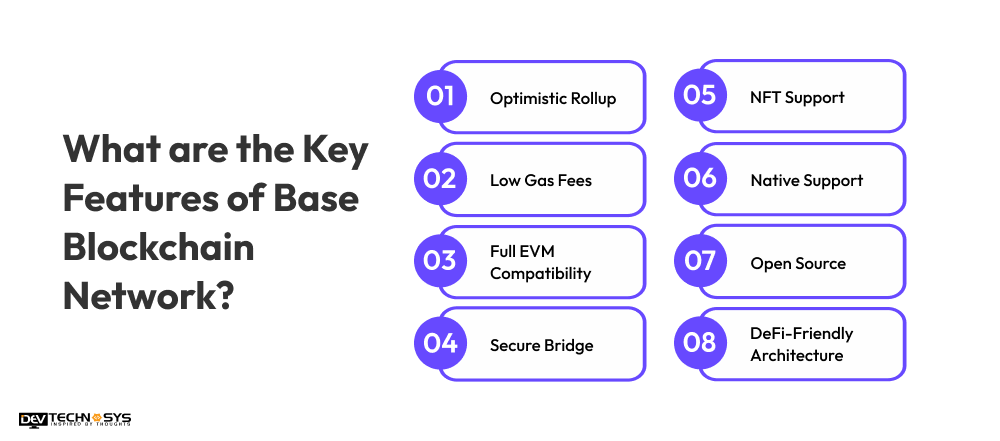
1. Optimistic Rollup
Base uses Optimistic Rollup technology to batch transactions and submit them to Ethereum. You can create a meme coin that ensures faster processing while preserving the security of the Ethereum mainnet.
2. Low Gas Fees
By processing transactions off-chain and batching them, Base drastically reduces gas fees. It is beneficial to make a token on a base that is cost-effective for both users and developers.
3. Full EVM Compatibility
Base is fully compatible with the Ethereum Virtual Machine (EVM). Developers can seamlessly deploy existing Ethereum smart contracts and dApps on Base without modification.
4. Secure Bridge
Base provides a secure bridge to Ethereum, allowing smooth asset transfer between networks. An app like Coinbase uses robust protocols to safeguard cross-chain operations.
5. Native Support
Built by Coinbase, base chain tokens enjoy native support within the Coinbase ecosystem. The base blockchain native token offers easy integration with Coinbase products and a large user base.
6. Open Source
Base is an open-source project, encouraging community contributions and transparency. Developers can inspect and contribute to base crypto tokens through its codebase.
7. DeFi-Friendly Architecture
Base Networks token is optimized for decentralized finance (DeFi) applications, offering low fees, fast transactions, and seamless Ethereum interoperability. It supports the rapid growth of DeFi protocols.
8. NFT Support
Base natively supports NFT standards like ERC-721 and ERC-1155. This layer-2 blockchain enables creators and marketplaces to mint, trade, and manage NFTs efficiently on the network.
Industry Insights: ZTABS states that Blockchain development demand continues to rise, with enterprises prioritizing tokenization use cases and compliance-ready systems over speculative crypto projects.
Applications of the ERC-20 Token Standard for Base Blockchain
The Base Blockchain makes extensive use of the ERC-20 token standard to facilitate easy token development. Numerous applications in DeFi, gaming, and commerce solutions are supported:
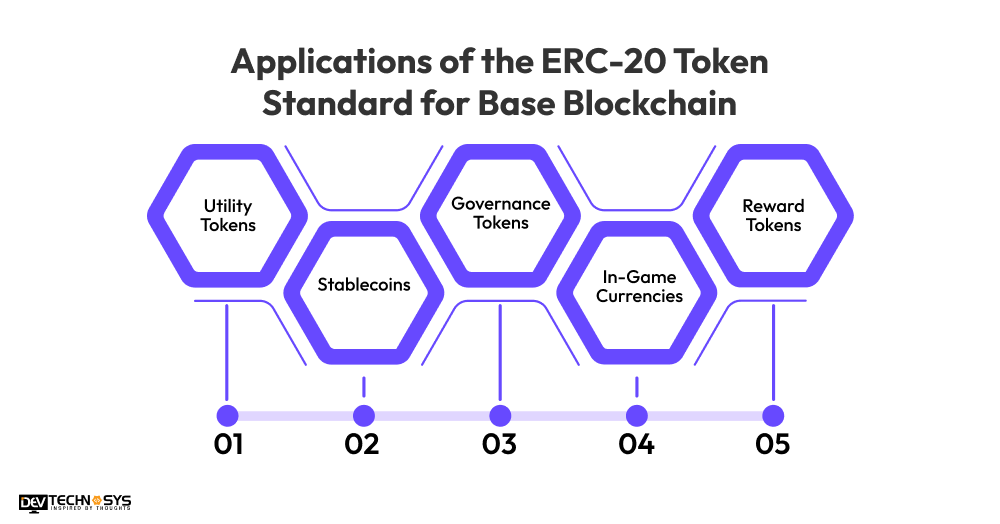
1. Utility Tokens
Within a dApp or ecosystem, utility tokens give consumers access to particular goods or services. These tokens have cheap costs and quick transactions on Base, which improves their usefulness. Experts who provide DApp development services can build a token on the basis of promoting community trust and involvement.
2. Stablecoins
The ERC-20 standard can be used on Base to create a stablecoin that is based on fiat currencies. They offer a dependable channel of communication throughout the ecosystem. They are perfect for remittances and micropayments due to the use of base token development services.
3. Governance Tokens
Holders of governance tokens can take part in dApp and DAO decision-making. These tokens enable on-chain voting on Base with low gas expenses. They facilitate community-driven innovation and decentralized governance by reducing the cost to develop a base token.
4. In-Game Currencies
ERC-20 tokens on base chain can be made by game producers and used as Base in-game currency. Players use these tokens to buy goods, make upgrades, or get access to features. Businesses can launch an ERC20 token that improves quick transaction speeds.
5. Reward Tokens
ERC-20 reward tokens encourage user actions, including content production, participation, and staking. Projects on Base are able to offer incentives on a regular basis without incurring base token development services. This fosters communities that are engaged and active.
Cost to Develop a Token on Base Blockchain
The cost to develop a token on base blockchain is around $8,000 to $30,000+. The total pricing range is determined by several key factors, such as market strategy, technological design, developer location, and more. Project owners can make an efficient budget by being aware of these factors. While basic tokens are affordable, advanced features like audits, integrations, and scalability significantly increase the overall budget. Now, let’s discuss the major factors affecting the blockchain app development cost in detail.
1. Token Complexity
The cost to build a token on base blockchain with a simple design and basic transfer functions is less. More complex smart contracts are needed for advanced tokens with governance, staking, or vesting capabilities. Complexity lengthens development time and raises related expenses.
2. Security & Auditing
Security plays a critical role in token development. Cost to develop a token on base blockchain increases with professional smart contract audits, penetration testing, and vulnerability assessments, ensuring protection against hacks and exploits while maintaining compliance and reliability.
3. Blockchain Integrations
Integrating your token with wallets, DeFi platforms, exchanges, and cross-chain bridges adds complexity. These integrations require additional development effort, testing, and API configurations, which directly impact the cost to build a token on base blockchain.
4. Development Team
The cost to create a token on base blockchain varies depending on whether you hire freelancers, in-house developers, or experienced blockchain agencies. Skilled teams with expertise in smart contracts and Web3 development typically charge higher but deliver better quality and security.
5. UI/UX Dashboard
Building a user-friendly dashboard or admin panel for token management, analytics, or staking features adds to the cost to create a token on base blockchain. A well-designed interface improves usability but requires additional frontend development and design efforts.
| Factor | Description | Estimated Cost Impact |
| Token Complexity | Basic ERC-20 vs advanced features like staking, governance, or vesting | $3,000 to $10,800+ |
| Security & Auditing | Smart contract audits, testing, and vulnerability prevention | $5,000 to $12,000+ |
| Blockchain Integrations | Wallets, DeFi protocols, exchange APIs, cross-chain bridges | $4,500 to $10,000+ |
| Development Team | Freelancers vs experienced blockchain agencies or experts | $8,000 to $18,000+ |
| UI/UX Dashboard | Admin panel, token management system, and user interface | $3,000 to $8,000+ |
Monetization Strategies For Base Tokens
Monetizing Base tokens involves creating sustainable revenue streams while driving user engagement and ecosystem growth. Here are the most effective strategies:
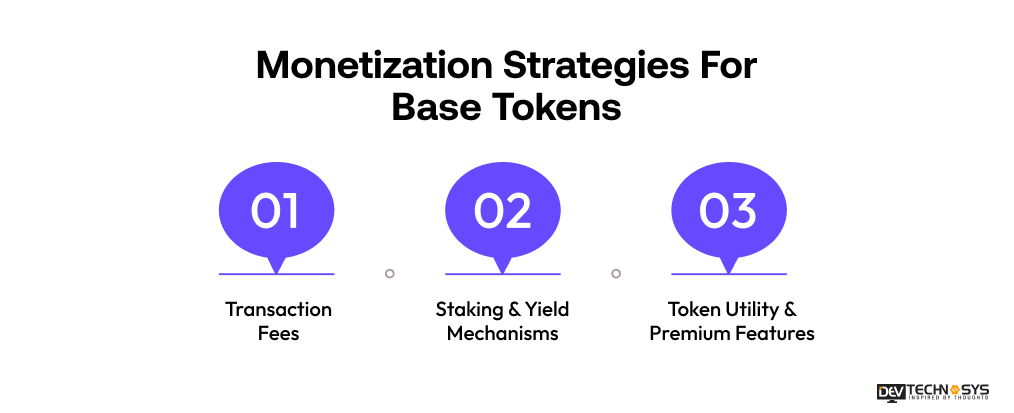
1. Transaction Fees
Charge small fees on token transfers, swaps, or platform interactions to create a steady income stream. With Base’s low gas fees, even micro-transactions can generate significant revenue over time, especially as user activity and adoption grow across your platform.
2. Staking & Yield Mechanisms
Enable users to stake tokens and earn rewards while your platform benefits from staking fees, lock-up periods, or yield generation models. Staking and Yeild Mechanisms are used by the decentralized exchange development company to encourage long-term holding, improve token stability, and create recurring revenue through participation in staking pools.
3. Token Utility & Premium Features
Offer exclusive platform features such as advanced analytics, governance participation, or premium tools accessible through token ownership. This increases token demand while generating revenue from users who pay or hold tokens to unlock enhanced services and benefits.

How Long Does it Take to Create a Token on Base?
Creating a token on Base blockchain is relatively quick due to its EVM compatibility and efficient infrastructure. A basic ERC-20 token can be deployed within a few hours, but building a secure, scalable, and feature-rich token typically takes 1 to 4 weeks, depending on complexity, integrations, and security requirements. A simple token is fast to launch, but a production-ready token requires careful testing, security audits, and integrations to ensure long-term success.
| Stage | Key Activities | Estimated Time |
| Planning & Setup | Define tokenomics, configure wallet & Base network | 1 to 2 days |
| Smart Contract Development | Write and test a Solidity contract | 2 to 5 days |
| Deployment | Deploy contract on Base network | Few hours |
| Testing & Optimization | Debugging, performance checks | 3 to 7 days |
| Security Audit | Code review and vulnerability testing | 5 to 10 days |
How AI Improves the Efficiency of Base Tokens?
The effectiveness, security, and market dynamics of Base Blockchain tokens are greatly improved by using AI technologies with crypto token development services. AI enables developers and users to get more out of token ecosystems by automating procedures, streamlining smart contracts, and enhancing data insights. You can make a token on base to promote scalability and creativity.
- Automates smart contract optimization and performance tuning.
- Enhances fraud detection and transaction monitoring for token security.
- Provides predictive analytics for token pricing and market trends.
- Optimizes user engagement through personalized token rewards.
- Enables intelligent liquidity management in DeFi applications.
Best Tools & Tech Stack for Base Token Development
According to a top crypto exchange development company, building a token on Base blockchain requires a reliable and scalable tech stack to ensure smooth smart contract deployment, secure transactions, and efficient testing. Since Base is EVM-compatible, developers can leverage widely used Ethereum tools, making development faster, cost-effective, and easier to manage.
| Layer | Tools/Technologies |
| Smart Contract Language | Solidity |
| Development Frameworks | Hardhat, Truffle, Foundry |
| IDEs | Remix IDE, VS Code |
| Wallets | MetaMask, Coinbase Wallet |
| Web3 Libraries | Ethers.js, Web3.js |
| Blockchain Explorer | BaseScan |
| Frontend | React.js, Next.js |
| Backend (Optional) | Node.js, Express.js |
| Testing Tools | Mocha, Chai |
| Deployment & Hosting | AWS, Vercel, Docker |
Future of Base Ecosystem & Tokenization Trends
The Base ecosystem is rapidly evolving, positioning itself as a key player in the next phase of Web3 innovation. With strong growth in DeFi, scalability, and emerging technologies, Base is shaping the future of tokenization and decentralized applications.
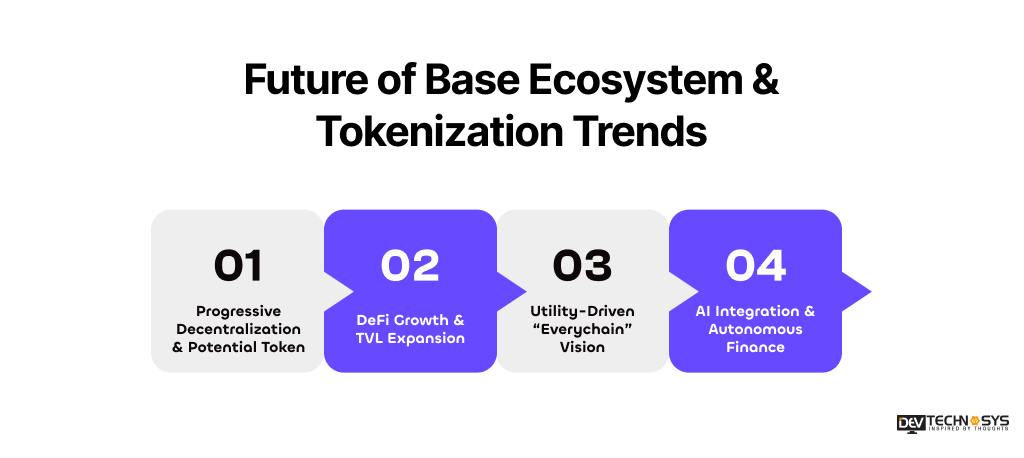
1. Progressive Decentralization & Potential Token
Base is gradually moving toward decentralizing its infrastructure, including its proving stack and governance systems, to avoid being perceived as a centralized or corporate-controlled chain. Market sentiment suggests a potential native token launch to enhance participation and ecosystem alignment.
2. DeFi Growth & TVL Expansion
Base is emerging as a major hub for decentralized finance, with rapid growth in decentralized exchanges and lending protocols. Its Total Value Locked (TVL) has seen significant increases, reflecting rising user adoption and capital inflow into the ecosystem.
3. Utility-Driven “Everychain” Vision
Base aims to become a universal utility layer for on-chain finance, enabling seamless payments, tokenized assets, and even 24/7 trading of tokenized stocks. This vision positions it as a backbone for real-world blockchain applications.
4. AI Integration & Autonomous Finance
The integration of AI-powered agents is set to transform Base’s ecosystem by enabling automated, high-frequency on-chain transactions. This will enhance efficiency, reduce costs, and unlock advanced use cases in DeFi and decentralized economies.
Conclusion
Businesses that want to get into the Web3 environment with lower costs, high scalability, and Ethereum compatibility should consider making a token on Base blockchain. As the use of tokens spreads around the world, Base gives developers a way to make digital assets that are safe, efficient, and flexible.
If you are a business searching for a top blockchain app development company to make a token on base blockchain, contact Dev Technosys. With 180+ developers and 15+ years of expertise in blockchain, fintech, and Web3 development, the company delivers secure, scalable, and high-performance token solutions tailored to your business goals.
Frequently Asked Questions
Find answers to the most common questions related to this article.
Base tokens can be obtained by interacting with dApps on the Base ecosystem or through supported exchanges. Users need a compatible wallet like MetaMask to buy, swap, or earn tokens via decentralized platforms.
Currently, Base does not have an official native token. However, there is ongoing speculation that a governance or ecosystem token may be introduced in the future as the network continues to decentralize.
To create a meme coin, developers write an ERC-20 smart contract using Solidity, define the token name, symbol, and supply, then deploy it on Base blockchain using tools like Remix or Hardhat. Community engagement and marketing drive its adoption.
A Base token is used for utility, governance, or ecosystem functions, while a quote token is used for pricing and trading pairs like USDT or ETH. Choose Base tokens for building ecosystems and quote tokens for liquidity and exchange purposes.
Yes, Base blockchain is highly suitable for token development due to its low transaction fees, high scalability, and full Ethereum compatibility. Make a token on base blockchain that supports ERC-20 and other token standards, making it ideal for building secure, fast, and cost-efficient Web3 applications.