















Quick Summary:
The POS software development cost generally ranges from $4,999 to $120,000+, depending on system scope, integrations, hardware compatibility, and scalability requirements. A basic MVP POS system may cost around $4,999 to $15,000; mid-sized business solutions range from $15,000 to $50,000, while advanced enterprise POS platforms can exceed $50,000 to $120,000+ based on customization, payment integrations, deployment model, and development team location.
Cost Impacted by Project or Development Complexity:
-
- Basic/MVP ($4,999–$15,000): Includes billing functionality, product catalog, basic inventory management, user roles, tax configuration, and simple reporting. Suitable for small retailers and restaurants.
- Mid-Level ($15,000–$50,000): Features multi-store management, advanced inventory tracking, CRM and accounting integrations, cloud synchronization, employee management, and detailed analytics dashboards.
- Enterprise/Advanced ($50,000–$120,000+): Includes omnichannel sales support, ERP integrations, AI-driven sales forecasting, loyalty programs, and enterprise-grade security architecture for large businesses.
Development Timeline:
-
- MVP POS System: 1 to 2 months
- Mid-Level POS Software: 2 to 3+ months
- Enterprise POS Platform: 4 to 5+ months or longer
Cost Based on Different Regions/Countries
-
- United States: POS software development rates range from $20 to $50 per hour.
- United Kingdom & Western Europe: Development rates range from $22 to $52 per hour.
- Eastern Europe: Development rates range from $20 to $45 per hour.
- Southeast Asia: Development rates range from $15 to $25 per hour.
- Australia: Development rates range from $21 to $48 per hour.
Additional Costs
-
- Maintenance & Support: Approximately 15% to 20% of the initial development cost annually.
- Hardware Expenses: POS terminals, barcode scanners, receipt printers, and tablets required for system operations.
- Cloud Hosting & Licensing: Recurring infrastructure, hosting, and software subscription costs.
- Upgrades & Feature Expansion: Additional investment for scaling the system, improving performance, and introducing new features as business needs evolve.
There’s been an increase in the demand for Point of Sale (POS) software as businesses seek seamless, efficient, and smart transaction solutions. POS software in 2026 handles everything from inventory management and omnichannel payment processing to customer relationship management (CRM) in a single platform.
However, making a scalable and personalized Integrate a POS System in 2026 brings unique challenges and considerations, be it security compliance, multi-platform compatibility, scalability, or most importantly, cost.
Understanding the POS software pricing model is critical for businesses that want to invest in a system that balances functionality, user experience, and future growth. In this guide, we provide you with a complete breakdown of POS software development cost along with the key influencing factors, types, and timelines to help you plan your budget effectively. Let’s drive in!
What is POS Software?
A point of sale, or point of purchase, is where you contact customers and accept payments. When customers check out digitally, walk up to your counter to check out, or choose an item from your booth, they’re at the point of sale. It’s also possible to do it with the existing hardware you already use for your business: your computer.
Beyond transactions, modern, cloud-based POS software development entails creating a system for managing inventory and generating detailed sales reports. Not only that, but they also track employee performance and maintain customer loyalty data, performing as a central command hub for retail and hospitality operations.
What is the Average Cost to Develop a POS Software?
The Point Of Sale software development cost ranges from $8,000 to $25,000, depending on the features implemented, the platform (Android, iOS, or Cross-Platform) used, and any design customizations. Generally, the cost to build POS Software with basic features like inventory management and transaction processing will be around $8,000 to $12,000.
Now, if you want to level up and add advanced features like multi-store management, customization, and a centralized dashboard, expect a higher custom POS software cost, around $25,000 or more.
| POS Software Type | Features Included | Estimated Cost (USD) |
| Basic POS | Billing, simple product catalog, basic receipt printing | $4,999 – $15,000 |
| Standard POS | Inventory tracking, sales reports, and user management | $15,000 – $30,000 |
| Enhanced POS | Cloud synchronization, customer accounts, and basic analytics | $30,000 – $50,000 |
| Mobile/Tablet POS | iOS/Android app, barcode scanning, and mobile transactions | $20,000 – $40,000 |
| Advanced POS | Multi-location management, CRM integrations, and advanced reporting | $40,000 – $70,000 |
| Enterprise POS | Omnichannel sales, ERP integrations, AI analytics, and enterprise security | $70,000 – $120,000+ |
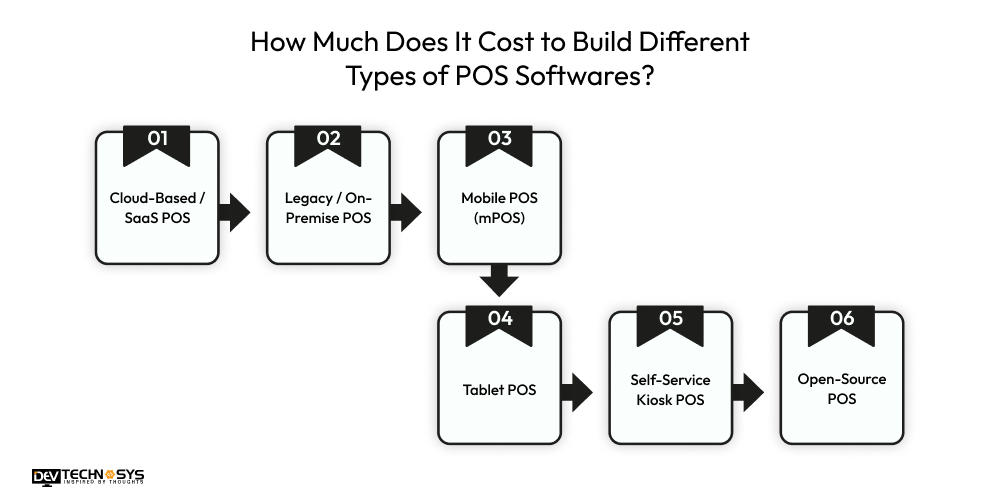
How Much Does It Cost to Build Different Types of POS Softwares?
Walk through this POS system development budget guide and see how different types of POS softwares impact the cost. Whether you are looking for a drive-thru restaurant POS system development or an on-premises POS, the cost for developing each type is different, and knowing these cost variations is essential.
1. Cloud-Based / SaaS POS
When brainstorming what affects POS software development costs, the first thing that comes to mind is Cloud technology. Cloud-based or SaaS POS systems hosted on remote servers provide real-time access to business data from anywhere.
Cloud-based pOS systems are especially valuable for multi-location businesses, franchises, and enterprises that require centralized management of sales, inventory, and staff.
Due to their scalability, security requirements, and continuous synchronization features, the cost to develop cloud based POS software in USA typically ranges from $15,000 to $25,000, with an average development timeline of 10 to 16 weeks.
| POS Development Level | Estimated Cost (USD) |
| Basic Cloud POS | 4,999–12,000 |
| Mid-Level Cloud POS | 12,000–28,000 |
| Advanced Cloud POS | 28,000–65,000 |
| Enterprise SaaS POS | 65,000–120,000+ |
2. Legacy / On-Premise POS
On-premise POS software is installed directly on in-store servers and operates independently of internet connectivity. This makes it suitable for businesses operating in areas with unreliable internet access. However, these systems require regular maintenance, manual updates, and higher hardware investment.
While they offer complete data control, scalability is limited compared to cloud solutions. Development costs for a POS software generally fall between $12,000 and $20,000, and take 8 to 14 weeks to develop, depending on which software product development company in United States you hire.
Service Options
Which POS Software Solution Matches Your Business Needs?
Communicate your operational aims and the checkout functionalities you aim to enhance in your POS program.
Custom Development of POS System
Design a POS system that is tailor-made for your needs, including billing, controlling stock, monitoring transaction workflows, and generating sales statistics.
Build Your POSPOS System Integration & Automation
Connect payment systems, stock accounting systems, and accounting systems while automating daily checkout and sales processes.
Streamline Your OperationsPOS Modernization & Advanced Features
Upgrade your existing POS system with user-friendly interfaces, real-time data analysis, smart sales data, and flexible scalability solutions.
Upgrade Your POS
| POS Development Level | Estimated Cost (USD) |
| Basic On-Premise POS | 8,000–18,000 |
| Mid-Level On-Premise POS | 18,000–35,000 |
| Advanced On-Premise POS | 35,000–70,000 |
| Enterprise On-Premise POS | 70,000–120,000+ |
3. Mobile POS (mPOS)
Mobile POS systems are app-based solutions that run on smartphones or tablets, enabling businesses to accept payments and manage sales on the go. They are commonly used in pop-up stores, events, outdoor markets, and for line-busting in busy retail environments.
mPOS systems often integrate with card readers, digital wallets, and QR payments. Their lightweight architecture keeps the cost to build POS software relatively moderate, typically ranging from $10,000 to $18,000, with a 6- to 12-week development timeline.
| POS Development Level | Estimated Cost (USD) |
| Basic Mobile POS | 4,999–14,000 |
| Mid-Level Mobile POS | 14,000–30,000 |
| Advanced Mobile POS | 30,000–60,000 |
| Enterprise Mobile POS | 60,000–110,000+ |
Industry Insights: In emerging markets, mPOS has boosted financial inclusion by over 49% in the last two years, according to Market.us.
4. Tablet POS
Tablet-based POS systems are designed specifically for tablets such as iPads or Android devices, offering a compact, modern, and user-friendly interface. These systems are widely adopted by small retail stores, cafes, and restaurants due to their affordability and ease of use.
Tablet POS development improves inventory management, Order Processing, and Basic Analytics. The cost to build POS Software usually ranges from $8,000 to $15,000, and the timeline spans 4 to 10 weeks, making it an ideal entry-level POS solution.
| POS Development Level | Estimated Cost (USD) |
| Basic Tablet POS | 5,999–14,000 |
| Mid-Level Tablet POS | 14,000–28,000 |
| Advanced Tablet POS | 28,000–55,000 |
| Enterprise Tablet POS | 55,000–100,000+ |
5. Self-Service Kiosk POS
Self-service POS systems for kiosks allow customers to place orders and complete payments without staff assistance. They are commonly used in quick-service restaurants (QSRs), food courts, cinemas, airports, and malls to reduce wait times and operational costs.
The cost to develop POS Software for a self-service type relies on the requirements of advanced UI/UX design, hardware integration, and secure payment processing. As a result, self-service POS software development costs range from $18,000 to $25,000.
| POS Development Level | Estimated Cost (USD) |
| Basic Kiosk POS | 12,000–25,000 |
| Mid-Level Kiosk POS | 25,000–45,000 |
| Advanced Kiosk POS | 45,000–80,000 |
| Enterprise Kiosk POS | 80,000–120,000+ |
6. Open-Source POS
Open-source POS systems provide businesses with a flexible foundation that you can customize according to specific operational needs. While the software itself may be free, development costs arise from customization, integrations, security enhancements, and ongoing maintenance.
Open-source POS solutions are best suited for startups and tech-savvy organizations with in-house development capabilities. The cost to develop POS Software for this type typically ranges from $8,000 to $18,000, with a 6 to 10 week timeline.
| POS Development Level | Estimated Cost (USD) |
| Basic Open-Source POS | 4,999–9,000 |
| Mid-Level Open-Source POS | 9,000–22,000 |
| Advanced Open-Source POS | 22,000–48,000 |
| Enterprise Open-Source POS | 48,000–95,000+ |
Planning a Pos Project?
Get a tailored development cost estimate in a few simple steps.
- 3 quick steps
- 100% free
- Reply in 1 business day
2 Minutes Read
How Much Does POS Software Development Cost? Top 5 Systems Explained
This section discusses the top 5 POS softwares and how much it would cost to develop similar softwares as businesses believe that development costs are necessary to build a POS system that can compete with existing giants. Take a look at these popular POS softwares and see their development costs!
1. Square POS
Square POS is a popular, easy-to-use solution designed for small and medium-sized businesses. It offers built-in payment processing, inventory management, sales reporting, and customer insights.
Square is known for its low upfront cost, quick setup, and flexible pricing, making it ideal for startups and retail stores. The table below provides a detailed POS development cost estimation.
Development Component |
Estimated Cost |
| UI/UX Design | $1,000 – $2,000 |
| Core POS Features (Billing, Payments) | $2,000 – $4,000 |
| Inventory & Customer Management | $1,500 – $3,000 |
| Payment Gateway Integration | $800 – $1,500 |
| Admin Panel & Reporting | $1,000 – $2,000 |
| Testing & Deployment | $700 – $1,500 |
| Total Development Cost | $8,000 – $15,000 |
2. Toast POS
Toast POS is a restaurant-focused POS system built specifically for food and beverage businesses. It supports order management, table tracking, menu customization, online ordering, and staff management. Toast’s pricing is higher than basic POS tools but justified by its deep restaurant-specific features and scalability.
Development Component |
Estimated Cost |
| UI/UX for Restaurant Workflow | $1,200 – $2,500 |
| Order, Table & Menu Management | $3,000 – $5,000 |
| Kitchen Display System (KDS) | $1,500 – $3,000 |
| Payment & Tax Integration | $1,000 – $2,000 |
| Staff & Role Management | $1,000 – $2,000 |
| QA, Testing & Deployment | $1,000 – $1,500 |
| Total Development Cost | $12,000 – $22,000 |
Interesting facts: Restaurants using kiosks have reported 20-30% higher sales compared to traditional cashier ordering. Source: Grand iew Research
3. Shopify POS
Shopify POS is best suited for businesses selling both online and in-store. It seamlessly integrates with Shopify’s eCommerce platform, enabling real-time inventory sync, omnichannel selling, and customer data tracking.
Development and customization costs vary on the basis of integrations and advanced retail needs. Talk to experts who provide SaaS development services to understand the actual cost to build Shopify-like payment software solutions.
Development Component |
Estimated Cost |
| UI/UX Design | $1,200 – $2,000 |
| POS + eCommerce Sync | $3,000 – $5,000 |
| Inventory & Order Sync | $2,000 – $3,500 |
| Payment & Checkout Integration | $1,000 – $2,000 |
| Customer & Analytics Dashboard | $1,200 – $2,500 |
| Testing & Launch | $800 – $1,500 |
| Total Development Cost | $10,000 – $20,000 |
4. Lightspeed Retail
Lightspeed Retail is a powerful cloud-based POS designed for growing retail businesses. It offers advanced inventory control, analytics, supplier management, and multi-store support. While more expensive than entry-level POS systems, it’s ideal for businesses needing robust reporting and scalability. Here’s the table showcasing the POS app cost breakdown:
Development Component |
Estimated Cost |
| Advanced UI/UX Design | $1,500 – $2,500 |
| Inventory & Supplier Management | $3,000 – $5,000 |
| Multi-Store POS Support | $2,000 – $4,000 |
| Reporting & Analytics | $1,500 – $3,000 |
| Integrations (Accounting, Payments) | $1,000 – $2,000 |
| QA & Deployment | $1,000 – $1,500 |
| Total Development Cost | $14,000 – $25,000 |
5. Clover POS
Clover POS is a flexible, hardware-driven POS system suitable for retail, restaurants, and service businesses. POS software can improve business operations by offering customizable apps, payment processing, inventory tracking, and employee management. The cost to create POS software depends on hardware choice, app integrations, and monthly subscription plans.
Development Component |
Estimated Cost |
| UI/UX Design | $1,000 – $2,000 |
| POS Billing & Payments | $2,500 – $4,000 |
| Inventory & Employee Management | $2,000 – $3,500 |
| Third-Party App Integrations | $1,000 – $2,000 |
| Admin Panel & Reports | $1,000 – $2,000 |
| Testing & Deployment | $800 – $1,500 |
| Total Development Cost | $9,000 – $18,000 |
What Factors Drive the POS Software Development Cost?
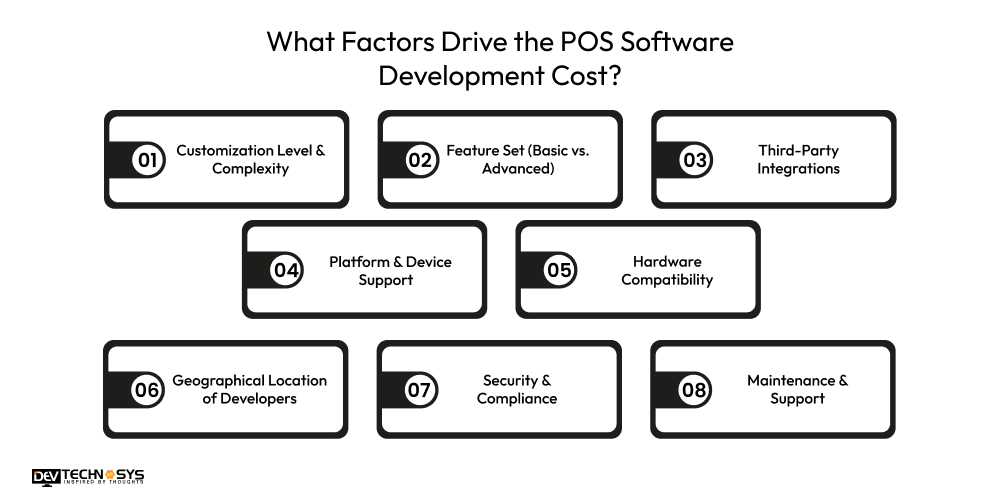
If you want to develop a POS software system that handles high transaction volumes across multiple locations, plan the budget in advance. The cost to develop POS Software in the USA is not fixed, as it depends on various factors. What are these cost-influencing factors? Let’s read and find out.
1. Customization Level & Complexity
POS software development cost in 2026 relies heavily on the level of customization. A fully customized POS solution designed around unique business workflows, branding, and operational requirements demands more planning, development, and testing. In contrast, template-based solutions are faster to build and more cost-effective, but they offer limited flexibility and scalability.
Customization Level |
Estimated Cost Impact |
| Low (template-based) | $8,000 – $12,000 |
| Medium (partial customization) | $12,000 – $18,000 |
| High (fully custom workflows) | $18,000 – $25,000 |
Industry Insights: Deliverect states that Toast has a 24.58% market share in the overall POS systems market, competing closely with Square.
2. Feature Set (Basic vs. Advanced)
When drawing a POS development cost comparison, remember that there’s no one fixed cost; it depends on the features and functionalities. The number and complexity of features directly impact development cost. Basic POS systems usually include sales processing, billing, and simple reporting and cost around $2,000 to $7,000.
Advanced POS software features include real-time inventory management, customer relationship management (CRM), and detailed dashboards. Adding advanced features requires complex backend logic and integrations, increasing total development costs by 20% to 50% or more.
Feature Scope |
Estimated Cost Impact |
| Basic features | $2,000 – $4,000 |
| Standard features | $4,000 – $5,000 |
| Advanced features | $5,000 – $7,000 |

3. Third-Party Integrations
Integrating the POS system with third-party platforms increases both development time and cost. Third-party integrations that influence cost include accounting software, ERP systems, eCommerce platforms, tax tools, and payment gateways. Each integration requires custom APIs, secure data handling, and rigorous testing to ensure seamless functionality and system stability.
Integration Level |
Estimated Cost Impact |
| Minimal (1–2 APIs) | $500 – $1,000 |
| Moderate (3–5 APIs) | $1,000 – $2,000 |
| Complex (ERP, CRM, payments) | $2,000 – $2,500 |
4. Platform & Device Support
According to TechQware, supporting multiple platforms, such as iOS, Android, and web browsers, increases the cost of developing POS Software by 40% to 100%.
Cross-platform compatibility requires additional UI/UX design and performance optimization. Additionally, testing across different devices and operating systems directly affects overall costs.
Platforms Supported |
Estimated Cost Impact |
| Single platform | $2,500 – $4,000 |
| Two platforms | $5,000 – $7,000 |
| Cross-platform | $8,000 – $10,000 |
5. Hardware Compatibility
When talking about POS development cost factors, don’t forget about hardware compatibility. POS systems often need to work with physical hardware such as barcode scanners, receipt printers, cash drawers, weighing scales, and NFC payment terminals.
Ensuring smooth hardware integration and device compatibility adds technical complexity, increasing both development and testing costs. It is best to hire dedicated developers to ensure smooth hardware integration.
Hardware Scope |
Estimated Cost Impact |
| Limited hardware | $700 – $2,000 |
| Standard POS devices | $3,500 – $5,000 |
| Advanced/NFC hardware | $6,700 – $7,000 |
5. Geographical Location of Developers
The development team’s location has a substantial impact on cost. Developers in North America and Western Europe typically charge higher hourly rates. At the same time, teams in Eastern Europe, India, and Southeast Asia offer more cost-effective pricing without compromising quality, making location a strategic cost factor.
Region |
Hourly Rate |
| North America | $80 – $150/hr |
| Western Europe | $60 – $120/hr |
| Eastern Europe | $30 – $60/hr |
| Asia (India, SEA) | $15 – $40/hr |
6. Security & Compliance
Security is critical for POS software, especially when handling payments and sensitive customer data. Implementing encryption, secure authentication, fraud prevention, and compliance with standards like PCI DSS adds additional layers of development, infrastructure, and testing, raising overall costs.
Security Level |
Estimated Cost Impact |
| Basic security | $900 – $1,800 |
| Standard compliance | $2,000 – $3,000 |
| PCI DSS & advanced security | $3,000 – $4,000 |
7. Maintenance & Support
POS software development does not end at launch. Ongoing maintenance, software updates, performance optimization, bug fixes, and technical support are essential for long-term stability and scalability. Custom-built POS solutions typically require ongoing support, which can lead to recurring costs.
Service Options
Who Can Benefit From Custom POS Software Development?
Companies aim to streamline their payment processes, track their revenue, and conduct their transactions in an effective manner.
Struggling With Daily Sales Management?
Make billing easy, check product availability, and manage your transactions through a single POS system.
For retailers and restaurant ownersNeed Greater Control Over Store Operations?
Make payments easier, control shops with several checkouts, and view reports.
For store managers and franchise operatorsLooking to Connect Your Business Systems?
Connect your POS software with online payment systems, inventory management systems, accounting systems, and eCommerce systems.
For growing businesses and operations teams
Support Type |
Estimated Cost |
| Basic maintenance | $250 – $500 |
| Standard support | $650 – $800 |
| Premium support | $1,500 – $2,000 |
Security & Compliance in POS Software Development
In POS System Development, the principle of security and compliance is vital for ensuring the protection of each aspect of one’s business, like payment details, customer data, transactions, and employee accounts. Adhering to security requirements affects development costs, notably when it comes to meeting regulatory compliance and implementing sophisticated protection mechanisms.
1. Security of Payments
When a POS system is responsible for card payments, it is necessary to comply with PCI DSS specifications. Proper payment gateways, use of tokenization, encryption, and fraud prevention improve the level of security but increase the expenses related to development.
2. Encryption of Data
Proper encryption of the vital data processed by POS should take place during its transmission and storage. Strong encryption keeps unauthorized access to a minimum and helps prevent any potential threat to commercial data as well as to customers.
3. Role-based Access Control
Role-based access control provides access to the POS functionality depending on the role of the employee. Cashiers, managers, and administrators have different responsibilities, thus having different access levels that reduce the chances of improper actions.
4. Security Authentication
Security authentication involves the use of strong passwords, multi-factor authentication, session control, and securing accounts. Such mechanisms prevent unauthorized people from using sensitive POS functions and information of the company.
5. Audit Logs
Audit logs allow for the recording of significant events such as refunds, discounts, inventory changes, login attempts, and user activities. This improves accountability and is a useful instrument for investigation.
6. Privacy Compliance
If the POS software is storing personal information, it is essential for it to meet the requirements of applicable privacy laws, such as GDPR, UK GDPR, CCPA/CPRA, or regional data protection requirements.
7. API and Integration Security
Payment gateways, accountancy software, inventory systems, loyalty systems, etc. are generally integrated with POS systems. A secure API as well as its authentication, encryption, and validation, is needed to prevent unauthorized users’ access to data.
What are the Smart Monetization Strategies for POS Solutions?
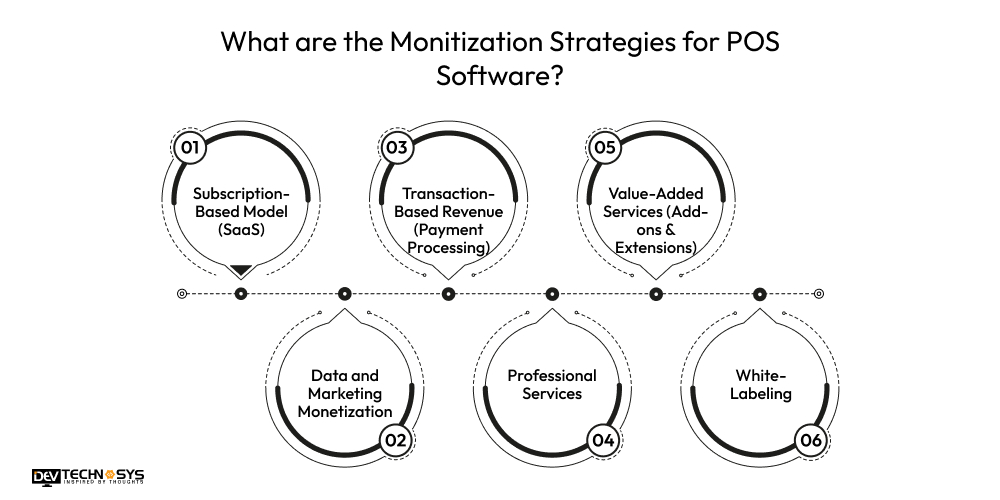
Monetization strategies for Point of Sale (POS) software have evolved from simple one-time license fees to recurring revenue models, integrated financial services, and data-driven insights. Here are some of the amazing strategies used by top companies to monetize a POS software:
1. Subscription-Based Model (SaaS)
The SaaS model is the most common monetization strategy for modern POS software in USA. Businesses pay a recurring monthly or annual fee to access the POS system, cloud hosting, updates, and customer support.
Pricing tiers are often based on features, number of users, locations, or devices. This POS software subscription cost model ensures predictable recurring revenue while allowing customers to scale their plans as their business grows.
Industry Insights: Lightspeed is among the top three player in North America with an estimated 8% to 10% market share.
2. Transaction-Based Revenue (Payment Processing)
Many POS providers generate revenue by charging a small percentage or flat fee on every transaction processed through the system. This includes card payments, digital wallets, and contactless payments.
As transaction volumes increase, revenue grows naturally, making this model highly profitable, especially for retail and hospitality businesses with high sales turnover.
3. Value-Added Services (Add-ons & Extensions)
POS software companies often offer premium add-ons such as advanced analytics, inventory forecasting, loyalty programs, CRM tools, employee management, and AI-driven insights. These features are sold as optional upgrades, enabling customers to pay only for what they need while increasing the vendor’s average revenue per user (ARPU).
4. Data and Marketing Monetization
With access to sales and customer behavior data, POS platforms can monetize insights by offering targeted marketing tools, campaign management, personalized promotions, and performance analytics.
If you discuss with a professional POS software development company in America, you will find they also deliver anonymized, aggregated insights to partners, ensuring compliance with privacy regulations while unlocking additional revenue streams.
5. Professional Services
Professional services such as POS customization, system integration, onboarding, staff training, and ongoing technical support represent another strong revenue source. These services are typically offered as one-time or recurring paid engagements, particularly for enterprise and multi-location clients.
6. White-Labeling
White-label POS solutions allow resellers, banks, fintech companies, or enterprises to rebrand and sell the POS software as their own. Vendors earn revenue through licensing fees, long-term contracts, or revenue-sharing agreements, making white-labeling a powerful strategy for expanding market reach without direct sales.
How Silly Cost Mistakes Can Increase POS Software Development Budget?
Many businesses spend more than necessary on POS software due to common mistakes. One major mistake is adding too many features at once. Overengineering increases development time and budget without improving usability. Another mistake is skipping the MVP approach. Building a full-featured app from day one raises costs and delays launch.
Ignoring security, compliance, and employee training adds hidden costs. Finally, overlooking maintenance and updates leads to rising expenses over time. Careful planning, focusing on core features, and budgeting for growth can save money and ensure a successful POS software implementation.
Mistake |
Cost Impact |
Solution |
| Overengineering Features | Higher development cost | Focus on core features first |
| Ignoring MVP | Large upfront investment | Launch MVP, scale gradually |
| Poor Vendor Choice | Delays & extra fees | Pick experienced developers |
| Skipping Integrations | Unexpected expenses | Plan API & system connections |
| No Scalability Planning | Costly upgrades later | Build scalable architecture |
| Ignoring Security/Compliance | Fines & rework | Include PCI/GDPR from start |
| No Training | Low adoption, extra support | Train employees properly |
| Overlooking Maintenance | Rising ongoing costs | Budget for updates & support |
What We Learned?
Modern POS software development is no longer just about billing but about delivering seamless, data-driven, and scalable retail experiences. We hope this blog helped you understand the POS software development cost in 2026. The development cost depends heavily on factors such as system complexity, cloud infrastructure, integrations with payment gateways and inventory tools, and compliance requirements.
Strategic planning, feature prioritization, and choosing a custom software development company in USA such as Dev Technosys will help you manage the costs while maximizing long-term business value.
Frequently Asked Questions
Find answers to the most common questions related to this article.
Initially, cloud-based POS software is comparatively more expensive than standard POS softwares due to hosting, security, and scalability requirements. However, it offers lower maintenance costs, easier updates, and better long-term scalability compared to on-premise systems.
Yes, there are ways to reduce the cost to create POS Software by prioritizing essential features and using cross-platform frameworks. Additionally, opting for modular development and working with experienced offshore or hybrid development teams can reduce costs to some extent.
Yes. POS software typically requires 15 to 25% of the initial development cost annually for maintenance, updates, security patches, server management, and feature enhancements to ensure smooth performance.
AI-driven features such as demand forecasting, customer behavior analysis, and fraud detection add to software development costs. However, using AI and analytics provides valuable insights that improve decision-making and revenue growth.
POS software development timelines typically range from 8 to 24 weeks, depending on features, platform support, integrations, and testing requirements. Enterprise-grade POS systems may take longer.