
















Key takeaways:
-
- To build a Blockchain MVP, it includes various development steps, such as market research, designing UI/UX, selecting technologies, development, testing, QA, deployment, and maintenance.
- The Blockchain MVP development cost ranges from $10,000 to $30,000, it mainly based on the number of features, development team, tech stacks, API integrations, and more.
- Blockchain MVP can generate higher revenue streams via monetization techniques like listing fees, trading fees, subscription fees, advertising, and more.
- AWS, IBM, and Oracle were identified as some of the star players in the blockchain market (global), given their strong market share and product footprint.
While the term ‘blockchain’ originally was primarily used by the cryptocurrency community, it is now widely used in many other industries as a means of developing decentralized applications and providing tamper-proof solutions.
Taking an idea for how to build out a dApp using blockchain technologies and making it a reality can be difficult to understand.
The technical landscape is changing rapidly, and there are large costs associated with building anything that requires a distribution of applications. Using a Minimum Viable Product (MVP) approach to building your dApp can help you achieve your goals and mitigate your risks.
This blog will introduce you to key concepts in developing an MVP for your blockchain dApp, including selecting a use case that will attract customers and selecting a technology stack that will allow you to create an MVP quickly and efficiently.
Whether you are an entrepreneur looking to invest or expand your dApp based on existing technology, this will provide you with a solid foundation on which to build a successful dApp.
Current & Future Market Projection of Blockchain MVP
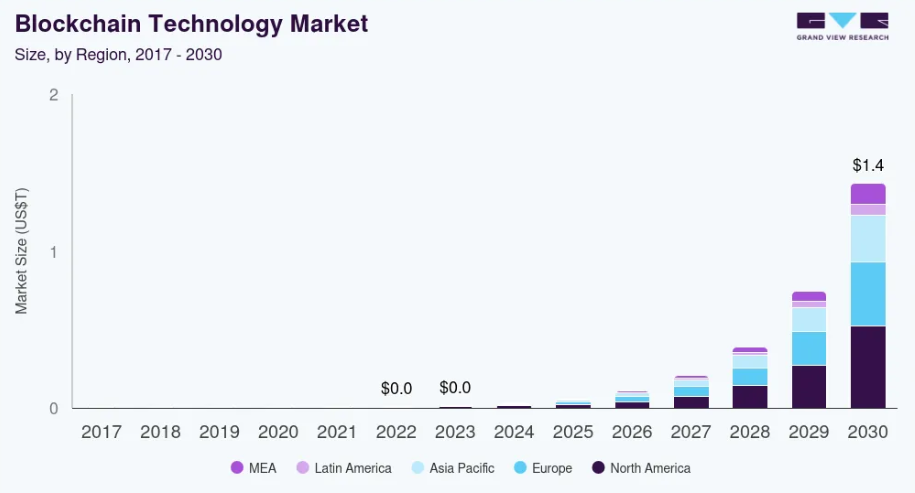
All these below-market statistics are sourced from Grand View Research:
- The worldwide blockchain tech industry had an estimated value of $31.28 billion in 2026, with projected growth through 2030 to $1,431.54 billion due to a CAGR of 90.1%.
- North America held 37.4% of the blockchain technology market in 2026, as the leading country in the world.
- The public cloud was the leading segment of the blockchain tech industry with a 61.5% share of overall sales volume.
- The infrastructure & DeFi protocols inventory was the amount of revenue generated by global, national, state, and local governments from within the blockchain industry.
- In terms of products, platforms represented the largest segment of global blockchain technology revenue.
What is Blockchain MVP?
An MVP for a blockchain app will be a basic grouping of the overall features of the app to provide an example of how a blockchain-based app will work in a practical manner. With the MVP in place, the developer then has an early opportunity to measure structural integrity, economic viability, and functional design against an actual user.
When limited to such basics as a smart contract or performing basic transactions, a blockchain MVP will minimize development risks and allow for faster iteration and more economic cost savings during the final development phase.
3 Core Elements Required for a Blockchain MVP
A Blockchain MVP is a method of validating your idea through essential features in order to reduce the cost and time associated with developing a project.
By implementing both smart contracts and decentralized architecture within a user-friendly interface, companies can use this method for testing functionality and obtaining feedback.
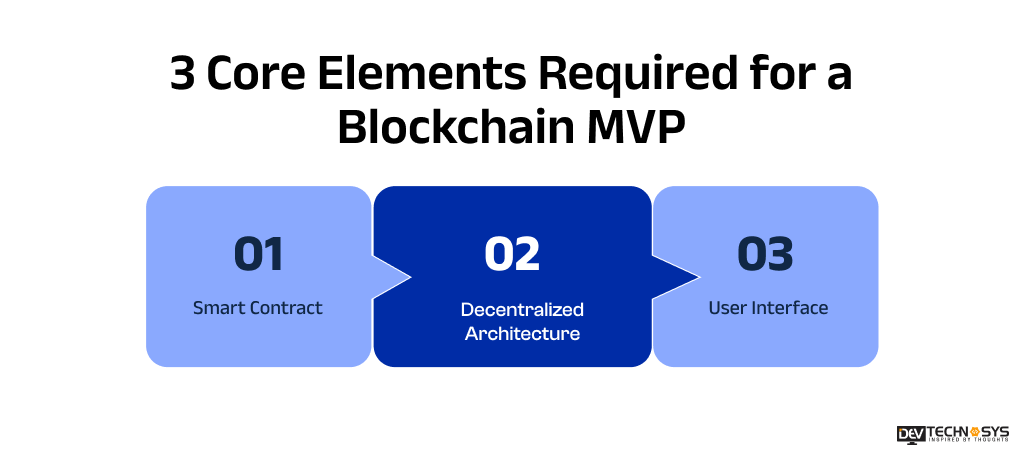
1. Smart Contract
Smart contracts are programs that automatically execute the contracts and transfer assets between parties that have agreed upon these rules, and execute the code against a defined set of parameters. They do not require an intermediary or person, as the contract is executed by the network.
2. Decentralized Architecture
The Decentralized Architecture provides for a distributed ledger, and/or data, across multiple nodes rather than being controlled by one central authority. The information stored will be secure, completely transparent, permanently recorded, and have no central point of failure.
3. User Interface
The User Interface is how the user interacts with the blockchain system. It’s important that a minimum viable product (or MVP) is very easy to navigate, so users can successfully find and use the product.
A great user interface(UI / UX) will help us gather top-quality feedback from our users about their experience with our product and will help to verify if we are meeting the main purpose of the product.
Industry Insights:
According to Market Reports World, over 47% of enterprises actively deploy blockchain, highlighting the importance of MVPs in testing scalable, production-ready decentralized solutions before full investment.
Why Businesses Want to Invest in Blockchain MVP Development?
Developing the blockchain MVP allows companies to validate their ideas more quickly, reduce the risk, and control their operating costs so that they can get into the marketplace faster.
By only building core features initially, companies will be getting real-time feedback from users about their products and can thus gain cost-effective ways. Here are the best blockchain benefits for business:
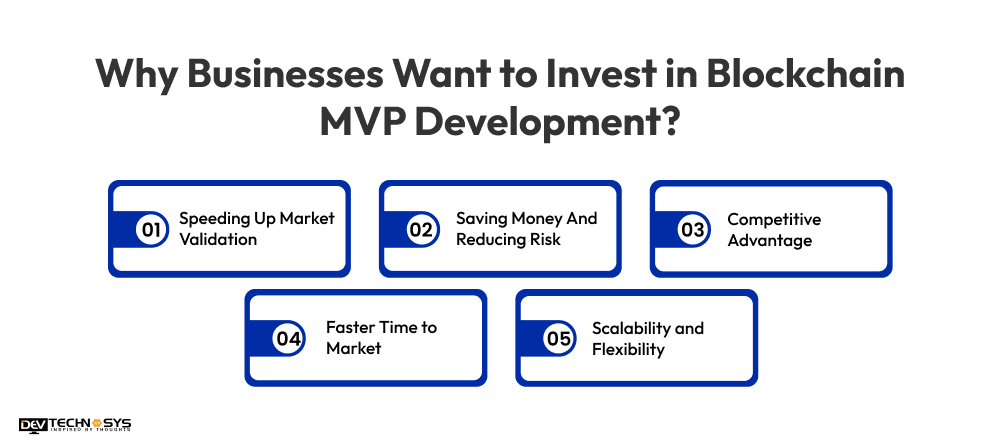
1. Speeding Up Market Validation
Companies create MVPs using blockchain technology so they can test their ideas very fast. By putting a scalable version of their product on a marketplace used by customers, they can see if customers have interest in their product as well as identify possible issues, and get user feedback prior to the development of a complete version of the product.
2. Saving Money And Reducing Risk
The custom Solana blockchain development solutions usually require an expensive and complex process. By creating an MVP, a company can save on up-front costs by only developing the necessary functions.
This also allows companies to conserve their budget while also reducing the financial and technical risks associated with creating a product that has never been validated.
3. Competitive Advantage
Blockchain technology can provide businesses with an advantage over their competition to launch products faster by leveraging the MVP model (Minimum Viable Product).
Companies can use the ways of distributing information with blockchain technology to develop products and services more quickly than traditional methods and build an early presence in their industry before their competitors are able to do so.
4. Faster Time to Market
Using blockchain technology for MVP app development allows for much more rapid product launches because they do not contain many of the features commonly considered “essential” for a successful launch.
This advantage will allow businesses to get into the market earlier and acquire some initial customers. While at the same time starting to build their brand in their industry and improving their product.
5. Scalability and Flexibility
An MVP provides flexibility to the business so it can grow. Businesses can start off smaller and then create new features by understanding user needs as well as how the market is going through the iterative build-out of the blockchain MVP; therefore, enabling them to implement something that is better, more flexible, and in support of their overall business objectives.
7 Key Steps to Build a Blockchain MVP
Developing a Minimum Viable Product (MVP) is key when blockchain application development; this involves multiple aspects to consider and develop a successful strategy, including but not limited to the definition of the use case, the best-fit platform to develop and operate your application, and a successful and scalable architecture. Let’s explore the steps to create a smart contract on blockchain:
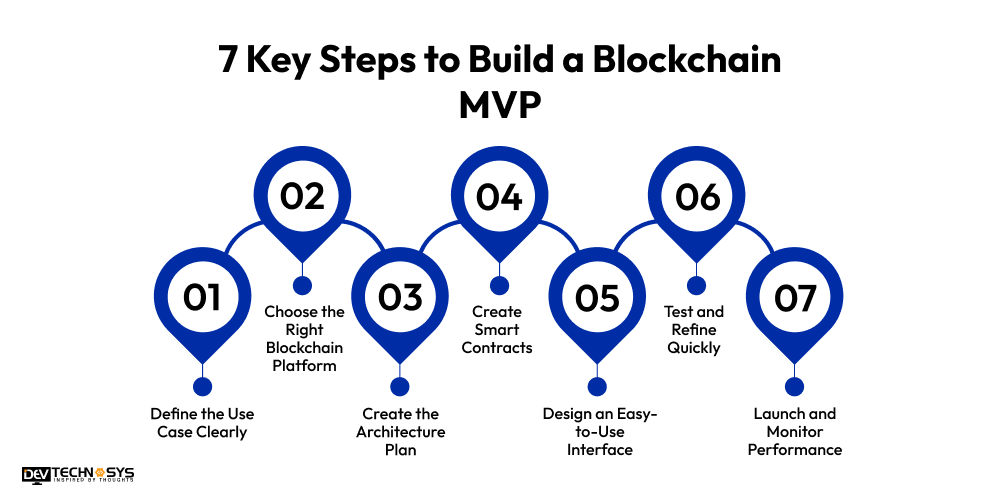
1. Define the Use Case Clearly
Identify exactly what specific problem your Blockchain MVP is trying to solve. Not all problems will require the implementation of Blockchain technology, so you’ll want to find out how relevant Blockchain is to solving your specific problem.
You’ll want to see how your MVP will fulfill your needs for transparency, security, and decentralization, where your MVP can provide you with an advantage.
2. Choose the Right Blockchain Platform
Choose the most suitable Blockchain platform to achieve your objectives. Hire MVP developers to consider the different factors on each platform that will impact each platform’s scalability, transaction costs, transaction speeds, and community support.
The selection process will directly affect the performance, safety, and future scalability of your MVP, so ensure that you are conducting an adequate assessment of which platform best meets the needs of your business.

3. Create the Architecture Plan
You will need to design your MVP from a technical perspective. Hire a blockchain development services provider to determine the back-end systems, user interfaces, and Smart Contract structure.
In addition, you will need to decide whether each component of your MVP should be on-chain or off-chain. A properly designed architecture will help optimize your product, potentially giving you cost reductions, more efficient use of resources, and the ability to scale long-term.
4. Create Smart Contracts
Smart contract development form the foundation of all Blockchain Applications. As such, perform adequate testing to produce secure, efficient code for Smart Contracts so that they will automate business logic and execute transactions appropriately.
Since security audits will assist in identifying any issues, full testing of Smart Contracts prior to their deployment is critical to ensure their performance is as designed in every scenario when deployed.
5. Design an Easy-to-Use Interface
In your blockchain MVP development process, providing customers with the fastest and most intuitive access should be your top priority, rather than forcing them through a complicated process.
The more straightforward the user experience is, the greater the chance customers will embrace your company’s minimum viable product (MVP). It gives you feedback and remains loyal to your company and product, with no issues or problems resulting because of their lack of technical understanding.
6. Test and Refine Quickly
Hire a professional enterprise blockchain development company to release your MVP in a controlled environment while performing complete functional testing of your application.
Based on feedback received from users about how your MVP performed, you will be able to address any concerns and enhance the performance, security, and needs of your user base to establish a more reliable and efficient solution over time through repeated upgrades.
7. Launch and Monitor Performance
Once you’ve put your MVP out into the marketplace, it is important to track its success. Blockchain developers for hire to utilize both analytics and user feedback to monitor how well your product performs in the real world.
By tracking the way customers utilize your product, you can identify areas of improvement, as well as develop a plan for future updates. It ensure that your blockchain product continues to develop into a fully functioning and successful product in the marketplace.
10 Must-Have Features to Integrate in Blockchain MVP
The key to a successful blockchain Minimum Viable Product (MVP) is offering these primary features: a distributed ledger, intelligent contracts, security, and the ability to grow as your business needs change. Consider these blockchain MVP features for startups and enterprises:
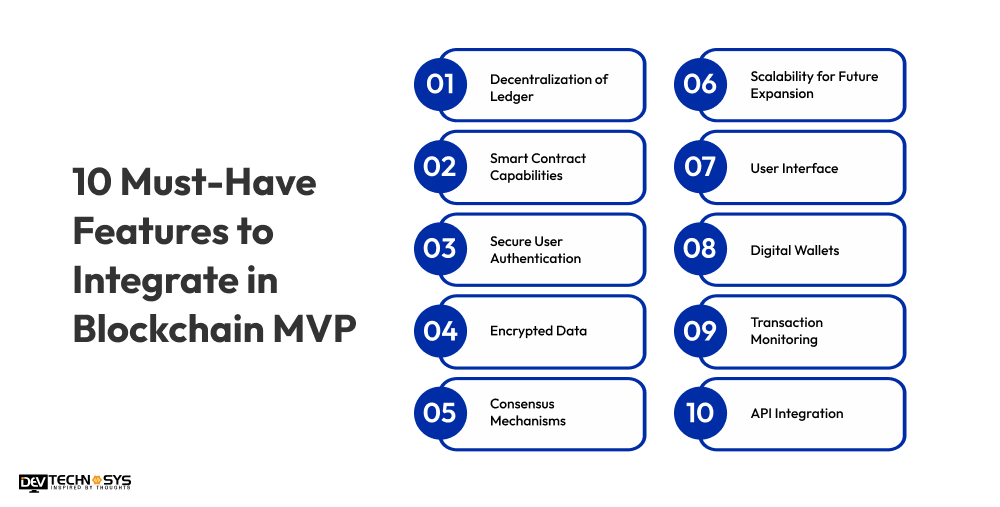
1. Decentralization of Ledger
The use of a decentralized and shared, tamper-proof ledger guarantees that all transaction records will be immutable and transparent across the entire network.
2. Smart Contract Capabilities
Automated smart contracts execute the rules specified in the contract without meaning having to consult with any third party, increasing the efficiency, accuracy, and trustworthiness.
3. Secure User Authentication
Strong identity authentication mechanisms will be employed to secure a user’s access to the blockchain, ensuring that only those individuals with authorization may participate.
4. Encrypted Data
Sensitive data stored within a blockchain will be encrypted using advanced cryptography, therefore protecting both the data itself and users’ privacy.
5. Consensus Mechanisms
Consensus mechanisms will be used to verify transaction validity and reach agreement among the participating nodes of the network in a secure and efficient manner.
6. Scalability for Future Expansion
An MVP needs to be scalable, meaning its performance should remain stable over time, regardless of how many users or transactions are using it.
7. User Interface
The user interface will be designed for ease of use so that all users can take advantage of the features offered by blockchain.
8. Digital Wallets
Digital wallets will be supported within the blockchain ecosystem. This will allow users to store, send, and receive distributed tokens and assets via a crypto wallet.
9. Transaction Monitoring
Systems and processes will be in place to enable the analytics and tracking of identity transactions, performance of the system, and activity of users to quickly identify areas.
10. API Integration
Application Programming Interfaces (APIs) are tools that provide a means for connecting to external systems. This creates better functionality and the capability to interact with current systems and services used by your company.
Want a chatbot demo or pricing? Fill the form and talk to our experts today.
Pick what you need below — you can select more than one — then tap Get detail to continue.
-
Chatbot demo dashboard
-
Cost to develop an app
-
Industry report
-
Case study
How Much Does Blockchain MVP Development Cost?
The cost of developing an MVP for blockchain technology varies substantially and is typically between $10,000 and $30,000, depending on the project requirements.
There are many factors that impact the overall blockchain app development cost, including whether there are any third-party integrations needed, whether the project requires manual or automated testing, as well as whether security testing needs to occur prior to launch, and which platform to deploy on.
The more sophisticated the project and its requirements are, for example, an MVP with extensive functionality and scalability, the greater the overall costs will be.
1. Project Complexity
The total cost of developing blockchain MVPs will be determined by the complexity of their respective MVPs, including, but not limited to, simple apps versus advanced apps.
More complex apps will typically require additional development time, expertise, and resources, which will ultimately lead to an increase in total MVP development cost.
Level |
Description |
Realistic Cost Impact |
| Low | Simple MVP with basic workflow and single feature set | $8,000 – $11,000 |
| Medium | Multi-feature MVP with light integrations | $11,000 – $17,000 |
| High | Complex logic, multiple modules, scalability focus | $17,000 – $25,000 |
2. Smart Contract Development
Smart Contracts are a significant driver of cost when developing a blockchain MVP. The increased level of sophistication of the business logic within each Smart Contract will lead to an increase in the level of development and auditing effort.
The costs associated with developing Smart Contracts include: costs related to ensuring that appropriate rigorous token standards were adhered to, as well as costs associated with the necessary testing.
Level |
Description |
Realistic Cost Impact |
| Basic | Simple token transfer or record-keeping contract | $2,000 – $3,500 |
| Medium | Conditional logic, multi-step workflows | $3,500 – $5,500 |
| Advanced | High-security contracts with audit requirements | $5,500 – $8,000 |
3. Design for UI and UX
The cost of user interface and experience design will factor into the cost of blockchain development services. A simple user interface will have a much lower cost than an advanced, interactive, and very intuitive design.
This will necessitate more of a designer’s capability to develop the design. In addition, custom graphics and animations, along with optimizing the user journey, will add to the development costs but improve the overall acceptance and usability of the blockchain MVP.
Level |
Description |
Realistic Cost Impact |
| Basic | Minimal UI with standard components | $1,000 – $1,800 |
| Standard | Clean, responsive design with user flows | $1,800 – $3,000 |
| Advanced | Custom dashboards and interactive experience | $3,000 – $4,500 |
4. Selected Blockchain Development Platform
The selection of a blockchain product development platform plays a major role in determining the cost of development. NFT infrastructure, gas fees, and difficulty integrating into many different platforms, such as Ethereum, Hyperledger, and Solana, can vary greatly.
Many of the aforementioned platforms require a substantial amount of gas optimization fees and specialized development resources compared to other networks, thereby increasing the total cost of initial development.
Level |
Description |
Realistic Cost Impact |
| Public Chain | Ethereum / Solana integration | $1,000 – $2,500 |
| Enterprise Chain | Hyperledger or private blockchain setup | $2,500 – $5,000 |
| Hybrid System | A combination of public + private networks | $5,000 – $7,000 |
5. Security and Testing Needs
Security plays an important role in the costs associated with developing blockchain MVPs, and extensive testing, auditing, and vulnerability assessment must occur prior to deployment to ensure that your application will not be exploited or have its data breached after release. Increased compliance and testing requirements are directly related to increased costs of NFT marketplace development.
Level |
Description |
Realistic Cost Impact |
| Basic QA | Functional testing and bug fixes | $500 – $1,200 |
| Standard Testing | Performance + security validation | $1,200 – $2,500 |
| Full Audit | Deep security audit + vulnerability testing | $2,500 – $4,000 |
Top 5 Blockchain MVP Use Cases Across Industries
All of these types of industries have implemented technologies that improve honesty and blockchain security for their operations, while simultaneously reducing the incidence of fraud or high operational costs through the use of a decentralized technology.
Decentralized app development technologies allow businesses an opportunity to experiment with new and innovative products, as well as provide confidence for their customers.
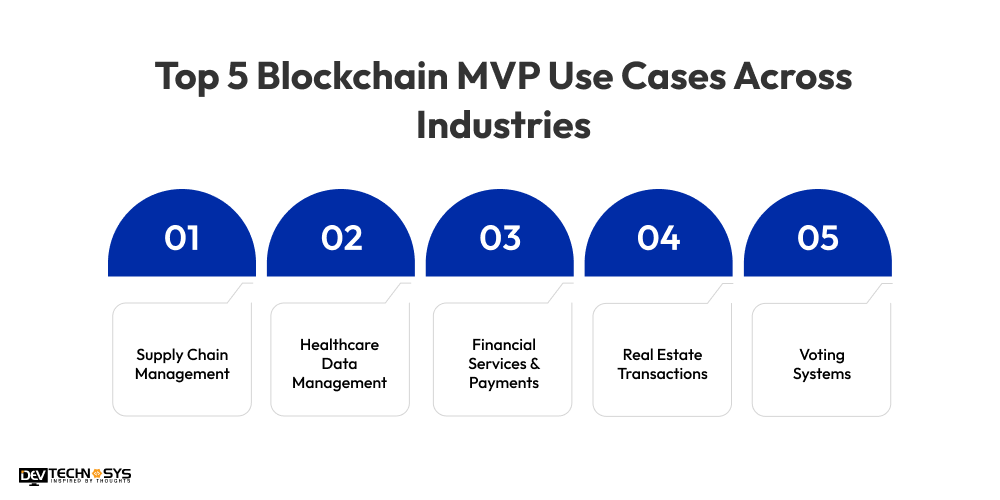
1. Supply Chain Management
Blockchain Minimum Viable Products (MVPs) enhance the visibility of the supply chain by providing a mechanism to track goods as they move from the point of origin to the point of delivery.
The blockchain’s ability to record every transaction on a decentralized ledger reduces the risk of fraud, delays, and inefficiencies in the supply chain. By having access to real-time tracking and immutable records of data, businesses have the ability to verify product authenticity and improve logistics.
2. Healthcare Data Management
Blockchain MVPs help keep patient records secure and maintain data privacy in the healthcare space. Hospitals and clinics can exchange data seamlessly across multiple networks without risking a data breach.
DeFi development solutions enable patients to have more control over the use of their medical history. Providers will have more accurate information at their disposal, resulting in enhanced coordination, precision, and efficiency in diagnosis and treatment processes.
3. Financial Services & Payments
Blockchain MVPs enable instant, low-cost, and safe financial transactions. Blockchain MVPs provide the financial industry with tools to utilize their existing systems without intermediaries. While maintaining an efficient method for cross-border transactions.
A large number of financial companies are seeking to utilize proof-of-concept solutions using blockchain technology in order to evaluate how they can use it in their full-fledged blockchain-based financial systems.
4. Real Estate Transactions
Blockchain Web3 development solutions allow for the performance of property transactions in a manner that eliminates the need for paper-based records and contracts for the recording of immovable property ownership.
Rust smart contracts provide electronic documentation of an agreement, which greatly reduces the volume of paperwork and the risks of fraud. Both buyers and sellers experience greater transparency and can complete transactions more quickly, securely, and build greater trust.
5. Voting Systems
There are multiple ways in which a blockchain MVP provides election security and record-changing security for voting in a way that cannot be manipulated or changed.
This keeps elections honest. Decentralized voting systems can be tested to help prevent fraudulent votes from being cast, allow for greater access to voting, and create global trust in democracies and decision-making.
4 Key Monetization Models of Blockchain MVP
Transaction fees, subscription options, token-based ecosystems, and technology licensing are examples of monetization strategies for a blockchain MVP. These monetization models can provide a consistent revenue stream through the scaling of platforms.
Companies can develop sustainable sources of revenue for their blockchain-based products and services by taking advantage of a decentralized platform framework.
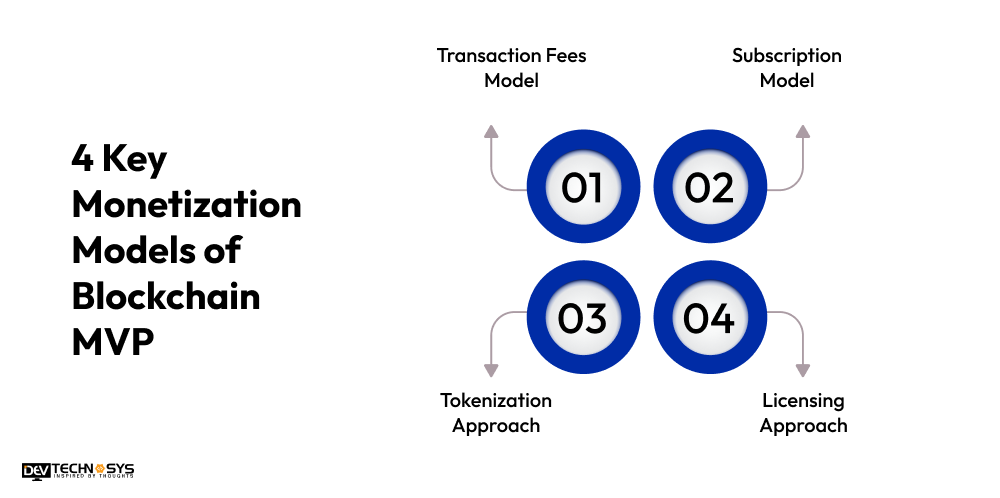
1. Transaction Fees Model
MVP’s on the blockchain can use this to generate revenue by charging small fees on all transactions made on the network. This revenue model is already being widely used in payment processing systems and also provides continuous revenue as a result of growing numbers of users and increasing platform usage.
2. Subscription Model
A subscription model can be used by businesses to provide premium access to blockchain-based features for a monthly or yearly fee. Users will pay for additional services such as advanced analytics, increased transaction speed, and enhanced security features. According to the MVP development company, This provides a steady and predictable stream of revenue to the platform.
3. Tokenization Approach
Custom tokens are issued by blockchain MVPs and utilized throughout the ecosystem. The custom tokens may be sold, traded, or accessed for service use.
As the purchase and demand for the custom token increase. So will the value of the token, thereby providing financial opportunities for both developers and users in the blockchain MVP ecosystem.
4. Licensing Approach
Blockchain app development solutions can be monetized by companies through the licensing of their technology to additional businesses. By allowing a business to utilize the blockchain infrastructure or smart contract for its business, the businesses will generate revenue through either one-time fees or through longer-term enterprise agreements with their business partners.
What Tech Stacks Are Used for Blockchain MVP Development?
Category |
Technologies / Tools |
Purpose |
| Blockchain Platforms | Ethereum, Hyperledger Fabric, Binance Smart Chain, Solana | Provide the core infrastructure for building decentralized applications |
| Smart Contract Languages | Solidity, Rust, Vyper | Used to write and deploy self-executing smart contracts |
| Frontend Development | React.js, Angular, Vue.js | Build user interfaces for interacting with blockchain apps |
| Backend Development | Node.js, Python, Go | Handle server-side logic and API integrations |
| Web3 Libraries | Web3.js, Ethers.js, Web3.py | Enable communication between the frontend and theblockchain networks |
| Wallet Integration | MetaMask, WalletConnect, Coinbase Wallet | Allow users to securely interact and sign transactions |
| Database | MongoDB, PostgreSQL, Firebase | Store off-chain data and application-related information |
| Dev Tools & Frameworks | Truffle, Hardhat, Ganache | Assist in smart contract development, audit testing, and deployment |
| Cloud & Hosting | AWS, Google Cloud, Microsoft Azure | Provide scalable infrastructure and hosting services |
| Security Tools | MythX, OpenZeppelin, CertiK | Ensure smart contract security and vulnerability testing |
| APIs & Node Providers | Infura, Alchemy | Provide access to blockchain nodes without running your own |
How Does Dev Technosys Help to Develop a Blockchain MVP?
Dev Technosys is a blockchain MVP development company that can build your Blockchain MVP for you. With our experienced team members of more than 15 years working with each other since 2010, we will help transform your concept into a functioning product by utilizing an agile approach to creating your concept into a working product.
Dev Technosys is a major tech company in San Francisco to gather your requirements, designs the Blockchain architecture, builds out the Smart Contracts, and creates a functioning MVP Product.
Conclusion
To summarize, develop an AI MVP is an effective way to quickly turn new concepts into working prototypes at low risk. This approach emphasizes performing value-added development related to essential functionalities of the MVP, allowing companies to validate the business concept, collect user feedback, and modify their products efficiently. The process allows for significant reductions in time and expense before full commercial launch while improving scalability.
Frequently Asked Questions
Find answers to the most common questions related to this article.
The cost to build a blockchain MVP typically ranges from $10,000 to $30,000 or more, depending on project complexity, features, and technology stack. Factors like smart contract development, UI design, integrations, and team expertise also influence the overall budget and final cost significantly.
Blockchain MVP development timeline usually takes between 3 and 6 months, depending on the project scope, complexity, and required features. A simple MVP can be developed faster, while advanced functionalities, integrations, and security requirements may extend the timeline significantly for successful node deployment.
Blockchain MVP development services commonly use technologies like Ethereum, Hyperledger, Solidity, Rust, and Web3 frameworks. These tools help developers create decentralized applications, build smart contracts, and ensure secure transactions while enabling scalability, flexibility, and efficient integration with other systems or platforms.
Blockchain MVP development services face challenges such as scalability limitations, high blockchain software development costs, complex integrations, and regulatory uncertainties. Additionally, finding skilled developers and ensuring robust security can be difficult. Proper planning, technology selection, and testing are essential to overcome these obstacles and ensure a successful product.
A blockchain MVP focuses on delivering core features to validate an idea quickly with minimal investment. In contrast, a full blockchain product includes advanced functionalities, scalability, and a complete user experience. MVPs are used for testing, while full products are designed for long-term growth and market expansion.