











Key takeaways:
-
- On demand logistics app development like Porter involves market research, defining features, UI/UX design, backend development, real-time tracking integration, testing, deployment, and continuous updates for scalability and performance.
- The basic MVP development cost for an app like Porter will be $8,000 to $15,000, whereas the logistics app development cost with slightly higher complexity will be $15,000 to $22,000.
- The cost to develop app like porter with advanced features and functionality like AI integration, AR/VR, and multi-platform compatibility will cost $30,000 or higher.
- Monetization strategies such as delivery fees, surge pricing, and subscriptions play a crucial role in generating consistent revenue.
- Scalability and security should be prioritized from the beginning to support future expansion, protect user data, and maintain long-term platform reliability.
Need to move goods quickly and easily? In today’s fast-paced world, apps like Porter are transforming how people transport everything from small packages to heavy loads, right from their smartphones. With just a few taps, users can book vehicles, track deliveries in real time, and enjoy fast, reliable logistics without the usual hassle.
As businesses and individuals increasingly rely on on-demand logistics, the demand for smart, efficient delivery solutions is growing rapidly. These apps are not just about transportation; they’re about convenience, transparency, and speed in a digital-first world.
If you’re planning to build a similar app in 2026, this guide will walk you through everything you need to build an app like Porter, from features and tech stack to development steps and growth strategies, helping you turn your logistics marketplace app idea into a scalable, high-performing platform ready for success.
What is Porter App?
Porter is a prominent Indian logistics technology platform established in 2014 that provides on-demand, intracity, and intercity goods transportation services. It acts as a tech-enabled aggregator, connecting users with a wide fleet of vehicles, from two-wheelers to trucks, for quick, reliable, and transparently priced deliveries.
It enables booking of mini-trucks, tempos, and two-wheelers for moving goods within 22+ Indian cities. It also provides various vehicle options, including 2-wheelers, 3-wheelers, and various mini-trucks.
Logistics App Market Stats
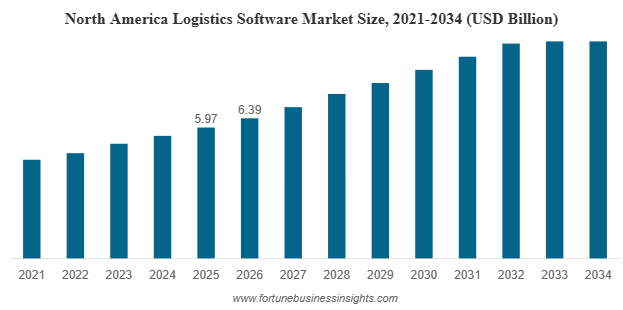
- The global logistics software market size is projected to grow from USD 17.47 billion in 2026 to USD 31.74 billion by 2034, exhibiting a CAGR of 7.75% during the forecast period
- North America dominated the global market with a share of 36.78%
- According to International Trade Administration.gov, the global B2B ecommerce market will be valued at USD 36 trillion by 2026.
- The Deployment segment is projected to dominate the market with a share of 62.28% in 2026
How Do Apps Like Porter Work?
Apps like Porter are on-demand logistics platforms that connect users with nearby drivers for quick and efficient goods transportation. They leverage real-time tracking, smart matching algorithms, and digital payments to streamline the entire delivery process. Here’s how porter app works step by step:
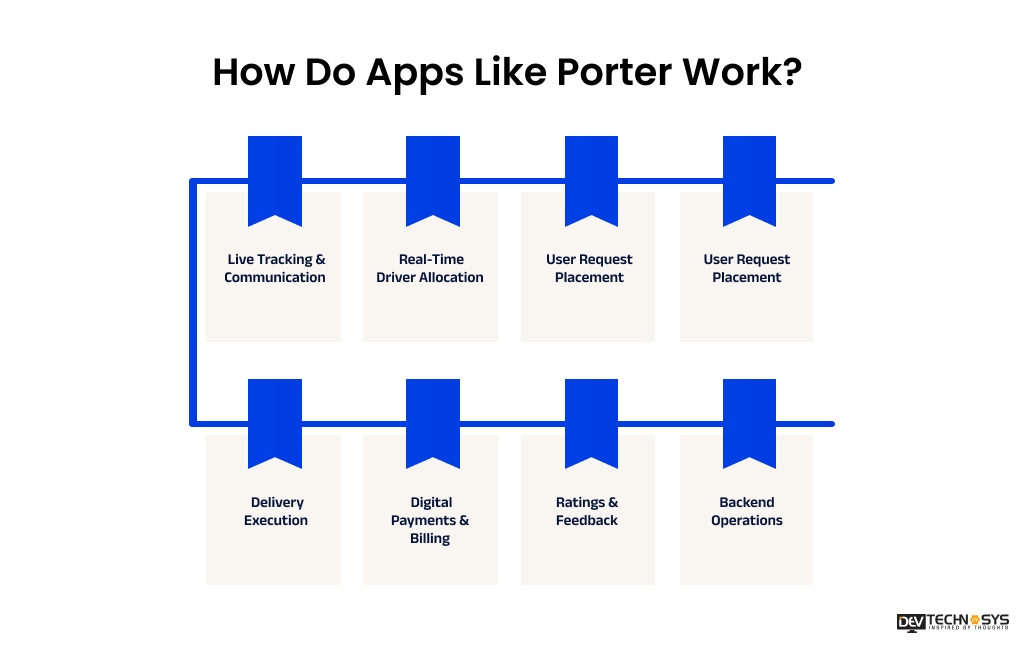
- User Request Placement: Customers open the app, enter pickup & drop locations, select vehicle type (bike, mini truck, etc.), and schedule the delivery (instant or later).
- Smart Matching Algorithm: The system uses GPS and AI-based matching to assign the nearest available driver, optimizing distance, time, and pricing.
- Real-Time Driver Allocation: Once a driver accepts the request, the real-time delivery tracking app sends users the driver’s details, ETA, and vehicle info. The trip starts with live tracking enabled.
- Live Tracking & Communication: mini truck booking app development an app like porter
- Help users in tracking the shipment in real time via GPS and communicate with the driver through in-app call/chat features.
- Delivery Execution: The driver picks up the goods and delivers them to the destination, following optimized routes suggested by the app.
- Digital Payments & Billing: After delivery, users can pay via UPI, cards, wallets, or cash. The app generates invoices automatically.
- Ratings & Feedback: Both users and drivers rate each other, helping maintain service quality and trust within the platform.
- Backend Operations: Admins manage logistics through dashboards that handle driver onboarding, pricing, order tracking, analytics, and dispute resolution.
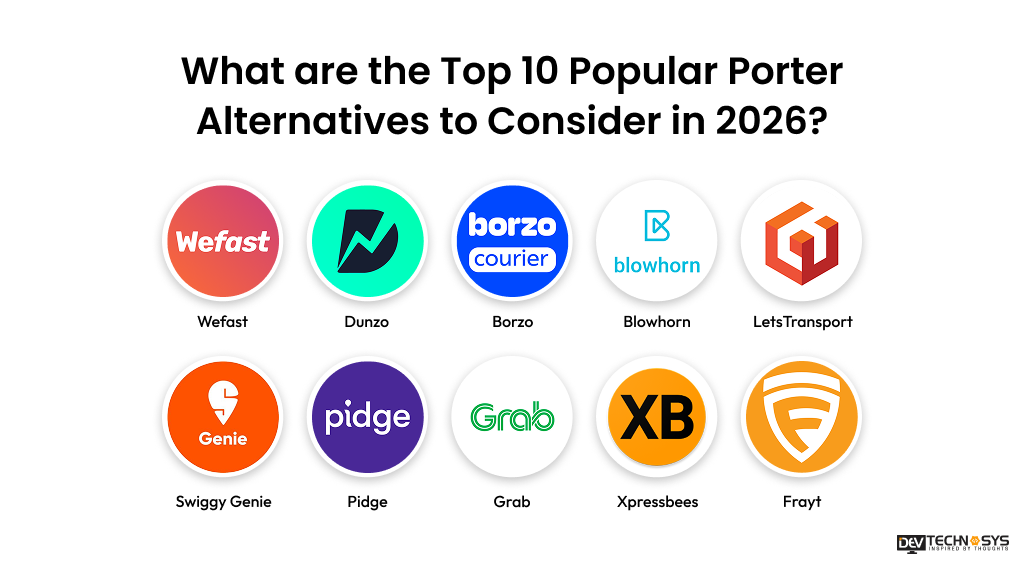
What are the Top 10 Popular Porter Alternatives to Consider in 2026?
Several on-demand logistics apps have emerged as strong alternatives to Porter, offering fast, reliable, and cost-effective delivery services. These platforms offer features such as real-time tracking, multiple vehicle options, and seamless booking, making them ideal choices for businesses and individuals in 2026.
App |
Launch Year |
Ratings (Approx.) |
Platform Availability |
| Wefast | 2012 | 4.3 | Android, iOS, Web |
| Dunzo | 2015 | 4.4 | Android, iOS, Web |
| Borzo | 2012 | 4.5 | Android, iOS, Web |
| Blowhorn | 2014 | 4.2 | Android, iOS, Web |
| LetsTransport | 2015 | 4.3 | Android, Web |
| Swiggy Genie | 2020 | 4.5 | Android, iOS |
| Pidge | 2019 | 4.2 | Android, Web |
| Grab | 2012 | 4.4 | Android, iOS |
| Xpressbees | 2015 | 4.3 | Android, Web |
| Frayt | 2017 | 4.4 | Android, iOS |
1. Wefast
Wefast is a reliable on-demand courier and delivery service designed for businesses and individuals. It offers same-day and express deliveries with real-time tracking, flexible pricing, and API integrations.
The platform is ideal for eCommerce, retail, and logistics operations requiring fast and efficient last-mile delivery solutions. For fleet management app development like Wefest, contact a professional app development provider.
Industry Insights:
According to PR Newswire, Wefeast has over 2 million customers globally, with approximately 90% of its 375,000 active clients.
2. Dunzo
Dunzo is a popular hyperlocal delivery app that enables users to send packages, shop for essentials, and complete everyday tasks. With robust order management system (OMS, it provides quick pickup and delivery services with live tracking, multiple payment options, and strong urban coverage, making it a convenient alternative for instant logistics needs.
3. Borzo
Borzo is an international same-day delivery service known for its affordability and efficiency. It supports businesses with scalable logistics solutions, route optimization algorithm, and real-time tracking.
The platform is widely used for courier deliveries, eCommerce logistics, and intra-city transportation across multiple countries. To build a courier delivery app for courier business, contact a top provider from a reputable firm.
4. Blowhorn
Blowhorn specializes in intra-city logistics using mini trucks and light commercial vehicles. It caters to SMEs, retailers, and enterprises for moving goods efficiently.
With features like scheduled deliveries, fleet management, and real-time tracking (GPS + WebSockets), Blowhorn ensures cost-effective and reliable transportation services.
5. LetsTransport
Let’s Transport is a technology-driven logistics platform that connects businesses with a network of transporters. It focuses on optimizing supply chains through smart matching, real-time tracking, and analytics. This platform supports bulk transportation, enterprise logistics, and last-mile delivery with scalable solutions.
Want a chatbot demo or pricing? Fill the form and talk to our experts today.
Pick what you need below — you can select more than one — then tap Get detail to continue.
-
Chatbot demo dashboard
-
Cost to develop an app
-
Industry report
-
Case study
What are the Smart Steps to Create A Logistics App Like Porter from Scratch?
This is it! You have reached the perfect guide that will provide you with five steps to develop a logistics app like Porter with successful results. So what are you waiting for? Carefully start reading this section with a notepad and write it down to create an impressive roadmap.
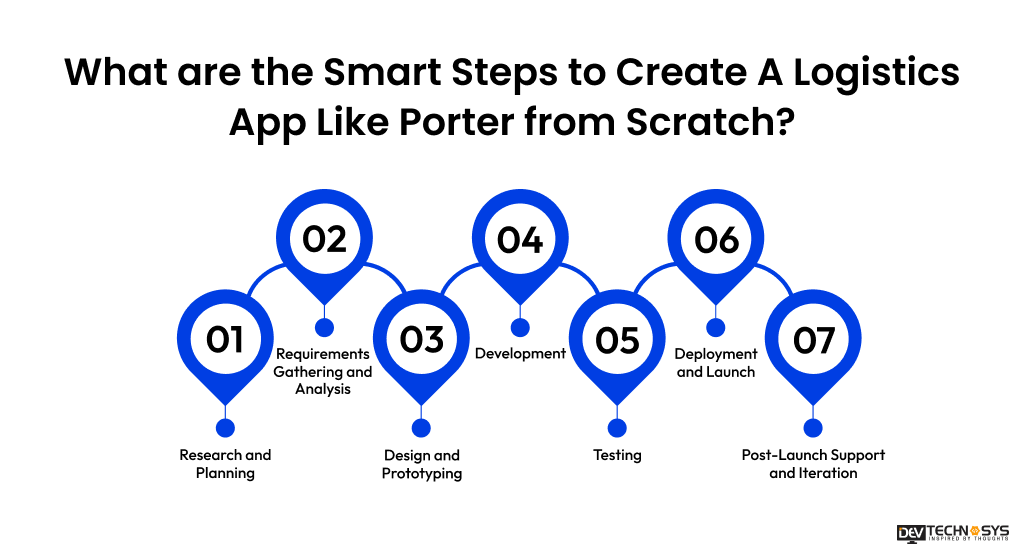
Stage 1: Research and Planning
This is the first stage to developing a logistics app like Porter, in which your on demand app development solutions providers will study the logistics quarterly, your goal market, and your competitors via in-depth marketplace research. Describe your app’s main features and special value proposition.
Create an intensive business plan that outlines your objectives, profit projections, and techniques for marketing. Find a sincere porter clone app development company that specializes in on-demand delivery apps and logistics by doing some research.
Stage 2: Requirements Gathering and Analysis
Clearly describe the practical and technical requirements of your logistics app and connect with the parcel delivery app development company of your preference. This stage to create a Logistics app like Porter covers the following: user roles, vital functionalities, integration desires, and scalability elements.
Create use cases and user tales to ensure every user involved is aware of the capability of the transport and logistics app development. To see the user interface and experience of the app, create wireframes and mockups.
Stage 3: Design and Prototyping
This is the third stage to create a Logistics App like Porter in which the experts who provide hybrid app development services must connect with the UI/UX designers at the warehouse management software development company to supply a user-friendly and aesthetically desirable app design.
Build app like porter with layouts that fits the unique necessities of logistics customers, even as being regular with your emblem identity. Create interactive prototypes so as to evaluate user flows and get input from possible users. Adjust the design in light of stakeholder feedback and the outcomes of user checking out.
Stage 4: Development
It is the fourth stage to create a logistics app like Porter. You hire the warehouse management software development company, normally utilizing an agile system with regular sprints and deliverables.
Database management, server-side good judgment improvement, and front-end development for the iOS and Android platforms are all covered in this step. Include vital features like fee processing, real-time tracking, booking systems, and user registration.
Industry Insights:
According to Business Insider, last-mile delivery accounts for nearly 41% of total logistics costs, making efficient app development and optimization essential for profitability
Step 5: Testing
At this stage, developers who provide pickup and delivery app development services will performs comprehensive testing across multiple levels, including unit testing, integration testing, and user acceptance testing.
This process helps porter clone app development experts to identify bugs, ensures smooth functionality, validates performance, and guarantees that the app delivers a secure, reliable, and user-friendly experience before deployment.
Stage 6: Deployment and Launch
This is the second last stage to create a logistics app like Porter, in which you must assemble the required server infrastructure and configure cloud services in advance of the app launch. Make sure the app complies with the necessities of each store before submitting it to the Apple Store and Google Play Store.
Your hired Webapp development company will create a thorough launch plan that includes PR campaigns, marketing projects, and promotional events.
To get early input and fix any final-minute bugs, the app will be soft-released to a small organization of customers. Proceed with the whole launch of the app whenever you’re happy with its stability and functionality.
Stage 7: Post-Launch Support and Iteration
Last but not least, the stage to create a logistics app like Porter, in which, after launch, your Android app development company will carefully examine the app’s capability and consumer critiques. Assist with continuing technical help and quickly clear up any problems that are pronounced.
Examine user facts and stats to find probabilities for brand-new features and areas that need modification. Your courier delivery app development company will create a plan for upcoming enhancements and updates based on user input and enterprise traits.
Release app updates often to deal with troubles, enhance functionality, and add new features. To grow your user base and roll out your app as the business’s top logistics answer, preserve your advertising efforts.
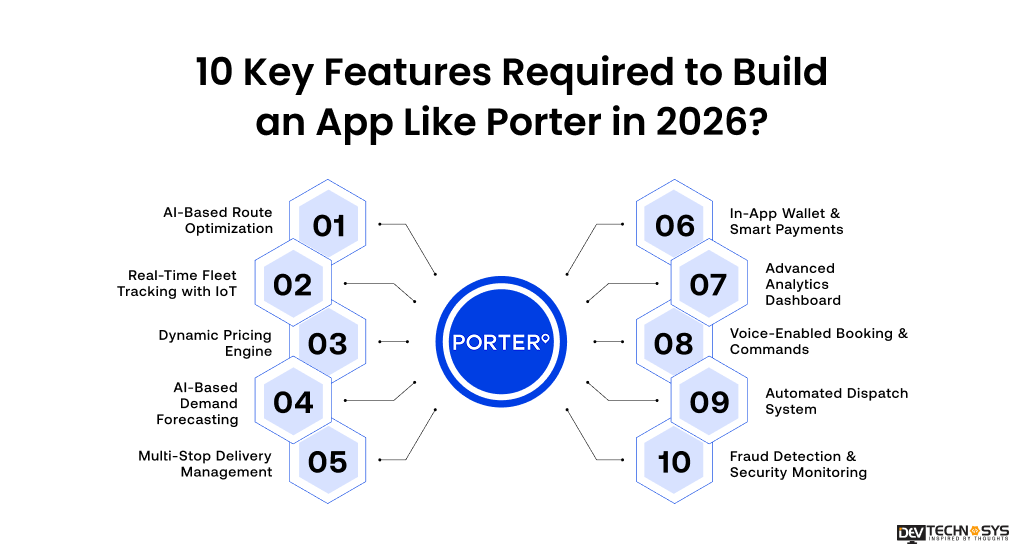
10 Key Features Required to Build an App Like Porter in 2026?
Building an app like Porter in 2026 requires a strong combination of real-time logistics capabilities and user-centric features. From seamless booking to intelligent route optimization, these features of porter app clone ensure efficient, scalable, and reliable on-demand delivery services.
Customer Panel |
Driver Panel |
Admin Panel |
| Easy Sign-up/Login | Driver Onboarding & KYC | User & Driver Management |
| Book Pickup/Delivery | Accept/Reject Requests | Order Management |
| Real-Time Tracking | Live Navigation (GPS) | Live Tracking Dashboard |
| Fare Estimation | Earnings & Wallet | Pricing & Commission Setup |
| Multiple Payment Options | Availability Toggle | Payment & Transaction Control |
| Order History | Trip History | Reports & Analytics |
| Push Notifications | In-app Chat/Call | Notification Management |
| Ratings & Reviews | Ratings & Feedback | Dispute Resolution |
1. AI-Based Route Optimization
Porter clone apps use AI-powered route optimization to analyze traffic patterns, delivery density, and real-time conditions to suggest the fastest and most cost-efficient routes, reducing fuel consumption, delivery time, and improving overall operational efficiency.
Industry Insights:
Statista reports that AI is increasingly used in logistics for route planning, forecasting, and automation, helping companies streamline operations.
2. Real-Time Fleet Tracking with IoT
Exports who provide GPS tracking software development services will add IoT sensors with GPS that enable real-time tracking of vehicles, monitoring speed, location, and delivery status. This enhances transparency, improves delivery accuracy, and helps businesses manage fleets more effectively.
3. Dynamic Pricing Engine
A smart pricing engine adjusts delivery charges based on demand, distance, traffic, and availability of drivers. This ensures competitive pricing while maximizing profits during peak hours or high-demand situations.
4. AI-Based Demand Forecasting
Using machine learning, the delivery app like Fetchr predicts delivery demand based on historical data, seasonal trends, and user behavior. This helps in better driver allocation, reducing wait times and increasing service efficiency.
5. Multi-Stop Delivery Management
This feature is crucial to build on demand truck booking app. It allows users and drivers to manage multiple pickups and drop-offs in a single trip. It optimizes routes and reduces operational costs, making it ideal for businesses handling bulk deliveries.
6. In-App Wallet & Smart Payments
An integrated wallet supports multiple payment options, auto-pay, and refunds. Smart payment systems enhance user convenience, streamline transactions, and provide secure and seamless financial management within the app.
7. Advanced Analytics Dashboard
Admins get access to detailed analytics of delivery app like DPD, including delivery performance, driver efficiency, revenue insights, and user behavior. These data-driven insights help in making informed business decisions and optimizing operations.
8. Voice-Enabled Booking & Commands
Voice recognition allows users to book deliveries, track orders, or communicate with drivers hands-free. This improves accessibility and enhances user experience, especially for users who prefer quick, voice-based interactions.

9. Automated Dispatch System
Create an app like Porter with intelligent dispatch system that automatically assigns delivery requests to the nearest available driver based on location, availability, and performance, reducing manual effort and ensuring faster order fulfillment.
10. Fraud Detection & Security Monitoring
AI-powered fraud detection systems monitor suspicious activities, payment anomalies, and fake bookings in real-time. This ensures secure transactions, protects user data, and maintains trust within the platform ecosystem.
Why Businesses Should Invest to Build an App Like Porter in 2026?
Investing in an app like Porter in 2026 is a strategic move as on-demand logistics continues to grow rapidly. With increasing user expectations for speed and convenience, such apps help businesses scale efficiently while maximizing revenue opportunities.
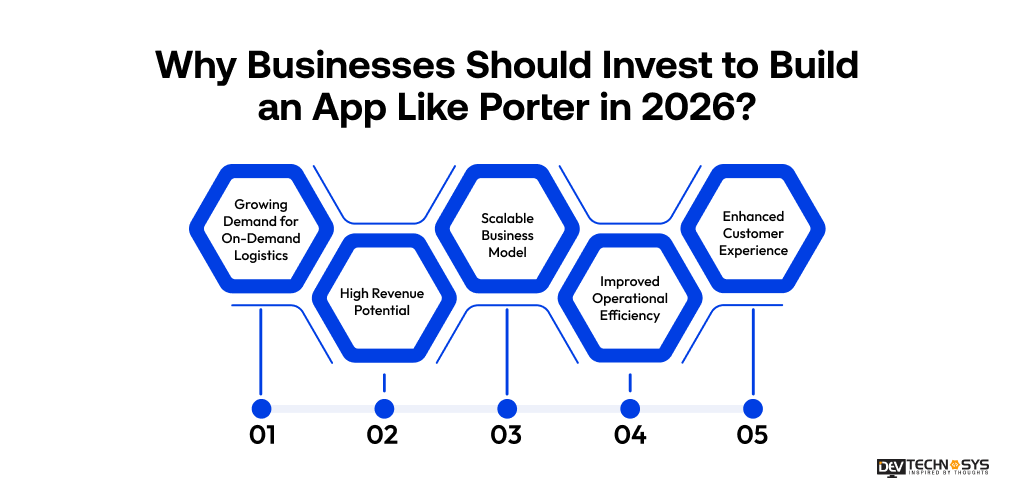
1. Growing Demand for On-Demand Logistics
The rapid expansion of eCommerce platforms and hyperlocal delivery services has significantly increased the need for fast, reliable logistics solutions, making apps like Porter essential for businesses aiming to meet modern consumer expectations efficiently.
2. High Revenue Potential
Courier delivery apps like Lalamove provide diverse revenue streams, including delivery fees, surge pricing during peak demand, subscription plans, and commission-based earnings. With the help of this strategy, businesses to generate consistent income while maximizing profitability through scalable service offerings.
Industry Insights:
Statista highlights that around 25 billion parcels are delivered globally, highlighting massive demand for logistics services.
3. Scalable Business Model
Create an app like Porter with cloud-based infrastructure and modern technologies to seamlessly expand into new cities and regions. This allows businesses to scale operations efficiently without major system overhauls or significant additional investments in resources.
4. Improved Operational Efficiency
Advanced automation features such as route optimization, real-time tracking, and automated dispatch systems minimize manual intervention, reduce errors, and enhance delivery speed. It ultimately improving overall operational productivity and resource utilization for businesses.
5. Enhanced Customer Experience
Make an app like Porter with user-friendly features like live tracking, instant booking, multiple payment options, and timely notifications to ensure convenience and transparency. It helps businesses deliver a superior customer experience that drives satisfaction, retention, and long-term brand loyalty.
How Much Does it Cost to Build an App Like Porter?
The cost to develop an app like Porter is between $8,000 to $30,000+, depending on various factors like features, platform choice, tech stack, geographic location of development team, and more.
The basic MVP development cost for an app like Porter will be $8,000 to $15,000, whereas the logistics app development cost with slightly higher complexity will be $15,000 to $22,000.
However, the cost to develop an app like Porter with advanced-level features like AI integration, AR/VR, and multi-platform compatibility will exceed to $30,000 or higher. Here’s the logistics app development cost breakdown based on app complexity level.
App Setup Type |
Included Modules |
Estimated Cost |
| Basic MVP | Customer App + Backend | $8,000 – $12,000 |
| Standard App (Core Porter Clone) | Customer + Driver App + Backend | $12,000 – $20,000 |
| Full System (Recommended) | Customer + Driver + Admin Panel + Backend | $20,000 – $30,000 |
The final cost to build an app like Porter can also depend on maintenance and security services. Below, we have discussed some of the major factors that impact the courier delivery app development cost. Let’s learn about these factors in more detail
1. Feature Complexity
Features are a crucial factor that influences the final Porter app development cost. The fewer the complex features, the lower the cost. The addition of advanced features can increase the cost to build an app like Porter can increase significantly. It is best to start with only core features, then add advanced features gradually with time.
Feature Level |
Estimated Cost |
| Basic MVP | $2,000 – $3,200 |
| Moderate | $3,000 – $4,700 |
| Advanced | $4,500 – $6,800+ |
2. Platform Choice
Your choice of platform also impacts the cost to develop an app lke porter. Cross-platform development (using frameworks like Flutter or React Native) saves time and cost in the long run.
How the cost to develop an app like Porter for native platforms (separate apps for Android and iOS) offers better performance, but increases the overall cost to develop a mobile app.
Platform |
Estimated Cost Impact (USD) |
| Android Only | $3,000 – $5,000 |
| iOS Only | $3,500 – $6,000 |
| Multi-Platform Compatibility (iOS, Android, Web) | $5,000 – $8,000 |
3. Tech-Stack
Choose your tech-stack for packers & movers app development wisely because it determines the scalability, performance, and most importantly, the cost to create your logistics app.
A well-optimized stack ensures smooth operations like real-time tracking, booking management, and payment processing, but increases the porter app development cost
Component |
Estimated Cost Impact (USD) |
| Frontend Framework (React Native / Flutter) | $2,000 – $4,000 |
| Backend Framework (Node.js / Django / Laravel) | $1,500 – $3,000 |
| Database (PostgreSQL / Firebase / MongoDB) | $1,000 – $2,000 |
4. Developer Location
The location of your development team plays a major role in determining the total cost of building an app like Porter. Different regions have varying hourly rates based on expertise, demand, and living costs.
Hiring developers from countries like India for MVP app development can reduce overall cost to make an app like Porter by 40% to 60% without compromising quality.
Location |
Estimated Cost Impact (USD) |
| North America / Western Europe | $50 – $150 / hour |
| Eastern Europe / Latin America | $25 – $50 / hour |
| India / Southeast Asia | $15 – $35 / hour |
5. Maintenance Services
After launching your app, ongoing maintenance is essential to ensure smooth performance, security, and scalability. Maintenance costs are often overlooked but are critical for long-term success.
From bug fixes to security patches and system optimization, every maintenance service is crucial to ensuring the app’s smooth performance in the long run.
Service |
Estimated Cost Impact (USD/year) |
| Bug Fixes & Updates | $800 – $1,500 |
| Feature Enhancements | $1,000 – $1,800 |
| Cloud & Server Management | $700 – $1,500 |
How Do Apps Like Porter Generate Revenue?
Apps like Porter generate revenue through multiple streams, including commissions, delivery fees, subscriptions, and surge pricing. These monetization strategies ensure consistent income while supporting scalability and efficient logistics operations.
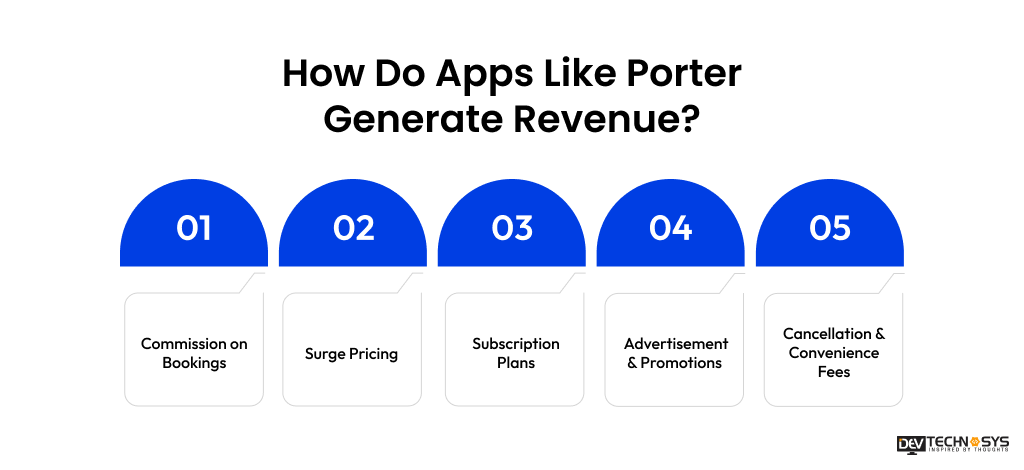
1. Commission on Bookings
Apps like Porter primarily earn revenue by charging a commission on every completed delivery. A percentage is deducted from the total fare paid by customers. This model ensures consistent income as the platform grows and handles more logistics and transportation requests daily.
2. Surge Pricing
During peak hours, high demand, or bad weather conditions, dynamic pricing is applied. Users pay higher fares, increasing platform revenue. This strategy not only boosts earnings but also encourages more drivers to stay active and fulfill urgent delivery requests efficiently.
3. Subscription Plans
Porter-like apps offer subscription models for businesses and frequent users. These plans provide benefits such as discounted delivery rates, priority bookings, and faster services. Subscriptions generate recurring revenue while improving customer retention and ensuring long-term engagement with the platform.
4. Advertisement & Promotions
The platform can monetize by displaying ads or promoting partner businesses within the app. Logistics companies, vendors, and service providers pay to gain visibility. This creates an additional revenue stream without directly impacting the core delivery services offered to users.
5. Cancellation & Convenience Fees
Apps charge cancellation fees when users cancel bookings after a certain time. Additionally, convenience or platform fees may be applied to each transaction. These small charges collectively contribute to steady revenue while helping offset operational and service management costs.
What Are the Latest Tech Trends Shaping the Future of Porter App Development?
Apps like Porter are rapidly evolving with the integration of advanced technologies that enhance efficiency, scalability, and user experience. From AI-driven automation to sustainable logistics solutions, these innovations are reshaping the future of on-demand delivery app development.
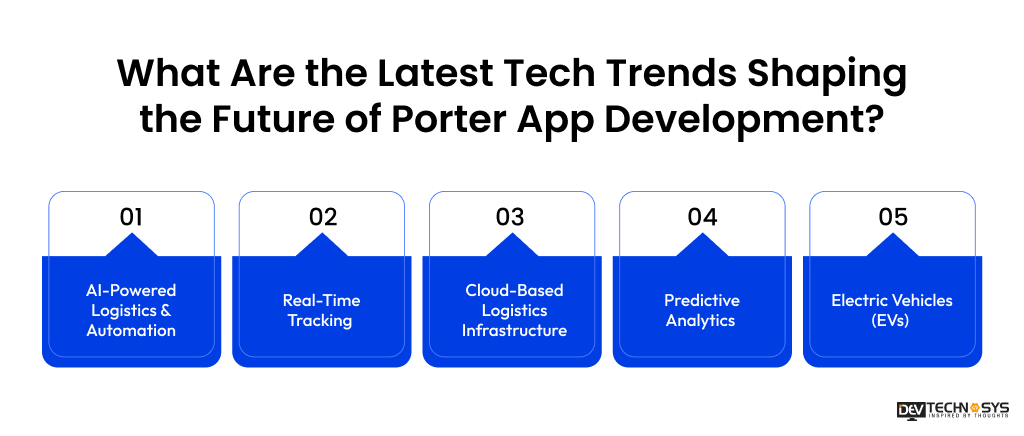
1. AI-Powered Logistics & Automation
Artificial Intelligence is revolutionizing logistics apps by enabling predictive decision-making, smart dispatching, and automated workflows. AI helps forecast demand, optimize delivery routes, and minimize delays, making operations faster and more efficient.
2. Real-Time Tracking & Smart Route Optimization
Advanced GPS systems combined with AI-driven route optimization allow apps to dynamically adjust delivery routes based on traffic, weather, and demand fluctuations. This enhances delivery speed, reduces fuel consumption, and improves overall efficiency while providing real-time visibility to users.
3. Cloud-Based Logistics Infrastructure
Cloud computing enables logistics platforms to scale, be flexible, and access real-time data. It connects drivers, customers, and businesses through centralized systems, enabling seamless coordination and uninterrupted service across multiple cities and operational zones.
4. Predictive Analytics & Demand Forecasting
Predictive analytics enables logistics apps to analyze historical and real-time data to forecast demand accurately. This helps businesses optimize fleet utilization, prevent delivery bottlenecks, and make proactive decisions, ultimately improving operational efficiency and reducing costs.
5. Electric Vehicles (EVs) & Sustainable Logistics
Sustainability is becoming a priority in logistics, with companies increasingly adopting electric vehicles for last-mile deliveries. This shift reduces fuel expenses and carbon emissions while supporting eco-friendly operations, making logistics platforms more sustainable in the long run.
You can reach out anytime; we are available 24/7. Our team provides a quick response.

Conclusion
Building an app like Porter in 2026 requires a strategic blend of advanced technology, user-centric design, and scalable architecture. With the growing demand for on-demand logistics, investing in a Porter-like app can be a highly profitable and future-ready business opportunity.
If you are a business wanting to develop a similar app like porter for your business, contact Dev Technosys, a top logistics app development company in USA. we turn your rough idea into a full-fledged pick-up and delivery app.
Frequently Asked Questions
Find answers to the most common questions related to this article.
The cost to develop an app like Porter typically ranges from $8,000 to $30,000 or more, depending on feature complexity, platform choice, UI/UX design, and integrations like real-time tracking, payment gateways, and fleet management systems.
Time taken to build on demand truck booking app like Porter lies between 3 to 5 months for an MVP with basic features, while a fully functional app with advanced capabilities may require 6 to 9 months or more.
Tech stack for building an app like Porter includes:
Frontend: Flutter / React Native (cross-platform), Swift (iOS), Kotlin (Android)
Backend: Node.js / Django / Ruby on Rails
Database: MongoDB / PostgreSQL / MySQL
Cloud & Hosting: AWS / Google Cloud / Microsoft Azure
Real-Time Services: Firebase, WebSockets
Maps & Navigation: Google Maps API, Mapbox
Payments: Stripe, Razorpay, PayPal
Notifications: Firebase Cloud Messaging (FCM), Twilio
DevOps: Docker, Kubernetes, CI/CD (Jenkins, GitHub Actions)
Key features of a Porter-like app includes:
User Panel: Easy registration, booking, fare estimation, live tracking
Driver Panel: Ride requests, earnings dashboard, route navigation
Admin Panel: User & driver management, analytics, reports
Real-Time Tracking: GPS-based vehicle tracking and ETA updates
Smart Matching: Auto-dispatch & load matching algorithm and driver allocation system
Secure Payments: Multiple payment options with wallet integration
Push Notifications: Push notification system (FCM/APNs) helps with booking updates, alerts, and reminders
Ratings & Reviews: Feedback system for service improvement
Route Optimization: Fastest path selection for efficient deliveries
Scalability: Multi-city support and high user load handling
Yes, start your goods transport app development with a Minimum Viable Product (MVP) that includes only essential features allows you to reduce initial costs, test the market, gather user feedback, and gradually scale the application with advanced features later.