



















Real estate app development is not just a digital enhancement, but a strategic investment. As every industry is going online, the real estate sector is also openly welcoming its digital transformation. So, building a real estate app from scratch can be a smart move for businesses that want to stay competitive in this digital world.
Developing custom real estate apps is really essential to evolve with customer behavior, streamline operations, and unlock new ROI options. From property listing to connecting buyers and sellers, building a real estate app simplifies the property sale and purchase journey.
Now, the important question is how to build a real estate app from scratch. So, developing a successful app requires clear planning, the right features, a suitable technology stack, and more. If you are starting with an idea, this real estate app development guide is definitely for you.
Real Estate App Development Market: Key Stats Every Business Owner Should Know in 2026
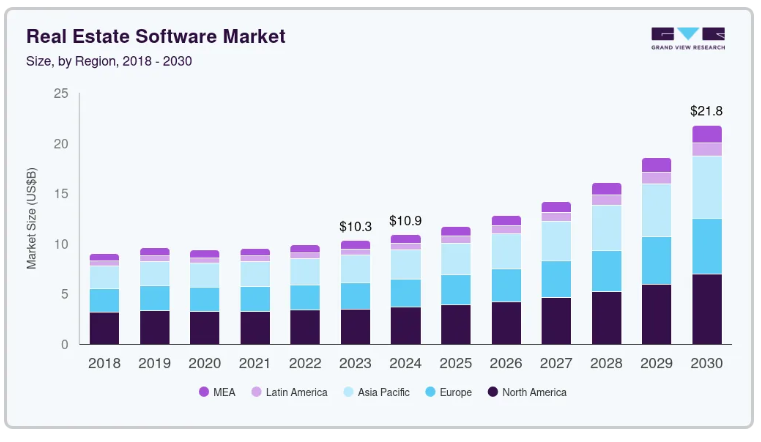
We can clearly see the rapid adoption of mobile technologies for everything; the real estate mobile app development is no exception. So, let’s understand the growth in real estate app usage and digital property transactions via statistical data provided by Grand View Research.
- In 2023, the market size of the real estate software was valued at USD 10,285.7 million globally.
- These numbers increased in 2024 and reached USD 10,882.2
- This market is expected to reach USD 21,766.9 million by 2030, with a growing CAGR of 3% from 2024 to 2030.
- North America dominated the target market in 2022 with a major share of08% of the overall share.
What Is A Real Estate App? Understand Its Ecosystem
As you must be thinking what is real estate app development, it is a platform that streamlines and optimizes multiple real estate activities, including buying, selling, renting, or managing properties. This app helps connect buyers, sellers, agents, and renters under one roof.
The ecosystem of a real estate mobile app development offers a smooth experience to users interested in selling, buying, or renting property. It is a combination of applications, technologies, and participants that interact around a central platform.
An iOS and Android app development for a real estate business is not only for buyers and sellers. It also includes core participants like renters, landlords, real estate agents, brokers, and investors. The key technologies and integrations required to make a real estate app include:
- Data and Analytics
- Geolocation and Mapping
- Virtual Reality (VR) and Augmented Reality (AR)
- Communication Tools
- Finance Calculators
Why Businesses are Investing in Real Estate App Development Services in 2026?
The demand for digital property search, diverse revenue streams, and revolutionized traditional processes attracts entrepreneurs to invest in real estate app design and development. Here, we will elaborate on some of these reasons.
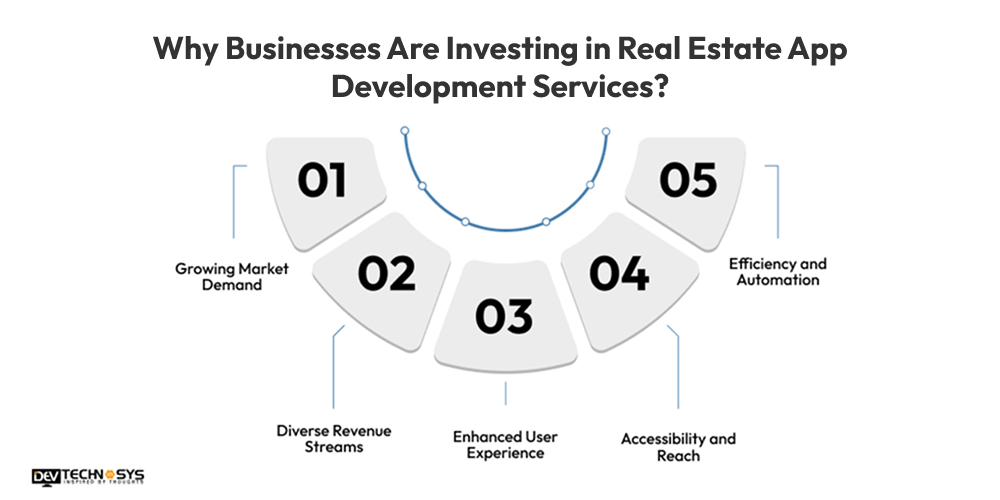
1. Growing Market Demand
Most people are showing interest in searching, comparing, and finalizing the properties online. So, entrepreneurs can build a real estate broker app to meet the growing demand and let users access property listings easily. It will become convenient for users to make faster and more informed property decisions.
2. Diverse Revenue Streams
With a real estate app development for brokers and users, business owners can make money from a variety of sources. This includes advertisements, commissions, featured listings, and subscriptions. This adaptability reduces the reliance on a single source of income while driving consistent income.
3. Enhanced User Experience
With a more upgraded search, maps, filters, and real-time communication, an app offers a seamless, user-friendly experience. This ease in operating the app increases the chances of property conversions. Such apps also help businesses by keeping people interested for longer and making them come back to the app again and again.
4. Accessibility and Reach
Users can browse real estate listings at any time and from any location with a mobile app. This lets you reach a larger audience of buyers, sellers, and agents, and broadens the scope of your business beyond local bounds. You can hire mobile app developers and make your app stand out, and give you more ideas to expand your accessibility and reach.
5. Efficiency and Automation
Lead monitoring, follow-ups, notifications, and listing administration, all automated by trendy real estate apps ideas, can increase its efficiency. This helps organizations run more effectively while focusing more on the app’s expansion and client relationships. It also saves time and minimizes human efforts and errors.
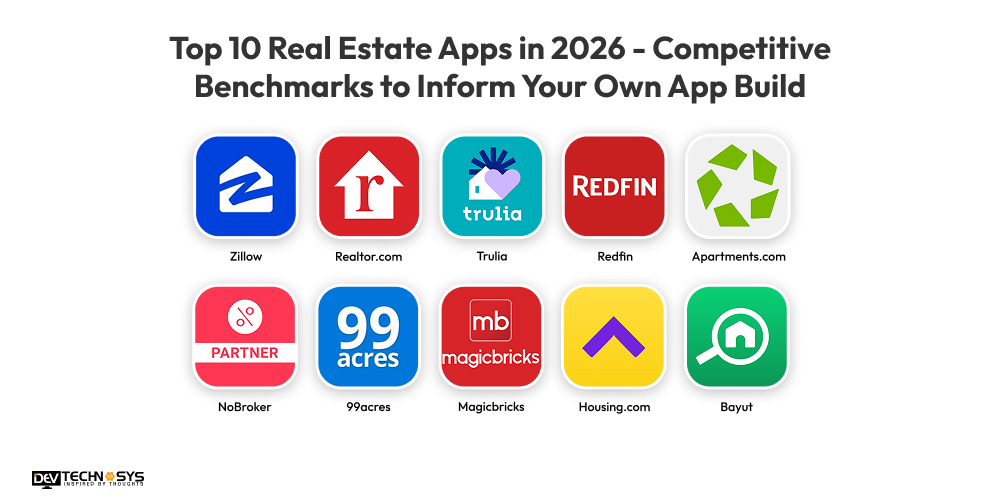
Top 10 Real Estate Apps in 2026 — Competitive Benchmarks to Inform Your Own App Build
The types of real estate apps in today’s world are transforming the way people used to buy, sell, or rent properties. Here are some of the widely used real estate apps available in the market.
App Name |
Launch Year |
Rating |
Downloads |
Platform Availability |
| Zillow | 2006 | 4.7 | 100M+ | iOS, Android |
| Realtor.com | 2010 | 4.6 | 50M+ | iOS, Android |
| Trulia | 2005 | 4.5 | 10M+ | iOS, Android |
| Redfin | 2010 | 4.7 | 10M+ | iOS, Android |
| Apartments.com | 2011 | 4.8 | 10M+ | iOS, Android |
| NoBroker | 2014 | 4.4 | 10M+ | iOS, Android |
| 99acres | 2005 | 4.1 | 5M+ | iOS, Android |
| Magicbricks | 2013 | 4.0 | 5M+ | iOS, Android |
| Housing.com | 2012 | 4.3 | 10M+ | iOS, Android |
| Bayut | 2014 | 4.2 | 1M+ | iOS, Android |
How to Build a Real Estate App From Scratch: A 5-Step Development Guide for 2026
For property listing app development from scratch, businesses need to list specific requirements. These include features, functionalities, API integrations, security, and regulatory compliance. Leaders might get confused about which factors to consider. Thus, a five-step approach is shared, providing a practical roadmap for developing a scalable real estate app.
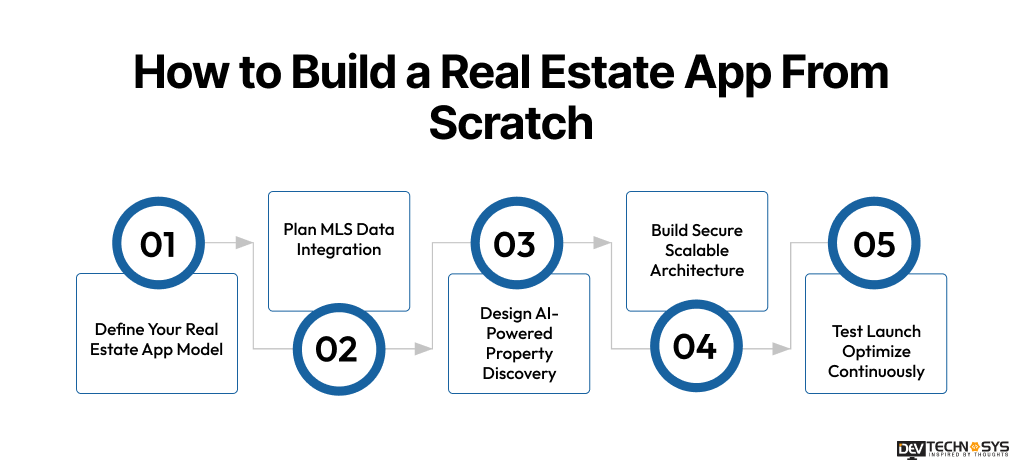
1. Define Your Real Estate App Model
To build a real estate app from scratch, it is important to understand the target audience and business operations, and to conduct research on competitors such as Zillow. The solution is an agent CRM, property marketplace, brokerage platform, or a rental platform. Also, a business needs to build an MVP or move ahead with custom real estate app development. The design determines the project’s budget and scope. Thus, businesses can connect with the project managers to discuss everything in detail.
2. Plan MLS Data Integration
A property listing app should have MLS connectivity to stay with trends and evolving customer needs. Today, preference is given to a mobile-first approach with AI integration. Businesses should at least include interactive, user-friendly features. Therefore, architecture should include:
- MLS or approved data-provider integration
- RESO Web API compatibility
- Standardized property data mapping
- IDX or applicable display workflows
- Property data synchronization
- Listing status updates
- Media and listing metadata handling
- Authentication and API authorization
3. Design AI-Powered Property Discovery
Modern users are exploring rental and nearby properties with AI recommendations, automated valuation models, a dynamic pricing engine, automated 3D tours, and more advanced AI features. This has reduced manual effort to manage the listings. Now, the design should include more than including a chatbot. AI should help users move from search → comparison → decision → action within the same platform. This acts as a blueprint for users acting as a next-generation real estate platform. The model uses large language models, vector databases, and a computer vision engine to provide results for specific queries.
4. Build Secure Scalable Architecture
Businesses must choose a technology stack specifically because it directly impacts costs and development timelines. Developers usually use React Native or Flutter, Next.js, Node.js, Python, and PostgreSQL, but the tech stack depends on the chosen solution type. Security and compliance are implemented simultaneously with the architecture to protect sensitive information. Developers perform different types of testing for both iOS and Android.
5. Test Launch Optimize Continuously
Business leaders must always partner with an experienced real estate app development company that can provide post-launch support. The team monitors API performance and MLS synchronization failures, AI recommendation accuracy, app crashes, and the functionality of other features.
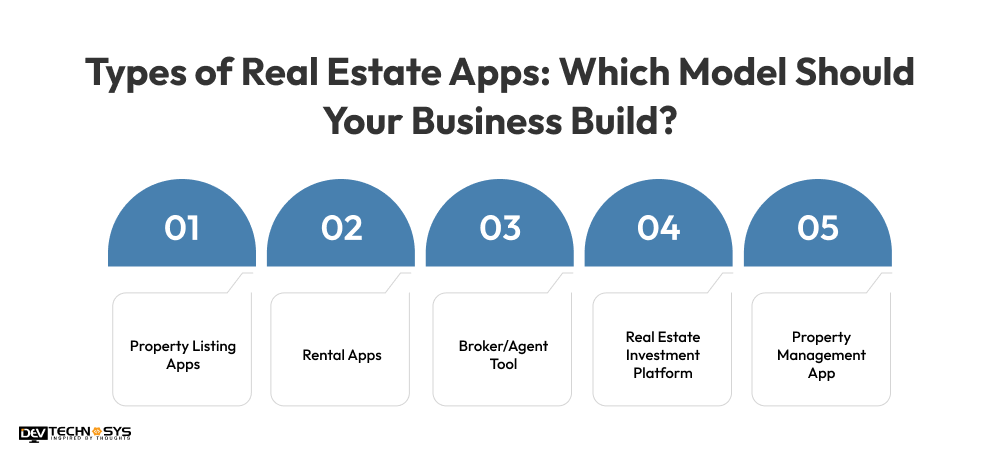
Types of Real Estate Apps: Which Model Should Your Business Build?
Selecting the ideal type of product is an important part of real estate app development services. Every type of app delivers to different audience demands. They also serve unique revenue strategies and complexity levels. Therefore, picking the right solution helps businesses maximize long-term ROI by optimizing costs. But before learning about the types, have a look at the comparison table:
App Type |
Revenue Model |
Development Complexity |
Estimated Cost |
Best For |
| Property Listing Apps | Ads, premium listings, subscriptions | High | $25,000 – $30,000 | Marketplaces connecting buyers & sellers |
| Rental Apps | Listing fees, subscriptions, ads | Medium-High | $18,000 – $28,000 | Rental-focused platforms |
| Broker/Agent Tool | SaaS subscription | Medium | $10,000 – $20,000 | Real estate agents & agencies |
| Real Estate Investment Platform | Commission, subscription, transaction fees | High | $22,000 – $30,000 | Investors & crowdfunding businesses |
| Property Management App | Subscription, service fees | Medium | $15,000 – $25,000 | Landlords & property managers |
Real Estate App Development Tech Stack: Complete Guide for Business Owners (2026)
To build your own real estate app, choosing the right tech stack is an important decision. The selected technologies can directly influence your app’s performance, scalability, and security. Businesses pick the stack that helps balance their cost efficiency and reliability in the long term.
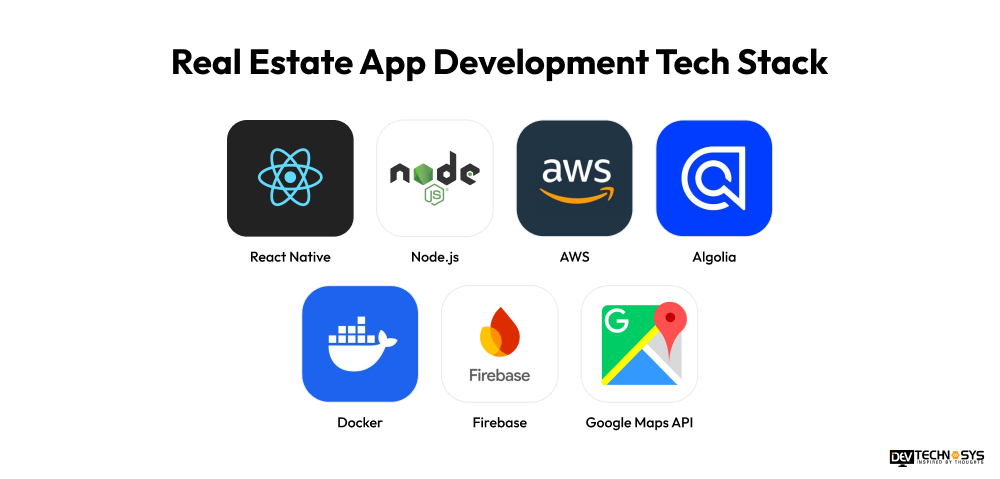
Layer |
Recommended Technologies |
Why It Matters for Your App |
| Frontend (Mobile) | React Native, Flutter | Build cross-platform apps faster with consistent UI/UX |
| Frontend (Web) | React.js, Vue.js, Angular | Create responsive property listing platforms and dashboards |
| Backend | Node.js, Django | Handle business logic, APIs, and user requests efficiently |
| Database | PostgreSQL, MongoDB | Store property data, user profiles, and transactions securely |
| Cloud & Hosting | AWS, Google Cloud | Ensure scalability, uptime, and data storage |
| APIs & Integrations | Google Maps API, Payment APIs, MLS APIs | Enable maps, payments, and real-time property data |
| Authentication | Firebase Auth, JWT, OAuth | Secure user login and protect sensitive data |
| Search & Filters | Elasticsearch, Algolia | Deliver fast and accurate property search results |
| Real-Time Features | WebSockets, Firebase Realtime DB | Power chat, notifications, and live updates |
| DevOps & Deployment | Docker, Kubernetes, GitHub Actions | Automate deployment and improve development efficiency |
| Analytics & Tracking | Google Analytics, Firebase Analytics |
Monitor use |
10 Essential Features for Building a Real Estate App
Property listing, smart search filters, interactive maps, user profiles, saved favorites, and so on are the essential real estate app features. Have a look at some of the most important features of real estate applications.
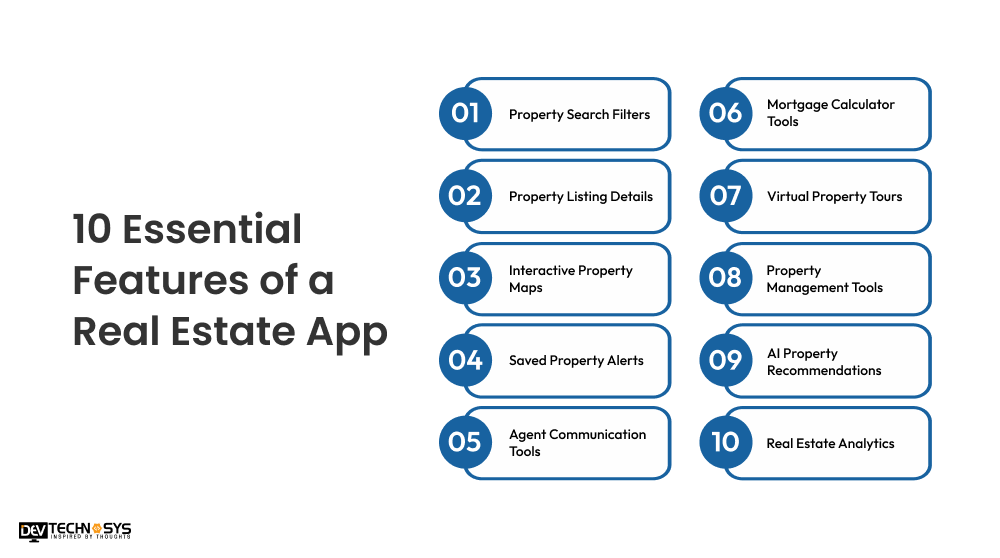
| Feature | Basic App | Mid-Level App | Advanced App |
| Property Search Filters | Location, price, property type, bedrooms | Advanced filters, amenities, furnishing | AI search, natural language search, predictive results |
| Property Listing Details | Photos, price, description, specifications | Videos, floor plans, amenities, agent details | 3D models, property history, AI listing enrichment |
| Interactive Property Maps | Map view, property pins | Nearby facilities, landmarks, commute data | Geofencing, neighborhood intelligence, location recommendations |
| Saved Property Alerts | Favorites, saved listings | Saved searches, price alerts, push notifications | AI-powered alerts, personalized property feeds |
| Agent Communication Tools | Inquiry forms, call buttons | In-app chat, appointment scheduling | AI chatbots, lead qualification, video consultations |
| Mortgage Calculator Tools | EMI calculator, loan calculator | Affordability calculator, down-payment estimates | Live rate integration, loan eligibility, financing insights |
| Virtual Property Tours | Photo galleries, video tours | 360° virtual tours, interactive floor plans | 3D tours, AR staging, remote property viewing |
| Property Management Tools | Basic property records | Tenant management, rent tracking, maintenance requests | Digital leases, online payments, automated maintenance workflows |
| AI Property Recommendations | Similar property suggestions | Behavior-based recommendations | AI property matching, predictive recommendations, valuation insights |
| Real Estate Analytics | Basic admin reports | Agent dashboards, lead analytics | Predictive analytics, AI lead scoring, market intelligence |

How Much Does Real Estate App Development Cost in 2026? Full Budget Breakdown
Usually, the cost to develop real estate apps like Zillow can be estimated somewhere between $8,000 and $30,000. This cost is primarily determined by the complexity of the application; the more complex the app, the higher the cost to develop a real estate app. A simple app comes with MVP features, core functionalities, efficient development tools, and basic UI/UX. This lowers the complexity and the real estate mobile app development cost.
In comparison, a high-level app has advanced features, complex integrations, and high-performance requirements. This makes the complexity and the cost to build real estate app like Redfin higher. Let’s understand this with the real estate app development cost breakdown table to develop real estate app development solutions.
App Type |
Features Included |
Estimated Cost (USD) |
| Basic Real Estate App | User sign-in, simple listings, basic search, contact form | $8,000–$12,000 |
| Mid-Range Real Estate App | Advanced filters, map search, favorites, push notifications | $12,000–$20,000 |
| Advanced Real Estate App | Agent dashboard, in-app chat, virtual tours, analytics | $20,000–$30,000 |
6 Key Factors That Affect Real Estate App Development Cost: With Budget Ranges
Apart from complexity, multiple features exist that affect the final real estate app development cost. In this section, we will explain some of these factors along with their real estate app development cost breakdown table for a clearer concept.
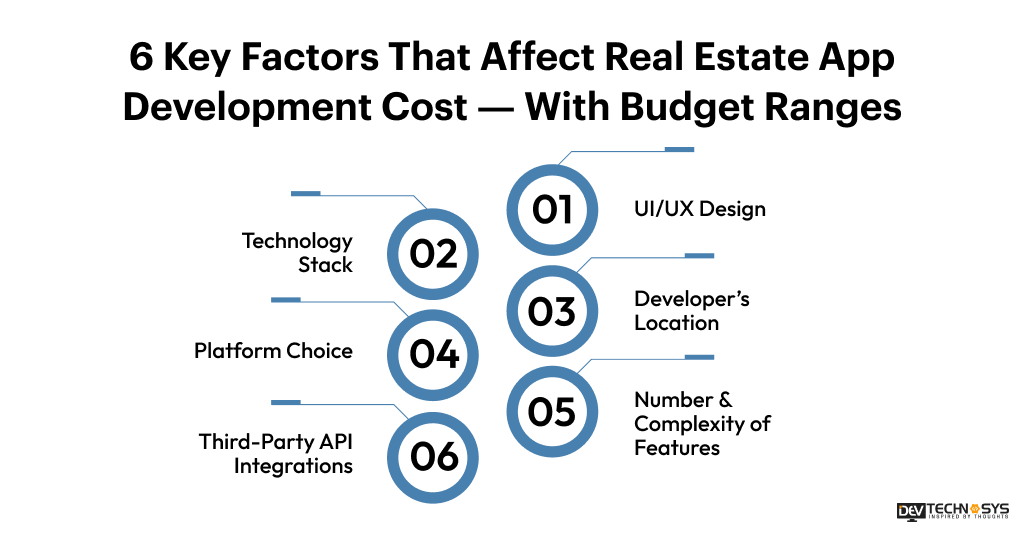
1. UI/UX Design
The cost of real estate app development for startups is affected by its design complexity, number of screens, and animation. When the real estate app UI/UX design is customized and user-friendly, it will automatically increase the real estate app development cost.
Design Level |
Description |
Cost Range |
| Basic UI | Simple layouts, standard navigation, basic property listing screens with minimal customization. | $2,000–$4,000 |
| Mid-Level UI | Custom layouts, advanced filters, better visuals, improved user flow, and engagement. | $4,000–$7,000 |
| Advanced UI | High-end design, animations, interactive maps, virtual tour-friendly layouts, and strong branding. | $7,000–$10,000 |
2. Technology Stack
The selection of the tech stack of the app, including programming languages, frameworks, databases, and third-party tools, affects its performance and scalability. Integrating these technologies raises the cost to develop a real estate app.
Tech Complexity |
Description |
Cost Range |
| Basic Stack | Standard frontend, simple backend, basic database, and limited third-party integrations. | $2,000–$4,500 |
| Moderate Stack | Scalable backend, API integrations, cloud hosting, and enhanced security features. | $4,500–$7,000 |
| Advanced Stack | AI recommendations, map services, analytics tools, and high-performance cloud infrastructure. | $7,000–$10,000 |
3. Developer’s Location
The mobile app development cost depends on the region of developers, as labor rates, expertise, and market demand of every region vary. Developers from regions like North America and Western Europe can significantly influence the overall budget.
Region Type |
Description |
Cost Range |
| Offshore Teams | Cost-effective development with skilled resources and longer turnaround times. | $8,000–$15,000 |
| Nearshore Teams | Balanced cost and quality with better communication and timezone alignment. | $15,000–$22,000 |
| Onshore Teams | Premium pricing with faster delivery, local compliance knowledge, and direct collaboration. | $22,000–$30,000 |
4. Platform Choice
The choice of developing an app on platforms like iOS, Android, or both impacts the cost of real estate app development solutions. The development of native apps for different platforms requires a higher investment.
Platform Type |
Description |
Cost Range |
| Single Platform | Development for either Android or iOS with core real estate features. | $8,000–$15,000 |
| Cross-Platform | One codebase for Android and iOS, reducing time while maintaining performance. | $15,000–$22,000 |
| Native Multi-Platform | Separate native apps for Android and iOS with top performance and customization. | $22,000–$30,000 |
5. Number & Complexity of Features
The more features added, the more complexity increases, leading to an elevated real estate app development cost. Advanced features, like AI recommendations, virtual tours, or real-time chat, increase development efforts, complexity, and cost.
Feature Level |
Examples |
Cost Impact |
| Basic Features | User login, property listings, simple search | $2,500 – $4,000 |
| Moderate Features | Filters, favorites, notifications, maps | $4,000 – $6,000 |
| Advanced Features | AI recommendations, chat, AR/VR tours | $6,000 – $8,000 |
6. Third-Party API Integrations
Adding pre-built, third-party services such as maps, payments, and data feeds can increase the development budget. These APIs include location services (maps), secure payment gateways, and MLS/property data integrations. These require additional setup and maintenance.
Integration Type |
Examples |
Cost Impact |
| Basic APIs | Authentication, email services | $500 – $1,000 |
| Standard APIs | Maps, payment gateways | $1,000 – $2,500 |
| Advanced APIs | MLS data feeds, analytics tools | $2,500 – $3,500 |
Planning a Real Estate App Project?
Get a tailored development cost estimate in a few simple steps.
- 3 quick steps
- 100% free
- Reply in 1 business day
2 Minutes Read
5 Proven Real Estate App Monetization Models — Revenue Potential & Best Fit Analysis
The first question of every businessperson is how to make money with the custom real estate app development. So, here we are with some of the highly preferred real estate app monetization models that allow businesses to earn recurring income.
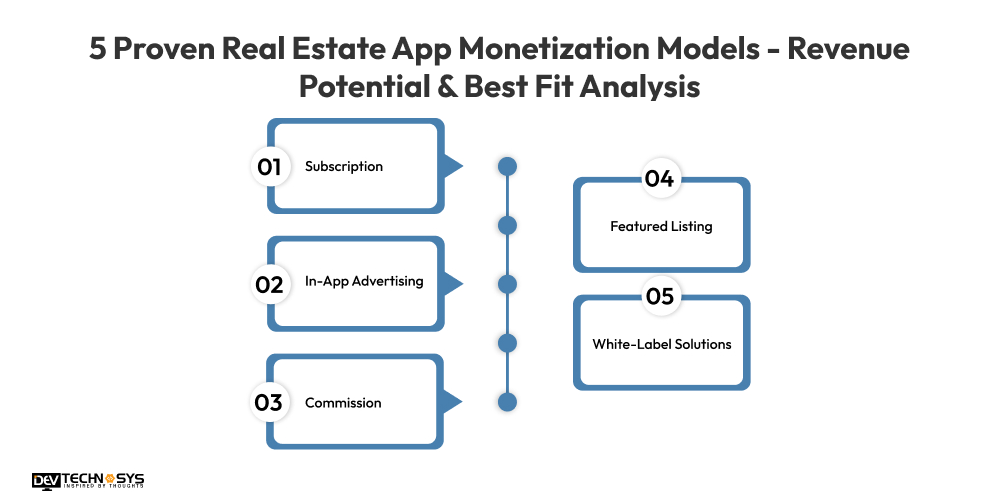
1. Subscription
In the subscription model, users can access premium features like advanced search filters, detailed property insights, and unlimited property listings. Instead, they have to purchase a monthly, quarterly, or yearly fee, making a great revenue source for app owners.
2. In-App Advertising
The app owners can earn money by displaying various ads, specifically of real estate agencies, mortgage providers, or home service brands. This can allow app owners to reach their targeted audiences, and they can actively search for properties.
3. Commission
In the real estate auction app development, the apps can charge a fixed percentage of every successful transaction as a commission. Whether for property sales or booking services, charging commission can be a great monetization model to make profits.
4. Featured Listing
Property owners or agents can pay an extra amount to get featured or highlighted at the top of search results. This helps them increase their visibility, leads, and property conversions. At the same time, app owners can get a steady income from this.
5. White-Label Solutions
App owners can also make money by offering their app to agencies and businesses to use it under their brand name. This is also a widely used monetization model, allowing app owners to have a steady revenue from a license or setup fee.
What Are The Challenges Faced in Building A Real Estate App?
Despite everything good, business normally faces potential challenges during real estate app architecture. Now, we will discuss some of these significant issues in this section.
- One of the main problems of top real estate apps is the data accuracy and updates. Maintaining property listings, prices, and availability updated in real time can sometimes become hectic.
- The real estate apps have sensitive information about the users, including financial and personal information. Keeping the user data safe from security breaches is highly demanding.
- The top real estate apps for buyers and sellers work for a few hundred users but may crash with thousands. Therefore, a scalable, cloud-native architecture is essential so the app remains intact with even millions of users.
- Simplifying complex searches, detailed listings, virtual tours, and document management is really mandatory. For this, designing an easy-to-use interface is a massive task.
- Real estate apps must comply with strict laws, such as fair housing rules, data privacy regulations, and local licensing requirements to avoid legal risks.
Real Estate App Development Timeline: How Long Does It Take to Build? (2026)
It is really important to knwo the development timeline if you are exploring how to create a real estate app. This will help you plan your resources, budget, and app launching strategy. The timeline can be different according to the app’s complexity and features.
Phase |
Basic App |
Mid-Range App |
Advanced App |
| Discovery | 1–2 weeks | 2–3 weeks | 3–4 weeks |
| Design | 2–3 weeks | 3–4 weeks | 4–6 weeks |
| Development | 4–5 weeks | 6–10 weeks | 10–16 weeks |
| Testing | 1–2 weeks | 2–3 weeks | 3–4 weeks |
| Deployment | 1 week | 1 week | 1–2 weeks |
| Total Time | 8–12 weeks | 12–20 weeks | 20–32 weeks |
Security Compliance for Real Estate App Development
When building real estate apps for buyers and sellers, businesses have to focus on security compliance from the development stage. Industry- and country-specific, as well as essential, security practices should be implemented to ensure data is protected across devices.
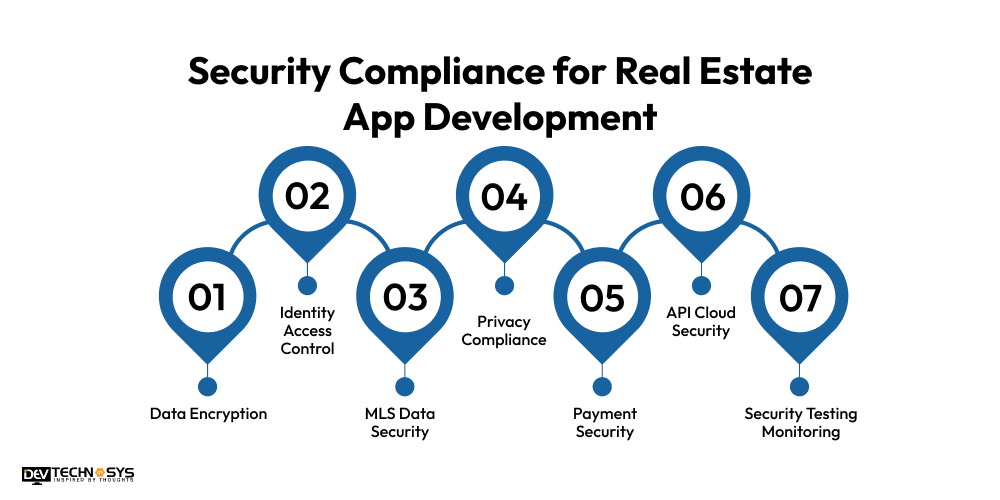
1. Data Encryption
Data privacy regulations are vital for real estate software with multiple users accessing the same platform and information. TLS and AES encryption protect data from unauthorized access. Property details, banking information, or customer details are masked and visible only to authorized users.
2. Identity Access Control
Implementation of role-based access control limits app permissions to ensure that data and functions are accessed appropriately. RBAC supports buyers, sellers, agents, brokers, and multiple users for an application.
3. MLS Data Security
U.S. real estate apps that display MLS listings must comply with applicable MLS, IDX, and data licensing requirements. Developers implement controlled API access, listing display rules, attribution requirements, data synchronization, and appropriate caching mechanisms in accordance with the agreements governing each MLS data source.
4. Privacy Compliance
Developers implement U.S. state privacy regulations, including CCPA/CPRA where applicable and GDPR compliance in IT operations wherever applicable. This ensures that customers can trust a business, as the solution comprises consent management and privacy notices.
5. Payment Security
Most companies use PCI DSS to protect cardholder data through tokenization, secure APIs, access controls, and transaction monitoring. This compliance is important for real estate app solutions because users share critical information about their property as well as bank data. Their card details need to be protected from fraud.
6. API Cloud Security
Businesses that prefer cloud infrastructure must adhere to cloud API security standards to protect information. This includes input validation, secure backups, and restricted administrative access to safeguard sensitive information.
7. Security Testing Monitoring
Specialized IT teams focus on conducting multiple tests, such as code reviews, vulnerability assessments, and application and backend infrastructure testing, to ensure the solution works properly for all authorized users.
Conclusion
While ending this blog, we would like to conclude that a successful real estate app development is a strategic combination. It is the combination of advanced technologies, user-centric features, and a clear business strategy. We have covered everything you need to know about real estate mobile app development.
Be it feature selection or development cost, this blog had it all. It is said that building a real estate app is something beyond just development. It is a solution that simplifies property transactions, enhances user experience, and drives long-term business growth. To make a real estate app, reaching out to Dev Technosys is the perfect choice. We have been in this industry, serving reliable digital solutions for more than 15 years.
Frequently Asked Questions
Find answers to the most common questions related to this article.
If you want to choose the right real estate development company, you have to evaluate it properly. In this examination, firstly, check the company’s portfolio and client reviews. Then analyze their expertise in modern technologies, scalability, and post-launch support. Make sure the firm you are picking is transparent about pricing and implementations throughout development. Also, ensure the solutions they create are aligned with the client’s demand.
The technologies used in real estate mobile app development are as follows:
For frontend development, React Native or Flutter is used.
For Backend development, Node.js or Django are largely preferred.
For seamless database management, PostgreSQL or MongoDB is used.
For cloud hosting, AWS or Google Cloud ensures scalability and performance.
For APIs and integrations, the Google Maps API and payment gateways are used to enhance functionality.
Some of the essential features a real estate app must incorporate are:
● User Profiles & Onboarding
● Map Integration
● Mortgage Calculator
● Interactive Property Listings
● AR/VR Tours
You can monetize your real estate app by implementing some monetization models, such as:
● Subscription
● In-app advertising
● Commission
● Featured listing
● White-label solutions
Primarily, a simple app with basic features will take 5-7 months to get developed. At the same time, a highly advanced app with modern features will take 8-12 months to get developed.