



















Did you know that people can trade cryptocurrencies without needing a bank or a middleman?
That’s where a DEX, or Decentralized Exchange, comes in!
PancakeSwap is one of the most popular DEX platforms that lets users swap tokens directly with each other. Amazing, right?
But how is something like this made?
Key Takeaways:
-
- By 2026, the decentralized finance (DeFi) market is expected to exceed USD 26 billion, fueled by growing interest in peer-to-peer crypto trading and blockchain innovation.
- Popular DEX platforms like PancakeSwap succeed by offering low fees, user-friendly interfaces, and fast, secure token swaps without needing a central authority.
- The cost to build a DEX like PancakeSwap typically ranges from $8,000 to $25,000, based on features, blockchain integration, and smart contract complexity.
- Core features include wallet integration (like MetaMask), liquidity pool development, token swapping, yield farming, staking options, governance systems, and real-time analytics dashboards.
We’ll show you how to build a DEX platform like PancakeSwap step by step in this blog. If you’re not tech-savvy, don’t worry, we’ll keep it really simple and easy to understand.
You’ll learn the basic tools, what smart contracts are, and how everything works together to make trading safe, fast, and fun.
Let’s explore the fascinating world of decentralized markets!
Present and Future Projections of Decentralized Finance(DeFi) Market
- Around the world, the DeFi business for the country is expected to bring in US$14.0bn by 2026.
- With a compound annual growth rate (CAGR) of 94% from 2025 to 2026, it’s estimated to reach a total of US$14.6bn by 2026.
- Most people think that the DeFi market will bring in US$75.8 per user in 2026.
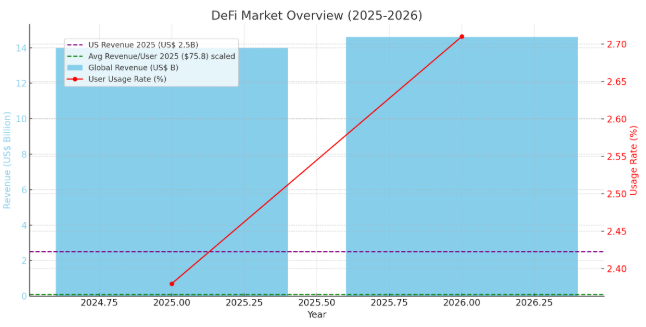
- When compared to the rest of the world, the US DeFi business brings in the most money, with US$2.5bn by the end of the year.
- By 2026, the DeFi market is projected to encompass 23 million individuals.
- It is predicted that the user usage rate will be 38 percent in 2025 and will rise to 2.71 percent by 2026.
What is Pancakeswap?
The PancakeSwap decentralized exchange (DEX) is based on the BNB Smart Chain and lets users swap cryptocurrencies directly with each other, without going through any middlemen. Crypto exchange like Bitstamp and Pancakeswap work with an automatic market maker (AMM) strategy, which lets users trade tokens, yield farm for rewards, and provide liquidity.
As well as staking, raffles, and NFTs, PancakeSwap is a well-known DeFi tool for swapping digital assets quickly, cheaply, and without permission.
Success Story: Pancakeswap
- Launch: PancakeSwap decentralized finance platform launched in September 2020 on Binance Smart Chain, offering a cheaper and faster alternative to Ethereum-based DEXs.
- Rapid Growth: Within months, PancakeSwap surpassed Uniswap in trading volume, driven by low fees and strong community engagement.
- User Base: By 2021, it had attracted millions of users due to yield farming, staking, and a fun, gamified user experience.
- Token Success: Its native token, CAKE, gained massive popularity, with market capitalization reaching billions during the 2021 DeFi boom.
- Fundraising: PancakeSwap raised significant capital via platform-generated fees and didn’t rely on traditional VC fundraising to grow operations.
- Ecosystem Expansion: Introduced NFTs, prediction markets, and lottery systems, diversifying offerings beyond standard trading and liquidity pools.
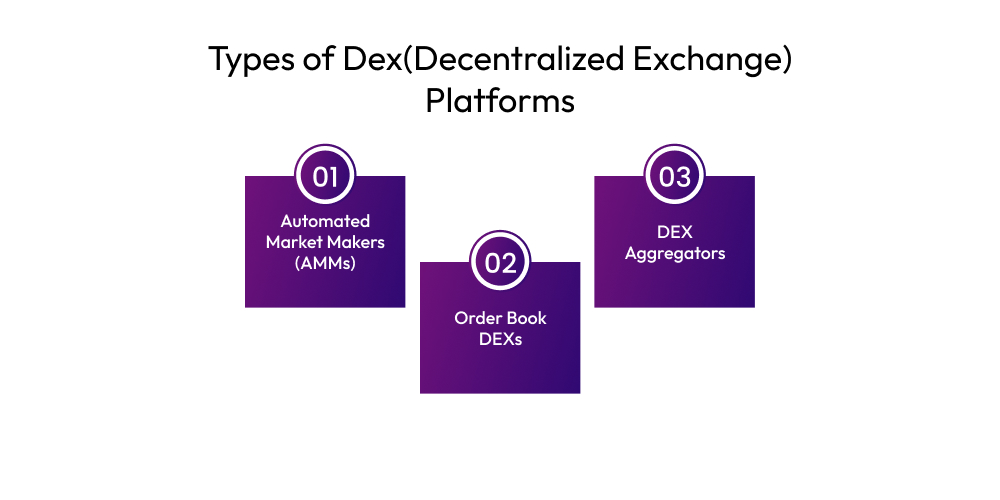
Types of Dex(Decentralized Exchange) Platforms
Decentralized exchanges manifest in several varieties, such as Automated Market Makers (AMMs), Order Book DEXs, and DEX Aggregators. Each decentralized crypto trading category has distinct trading techniques, user experiences, and advantages designed to meet various requirements within the decentralized financial ecosystem.
1. Automated Market Makers (AMMs)
Automated Market Makers (AMMs) supplant conventional order books through the use of smart contracts and liquidity pools. Users generate liquidity and earn fees, while traders instantaneously switch tokens. Pricing is set by algorithms, such as constant product formulae. AMMs are the most popular form of DEX nowadays because to their simplicity and speed of transactions.
2. Order Book DEXs
These DEXs employ order books, which are analogous to centralized exchanges. Orders can be kept on-chain or off-chain, and they are matched for execution. RWA tokenization in crypto supports limit orders, more price control, and more advanced trading methods. However, they may require more technical infrastructure and are often slower than AMMs.
3. DEX Aggregators
DEX aggregators evaluate many decentralized exchanges to identify optimal token swap rates with minimal slippage. They divide orders between platforms as needed to enhance efficiency. Aggregators do not supply liquidity directly, but rather assist customers in obtaining the most beneficial deals by leveraging the liquidity of many DEXs.
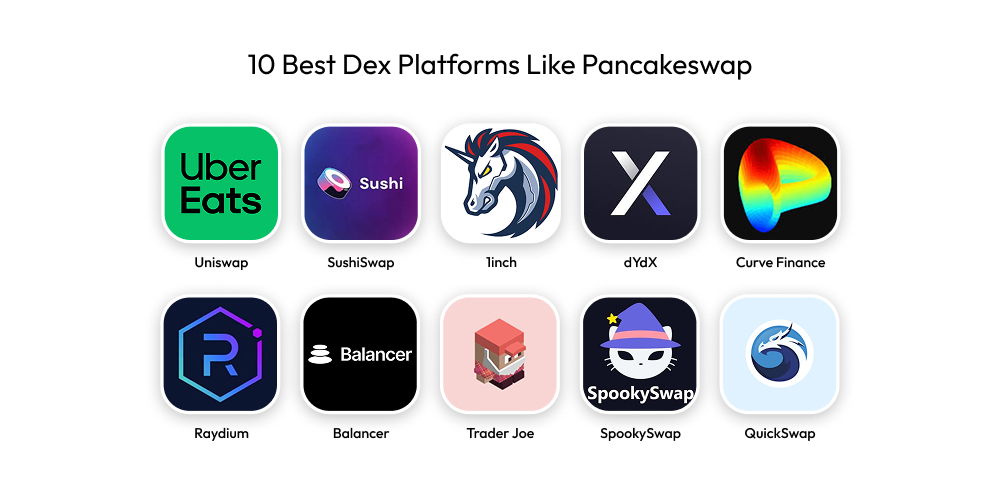
10 Best Dex Platforms Like Pancakeswap
Explore the best decentralized exchanges offering unique features, multi-chain support, and seamless trading experiences across various blockchain networks, similar to PancakeSwap’s AMM-based DeFi model.
DEX Platform |
Launched Year |
Platform Availability |
Special Function |
| Uniswap | 2018 | Ethereum, Arbitrum, Polygon | Pioneered the AMM model with permissionless token listings |
| SushiSwap | 2020 | Ethereum, BNB Chain, others | Offers yield farming and “Onsen” rewards for new tokens |
| 1inch | 2019 | Multi-chain | Automatically consolidates optimal rates from many decentralized exchanges |
| dYdX | 2019 | Ethereum, Cosmos (V4) | Supports margin and perpetual trading with an order book model |
| Curve Finance | 2020 | Ethereum, Arbitrum, others | Optimized for stablecoin and low-slippage swaps |
| Raydium | 2021 | Solana | Integrates with Serum for order book and AMM functionality |
| Balancer | 2020 | Ethereum, Arbitrum, others | Customizable liquidity pools with multi-token support |
| Trader Joe | 2021 | Avalanche, Arbitrum, others | Combines DEX, lending, and NFT marketplace in one platform |
| SpookySwap | 2021 | Fantom | Offers a built-in bridge for cross-chain swaps |
| QuickSwap | 2020 | Polygon | Fast, low-fee DEX optimized for Polygon network |
Case Study: PAYCOINZ
PAYCOINZ is a fintech payment solution built by Dev Technosys that makes online purchases simpler and wallet management better. A team of 12 blockchain developers, UI/UX designers, and QA engineers worked on the project for 32 weeks. Technologies ike bitcoin, Node.js, React, and cloud infrastructure were used. The team overcame hurdles with transaction security, scalability, and integrating payments without any problems by using advanced encryption and improving the backend design.
Why Entrepreneurs Want to Build A Dex Platform Like Pancakeswap?
Because they let people trade crypto with each other without going through middlemen, decentralized exchanges (DEXs) like PancakeSwap have become very popular. Here are five key reasons to invest in decentralized cryptocurrency exchange development:
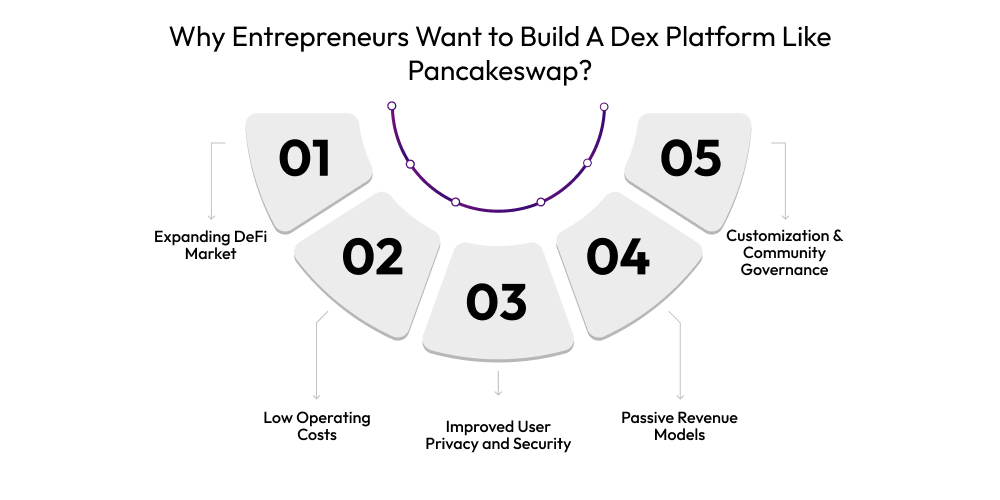
- Expanding DeFi Market
- Low Operating Costs
- Improved User Privacy and Security
- Passive Revenue Models
- Customization & Community Governance
1. Expanding DeFi Market
The decentralized finance (DeFi) sector has expanded rapidly, with billions of dollars tied up in smart contracts. Entrepreneurs view DEXs as a way into this high-potential sector, with chances for income generation through trading fees, yield farming, and liquidity pools.
2. Low Operating Costs
DEXs, unlike centralized exchanges, rely on smart contracts, reducing the need for a huge operating crew and physical infrastructure. This reduces expense and improves scalability, making it an appealing business model for startups and solitary entrepreneurs.
3. Improved User Privacy and Security
With increased worries about data breaches and legal constraints on centralized platforms, DEXs appeal to individuals who value their privacy. If entrepreneurs develop crypto asset management software, it may benefit from this trend by offering non-custodial trading, which enables users to retain full ownership of their assets and private keys.
4. Passive Revenue Models
Pancakeswap alternatives earn ongoing revenue through transaction fees, token listings, and staking pools. Entrepreneurs may also create their own native tokens to generate extra revenue streams using tokenomics tactics such as buybacks and burns.
5. Customization & Community Governance
Many DEX platforms feature decentralized governance, which let users to vote on upgrades and policy changes. This community-first strategy promotes loyalty and organic growth. Entrepreneurs may carve out specialized markets by customizing their DEXs with unique features or focusing on certain ecosystems (for example, gaming tokens or NFTs).
7 Easy Steps to Build A Dex Platform Like Pancakeswap
Want to launch your own decentralized exchange? This guide goes over the important steps, such as picking a blockchain, setting up smart contracts, and advertising your platform. In just a few steps, you can learn how to make a DEX that is safe, easy to use, and competitive with PancakeSwap.
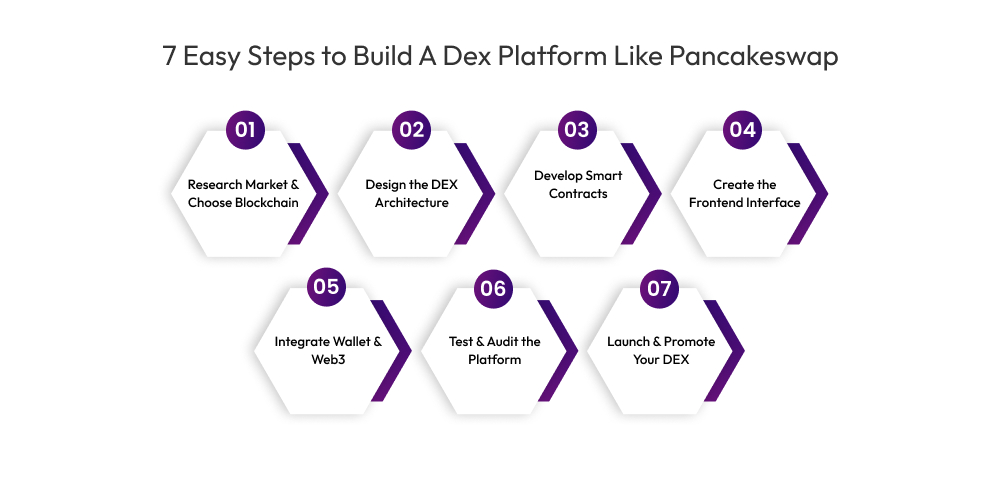
- Research Market & Choose Blockchain
- Design the DEX Architecture
- Develop Smart Contracts
- Create the Frontend Interface
- Integrate Wallet & Web3
- Test & Audit the Platform
- Launch & Promote Your DEX
1. Research Market & Choose Blockchain
In the first stage of Binance Smart Chain development, start by analyzing DeFi trends and identifying your target audience. Choose a blockchain like BNB Chain, Ethereum, or Polygon that supports smart contracts, low gas fees, and strong community adoption. This foundational decision impacts scalability, security, and user experience.
2. Design the DEX Architecture
Plan your platform’s core features, AMM (Automated Market Maker), liquidity pools, farming, and staking. Decide on a non-custodial structure for user wallet integration. Creating a scalable, modular architecture ensures flexibility for future upgrades and feature additions.
3. Develop Smart Contracts
Hire professional developers from a Web3 development company to write and test smart contracts using Solidity (for EVM-compatible chains). These will handle token swaps, liquidity, yield farming, and rewards. Ensure contracts are secure, optimized for performance, and well-documented to minimize vulnerabilities and maximize transparency.

4. Create the Frontend Interface
Design an intuitive, responsive UI/UX for desktop and mobile users. Use frameworks like React or Vue.js to connect with Web3 wallets (e.g., MetaMask, Trust Wallet). The interface should enable easy swapping, staking, and tracking of tokens with real-time data.
5. Integrate Wallet & Web3
Moving to the fifth stage of smart contract development, integrate popular Web3 wallets using libraries like Web3.js or Ethers.js. Secure wallet connections enable seamless, decentralized transactions. Ensure compatibility with major wallets to expand user reach and enhance the platform’s accessibility and trust.
6. Test & Audit the Platform
Conduct rigorous internal and third-party audits of your smart contracts and frontend code. Simulate real-world trading scenarios to detect bugs and security flaws. Auditing is essential for gaining user trust and preventing costly vulnerabilities or hacks.
7. Launch & Promote Your DEX
Consult with an experienced NFT development company to deploy the platform on mainnet and announce it via social media, crypto forums, and influencers. Offer initial incentives, such as yield farming or token airdrops. Continuous community engagement and support will help build trust and long-term adoption.
How Can Pancakeswap Platform Benefit Users?
PancakeSwap offers decentralized trading, low fees, passive income through yield farming and staking, and community-driven governance, empowering users with full control, security, and rewarding opportunities in the DeFi ecosystem.
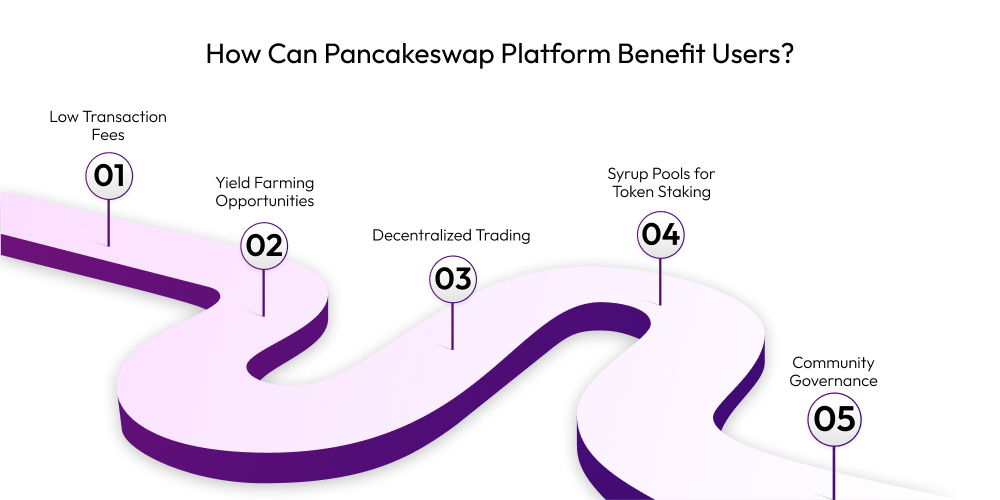
1. Low Transaction Fees
Built on BNB Chain, PancakeSwap has much cheaper gas prices than Ethereum-based DEXs. Users benefit from speedier transactions and lower expenses, making it suitable for small and big deals.
2. Yield Farming Opportunities
Users can use liquidity tokens to bet on yield farms and win CAKE tokens. This encourages participation and provides passive income potential, particularly for long-term investors wishing to expand their cryptocurrency holdings.
3. Decentralized Trading
Solana blockchain development solutions allow users to swap bitcoins straight from their wallets, without middlemen. This guarantees better privacy, ownership over funds, and lowers the hazards associated with centralized exchanges, such as hacking or freezing withdrawals.
4. Syrup Pools for Token Staking
PancakeSwap Syrup Pools let users to earn CAKE and other tokens by staking them. It’s a simple method to diversify revenues and participate in new DeFi ventures without making extra investments or trading.
5. Community Governance
By voting on proposed changes and improvements to the platform, CAKE token holders may take part in governance. This democratic mechanism gives the community the ability to determine PancakeSwap’s future and assures user-centered growth.
10 Key Features of Dex Platforms Like Pancakeswap
Decentralized exchanges (DEXs) like PancakeSwap have revolutionized crypto trading by offering secure, permissionless, and efficient alternatives to centralized platforms. Here are 10 key features to build a DEX like PancakeSwap:
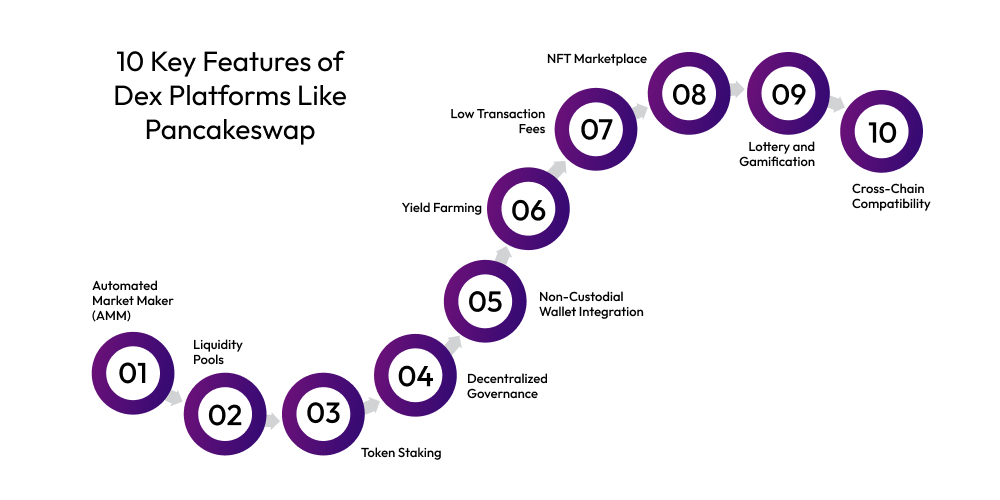
1. Automated Market Maker (AMM)
Pancakeswap clone script enables users to trade tokens without the use of conventional order books. Users supply liquidity, while algorithms set pricing.
2. Liquidity Pools
Users can put pairs of tokens into liquidity pools and get a cut of the trade fees. These pools power the AMM concept and enable smooth, immediate token swapping.
3. Token Staking
DeFi Exchange like Pancakeswap allow users to stake native tokens in staking pools (such as Syrup Pools) to gain additional cryptocurrency incentives, resulting in a passive income stream.
4. Decentralized Governance
Holders of governance tokens can vote on ideas like as platform upgrades, fee modifications, and new feature releases, assuring community participation.
5. Non-Custodial Wallet Integration
Pancakeswap alternative allows users to maintain complete control over their assets by linking wallets such as MetaMask or Trust Wallet, which improves security and privacy.
6. Yield Farming
An app like Coinbase allows users to stake liquidity provider (LP) tokens in farms to gain rewards, which are often in the platform’s native token (CAKE).
7. Low Transaction Fees
DEXs like PancakeSwap, built on chains like BNB Smart Chain, have lower gas fees than Ethereum-based exchanges.
8. NFT Marketplace
Some Pancakeswap alternatives have integrated NFT trading, which increases user participation beyond token swaps and staking.
9. Lottery and Gamification
Pancakeswap clone script includes lotteries, prediction markets, and games to keep users interested and drive platform usage.
10. Cross-Chain Compatibility
Decentralized Exchange like Pancakeswap handles various blockchains, allowing users to trade across networks and access more tokens.
Want a chatbot demo or pricing? Fill the form and talk to our experts today.
Pick what you need below — you can select more than one — then tap Get detail to continue.
-
Chatbot demo dashboard
-
Cost to develop an app
-
Industry report
-
Case study
What is the Cost to Build A Dex Platform Like Pancakeswap?
The cost to develop a DEX platform like PancakeSwap typically ranges from $8,000 to $25,000, depending on features, blockchain choice, and development complexity. Basic platforms with core trading and liquidity features cost less, while adding advanced functionalities like yield farming, governance, and NFT integration increases expenses.
Additional costs include smart contract audits, UI/UX design, and ongoing maintenance. Hiring a skilled mobile application development company may also impact the budget. For a platform to be successful in the long run, protection, scalability, and user experience must be given top priority.
Feature/Component |
Estimated Cost (USD) |
| UI/UX Design | $3,000 – $5,000 |
| Frontend Development | $5,000 – $10,000 |
| Smart Contract Development | $7,000 – $12,000 |
| Smart Contract Audit | $5,000 – $10,000 |
| Backend Development | $4,000 – $10,000 |
| Wallet Integration | $2,000 – $4,000 |
| Admin Panel | $2,000 – $5,000 |
| Token Creation | $1,000 – $2,000 |
| Testing & QA | $2,000 – $4,000 |
| Deployment & Hosting | $1,000 – $3,000 |
Total Estimated Cost: $8,000 – $25,000+
What are the key Factors That Affect the Dex Platform Development Cost?
The DEX platform development cost depends on several factors, including feature complexity, blockchain choice, development team expertise, smart contract auditing, and UI/UX design. Understanding these elements helps in budgeting effectively and building a secure, scalable decentralized exchange tailored to your needs.
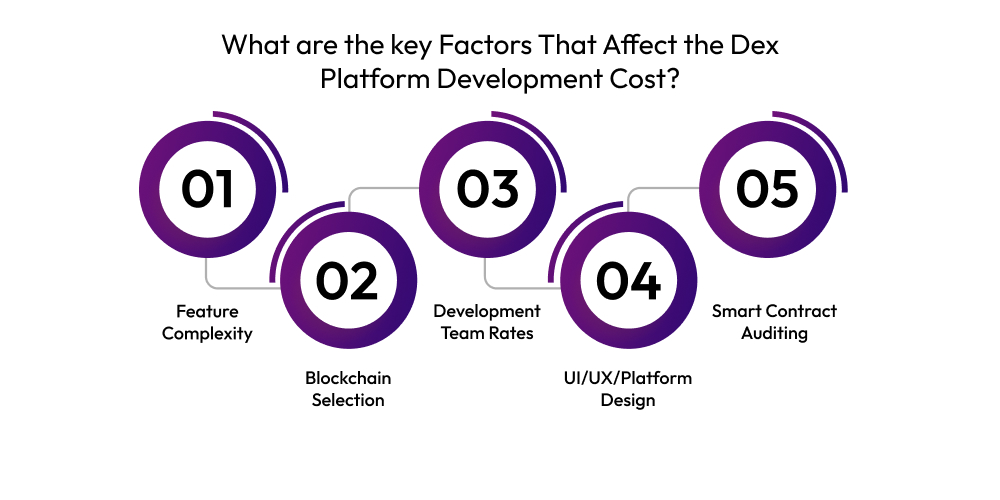
1. Feature Complexity
The amount and sophistication of features, such as token swaps, yield farming, staking, NFT integration, and governance, have a significant impact on PancakeSwap platform development costs. A simple DEX costs less; however, sophisticated functionality involves more work, development, and testing, raising overall AI token development costs.
Feature Level |
Estimated Cost (USD) |
| Basic Token Swap | $5,000 – $7,000 |
| Yield Farming & Staking | $7,000 – $9,000 |
| Governance & Voting | $4,000 – $7,000 |
| NFT Integration | $5,000 – $8,000 |
| Advanced Analytics | $2,000 – $4,000 |
2. Blockchain Selection
Pancakeswap platform development costs vary depending on the blockchain used, owing to differences in development environments, gas prices, and smart contract requirements. Building on Ethereum is typically more expensive because of increased transaction costs, whereas platforms such as BNB Chain or Polygon provide more cost-effective deployment and scaling choices.
Blockchain |
Estimated Deployment & Development Cost (USD) |
| Ethereum | $8,000 – $12,000 |
| Binance Smart Chain (BSC) | $10,000 – $15,000 |
| Polygon | $13,000 – $17,000 |
| Avalanche | $10,000 – $18,000 |
3. Development Team Rates
The blockchain development services cost varies depending on whether you use freelancers, an in-house team, or a professional agency. Location and experience are also important; US or European developers charge more than Asian teams but may provide higher-quality or faster outcomes.
Team Type |
Hourly Rate (USD) |
Estimated Total Cost (USD) |
| Freelancers | $10 – $20 | $5,000 – $15,000 |
| Offshore Agencies | $15 – $25 | $8,000 – $20,000 |
| US/Europe Agencies | $25 – $50 | $20,000 – $30,000 |
4. UI/UX/Platform Design
A well-designed interface makes things easier for users but costs more. DEX development with custom graphics, responsive design, and mobile optimization all demand specialist knowledge. The more polished and user-friendly your DEX on BSC has to be, the more you’ll spend on design and frontend Pancakeswap clone development.
Design Complexity |
Estimated Cost (USD) |
| Basic Responsive Design | $3,000 – $6,000 |
| Custom UI/UX | $6,000 – $12,000 |
| Mobile App Design | $8,000 – $15,000 |
5. Smart Contract Auditing
Security is critical in decentralized exchange development, making third-party audits essential. Auditing ensures the platform is free from vulnerabilities, but comes with significant costs. Comprehensive audits from reputable firms can greatly increase your Ethereum development services budget, but they’re necessary to build user trust.
Audit Type |
Estimated Cost (USD) |
| Basic Audit | $3,000 – $5,000 |
| Comprehensive Audit | $5,000 – $10,000 |
| Multi-Contract Audit | $10,000 – $20,000 |
Tech Stacks to Build A Dex Platform Like Pancakeswap
Component |
Technology/Tool |
Purpose |
| Blockchain Platform | Binance Smart Chain | Smart contract deployment |
| Smart Contract Language | Solidity | Writing smart contracts |
| Frontend Framework | React.js | User interface development |
| Web3 Integration | Web3.js | Blockchain-wallet connection |
| Wallet Support | MetaMask | User wallet access |
| Backend | Node.js | Server-side logic |
| Database | MongoDB | Data storage |
| Hosting | AWS | Application hosting |
How to Generate Income From Dex Platforms Like Pancakeswap?
Decentralized exchanges (DEXs) like PancakeSwap offer multiple revenue streams for platform owners and users alike. Here are five primary ways to generate income from such platforms:
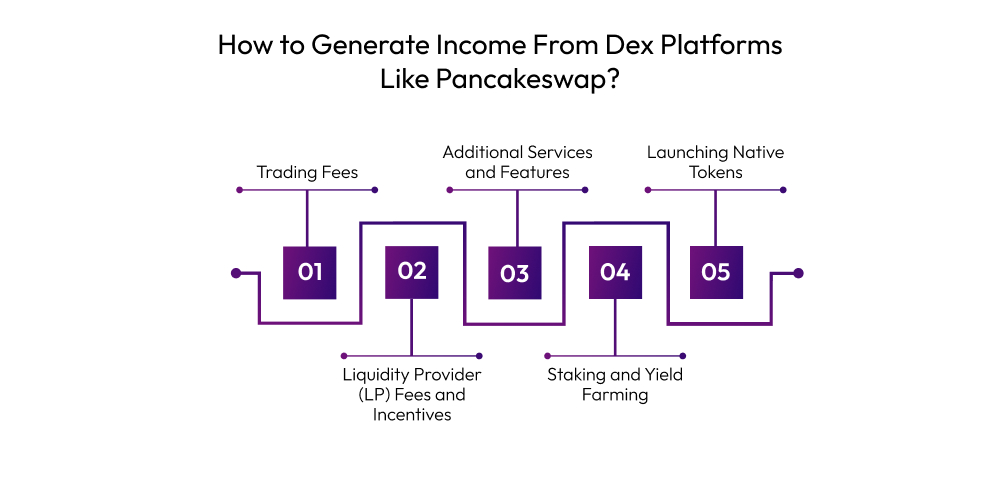
- Trading Fees
- Liquidity Provider (LP) Fees and Incentives
- Additional Services and Features
- Staking and Yield Farming
- Launching Native Tokens
1. Trading Fees
Every token exchange on a DEX results in a tiny transaction fee, which is often a percentage of the deal value. The cost is shared between liquidity providers and the platform itself. The more active the exchange, the greater the fee revenue. By charging reasonable fees, the platform generates a steady revenue proportional to trade volume.
2. Liquidity Provider (LP) Fees and Incentives
Users that add tokens to liquidity pools get a portion of the fees produced by trading between such pools. Some DEX systems additionally provide native tokens to liquidity providers as incentives. More liquidity is good for the site because it improves the user experience and trade volume, which brings in more fee money.
- Additional Services and Features
Some systems commercialize add-ons, such as NFT marketplaces, lotteries, prediction markets, and premium analytics tools. According to the cryptocurrency development services provider, these value-added services draw consumers and generate additional revenue streams outside of basic trading activity.
4. Staking and Yield Farming
DEXs frequently offer staking pools in which users may lock their tokens to gain incentives. Platforms may impose a modest performance or withdrawal fee for certain activities. Furthermore, native tokens staked by the team or treasury might earn yield, adding to the platform’s revenue.
5. Launching Native Tokens
There are a lot of DEX systems that offer their own utility or governance coins. These tokens can be sold in initial public offerings, utilized to raise capital, or generated value through tokenomics such as buybacks and burns. Holding some of these tokens provides the platform with a long-term investment in the success of its ecosystem.
How Dev Technosys Will Help You to Build A Dex Platform Like Pancakeswap?
Dev Technosys is a top blockchain app development company that can help you construct your DEX platform like PancakeSwap. We make sure your platform is strong, scalable, and easy to use by using our extensive knowledge in smart contract creation, DeFi protocols, and secure wallet integrations. Our staff works hard to give you specific features that are suited to your needs.
We also do a lot of testing and audits to make sure they are as safe as possible. In today’s competitive blockchain sector, work with Dev Technosys to make your concept for a decentralized exchange a reality quickly and with confidence.
Frequently Asked Questions
Q1. How Much Does It Cost To Build A Dex Platform Like Pancakeswap?
The cost to develop a Dex platform like Pancakeswap is around $8,000 to $25,000, depending on features, blockchain choice, smart contract complexity, security audits, and crypto exchange development team expertise.
Q2. How Long Does it Take to Create A Dex Platform Like Pancakeswap?
To create a DEX platform like PancakeSwap usually takes 3 to 6 months, depending on feature complexity, blockchain integration, smart contract development, testing, and security audits to ensure a secure, scalable platform.
Q3. Which Technologies Are Used to Launch A Dex Platform Like Pancakeswap?
There are many popular technologies used to launch a Dex platform like Pancakeswap:
- Binance Smart Chain (BSC) or Ethereum blockchain
- Solidity (smart contract programming language)
- js or Vue.js (frontend development)
- js or Ethers.js (blockchain interaction)
- MetaMask, Trust Wallet (wallet integration)
Q4. Which Blockchain Is Best For Building A Dex?
The best blockchain for building a decentralized trading platform depends on your needs, but Binance Smart Chain, Ethereum, and Polygon are popular choices. They offer strong security, smart contract support, and varying transaction speeds and fees to fit different projects.
Q5. Can Users Retain Control of Their Funds on a DEX?
Yes, because a DEX is not a bank, users keep full control of their cash. They trade directly from their wallets without trusting a third party, ensuring greater security and ownership.
Q6. What is the Difference Between Uniswap Vs PancakeSwap?
Uniswap runs on Ethereum, offering high security but higher gas fees, while PancakeSwap operates on BNB Chain, providing faster transactions and lower fees. Both use AMM models but cater to different blockchain ecosystems.